
On June 26, Ukraine’s Security Service struck cable-laying ships, a radar station, and an air defense system in occupied Crimea as part of a newly authorized 40-day strike campaign, prompting Russian-installed officials to declare a state of emergency across the peninsula. Hundreds of kilometers away, Ukrainian drones forced Russia’s fourth-largest oil refinery offline and torched a chemical plant in Tula Oblast, deepening a nationwide fuel crisis that has now reached Siberia. As Russian nationalists openly call for Putin to consider nuclear escalation, a Nikopol bus bombing and the slow-motion humanitarian catastrophe in occupied Oleshky were grim reminders of the war’s daily human cost.
The Day’s Reckoning
At the Zatoka shipyard near occupied Kerch, two ships built to hunt submarines burn through the night. By morning, Crimea’s occupation government admits, in writing, what it rarely admits: it cannot cope. A state of emergency — not from invasion, but from gridlock. Thousands of cars lined up to leave. Gas stations with nothing to sell. A grid buckling under its own restrictions.
Eight hundred kilometers north, Russia’s fourth-largest refinery goes dark. In Omsk, a city Ukrainian drones cannot reach, attendants now cap fuel purchases at forty liters. The crisis Kyiv started in Crimea has crawled all the way to Siberia.
And in Nikopol, a minibus enters the city limits carrying people who have made this drive a hundred times before. A drone is waiting. Two die. Two twelve-year-old girls are carried out with shrapnel wounds.
Three stories, one war: a peninsula admitting defeat in bureaucratic language, an economy bleeding from a thousand drone-sized cuts, and a Russia that has run out of reasons to spare civilians. The gap between Moscow’s claims of stability and the reality on the ground keeps widening — and today, that gap became impossible to paper over.
Crimea Under Siege: Ukraine’s 40-Day Campaign Begins
A camera mounted on a Ukrainian drone finds the Volga in the dark, riding at anchor in the Zatoka shipyard near occupied Kerch. The strike lands. Then a second drone finds the Vyatka beside it. Within minutes both ships are burning — not fishing boats or barges, but Project 15310 cable-laying vessels, purpose-built for Russia’s Defense Ministry to deploy the Harmony underwater surveillance system, the kind of equipment that hunts submarines and protects pipelines. Ukraine’s Security Service (SBU) says the ships are worth hundreds of millions of dollars and were also capable of laying contactless mines against ships and undersea cables. NASA’s satellite fire-tracking system confirmed heat anomalies at the shipyard the same day.
The ships were not the only target. SBU drones also struck the Petropavlovsk, a cargo-passenger ferry that was 96 percent complete, along with an S-400 air defense system’s radar station guarding the Kerch Strait. Ukraine’s Unmanned Systems Forces separately reported hitting radar stations near occupied Dzhankoi and Armyansk, electrical substations as far as 200 kilometers from the front, and a Crimean airfield — a single night’s harvest stretching across the width of the peninsula.
This was the opening salvo of something larger. President Volodymyr Zelensky had approved a 40-day SBU operation just a day earlier, explicitly designed to pressure Moscow toward ending the war by hollowing out Russia’s hold on Crimea. The SBU put it plainly: degrading air defenses opens the door to future precision strikes, and damaged ships and ports weaken Russia’s ability to support its forces in the south. Forty days is a deadline with teeth — and June 26 was only day one.
A Peninsula Declares Emergency
By Friday afternoon, the bureaucratic language could no longer hide what was happening. Crimean occupation head Sergey Aksyonov and Sevastopol occupation head Mikhail Razvozhaev jointly signed decrees declaring a regional state of emergency across the entire peninsula, effective 1 p.m. and lasting, in Aksyonov’s words, “until the situation stabilizes.” The official reason given was almost comically bland: to “streamline economic issues.” Razvozhaev’s version was only slightly more candid, citing a need to restore energy facilities quickly and help residents whose appliances were damaged by power surges.
What the decrees actually unlock is sweeping authority — the power to restrict movement, halt business operations, and order forced evacuations, even though Aksyonov insisted no curfew was imminent. Independent analysts read the declaration as something closer to a confession. Jenny Mathers, a senior lecturer in international politics at Aberystwyth University, called it perhaps the clearest evidence yet of how effective Ukraine’s drone campaign against Crimea has become, arguing it strips away Vladimir Putin’s effort to shield ordinary Russians — including those who fled to Crimea as tourists or new residents — from the costs of his war.
The most visible proof was traffic. A Telegram channel monitoring the Kerch Strait Bridge reported the span closed for six hours overnight after drone strikes, then reopened to find roughly 2,450 vehicles backed up on the Crimean side, all trying to leave. Almost no one was trying to get in. Tourists, military families, and occupation administrators are voting with their gas tanks — and a peninsula that once advertised itself as Russia’s reclaimed paradise is now emptying out one car at a time.
Russia’s Refineries Buckle
A quarter of a refinery’s capacity does not disappear quietly. When a Ukrainian drone struck the CDU-5 unit at the Nizhegorodorgsintez refinery in Kstovo — Russia’s fourth-largest refinery and second-largest gasoline producer — it knocked out a unit processing 12,000 metric tons of crude oil a day, forcing the entire facility, known as NORSI, to halt operations on June 24. NORSI’s annual capacity runs to 15 million tons of crude, five million tons of gasoline, and more than five million tons of diesel. The St. Petersburg exchange suspended sales of its diesel and gasoline the same day.
NORSI was not alone. Ukrainian open-source intelligence reported fires at two refineries in Bashkortostan — Bashneft-Novoil and Bashneft-Ufaneftekhim — after strikes hit their ELOU-AVT-6 and AVT-4 processing units, together destroying 10.5 million tons of annual capacity. In Voronezh, opposition outlet Astra reported that a June 22 strike on the city’s semiconductor plant destroyed three production floors and one administrative floor — a target with no fuel value, but a clear hit against the chip-dependent defense-industrial base.
Overnight, drones reached even farther, striking the Azot Chemical Plant and the Novomoskovsk State District Power Plant in Tula Oblast, roughly 395 kilometers from Ukraine. Governor Dmitry Milyaev confirmed power lines and an industrial facility were damaged; NASA’s satellite fire data confirmed the heat signature at the power plant. Residents reported an ammonia-like smell lingering over the city afterward. Combined with damage already inflicted on Moscow’s own oil refinery — unlikely, industry sources say, to resume production before year’s end — Russia’s refining sector is absorbing wounds faster than it can patch them.
A Nation Running Dry
Imagine driving to a gas station in Omsk — a city in central Siberia, further from Ukrainian-controlled territory than Chicago is from New York, a place that should be entirely insulated from this war. Since Wednesday, you can buy no more than 40 liters of petrol or 80 liters of diesel there. Not because of a supply problem an ocean away, but because Ukraine’s drone campaign against refineries thousands of kilometers to the west has finally reached a country so vast it once seemed immune to a war fought along its border.
Deputy Prime Minister Alexander Novak tried to project calm, claiming Russia has “sufficient” fuel reserves and is merely restructuring logistics to meet a demand spike he attributed to “artificial” causes — a 20 to 30 percent jump he did not fully explain. He floated a short-term export ban on diesel, of which Russia claims a surplus, even as the country imports gasoline from Kazakhstan to plug domestic gaps, according to industry insiders. The contradiction is the story: surplus in one breath, imports in the next.
Political scientist Nikolai Mitrokhin offered the starkest strategic framing. Russia, he argued, is held together not by its army or security services but by seventeen railway bridges crossing the Volga — every one within range of Ukrainian long-range drones and missiles. No matter how much fuel Moscow buys, it still has to cross those bridges. Putin, for his part, signed a decree extending Russia’s ban on selling oil at G7 and EU price-cap-compliant prices until the end of 2027 — a defiant gesture that costs Russia leverage rather than easing the crisis, and signals his refusal to bend to sanctions even as citizens ration diesel.
Moscow’s Night of Drones
By 2:30 a.m., the first wave was already inbound. Moscow Mayor Sergey Sobyanin spent the next several hours posting running totals on Telegram — 39 drones down by 5:45 a.m., 47 eventually claimed shot down before the capital was clear. Russia’s Ministry of Defense put the nationwide figure for the night at 660 drones intercepted across more than a dozen regions, occupied Crimea, the Black Sea, and the Sea of Azov — a number Kremlin newswire TASS called the highest single-night total of 2026, and which, if accurate, would represent one of the largest drone attacks on the Russian capital since the start of the full-scale invasion.
Numbers that large are themselves a kind of evidence. Ukraine rarely confirms how many drones it sends on any given strike, but a near-daily count in the hundreds, by Russia’s own admission, tells its own story about how this war has changed. The attacks are no longer probing raids; they are sustained pressure, deliberately aimed — Kyiv has called them “long-range sanctions” — at the same energy infrastructure that funds Moscow’s war machine.
The capital’s defenders are visibly adapting to a threat that increasingly targets symbols of power, not just infrastructure. Radio Free Europe/Radio Liberty investigative journalist Mark Krutov published satellite imagery on June 26 showing a newly built S-400 position fewer than 10 kilometers from the Kremlin, on Moscow’s Sparrow Hills, beside the Innopraktika Foundation headed by Putin’s daughter Kateryna Tikhonova. The 4.5-hectare site, constructed in mid-May, closely resembles other S-400 positions recently identified around Moscow — part of what RFE/RL describes as a broader ring of air defenses being quietly built around the people and institutions closest to Putin himself, including more than 25 air defense positions reported near his Valdai residence alone.
The Vlasyuk Ledger: An Economy at the Breaking Point
Numbers, stacked one on top of another, can tell a story no single headline can. Ukraine’s presidential commissioner for sanctions policy, Vladyslav Vlasyuk, laid out his case against the Russian economy like a prosecutor building toward a verdict. Oil and gas revenues — the Kremlin’s primary funding source — ran 30 percent below year-ago levels from January through May, even after a brief spike when tensions around the Strait of Hormuz pushed export revenues above $20 billion a month. That spike evaporated once shipping resumed; by Thursday, 17 tankers had departed the Persian Gulf, and Urals crude had settled to $58.83 a barrel — below the $59 the Kremlin had budgeted for the entire year.
The shortfall is compounding. Russia’s budget deficit hit 6 trillion rubles, or roughly $77 billion, in the first half of 2026 alone — 60 percent above its annual target. Defense spending consumed 48 percent of all state spending in the first quarter, a share Vlasyuk projects could reach 18 trillion rubles by year’s end, with three-quarters of tax revenue now flowing toward the war. To cover the gap, Moscow is borrowing at punishing rates: domestic public debt has climbed to 32.4 trillion rubles, bond issuance is up 54 percent despite weak demand, and yields have risen to around 16 percent — high enough that the most recent auction was simply canceled.
Kremlin spokesman Dmitry Peskov insists none of this matters, telling reporters that “macroeconomic stability is absolutely secured.” But Russia’s own exchange disagrees: the MOEX index fell more than 4 percent this week, a fifteen-week losing streak hitting a three-year low. Vlasyuk’s verdict is the more convincing one: 56 Russian regions now run budget deficits, and the war is being paid for, he says, through the “irreversible destruction” of Russia’s own financial system.
Nikopol: Another Bus, Another Morning
The minibus was simply entering town, traveling the same road into Nikopol that residents use every day, when the drone found it. The strike killed a woman and a man outright. At least twelve others were wounded, including two twelve-year-old sisters hospitalized with shrapnel injuries. Among the rest of the injured were men between 35 and 70 and women between 41 and 46 — the ordinary cross-section of people who happened to be on a bus on a Friday morning. Police say an investigative team is still working the scene; net-like drone barriers, strung up along the roadway specifically to blunt strikes like this one, are visible in photos from the site.
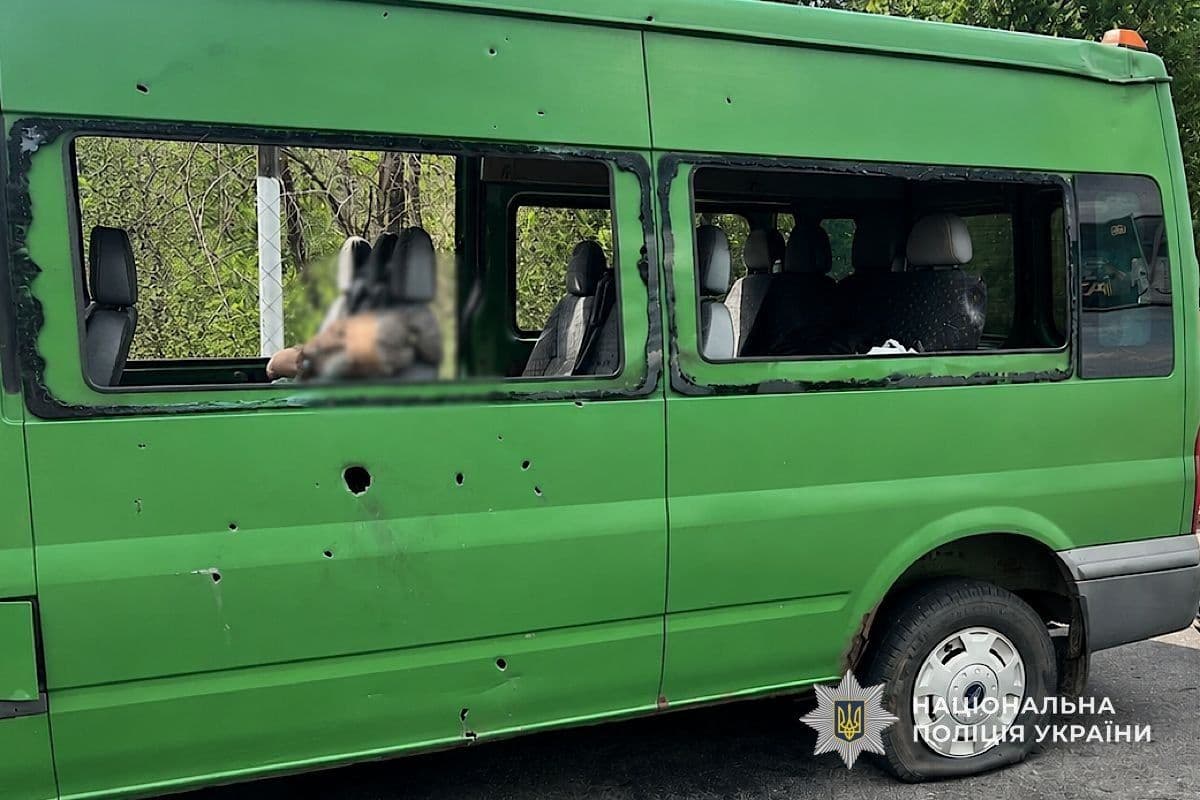
Nikopol sits on the bank of the drained Kakhovka Reservoir, directly across from Russian-occupied Enerhodar and the Zaporizhzhia Nuclear Power Plant, a position that has made it a fixture of Russian strike patterns for years. In April alone, Nikopol ranked among Ukraine’s highest-casualty cities, part of a month in which Russian short-range drones killed 80 civilians and wounded 481 nationwide, according to the United Nations. This was not an isolated tragedy so much as a recurrence — the latest entry in a pattern so well established that residents have already adapted their infrastructure around the expectation of being hit again.
Russian strikes regularly target Ukrainian buses and trains, and in areas closer to the front — most infamously in Kherson — Russian forces conduct what survivors call “human safari” operations, hunting civilians within range of even the shortest FPV drones. Nikopol’s bus was simply the latest name added to a list that keeps growing, one ordinary morning at a time.
Oleshky: The Human Safari
Picture a hospital running on a generator that is almost out of fuel, where the injured arrive by wheelbarrow because no ambulance has entered or left the city since May 26. This is Oleshky, occupied territory less than 1,500 meters from Kherson city, where Ukraine’s Foreign Ministry says more than 6,000 civilians — including roughly 200 children — are trapped behind landmines, drones, and a Russian military actively blocking evacuation. The population has collapsed from roughly 40,000 to 6,000; in Oleshky proper, from 24,000 to about 2,000.
The testimony from the ground is unanimous in its horror. Serhiy Kozyr, a Ukrainian MP and former head of the Kherson regional administration, described drones chasing civilians at speeds above 150 kilometers per hour — what locals call “human safari.” Mykola Kuleba of the children’s rights group Save Ukraine said the bodies of soldiers and civilians alike lie scattered and unrecoverable, because anyone who approaches risks death within a minute. Ambassador John Herbst of the Atlantic Council called it the worst chapter of a broader Russian war-crimes campaign against Kherson, noting there is no military value in targeting civilians “bereft of food and water.”
A UN Human Rights Monitoring Mission report this week documented at least 29 civilians killed and 54 injured in two settlements in 2026 alone, mostly in drone attacks, and confirmed no food has reached Oleshky since May 26. Matthias Schmale, the UN’s resident humanitarian coordinator, said only a ceasefire — even a brief, localized one — could open a window to deliver aid and evacuate the wounded. Nobel laureate Oleksandra Matviichuk, speaking in Gdańsk, called for sanctions pressure given Russia’s disregard for international law. Every organization watching Oleshky agrees on what is happening there. None has found a way to stop it.
Note: One Collective through Transform Ukraine is housing three displaced families from Oleshky at their Velykyi Lazy IDP Community.
The Frontline Grinds On
Across nearly the entire front, June 25 and 26 produced the same entry in the ledger again and again: Russian forces attacked, and Russian forces did not advance. In northern Sumy Oblast, Russian troops pushed at the border buffer zone without confirmed gains, though Russia’s Defense Ministry claimed a glide-bomb strike destroyed a Ukrainian drone control point near Velyka Pysarivka. The fighting there is not bloodless even when stationary — Russian forces struck a Ukrainian evacuation vehicle near Dyakivka belonging to the National Police’s White Angels unit, whose entire mission is pulling civilians out of danger.
North and northeast of Kharkiv City, the story repeated: continued attacks, no advance. In Vovchansk, the city’s military administration head reported Russian forces hammering humanitarian aid points, electrical lines, and communications towers with FPV drones, Shahed and Molniya strike drones, and rocket fire — a campaign aimed less at capturing ground than making it uninhabitable. Nearby in Velykyi Burluk, glide bombs hit residential buildings, killing one person and injuring four, even as front-line activity stayed quiet.
Along the Oskil River, a Russian milblogger claimed advances near Kupyansk, though Ukrainian forces struck back — destroying a long-range Msta-B howitzer, another artillery piece, and an ammunition depot in the same direction. Further south in Donetsk Oblast, Russian operations in Kostyantynivka, Dobropillya, Pokrovsk, and Novopavlivka all repeated the day’s pattern; Ukrainian counterattacks even pushed back gains near Oleksandrivka. Both sides are exploiting summer foliage for concealment in Kostyantynivka, with Ukrainian units adding anti-drone armor as Russian troops use roadside cover to ambush them. Ukrainian strikes destroyed two S-300 systems near occupied Volnovakha and have reportedly forced such an armored-vehicle shortage that some Russian assault groups now attack on motorcycles.
The one place the line actually moved was the west — toward Ukraine. Russian milbloggers acknowledged Ukrainian advances northeast of Kamyanske and the liberation of Prymorske in western Zaporizhia Oblast, with one Kremlin-aligned blogger warning the situation west of Orikhiv is “degrading” for Russian forces and that the village of Plavni has become a contested “gray zone” after a botched rotation. Ukrainian forces are also reportedly threatening the Russian logistics hub at Vasylivka, and a bridge on the M-14 Rostov-Crimea highway near Volodymyrivka appears destroyed in geolocated footage — another artery cut, another sign that holding ground is getting harder even where Russia holds it.
Lavrov’s Alaska Grievance
It is rare to watch two governments argue, in public, over whether they made a deal. Russian Foreign Minister Sergei Lavrov took exactly that fight to reporters on June 26, responding to US Secretary of State Marco Rubio’s blunt statement a day earlier that the August 2025 Alaska summit between Donald Trump and Vladimir Putin produced “no agreement” — only proposals. Lavrov called the comment “not very elegant” and pressed an odd rhetorical question: if one side put proposals on the table and the other expressed agreement, in what sense had no agreement been reached?
Lavrov’s account of the summit reads almost like courtroom testimony. He claimed that inside the room in Anchorage, Putin walked through the American proposals point by point, pausing after each to ask US envoy Steve Witkoff — who had reportedly delivered the same plan in Moscow days earlier — whether he had described it accurately. Witkoff, in Lavrov’s telling, said yes, each time. From that, Lavrov argues, Russia “accepted” what Washington offered, and any claim now that there was no agreement is Washington quietly walking back its own commitments.
The dispute matters because the Kremlin has spent months invoking vague “Anchorage agreements” and “Alaska understandings” to suggest Russia is the reasonable party in stalled peace talks. Rubio’s statement undercuts that narrative directly, and Lavrov’s pushback — alongside similar comments from presidential aide Yuri Ushakov accusing Washington of failing to “complete its part of the process” — looks less like a genuine misunderstanding than an attempt to assign blame for a peace process that has produced nothing in writing, no joint statement, and not even the dinner and press conference that had been planned for that night in Anchorage.
Hawks Circle the Kremlin
“What else needs to happen before we start fighting for real?” The question came from nationalist businessman Konstantin Malofeyev after a Ukrainian strike set fire to an oil refinery near Moscow, and it captures the mood spreading through Russia’s pro-war commentariat. As Ukrainian drones reach Moscow, St. Petersburg, and occupied Crimea with growing regularity, nationalist voices are openly urging Putin to abandon US-brokered negotiations and pursue Ukraine’s outright military defeat — Malofeyev going so far as to question why Russia is not “using nuclear weapons” developed in the Soviet era. Blogger Yuri Baranchik went further, arguing Ukrainian strikes on Moscow “would have been impossible without the go-ahead from Washington,” and that Russia has “no choice” but to confront the US more directly.
The Kremlin has not taken the bait — at least not yet. Three senior officials told Reuters this week that contacts with Washington have produced nothing of substance and accused the US of failing to deliver on Alaska summit promises, but Putin has avoided endorsing the most extreme proposals, including nuclear strikes or fresh mobilization. Still, Russia has signaled a harder edge elsewhere: the Foreign Ministry has floated “systematic strikes” on Kyiv, and the Defense Ministry has published the locations of alleged drone facilities in several European countries — a list widely read as a warning.
Analysts see the nationalist pressure as a symptom Putin cannot fully control: rising public expectation for a visibly winning war, at a moment when recruitment is reportedly declining sharply enough that the Kremlin is privately weighing new mobilization after September’s elections. Putin, addressing military academy graduates this week, struck a confident note regardless — claiming Russian forces were close to capturing Kostyantynivka and predicting Moscow-friendly European forces would eventually gain influence. Confidence and pressure, in Putin’s Russia this week, are running on parallel tracks.
Belgorod’s Reckoning
“We are here on our own.” That was Vyacheslav Gladkov’s reported complaint to military officials while he was still governor of Belgorod, a region roughly 25 miles from the Ukrainian border that has lived under near-constant drone and missile fire for years while the rest of Russia carried on largely undisturbed. Gladkov was genuinely popular by the standards of regional officials — he ran live-streams, showed up personally at utility emergencies, and was seen as rare among Russian officials for being truly accessible. None of that saved his job. Putin confirmed on June 26 that Gladkov, who resigned in May despite reportedly preparing for a future election campaign, has now been appointed Russia’s ambassador to the breakaway Georgian region of Abkhazia — a soft landing for a man one source close to him said “carries things through to the end.”
His replacement carries a far darker record. Major General Alexander Shuvaev, installed as acting Belgorod governor, previously commanded the 1st Separate Guards Motor Rifle Brigade, a unit investigative outlet Astra says ran an unlawful detention site inside a shuttered factory in Makiivka, where soldiers were physically abused and had weights fastened to their legs. Wounded troops were reportedly forced back into combat regardless of condition; those who complained were handcuffed for days before being sent to the front. Families called the unit the “Bermuda Triangle” — a place soldiers entered and frequently never left. For commanding it, Shuvaev was named a Hero of Russia.
Whatever Belgorod’s new governor inherits, it is a region in genuine crisis. Ukrainian strikes knocked out power for around 600,000 residents earlier this year in what Gladkov called a “catastrophic” energy crisis, during which local media were reportedly instructed not to cover the blackout. By last September, the regional budget had only 200 million rubles left for the year — roughly 0.1 percent of its annual total. “We have periods of calm, then periods of escalation,” one resident told reporters. “But the settlements right on the border… there it’s every day and doesn’t stop.”
Buying Smarter: Ukraine Overhauls Its Arsenal
Even a war this short on time runs on paperwork — and on June 26, Ukraine bet that better paperwork could mean more shells. The Ministry of Defense instructed its Defense Procurement Agency to launch a new competitive tender for long-range 155mm artillery rounds, one of the front’s most urgently requested munitions, Defense Minister Mykhailo Fedorov announced. Any manufacturer meeting the technical specifications can bid, though the process will run in a closed environment for security reasons — a balance between opening the field to more suppliers and keeping sensitive defense contracting out of public view.
The tender is not an isolated purchase but a piece of a larger shift in how Ukraine arms itself mid-war. Fedorov framed the goal as moving “all categories of defense procurement to competitive tender procedures wherever possible,” arguing that competition serves financial discipline and public trust as much as it serves the battlefield. He pointed to results as proof of concept: a previous competitive process saved more than 16 percent of the expected cost, savings the ministry redirected into buying tens of thousands of additional rounds — better bookkeeping translating directly into more firepower for units under constant pressure.
The stakes are practical, not theoretical. Long-range 155mm rounds let Ukrainian units strike command posts, ammunition depots, and logistics hubs from beyond the range of many Russian systems, reducing the exposure of frontline infantry to counter-fire. Commanders have repeatedly asked for more range and volume, and officials are framing this tender as a direct answer to that request rather than a bureaucratic exercise — part of an intended long-term shift toward rules-based procurement rather than a temporary wartime patch.
Gdańsk, Belarus, and Quiet Maneuvers
The Ukraine Recovery Conference opened in Gdańsk this week, gathering EU leaders, investors, and civil society to plan reconstruction and channel private capital toward Ukraine’s security needs — but the most notable absence was Volodymyr Zelensky himself, who skipped the conference amid a rift with Warsaw over his decision to name a Ukrainian military unit after the Ukrainian Insurgent Army (UPA), a group Poland holds responsible for the mass killing of Poles in World War II. Both governments insist Polish support for Ukraine’s security and its NATO eastern-flank logistics role remains intact regardless. On the conference floor, Ukrainian drone manufacturer SkyFall signed a memorandum with Poland’s state development bank, opening a potential pathway to EU financing for unmanned systems under the bloc’s Ukraine Facility program.
Quieter maneuvers were unfolding elsewhere. Putin met Belarusian President Alexander Lukashenko at his Valdai residence to discuss Union State integration and trade — a meeting significant enough that authorities closed several kilometers of the Moscow-St. Petersburg highway nearby. Zelensky separately renewed his warning that Belarus’s construction of military road infrastructure and ammunition and fuel storage bases along the border is “nearing completion,” facilities he said, “have no purpose other than a military one.” The warning came days after Belarus’s exiled opposition handed Kyiv a list of signals suggesting Minsk may be preparing to enter Russia’s war directly.
Further west, The Guardian reported that NATO intelligence sources believe Russia may be preparing hybrid “provocations” against the Baltic states or Poland — not a conventional second front, which Latvian intelligence says Russia currently lacks capacity for, but drone incursions or sabotage designed to test NATO’s resolve. Polish Prime Minister Donald Tusk echoed the warning after this week’s Eastern Flank summit, saying allies expect further escalation in the coming months. Moldovan authorities, meanwhile, dismantled a scheme funneling military-grade aircraft sensor components — falsely declared as “waste processing equipment” — to sanctioned Russian defense firms, the latest in a pattern of Russian interference the country says it has faced repeatedly since the invasion began.
Coming Home, While the Strikes Continue
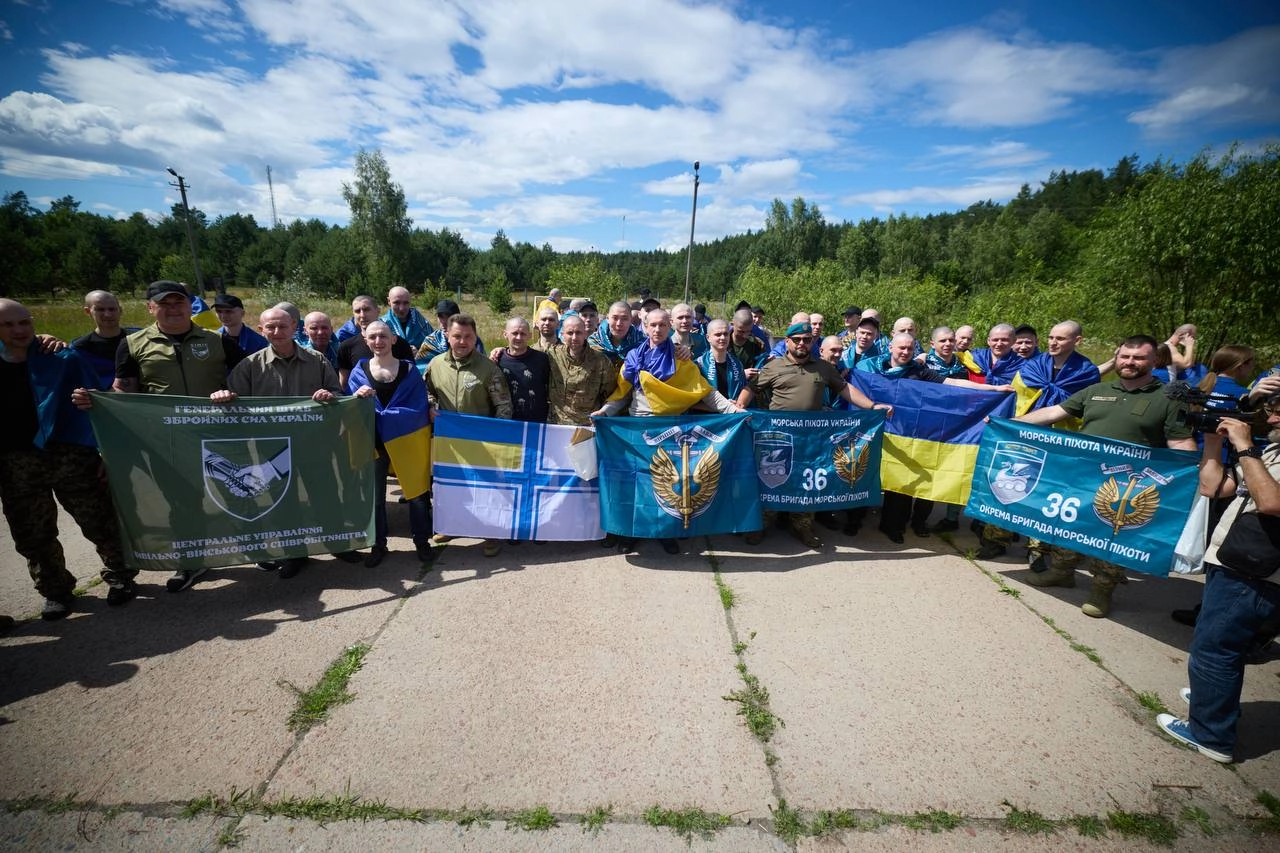
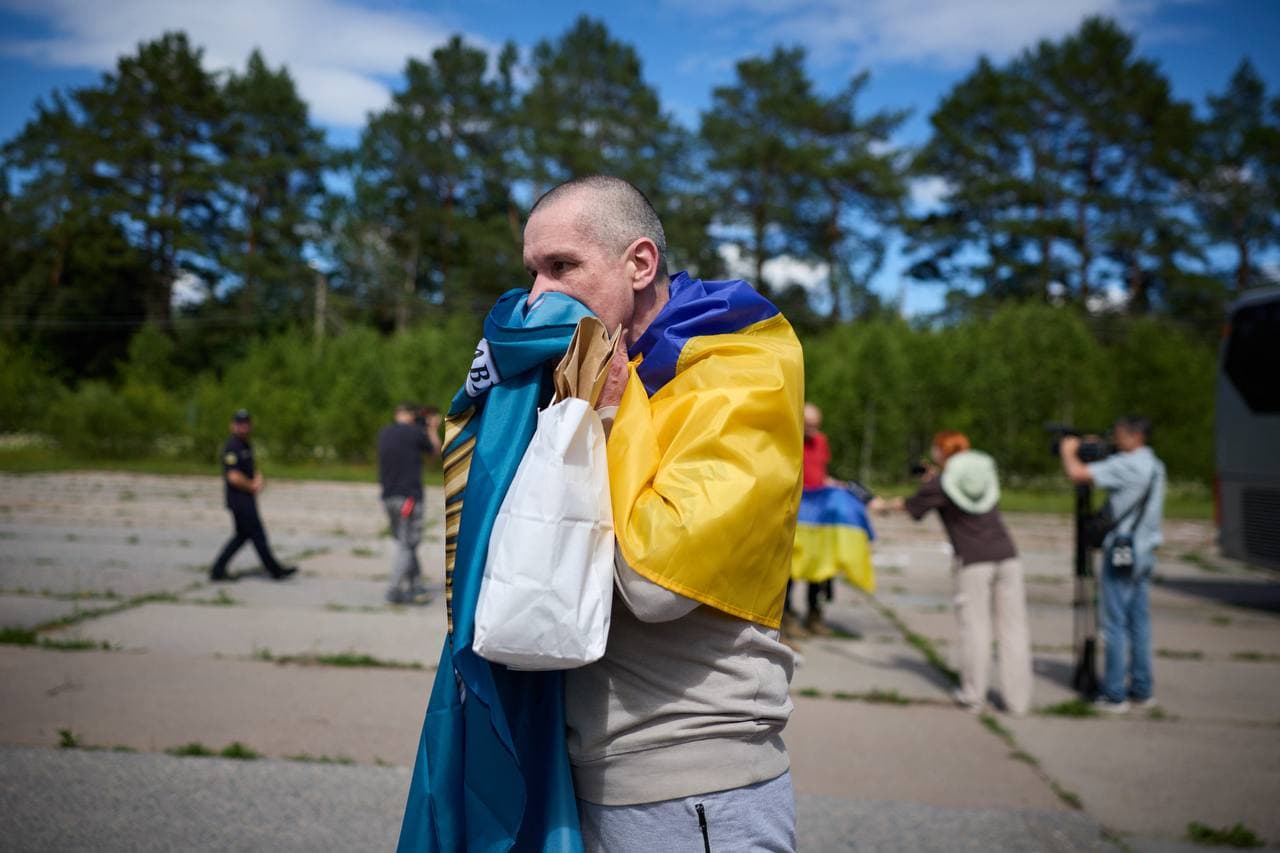
For 160 Ukrainian families, June 26 was the day a years-long wait ended. Russia and Ukraine carried out a prisoner exchange returning 160 people held by each side, the latest in a series of swaps that remain among the only functioning channels between Kyiv and Moscow. Among those released were defenders of the Azovstal steel plant, the last Ukrainian stronghold in Mariupol before the city fell in May 2022 — meaning some of these soldiers had waited more than four years for this morning. “We check every last name,” Zelensky said. “We must return everyone — both military and civilians.” Presidential Office head Kyrylo Budanov, who welcomed the released prisoners personally, said their first phone calls home represented “real, genuine happiness shared by all of Ukraine.”
Even as some Ukrainians came home, others were losing their homes to fire. Russian forces struck energy and civilian infrastructure overnight in Vilkove, a Danube-region community near Ukraine’s border with Romania, injuring one person and cutting power to the town and surrounding settlements. The same night, a separate strike on Zaporizhzhia damaged a residential building and injured another person, while Kyiv and several regions were placed under air alert twice before dawn after the Air Force warned of a ballistic missile threat from the northeast — a missile that was later reported moving toward Kremenchuk. Two people were injured by falling debris from an earlier missile threat the previous evening. Officials continue to plead with residents not to ignore air raid sirens, warning that ballistic threats leave almost no time to reach shelter once the alarm sounds.
Against this backdrop, the European Commission proposed extending temporary protection for Ukrainian refugees across the EU by one more year, to March 2028, European Commissioner for Migration Magnus Brunner announced. The extension would exclude new arrivals who leave Ukraine in violation of its wartime mobilization laws — a condition Brunner said was added explicitly at Kyiv’s request, to balance continued support for refugees against Ukraine’s need to retain fighting-age men. The measure, which still requires approval from EU member states and may not be finalized until September, would provide a measure of stability for millions of Ukrainians who have built new lives, jobs, and schooling across the bloc since 2022 — even as the war that displaced them grinds on with no resolution in sight.
Closing
The ships are still smoldering at Zatoka. The lines are still backed up at Kerch. Somewhere in Omsk, a gas station attendant is turning away the forty-first liter, and somewhere in Oleshky, a wheelbarrow is making another impossible trip toward a generator that is almost out of fuel. None of it resolves. None of it ends. Crimea declared an emergency it cannot actually fix; Moscow’s nationalists demand a war it cannot actually win faster, and a minibus in Nikopol became, for one more day, the place where all of this theory turns back into blood. The distance between what Russia claims and what Russia is keeps widening — and somewhere in that gap, the war goes on costing more than anyone in the Kremlin is willing to admit.
A Prayer for Ukraine
1. For the Two Who Never Reached Nikopol
Lord, a woman and a man boarded a minibus this morning meaning only to arrive somewhere ordinary. They did not. Be near to the families who must now grieve a death with no battlefield, no warning, no reason but cruelty wearing the shape of a drone. Hold the two twelve-year-old girls who survived with shrapnel in their bodies and give the doctors treating them steady hands and clear minds.
2. For the Children of Oleshky
Father, You see the roughly two hundred children trapped behind mines and drones in a town with no food, no power, no way out. Some of them are scattered now among the dead and wounded who cannot even be carried to safety. Reach them where soldiers and aid workers cannot. Let no child in that town go another day believing they have been forgotten by the whole world.
3. For Those Who Carry Impossible Decisions
God of wisdom, look upon the men in Kyiv and Moscow weighing forty-day campaigns, fuel embargoes, and rhetoric that edges toward weapons too terrible to name. Give Ukraine’s leaders discernment to press toward peace without losing the country they are trying to save. Restrain any hand in Moscow tempted toward escalation and let no nationalist’s anger become a nation’s policy.
4. For the Defenders and the Returning
Lord of hosts, we thank You for the 160 who came home today after years in captivity, some of them since Azovstal fell. Be with the families on the phone tonight hearing a voice they feared they’d lost. And watch over the soldiers still in the trenches near Kupyansk, Kostyantynivka, and Vovchansk, who hold ground in the heat and foliage so that others might one day make that same phone call.
5. For Justice That Has Not Yet Come
God of justice, the testimonies pile higher every week — human safari, unlawful detention, civilians used as shields — and still no tribunal, no reckoning, no end. We do not ask You to forget any of it. We ask You to remember all of it, every name, every unmarked grave, until the record is complete and the accounting is whole.
In Your mercy, in Your justice, in Your time — bring this war to its end and let the ending be worthy of what Ukraine has endured.
Howdy! Someone in my Myspace group shared this site with us so I came to take a look.
I’m definitely enjoying the information. I’m bookmarking and will be tweeting this to my followers!
Superb blog and excellent design and style.