
Ukraine Daily Briefing | June 30, 2026 | Day 1,588 of the Full-Scale Invasion
Prepared by Dayana Bozhyk
Volodymyr Zelensky disclosed on June 30 that the Kremlin has set and missed 15 separate deadlines to seize all of Donetsk Oblast since 2022, a record that stands against a Russian advance rate now down to a quarter of last August’s pace. Ukrainian drones struck Russia’s Dubna Space Communications Center for the second time in eight days and hit a bearing plant deep inside Penza Oblast, while a Russian drone crash killed a six-month-old baby in Moscow Oblast the same morning a nationwide barrage killed 13 people and injured 109 more. Amid record numbers of Russians searching online for when the war will end, Ukraine signed a deal for 16 Swedish Gripen E fighter jets, one more step in rebuilding an air force still flying Soviet leftovers.
THE DAY’S RECKONING
Picture Volodymyr Zelensky reading a list out loud: March 31, May 9, June 1, September 15, December 31. Then the next year’s dates. Then the next. Fifteen deadlines in total, each one a Kremlin promise that Donetsk Oblast would fall by a certain day, each one broken. On June 30, he read the whole list, and the number that matters most sits underneath it — Russian forces still need roughly 5,305 more square kilometers to finish the job, advancing now at less than a quarter of the rate they managed last August.
Five hundred kilometers north, in Dubna, Moscow Oblast, smoke rose over a satellite communications facility for the second time in eight days. Five hundred fifty kilometers to the east, in Penza, a bearing plant burned. And in a small house in Yegoryevsk, also Moscow Oblast, a six-month-old baby died when a Russian drone came down and set the building on fire — killed not by Ukraine, but by the very war machine Moscow keeps aloft over its own cities.
None of it stopped the missiles. Thirteen more people died in Ukraine before the day was out. The war does not pause to let anyone finish counting the ways it fails to end.
FIFTEEN DEADLINES AND COUNTING: THE KREMLIN’S TIMELINE THAT NEVER ARRIVES
Zelensky told the public on June 30 that the Kremlin has issued 15 separate deadlines for Russian forces to seize all of Donetsk Oblast since the full-scale invasion began — five in 2022 alone, including Putin’s original demand that Russian troops take the entirety of Donetsk and Luhansk oblasts by September of that year. Two more followed in 2023, two in 2024, three in 2025, and now three so far in 2026, with the latest deadline pushed to December 31. Every single one has come and gone with the territory still unconquered.
The math explains why. Russian forces advanced an average of 3.79 square kilometers per day in June 2026 — down from 16.65 square kilometers per day in August 2025, a collapse of more than three-quarters. At that pace, the roughly 5,305 square kilometers of Donetsk Oblast still outside Russian control will not fall by any deadline the Kremlin has yet named. The Institute for the Study of War (ISW) assesses that these unrealistic timelines are themselves doing damage, pushing Russian units toward flag-planting stunts, “beautiful reports” sent up a chain of command that increasingly hears only what it wants to hear, and a growing reliance on AI-altered footage to manufacture advances that never happened on the ground.
Zelensky’s timing was not an accident. His accounting followed directly on Putin’s June 28 claims — the same interview in which the Russian president told journalist Pavel Zarubin that Russian forces were advancing rapidly on nearly every front. Zelensky’s list of fifteen broken promises was the quiet, devastating rebuttal: not a denial, just a calendar.
RUSSIANS START GOOGLING THE END OF THE WAR
Something is shifting inside Russia that no Kremlin broadcast can fully suppress. Russian opposition outlet Meduza reported on June 30 that Yandex — Russia’s dominant search engine — recorded more than 137,000 searches between June 22 and June 28 asking when the war against Ukraine will end. It is the highest weekly total since the invasion began in February 2022, and the second consecutive week of growth, with the previous peak coming right after Ukraine’s early-June strikes on St. Petersburg during that city’s flagship economic forum.
The geography of the searching tells its own story. Yandex’s Wordstat tool showed the heaviest concentration of queries coming from Moscow Oblast and St. Petersburg — precisely the regions where the Kremlin has poured resources into air defense, and precisely the regions that have still watched Ukrainian long-range strikes get through. Putin has spent years trying to keep Russia’s two largest cities insulated from the consequences of his war. The search data suggests that insulation is wearing thin.
Polling backs it up. The Kremlin-linked Public Opinion Foundation found Putin’s approval rating fell five percentage points, from 74 to 69 percent, between June 12 and June 21 — shortly after Ukraine’s largest strike yet on Moscow Oblast. Weekly polling from the same organization shows his trust rating has been sliding steadily since February. State-friendly pollsters do not publish numbers that embarrass the state without reason; that this one did suggests the discontent has become too large to fully paper over. Ukraine’s Commander-in-Chief Oleksandr Syrsky put it plainly in a June interview: the strategy now is to let the war reach Russian soil, because “it is when the war comes to their territory, when they feel the realities of this war on their own skin,” that anything in Russian public opinion begins to move.
LONG-RANGE SANCTIONS: DUBNA STRUCK AGAIN AS UKRAINE’S DEEP STRIKE CAMPAIGN WIDENS
Zelensky called it “long-range sanctions” — his own name for a campaign of drone strikes that keeps finding its way roughly 500 kilometers into Russia. On the night of June 29 to 30, Ukraine’s Unmanned Systems Forces, commanded by Major Robert “Magyar” Brovdi, struck the Dubna Space Communications Center in Moscow Oblast for the second time in eight days, following an earlier strike on June 22 that damaged a 32-meter satellite antenna and the facility’s main control building. Zelensky said the center coordinates Russian military communications, intelligence, and the reconnaissance that guides occupation forces inside Ukraine — and that Ukraine has already hit four similar facilities in Moscow and Vladimir regions, with more being prepared. Moscow Oblast Governor Andrei Vorobyov confirmed only that drones had damaged an administrative building, a description considerably smaller than the strategic communications hub Zelensky described.
Farther east, 550 kilometers from the border, Ukrainian drones set fire to a state-owned bearing plant in Penza overnight. Closer to the front, explosions and a blaze tore through a logistics lot in Russian-occupied Donetsk, target unconfirmed. And in occupied Crimea, the strike campaign against energy infrastructure continued: four electrical substations hit near Dzhankoi, a fire at a substation in Poshtove, a fuel train burning in Feodosiya, and confirmation that Ukraine’s June 28 strike on the Saky Thermal Power Plant destroyed the main building and one fuel tank. Sevastopol’s occupation governor admitted the peninsula had been forced into a temporary power-restriction regime just to keep its grid from failing outright.
The Ukrainian General Staff also released battle damage assessment from the June 28 strike on the Slavyansk Oil Refinery in Krasnodar Krai: four storage tanks destroyed, totaling 35,000 cubic meters of capacity, and nine more damaged. Zelensky said Ukrainian forces had “started Constitution Day very accurately.” The Security Service of Ukraine says the refinery strike belongs to a declared 40-day campaign targeting Russia’s military and economic infrastructure — a campaign with no announced end date, and, judging by the growing count of Yandex searches, one that Russians themselves are starting to notice.
The same June 30 accounting from the General Staff included quieter, less cinematic targets that matter just as much to the men actually fighting: a road bridge near occupied Azovske and a railway bridge near occupied Ichki, both routes Russian forces rely on to move troops, weapons, and ammunition, plus drone command posts near Vesele Lopan in Belgorod Oblast and near Komar, Myrne, and Skelky in occupied Donetsk and Zaporizhzhia oblasts, and a command and observation post near Staromlynivka. None of it will show up on any map Putin cites in his next interview. Bridges and command posts do not advance or retreat — they simply stop working, one strike at a time.
NO MAN’S LAND: THE FRONTLINE HOLDS WHILE MOSCOW’S MAPS LIE
Neither side made a single confirmed territorial advance anywhere along the front on June 30 — not in Sumy, not in Kharkiv, not in Kostyantynivka, not in Pokrovsk, not in Zaporizhzhia. Russian forces kept attacking. Ukrainian forces kept holding, and in several places, counterattacking: Ukrainian military observer Kostyantyn Mashovets reported Ukrainian units resumed counterattacks in the Lyman direction against Russia’s 20th Combined Arms Army, in the Oleksandrivka direction against the 36th, and near Orikhiv-Zaporizhzhia City against the 58th.
The Russian Ministry of Defense kept claiming otherwise. It announced the capture of Rivne and Lisne northwest of Hulyaipole — settlements four and nine kilometers, respectively, beyond the furthest confirmed Russian infiltration. It repeated the pattern in the Oleksandrivka direction on three consecutive days, claiming towns 14 to 15 kilometers from any verified Russian position. This is precisely the mechanism Ukraine’s Commander-in-Chief Oleksandr Syrsky described days earlier: if three soldiers reach the edge of a settlement, even briefly, before being pushed back out, the report up the chain still marks it captured, and the map gets colored in. “It is good for us that this is the case,” Syrsky said — a rare admission that Russia’s own propaganda has become a source of Ukrainian battlefield intelligence, since it reveals exactly how distorted Russian command’s picture of the war has become.
On the ground, small brutal patterns repeated themselves. Russian forces near Pokrovsk have stopped using armored vehicles entirely, driven off by Ukrainian drones; near the Oskil River, Russian troops now resupply by FPV drone because conventional trucks cannot survive the trip. Russian glide bombs hit a Ukrainian ammunition depot near Prydorozhnye and a Kharkiv City neighborhood, killing one person. The front did not move. The cost of holding it did not stop rising.
154 DRONES, ONE SMALL COFFIN: THE OVERNIGHT BARRAGE AND ITS TOLL
Russia launched 154 Shahed, Gerbera, and Italmas-type strike drones, plus Parodiya decoys, overnight from Kursk, Oryol, occupied Donetsk, and occupied Hvardiiske in Crimea. Ukraine’s Air Force shot down 138 of them; 13 struck ten locations directly, with debris falling on two more. It was, by the numbers, a fairly ordinary night for a war approaching its fifth year — which is itself the horror of it.
Across the country, the toll settled at 13 killed and at least 109 injured. Dnipropetrovsk Oblast absorbed the worst of it: six dead and 38 injured after more than 60 Russian attacks struck four districts with drones and a missile. In Kharkiv, four people died and 24 were injured, including two children, as strikes hit the city and 29 other settlements across the oblast. Zaporizhzhia lost three people, with 18 injured. Sumy counted ten injured; Kherson eleven, including three children; Donetsk four; Chernihiv four. Ukrenergo reported power outages stretching across Dnipropetrovsk, Zaporizhzhia, Sumy, Kharkiv, and Chernihiv oblasts. Russian forces continued their parallel campaign against Ukrainian gas stations — 13 strikes on fueling stations in Kharkiv Oblast alone since May 1 — a deliberate effort, ISW assesses, to inflict on Ukrainian civilians the same fuel anxiety that Ukrainian strikes have inflicted on Russia.
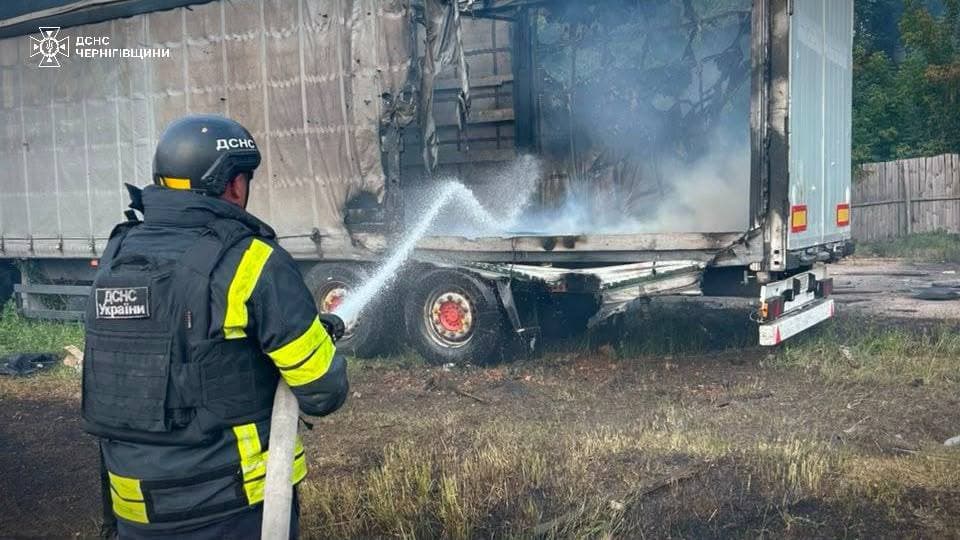
Emergency workers extinguish a fire after a Russian attack in Chernihiv Oblast. (Chernihiv Oblast authorities/Telegram)
And then there was Yegoryevsk, in Moscow Oblast, where Russian authorities said an overnight attack killed a six-month-old baby and injured two others when a house caught fire. Russian officials attributed it to a drone crash — not a strike, a crash, one of their own weapons falling out of the sky over their own territory. Geolocated footage showed the house partially destroyed. No nation’s failures spare its own children.
RACING THE SHAHED: UKRAINE’S NEW INTERCEPTOR DRONES
The Shahed — known inside Russia as the Geran-2 — has been Russia’s signature weapon of attrition since Iran first supplied the design in 2022: a loitering munition costing roughly $20,000, carrying up to 80 kilograms of explosives, flying low and slow but in swarms large enough to overwhelm air defenses by sheer volume. Nearly 57,000 have been launched at Ukraine as of March 2026, with single attacks now involving up to 700 drones at once.
Ukraine’s answer has been to build something cheap enough to match the Shahed’s economics. On June 3, Ukrainian companies Vyriy Industries and NOCTIS unveiled ZIRKA, an interceptor drone developed with input from the Darknode anti-Shahed battalion. It costs up to $2,000 per unit, reaches speeds above 340 kilometers per hour, operates up to six kilometers high, and can automatically detect, track, and neutralize aerial threats without an operator holding its hand the entire flight — a leap past the manually guided interceptors that came before it. “The more such teams and quality products there are, the higher the chances of winning this technological race,” Vyriy Industries CEO Oleksii Babenko said. A follow-up version, ZIRKA 2.0, is already in development, adding automated terminal guidance and thermal optics that can track targets from two kilometers out.
Ukraine’s Defense Ministry has separately codified the LITAVR interceptor, built by F-Drones, which reaches 350 kilometers per hour and 9 kilometers of altitude with its own automatic terminal guidance. Both drones represent the same bet: that Ukraine can out-innovate Russia’s brute-force drone economics one cheap interceptor at a time, faster than Moscow can build new Shaheds to replace the ones that get shot down.
GRIPENS, KRONER, AND GROUND ROBOTS: THE WEST ARMS UP
Zelensky announced on June 30 that Ukraine and Sweden had signed an agreement to purchase 16 Gripen E fighter jets — Sweden’s most advanced version of the aircraft, financed through European Credit Funds with British backing, with deliveries beginning in 2029. It runs alongside a separate, earlier commitment from Sweden to donate 16 older Gripen C/D jets outright, arriving in early 2027. “Together with Sweden, we continue strengthening Ukraine’s combat aviation,” Zelensky said. Defense Minister Mykhailo Fedorov called the Gripen’s ability to carry Meteor long-range air-to-air missiles a potential turning point for an air force that still flies 1990s-era F-16s from Norway, the Netherlands, and Denmark alongside Soviet-vintage MiG-29s and Su-27s.
The money kept moving on other fronts too. The European Commission announced it is disbursing €3.9 billion specifically for Ukrainian drone procurement, part of a larger €90 billion Ukraine Support Loan; combined with an earlier tranche, Ukraine has now received over €7 billion through the mechanism. Denmark unveiled its 30th military aid package for Kyiv, worth roughly $670 million in ammunition, arms, and training funding, with Danish Foreign Minister Lars Lokke Rasmussen warning, “we must maintain our support for Ukraine and increase the pressure on Russia.” And at the Ukraine Recovery Conference in Poland, Norwegian defense firm Kongsberg and Ukraine’s DevDroid signed a memorandum to jointly produce armed ground drones — one of roughly 160 agreements at the conference worth a combined $10 billion. Separately, a bipartisan group of U.S. lawmakers introduced the Strategic Unmanned Systems Partnership Act, aimed at creating a U.S.-Ukraine working group to mass-produce Ukrainian drone designs on American soil.
BRITAIN REBUILDS AROUND UKRAINE’S LESSONS
Outgoing British Prime Minister Keir Starmer used one of his final acts in office to unveil, on June 30, a Defense Investment Plan reshaping the UK armed forces around lessons drawn directly from Ukraine’s battlefield. The plan pairs an immediate £15 billion ($20 billion) funding boost with £300 billion ($400 billion) over four years, pushing Britain toward NATO’s 3.5 percent defense-spending target by 2035 and raising annual defense spending to nearly £80 billion ($106 billion) by 2029. The philosophy behind it, according to the Ministry of Defence, favors “cheap systems destroying high-value targets and innovation cycles measured in weeks, not years” — a direct borrowing from Ukraine’s drone-first response to a numerically superior enemy.
The clearest sign of that shift is the likely cancellation of Britain’s planned Type 83 destroyers and Type 32 frigates, to be replaced by cheaper “Common Combat Vessels” built to command swarms of unmanned sea, air, and underwater systems. Five billion pounds ($6.6 billion) is earmarked for drone modernization alone, including £650 million ($860 million) for mass-produced cheap aerial and ground drones, while the Royal Air Force pursues a Collaborative Combat Air Programme pairing crewed jets with AI-guided drones alongside Italy and Japan. “By choosing to embrace new technology, I am equipping our forces with the autonomous systems which will give them the edge,” Defense Secretary Dan Jarvis said.
The plan arrived amid unusual turmoil at the top of British government. Starmer’s own defense secretary, John Healey, resigned June 11 over funding disputes, and Starmer himself announced he is stepping down as prime minister barely a week before unveiling the plan meant to define his defense legacy — a generational overhaul, in his words, launched by a government already walking out the door.
A FRACTURED FRIENDSHIP: POLAND WITHHOLDS MIGS OVER DRONES AND BANDERA
Poland’s Defense Minister Władysław Kosiniak-Kamysz confirmed on June 29 what Ukrainian officials had not: the promised transfer of additional MiG-29 fighter jets is dead, at least for now, because Ukraine never delivered the drone technology it agreed to share in return. “I proposed what I believe was a very fair, partnership-based approach: MiGs in exchange for drones,” he said. “The Ukrainians initially accepted it but did not follow through, so there are no MiGs for Ukraine because there are no drones.” Poland had approved the transfer of up to nine additional MiG-29s in January, on top of the 14 it gave Ukraine in spring 2023 — the first country to hand Kyiv warplanes after the invasion began. Six to eight of those newer jets, already written off by the Polish military, were expected in Ukrainian hands by the end of 2026.
The stalled jets are almost a footnote next to the deeper rift driving them. Relations between Warsaw and Kyiv have soured since Ukraine named a special-forces unit in honor of the Ukrainian Insurgent Army (UPA) in May — an organization Ukrainians widely remember as wartime resistance fighters and most Poles remember as the perpetrators of the 1943–1945 Volyn massacres of ethnic Poles. “With Bandera, Ukraine will not join the European Union,” Kosiniak-Kamysz said, invoking the UPA-linked nationalist leader Stepan Bandera directly. The aging MiGs themselves are not much of a loss militarily — Ukraine’s Air Force found earlier Polish transfers poorly suited to modern air defense work, and lost two of them in a single day on June 27. But a wartime alliance running on old grievances is a harder thing to repair than a supply chain.
SEALING THE BORDER: RUSSIA SHUTS CROSSINGS AS SWEDEN WARNS OF A LASTING THREAT
Russia announced it will suspend rail traffic through seven border checkpoints with Finland, Estonia, and Latvia starting July 1 — five crossings on the Finnish border, including the historic Saint Petersburg-Finlyandsky checkpoint, plus one each on the Estonian and Latvian borders. The government order gave no explanation. It follows a June 26 Danish investigation concluding that Russia is significantly building up military infrastructure along NATO’s northeastern flank in apparent preparation for a longer confrontation with the alliance.
Sweden’s intelligence chief made the stakes explicit the same day. Thomas Nilsson, head of Sweden’s Military Intelligence and Security Service, told Bloomberg that Russia will likely remain a threat to the West long after Vladimir Putin eventually leaves office, calling Moscow’s confrontation with the West “deep, structural and enduring.” He said Russian domestic political opposition has been “effectively been eliminated — through exile, imprisonment, or, in the worst cases, assassination,” leaving no organized alternative to the current regime even as economic strain mounts. Nilsson said Russia is planning to expand its military footprint the length of NATO’s northeastern border, “from northern Finland all the way down” — plans currently on hold only because the war in Ukraine consumes Moscow’s resources, not because Russia has abandoned them. For a border region that has spent four years bracing itself, the message from Stockholm was less a warning than a confirmation: whenever this war ends, the standoff with Russia will not.
THE BILL COMES DUE: FUEL LINES AND EMPTY SHOPS IN RUSSIA
In Russia’s Irkutsk region, more than 5,000 kilometers from the front, police and National Guard units have been posted at gas stations around the clock — not for security against Ukraine, but to manage the queues and stop drivers from filling extra canisters. Governor Igor Kobzev declared a state of “high alert” over fuel shipments after Ukrainian strikes knocked out roughly a quarter of Russia’s national refining capacity, spreading shortages across more than 50 Russian regions. “The fuel situation in the city remains tense,” Irkutsk’s deputy mayor said, describing drivers racing to stockpile gasoline before rationing bites harder. Four people have already been fined for reselling fuel at inflated prices.
Two thousand kilometers to the west, in the Moscow commuter town of Mytishchi, the war’s economic weight is showing up as shuttered storefronts. “My business is on its last legs. I’m thinking about shutting down completely,” a pharmacy owner told AFP, describing years of rising taxes and thinning customer flow. Military spending has climbed to roughly eight percent of Russian GDP — the highest since the Cold War — while the civilian economy that everyone else depends on posted its first quarterly contraction in three years. “The Russian economy is a two-tier economy — the state-dominated defense industry, doing pretty well, and basically everything else,” economist Alexander Kolyandr said. A manicure salon owner has moved into a shared studio to cut rent; a grocer, in business since 2015, says her tax bill has jumped fifteen-fold. None of these are battlefield casualties. All of them are casualties of the war anyway.
MONEY AND METAL: A BELGIAN COURTROOM AND A EUROPEAN QUOTA SQUEEZE UKRAINE’S LIFELINES
Two financial fights, thousands of kilometers apart, both trace back to the same war. In Brussels, Euroclear — the financial infrastructure firm holding roughly €193 billion of Russia’s frozen central bank assets — filed suit against the Bank of Russia, challenging a Moscow court ruling that ordered Euroclear to pay €200 billion in damages over its handling of those frozen funds. Euroclear says the Russian proceedings were closed-door and without jurisdiction; the case now moves to a Brussels commercial court, with implications for the broader Western debate — including a bipartisan U.S. Senate bill introduced in June — over whether frozen Russian assets can be legally redirected to arm Ukraine.
Meanwhile, the European Commission’s new global steel quotas, taking effect July 1, will cut Ukraine’s tariff-free steel exports to the EU by more than half compared to 2025 — capping Kyiv at 1.05 million metric tons annually against a market where the EU absorbs 79 percent of Ukraine’s total steel trade. “We can understand in reality there is no preferential treatment for Ukraine,” said Oleksandr Kalenkov of the Ukrainian steel association Ukrmetallurgprom. The quotas were calculated using 2022–2024 trade volumes — the very years Russia’s invasion crippled Ukrainian steel production and blocked Black Sea exports — locking Kyiv’s allotment to its worst years rather than its 2025 recovery. A Polish diplomatic source told Polish radio that Warsaw had actively lobbied to make sure Ukraine was included in the restrictions. MEP Karin Karlsbro called the decision a threat to Ukraine’s “ability to finance its fight for existence.” Britain, notably, exempted Ukraine from its own parallel steel measures. The EU did not.
JUSTICE AND MEMORY: A TRAITOR’S ARREST AND THE DEAD WHO STILL CARRY EXPLOSIVES
Ukraine’s Security Service detained a man in Kyiv on June 30 whom open-source reporting identifies as Serhii Kolobov, 65 — the former Russian-installed energy minister of occupied Crimea. According to the SBU, Kolobov took Russian citizenship after the 2014 occupation, spent two years re-registering Crimea’s power plants, gas infrastructure, and oil terminals under Russian law, and later ran extractive industry companies for Moscow. He now faces high treason charges carrying up to 15 years in prison — a rare case, since most officials who defected to occupation authorities are tried in absentia and never actually face a cell.
Justice for the living runs alongside a slower, grimmer reckoning for the dead. In Kirovohrad, police investigator Taras Tarasenko described the routine no one wants to talk about: Ukrainian servicemen’s bodies, returned from Russia through repatriation, sometimes arrive rigged with explosives, grenades, or other hazards, requiring a mandatory safety sweep before any identification can even begin. “We have found explosive objects, grenades and other things, so we work as carefully as possible,” he said. His 32-person center can process only about ten bodies a day even when batches of 200 or more arrive at once, cross-referencing dental records, tattoos, and DNA against a database that sometimes takes years to produce a match. “Today, we identified a person who went missing back in 2023,” Tarasenko said. “For three years nothing was known about their fate.” Some families are still waiting on cases opened in 2014. Ukraine’s Coordination Headquarters reported recovering 522 bodies in its most recent repatriation operation, alongside a June 26 exchange returning 160 prisoners of war from each side, and the release of seven long-held civilian detainees, some held since the war’s first year.

The SBU said it detained in Kyiv a former Russian-installed energy minister of occupied Crimea. (Security Service of Ukraine)
HUNGARY’S BALANCING ACT AND ROMANIA’S NEW HOTLINE
Hungarian Prime Minister Péter Magyar told parliament on June 30 that Hungary will not support a European Commission proposal to bar military-age Ukrainian men from entering EU territory, even if the bloc adopts it — insisting Budapest will keep admitting ethnic Hungarians fleeing Ukraine’s roughly 70,000-to-80,000-strong Hungarian community in Zakarpattia Oblast regardless of the rule. The Commission’s proposal, unveiled June 26, would extend protections for 4.4 million displaced Ukrainians across the EU while closing the door specifically to draft-eligible men; it needs a qualified majority to pass and would not take effect before March 2027. Magyar, who unseated the pro-Kremlin Viktor Orbán in Hungary’s April elections, has staked his foreign policy on protecting ethnic-Hungarian communities abroad while pursuing a warmer relationship with Kyiv than his predecessor ever attempted, including a recent minority-rights agreement and the lifting of Hungary’s veto on Ukraine’s EU accession bid.
Farther south, Romania and Ukraine have quietly built a more practical safeguard: a direct communication line meant to prevent the kind of confused, slow-moving response that followed a May Shahed-type drone strike on a residential building in Galați, which injured two civilians, and a June naval drone that drifted into Romanian waters near Constanța. Romanian President Nicușor Dan said the two countries have held talks at multiple levels and built the direct channel specifically so that a similar incident would not need to work its way through several decision-makers before anyone could respond. Romania’s Defense Ministry is still investigating both cases. It is a small fix for a large problem — the war’s periodic habit of spilling, by accident or malfunction, past its own borders — but a fix all the same.
THE CARPATHIAN REFUGE: FRONTLINE MEDICS FIND A SPACE TO HEAL
There is a program in the Carpathian Mountains where Ukrainian combat medics go to remember what a body feels like when nothing is trying to kill it. The Repower Foundation has run recovery retreats for nearly 2,000 Ukrainian military medics since 2022, and three of them tell the same war from three different angles.
Elena Olenivska enlisted after her fiancé was killed in Irpin on March 5, 2022. Asked why, she said only, “That’s all.” She considered joining an assault unit — “it would be nice, bright, but very short,” she said of a heroic death — and chose instead the harder, longer path of staying alive and useful as a combat medic. Ivan “Ivo,” who leads a medical evacuation team near the Sumy-Kursk sector, takes pride in one fact above all: in his years of pulling wounded soldiers from armored vehicles under fire, not one has died in his arms. Serhiy Zhuravlyov, mobilized on the invasion’s first day, once used his own scarce medical supplies to treat a wounded Russian prisoner with broken legs — “on the one hand, it’s the enemy,” he said, “but on the other hand, I’m a doctor.”
None of what they described in the Carpathians was combat. That was the point. “It was only physically difficult,” Serhiy said of climbing the peaks, “zero responsibility” compared to the front — a kind of rest that has nothing to do with safety, since, as Elena put it, “the issue of security does not exist” anymore for anyone doing this work. What Repower gives them instead is smaller and, in its way, harder to manufacture: a week where the only thing trying to break them is a mountain.
June 30, 2026 ended, as most days in this war do now, with two versions of events refusing to reconcile. Zelensky’s fifteen broken deadlines sat next to Putin’s claims of rapid advance everywhere; Yandex recorded a record number of Russians quietly asking when it will all stop while their government suspended railway crossings and dug in for a longer confrontation with NATO. A baby died in a burning house in Moscow Oblast from a weapon that was never aimed at her, and thirteen people died in Ukraine from weapons that were. Between deadlines nobody meets and a war nobody has found a way to end, three medics climbed a mountain in the Carpathians, because for one week, nothing there was trying to kill them.
A PRAYER FOR UKRAINE
1. For the Six-Month-Old Killed in Yegoryevsk
Lord, a baby died on June 30 in a burning house in Moscow Oblast, killed not by an enemy but by a weapon her own country sent into the sky and could not control. Two others in that house are injured tonight. We do not ask you to weigh whose war this is when a child this small has died in it. We ask only for mercy for her family, and for every parent anywhere — Ukrainian or Russian — who has learned that no border keeps a falling drone from finding a nursery.
2. For the Children Wounded in Kharkiv, Kherson, and Zaporizhzhia
God of the young, on June 30 two children were among 24 injured in Kharkiv, three among eleven in Kherson, and more still in Zaporizhzhia — Monday’s entries in a ledger that has been filling for 1,588 days. We ask for their full healing, and for parents who can find the strength tonight to sit beside a hospital bed one more time. Let this stop being ordinary before it stops being survivable.
3. For the Commanders Carrying the Weight of Every Decision
Father, Volodymyr Zelensky spent June 30 reciting fifteen broken Kremlin deadlines to a public that has waited 1,588 days for any deadline to bring peace instead. Oleksandr Syrsky spoke the same week of a strategy built on letting the war reach Russian soil, knowing exactly what that costs on both sides of the line. We pray for clarity for both men, for wisdom heavier than the decisions in front of them, and for the strength to bear a weight neither ever asked to carry alone.
4. For the Medics Who Carry the Living and the Dead
Lord of the brokenhearted, Elena, Ivan, and Serhiy — combat medics who spoke this week of grief, of a Russian prisoner they chose to save, of a mountain climb that was, for once, only physically hard — carry wounded soldiers through conditions where, as one of them said, “the issue of security does not exist.” We pray for their hands, steady enough to keep working, and their hearts, soft enough to keep caring. Give them the rest the Carpathians offered, and let it hold.
5. For the Missing Still Being Found, and for Justice Yet to Come
God of justice, in Kirovohrad this week, an investigator identified a man who vanished in 2023, three years after his family first gave a DNA sample and had no answer. In Kyiv, a man accused of helping Russia seize Crimea’s energy grid was finally arrested and may finally face a courtroom. We pray for every family still waiting on a match that has not yet come, and for every case still open since 2014. In Your mercy, in Your justice, in Your time — bring this war to its end, and let the ending be worthy of what Ukraine has endured.