
Ukraine Daily Briefing | July 1, 2026 | Day 1,589 of the Full-Scale Invasion
Prepared by Dayana Bozhyk
The Institute for the Study of War reported on July 1 that Russian forces advanced just 30.42 square kilometers in June 2026, a 94 percent collapse from the 481.25 square kilometers they seized in June 2025, while suffering 39,490 casualties for the month. Ukrainian forces struck the Ufa Oil Refinery in Bashkortostan for the second time in a week and a Roscosmos missile-component plant in Penza, as a Bloomberg analysis found Ukrainian long-range weapons can now reach regions home to more than 70 percent of Russia’s population. Russian attacks nationwide killed at least six people and injured well over 100 through the day, as President Volodymyr Zelensky, opening Ireland’s EU presidency in Dublin, warned of another mass Russian strike and said Putin “absolutely refuses to end the war.”
THE DAY’S RECKONING
Start with the number that makes the rest of the day make sense: 30.42. That is how many square kilometers Russian forces gained in the whole of June 2026 — not a typo, not a single sector, the entire monthly offensive across the entire front. A year earlier, in June 2025, the same army took 481.25 square kilometers. The offensive that was supposed to break Ukraine this summer is now advancing at about one-sixteenth of last year’s pace, and it is paying nearly twenty times more blood for every kilometer it takes.
Ukraine spent July 1 making sure that trade stays lopsided. Drones found the Ufa Oil Refinery again, 1,300 kilometers from the front, for the second hit in a week. Others found a Roscosmos plant in Penza that builds sensors for Russia’s cruise missiles. A Bloomberg analysis published the same day counted air-raid alerts this year across regions holding more than seven in ten Russians — proof that the war Moscow once kept comfortably far from home now reaches almost all of it.
None of that stopped a Russian drone from finding a civilian minibus in Kherson at seven in the morning, killing two people on their way to work. It did not stop seven glide bombs from killing a fifteen-year-old boy in Kharkiv. By evening, President Volodymyr Zelensky was in Dublin, warning that another mass strike was coming, while Ukraine’s own monthly numbers sat quietly in an ISW report, saying more about who is actually winning this war than either side’s press office ever will.
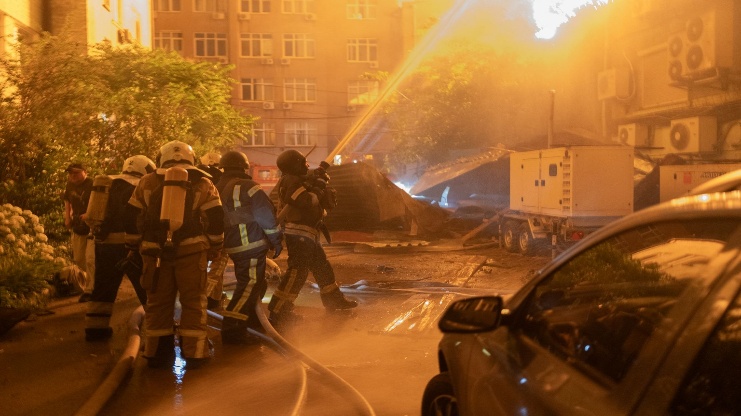
Ukrainian firefighters battle a fire in a building previously hit during a Russian air attack on Kyiv, Ukraine, early. (Roman Pilipey / AFP / Getty Images)
RUSSIA’S SPRING-SUMMER OFFENSIVE GRINDS TO A NEAR-HALT
The Institute for the Study of War’s monthly accounting, released July 1, is the starkest measure yet of how badly Russia’s 2026 offensive has stalled. Russian forces seized or infiltrated only 30.42 square kilometers in June 2026, advancing at an average pace of 1.01 square kilometers per day — compared to 481.25 square kilometers and 16.04 square kilometers per day in June 2025. Widen the lens to the full first half of each year and the gap holds: Russian forces took 2,189.87 square kilometers between January and June 2025, but only 622.60 square kilometers in the same months of 2026, just 28.43 percent as much ground.
The cost of what little ground Russia did take has climbed even faster than the gains have shrunk. Ukrainian General Staff reporting indicates Russian forces suffered 39,490 casualties in June 2026 alone — about 1,298 casualties for every square kilometer seized or infiltrated, compared to 68 casualties per kilometer in June 2025, a nineteen-fold increase in blood cost per meter of ground. Equipment losses tell the same story: Russian forces lost 60,849 drones in June 2026 versus 4,581 a year earlier, 12,867 fuel vehicles and tankers versus 3,395, and 2,053 artillery systems versus 1,243. ISW assesses that Ukraine’s intermediate- and long-range strike campaigns are directly responsible for compounding these losses, hitting Russian logistics and equipment before it ever reaches the front. Russia’s one area of genuine progress remains Kostyantynivka in Donetsk Oblast, where Russian forces now hold or have infiltrated 36.98 percent of the city and made more than three-quarters of their June gains — tactical progress bought at a cost ISW expects Russia to keep paying through the summer without a breakthrough against Ukraine’s broader Fortress Belt defenses.
UFA STRUCK AGAIN AS HALF OF RUSSIA COMES WITHIN REACH
Zelensky announced on July 1 that Ukrainian forces had struck the Ufa Oil Refinery in Bashkortostan — more than 1,300 kilometers from the front line and one of Russia’s largest producers of industrial lubricants — for the second time in a week, following an earlier strike on two Ufa refineries on June 25. The Ukrainian General Staff separately reported an overnight strike on the JSC Scientific Research Institute of Physical Measurements in Penza, a facility under Russia’s Roscosmos space corporation that manufactures sensors for cruise and ballistic missiles, components for Su-34, Su-35, and Tu-95MS aircraft, and equipment for reconnaissance satellites. Geolocated footage published July 1 showed the aftermath in Penza City.
Satellite imagery released the same day filled in the damage picture from earlier strikes: the June 27 Flaming cruise missile strike on the Titan-Barrikady enterprise in Volgograd destroyed parts of two buildings, while newer imagery confirmed damage at the GRU’s Rubin communications complex in Beloomut, Moscow Oblast, and further destruction at the Voronezh Semiconductor Devices Assembly Plant from the June 22 strike. A Bloomberg analysis published July 1 put the strategic picture in scale: Ukrainian missile alerts have now been recorded this year across Russian regions home to more than 70 percent of the population, reaching as far as Astrakhan (900 kilometers from Ukraine), the North Caucasus, and even Omsk in western Siberia, nearly 3,000 kilometers away. Samara, a city of 1.2 million on the Volga, briefly suspended overground public transport during an air alert earlier in the week. Ukrainian officials say the domestically built Flamingo cruise missile, with a range exceeding 1,500 kilometers, is behind much of that expanding reach.
NO ADVANCES, FRONTLINES HOLD
Neither side gained confirmed ground anywhere along the front on June 30 or July 1 — not in Sumy, not in Kharkiv Oblast, not along the Oskil River, not in Slovyansk, Kostyantynivka-Druzhkivka, Dobropillya, Pokrovsk, Novopavlivka, or Oleksandrivka. The Russian Ministry of Defense claimed its 55th Naval Infantry Division seized Kopani northwest of Hulyaipole, but Ukrainian military observer Kostyantyn Mashovets reported that Russia’s 5th Combined Arms Army — the largest army in Russia’s Eastern Grouping of Forces — has largely stalled in the Hulyaipole direction, reduced to small infiltration groups bypassing Ukrainian positions rather than sustained advances, its logistics along the M-14 Rostov-Crimea highway under constant Ukrainian interdiction. Mashovets assessed that Russian command is prioritizing Slovyansk-Kramatorsk and is unlikely to commit reserves to Hulyaipole at all.
Behind that static line, Ukraine’s intermediate-range strike campaign kept working: the General Staff reported hits on Russian drone control posts near Udachne, Novooleksandrivka, and Pokrovsk itself; a logistics crossing near Novoocheretuvate; a road bridge over the Malyi Kalchik River near occupied Hranitne, 107 kilometers from the front; a logistics depot near Rivnopil; and a railway bridge across the Telpa River near occupied Nyzhnoteple in Luhansk Oblast, roughly 100 kilometers behind Russian lines. Geolocated footage showed a destroyed bridge on the H-20 Rostov-Crimea highway near Kremenivka and a burning ammunition depot with twenty damaged trucks near Donetsk City. Ukrainian Joint Forces Task Force spokesperson Colonel Viktor Trehubov reported that Russian units in Kharkiv and Sumy oblasts are now rationing fuel for generators and moving supplies on foot during assaults — a direct consequence, Trehubov said, of Ukraine’s strikes on Russian refineries and logistics.
CRIMEA UNDER SIEGE: SAKY AIRFIELD BURNS, ARMYANSK GOES DARK
Ukraine’s Security Service (SBU) reported striking hangars at the Saky military airfield in occupied Crimea overnight, recording five hits including on two hangars sheltering Su-30 and Su-30SM fighter jets. The SBU said the strike ignited a fire in the hangar housing the Su-30SM, indicating the aircraft — worth an estimated $30 to $50 million — was likely destroyed. NASA satellite fire-detection data collected July 1 confirmed heat anomalies at the airfield. Defense Minister Mykhailo Fedorov, speaking alongside Swedish Defense Minister Pål Jonson in Kyiv, called the strike part of a “new technological stage of the war” and said Crimea has effectively become a Russian military base that Ukraine intends to keep isolating from resupply.
The isolation is visibly working. The Crimean occupation government told Russian business outlet Kommersant on July 1 that occupied Armyansk has gone more than two days without power or water, while Yany Kapu and the Feodosia municipal district face significant outages of their own — all consequences, officials there acknowledged, of the ongoing Ukrainian strike campaign. Fedorov said Russian occupation authorities in Crimea had tried rationing fuel by QR code before abandoning the scheme entirely: “Right now it’s impossible to buy anything at all,” he said, adding that Russian infantry in some southern sectors are now walking up to 30 kilometers to reach their own positions because logistics have been destroyed.
RUSSIA’S OIL MATH DOESN’T ADD UP
Bloomberg reported June 30 that Russia’s seaborne crude oil exports rose to 4.13 million barrels a day in June — the highest since February 2022 — even as gross export revenue fell to $1.9 billion a week, the lowest since March. The contradiction resolves once the destination is clear: Bloomberg found Russian oil accumulating at sea rose 34 percent, to 133 million barrels, with tankers idling off Egypt and Singapore because buyers are running out. Two industry sources told Reuters that Russia has begun importing gasoline from India, with at least 60,000 metric tons already dispatched and plans for 400,000 tons a month from India, Belarus, and other suppliers — an admission, in effect, that Ukrainian strikes have broken Russia’s ability to refine its own crude into usable fuel even as it exports more of the unrefined product than ever. Indian imports of Russian crude, meanwhile, hit a record 2.70 million barrels a day in June, over half of India’s total oil imports.
Separately, the seven railway border crossings Russian Prime Minister Mikhail Mishustin ordered closed with Finland, Estonia, and Latvia took effect July 1 as scheduled, with Russian authorities still offering no public explanation for the closures.
BELARUS KEEPS THE REPEATERS ON
Ukrainian Commander-in-Chief Oleksandr Syrsky reported June 30 that Belarus has not dismantled Russian-installed signal repeaters along its border with Ukraine, despite switching them off June 22 after Zelensky threatened to strike the equipment directly. Belarus turned at least one repeater back on June 29. Syrsky said Belarus “will realize this is not necessary” — a pointed but vague reference to unspecified Ukrainian countermeasures — underscoring that the repeaters, which extend the range of Russian drones flown over Belarusian airspace into western Ukraine, remain a live threat rather than a resolved one.
NIGHT AND DAY: UKRAINE ABSORBS A TWO-WAVE BARRAGE
The night of June 30 into July 1 followed a familiar pattern: one Iskander-M ballistic missile, one Kh-59 guided missile, and 151 Shahed-, Gerbera-, and Italmas-type drones plus Parodiya decoys launched from Kursk, Bryansk, Oryol, Rostov, Krasnodar, and occupied Donetsk and Crimea. Ukrainian air defense downed the Kh-59 and 130 drones; 17 drones struck 16 locations and debris fell on four more, hitting gas, agricultural, commercial, residential, and road infrastructure across Chernihiv, Dnipropetrovsk, Kharkiv, Kherson, Mykolaiv, Poltava, Odesa, and Sumy oblasts. Regional officials reported Russian forces have specifically been targeting civilian fuel infrastructure with long-range drones — four gas stations hit in Chernihiv, five in Dnipropetrovsk, seven in Zaporizhzhia over the past week alone — prompting fuel retailer WOG to shut its stations across Kyiv and six other oblasts from 9 p.m. to 7 a.m. starting July 1.
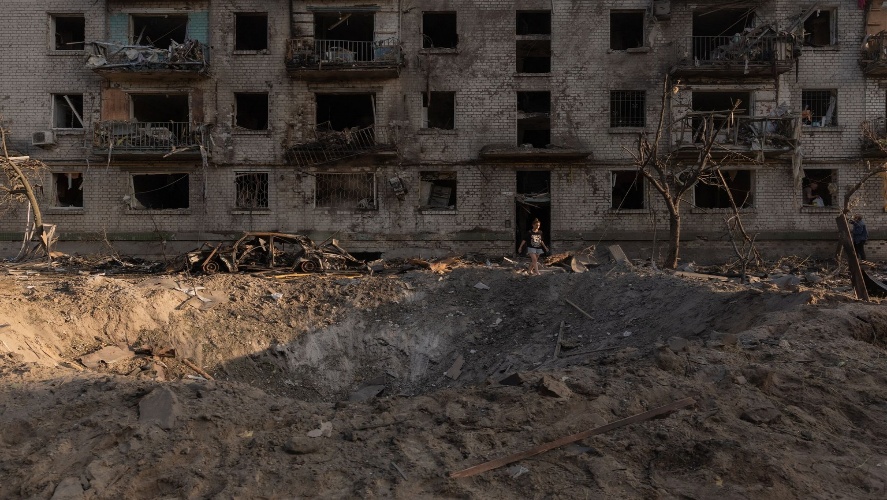
A person walks away from a residential building damaged in a Russian air attack on Kyiv, Ukraine. (Roman Pilipey / AFP / Getty Images)
Daylight brought a second, harder wave. At around 7 a.m., a Russian drone operator deliberately struck a civilian minibus in central Kherson during morning rush hour, killing two and injuring nine; Kherson Oblast had already lost one person and seen seven injured earlier in the day, with two apartment buildings and twelve private homes damaged. In Dnipropetrovsk Oblast, one person was killed and seven injured as Russian forces struck three districts more than twenty times with drones and artillery, damaging a cultural center, a school, and a memorial alongside five gas stations — even as, in a small counter-note, a newly finished underground shelter at a Nikopol lyceum brought 120 students and staff back to in-person classes the same day. Zaporizhzhia Oblast absorbed the worst of it: two killed and 36 injured across 846 recorded strikes on 48 settlements. Then, at 3:50 p.m., seven Russian glide bombs hit Kharkiv City directly, killing a fifteen-year-old boy and injuring 32 people — the youngest a one-year-old, the oldest 76 — across five separate impact sites in the Kyiv, Slobidsky, Novobavarsky, and Osnovyansky districts. Odesa Oblast lost two people and saw 13 injured when a ballistic missile destroyed two warehouses. Sumy counted 25 injured across nearly 130 strikes on 28 settlements; Donetsk, seven injured; Chernihiv, one woman hurt in a market strike; Poltava, four injured when a missile hit an enterprise. Regional authorities’ running tally, published July 1 before the day’s later attacks were even added in, already stood at six killed and at least 111 injured nationwide.

The interior of a civilian minibus after it was struck by a Russian drone in central Kherson during the morning. (Kherson Oblast Military Administration/Telegram)
ZELENSKY IN DUBLIN: A WARNING, A PRESIDENCY, AND A BLOCKED PATH TO EUROPE
Zelensky arrived in Ireland on July 1 for the opening ceremony of Dublin’s six-month rotating presidency of the Council of the European Union, meeting Irish Finance Minister Simon Harris at Baldonnel Aerodrome before sitting down with Taoiseach Micheál Martin at Dublin Castle. At the ceremony, Zelensky pressed European Council President António Costa to open the five remaining EU accession clusters Ukraine needs to advance its membership bid — “We can open five more clusters. Antonio, what do you think?” he asked. Costa’s reply, “Maybe,” reflected a monthslong stall: a Hungary-led push at a June 18 EU summit had already forced the phrase “as soon as possible” out of joint conclusions on Ukraine’s and Moldova’s accession, and diplomats told the Kyiv Independent Hungary continues to block the remaining clusters from opening.
At a press conference beside Martin, Zelensky said Ukrainian intelligence had detected preparations for another mass Russian strike, noted that Ukraine had faced attacks “all day” across multiple regions, and said he would return to Ukraine immediately after the briefing. He was blunter about the diplomatic track: “The leader of Russia absolutely refuses to end the war,” he said, describing a June letter in which he had proposed a bilateral summit with Putin, only to have the Kremlin dismiss the idea and respond that “if Zelensky wants to meet, he can come to Moscow.” Zelensky noted that even as Trump and G7 leaders have pushed Moscow to “make a deal,” and Putin has periodically signaled openness to resuming talks on the 2022 Istanbul framework, Russia has simultaneously kept calling Kyiv’s government “neo-Nazi” and insisting the battlefield favors Moscow — a contradiction Zelensky said proves the Kremlin isn’t negotiating in good faith at all.
SYRSKY’S SIX POINTS, CONDENSED TO THREE
In a lengthy interview with Ukrainian broadcaster TSN, Commander-in-Chief Oleksandr Syrsky offered a rare on-the-record accounting of how Ukraine’s military leadership reads the war’s trajectory. He said Russian forces once attacked along roughly 13 major operational axes; today only about four remain principal offensive efforts, with total active axes down to seven. He said Ukrainian forces now initiate 45 to 50 percent of daily combat engagements along the front — evidence, he argued, not that Ukraine holds the strategic initiative everywhere, but that Russian offensive capacity has degraded enough for Ukraine to dictate the tempo in selected sectors, pointing to a claimed 600 square kilometers of net territory retaken from Russian forces since the start of 2026.
Syrsky was careful not to overstate the moment: Russia’s manpower and resource advantage remains large, he said, and the Kremlin’s willingness to force felons and debtors into service means Russia is unlikely to run out of troops soon. Ukraine’s own long-range strike campaign, he said, operates on three layers — deep strikes on industry, operational strikes on logistics, and frontline strikes on combat units — each reinforcing the others. Asked if the war had reached a turning point, Syrsky said the trend was moving that way but that no turning point had yet arrived: a genuine one, he said, would look like Ukrainian forces gaining 18 to 20 kilometers in a single day, a pace nowhere close to today’s reality.
KYIV LAYS THE GROUNDWORK FOR A NATIONAL PANTHEON, WARSAW CALLS IT ESCALATION
The Verkhovna Rada approved a bill on July 1 establishing a Ukrainian National Pantheon to memorialize state builders, military leaders, and cultural figures, submitted by Zelensky on June 28 and now awaiting his signature. Parliament speaker Ruslan Stefanchuk called it “the navel of Ukrainian statehood.” Expected to be commemorated there, according to RBC Ukraine sources, are Yevhen Konovalets, who led the Organization of Ukrainian Nationalists from 1929 to 1938; Mykhailo Omelyanovych-Pavlenko, a Ukrainian People’s Republic military commander; and Vasyl Kuk, who led the Ukrainian Insurgent Army (UPA) in the early 1950s. Former President Viktor Yushchenko has separately proposed reburying figures including 18th-century hetmans Ivan Mazepa and Pylyp Orlyk, and OUN-B leader Stepan Bandera; OUN-M leader Andrii Melnyk was already reburied in Ukraine in May.
The Pantheon law lands squarely on an open wound in Ukrainian-Polish relations, which have deteriorated since Zelensky named a special forces unit after the UPA in May. Poland’s government has formally recognized the UPA as responsible for genocide against Poles in the 1943–1945 Volyn massacres, which Ukrainians largely regard instead as a two-sided wartime tragedy; historians estimate 60,000 to 90,000 Polish deaths and 10,000 to 20,000 Ukrainian deaths in the same period. Warsaw’s presidential office has already called the Pantheon initiative a further “escalation” between the two capitals — a disagreement over how to bury the dead of one war complicating the alliance fighting another.
UKRAINE OPENS THE DOOR TO WEAPONS EXPORTS
Ukraine’s government approved what Fedorov called the country’s “first transparent mechanism” for exporting Ukrainian-made weapons and defense technology, announced July 1 after more than a year of preparation. The system applies to transfers worth roughly $334,795 or more, limited to the 27 countries — 15 of them NATO members — that have signed onto Ukraine’s Drone Deal framework; applications will be reviewed within 30 days, no intellectual property will transfer, and 20 percent of any onward re-export value will flow into Ukraine’s state budget. Fedorov said Ukraine’s own military needs remain the priority and exports can be blocked if domestic demand isn’t fully met first, but argued that Ukrainian manufacturers are now producing more than the state can afford to buy, leaving firms needing outside revenue to survive and scale.
The Kyiv School of Economics estimates Ukraine’s high-tech defense sector reached $6.8 billion in 2025, likely an undercount; FirePoint, maker of the Flamingo cruise missile, was valued at $6 billion in May alone. “I hope it will make Ukraine a global player,” Fedorov said, framing the move as both an economic lifeline for defense firms and a way to arm allied democracies with battle-tested technology.
KYIV TELLS THE WORLD: RUSSIA’S SHADOW FLEET ISN’T CIVILIAN ANYMORE
Ukraine formally argued to the International Maritime Organization, in a June 26 letter from Deputy Prime Minister Oleksii Kuleba reported July 1 by the Financial Times, that Russia’s shadow fleet of tankers may no longer qualify for protection as ordinary civilian shipping, since the vessels are “critical to the generation of budget revenues for the Russian Federation and the continuation of its war effort.” The letter came in response to a Russian complaint accusing Ukraine of “terrorism” over a March attack on the tanker Arctic Metagaz; Kuleba countered that Russian forces have themselves attacked 59 merchant vessels since 2022, including ships flagged to Turkey and Germany.
The legal argument has real evidence behind it. An OCCRP investigation published June 29 found the Gazprom-owned tanker Marshal Vasilevskiy, which supplies Russia’s Kaliningrad exclave, equipped with heavy machine guns and crewed partly by people with Russian military backgrounds. The UK seized a shadow fleet tanker in the English Channel on June 14, and France intercepted another in the Mediterranean on June 25. Shipbroker Clarksons estimates Russia’s shadow fleet at roughly 1,800 vessels, some 1,500 of them oil tankers, most more than two decades old — aging, armed, and now, in Ukraine’s telling, no longer entitled to sail as neutral cargo.
GERMANY CHARGES A UKRAINIAN IN THE NORD STREAM CASE
German federal prosecutors filed the first-ever charges in the 2022 Nord Stream pipeline sabotage case, German outlet Tagesschau reported July 1, naming Ukrainian national Serhii Kuznietsov, extradited from Italy to Germany in November 2025 after a lengthy legal battle. Prosecutor General Jens Rommel charged Kuznietsov, a former Ukrainian soldier German investigators allege commanded the yacht Andromeda used in the operation, with attacking civilian energy infrastructure — a war crime under international law. He is being held in Hamburg awaiting trial. Speaking in Dublin, Zelensky declined to comment in detail, saying only that Kyiv would coordinate with Berlin once more information was available; Ukraine’s government has consistently denied any state involvement in the pipeline attacks, which destroyed three of the four Nord Stream lines and remain under investigation only in Germany, after Denmark and Sweden closed their own probes in 2024 without charges.
June 30, 2026 into July 1 closed the way most days in this war now do: with a monthly report proving Russia is losing ground at a historic crawl, and a night and day of strikes proving that losing ground has not stopped Moscow from killing people who have nothing to do with the front line at all. Somewhere between the 30.42 square kilometers Russia gained in June and the fifteen-year-old boy killed by a glide bomb in Kharkiv on July 1, the actual shape of this war sat waiting for anyone willing to look at both numbers at once.
A PRAYER FOR UKRAINE
1. For the Two Killed on Their Way to Work in Kherson
Lord, at seven this morning a drone found a passenger minibus in Kherson and a man who was watching chose, deliberately, to kill the people riding inside it. Two did not come home. Nine more are healing tonight. We ask for peace for the families who sent someone to work this morning and are now planning something else entirely. Let no commute anywhere in this country carry that risk again.
2. For the Boy Killed by a Glide Bomb in Kharkiv
God of the young, a fifteen-year-old boy died this afternoon when seven glide bombs hit Kharkiv, and thirty-two more people were hurt beside him, from a one-year-old to a woman of seventy-six. We do not have words equal to a child’s death by ordnance built to level buildings. We ask only that his family find some steadiness in the days ahead, and that this city, struck now more times than anyone should have to count, be spared the next one.
3. For the Dead and Wounded of Zaporizhzhia, Dnipropetrovsk, and Odesa
Father, this single day brought 846 strikes on Zaporizhzhia, dozens more across Dnipropetrovsk, and a ballistic missile on Odesa that leveled two warehouses and took two more lives. We pray for everyone counted among today’s six dead and hundred-plus wounded, and for the ones the count had not yet caught by evening. Hold what is broken in each of these places, Lord, and hold the people trying to rebuild it.
4. For the Commanders Weighing a War That Won’t Turn
Lord of wisdom, Oleksandr Syrsky said this week that no true turning point has arrived, even as Russia’s whole June offensive gained barely thirty square kilometers. Volodymyr Zelensky stood in Dublin today asking allies to keep a promise while warning his own people of another mass strike still to come. We pray for clarity for both men, and for patience for a nation that has now waited 1,589 days for a turn that keeps almost arriving.
5. For the Fleet, the Pipeline, and Every Long, Unfinished Reckoning
God of justice, this week Ukraine told the world that Russia’s tankers no longer deserve to sail as ordinary ships, and Germany finally charged someone in a pipeline case that has sat unresolved for nearly four years. Both are small steps in accountings that will likely take years more to close. We pray for patience for every investigator, diplomat, and lawyer still working these long threads, and, in Your mercy, for an end to the war that keeps generating them.