
UKRAINE DAILY BRIEFING
April 18, 2026 • Day 1,515 of the Full-Scale Invasion
A 58-year-old gunman born in Moscow killed six people and wounded fourteen others in a Kyiv supermarket before police special forces stormed the building and ended the siege — the deadliest domestic shooting Ukraine has seen in years, erupting on a day when Russian drones were simultaneously cutting power to 380,000 Chernihiv residents and killing a 16-year-old boy. Overnight, Ukraine struck four Russian oil refineries and pumping stations across Samara, Leningrad, and Krasnodar oblasts, while SBU naval commandos hit two Black Sea Fleet warships in occupied Crimea — blows that Ukraine says are costing Russia $100 million every day. At the Antalya Forum in Turkey, Russian Foreign Minister Lavrov announced that peace talks are simply not Moscow’s priority.
The Day’s Reckoning
Picture a Saturday morning in Kyiv. Families doing weekend shopping, children in tow. A man walks into a supermarket in the Holosiivskyi district. He has a hunting carbine — legally purchased, properly registered. He opens fire.
Six people are dead by the time police special forces drag themselves through the doors. Fourteen others are wounded, including a 12-year-old boy. A four-month-old infant nearby inhales carbon monoxide from a fire the gunman set. The attacker, a 58-year-old native of Moscow who had lived for years in Donetsk Oblast, barricades himself inside. Negotiators try. He refuses. KORD — Ukraine’s Rapid Operational Response Unit — ends it.
At the very moment those shots were echoing through Kyiv, Russian drones were cutting power to 380,000 people in Chernihiv. A 16-year-old was dying in the rubble of his home, hit in the overnight wave of 219 Russian drones — the largest single-night swarm of the year. A 64-year-old man in Kherson was shot off his moped by an FPV. An elderly woman on a minibus in Dnipropetrovsk Oblast was bleeding from shrapnel.
And somewhere in the pre-dawn dark, Ukrainian strike drones were threading through Russian air defenses stretched thin across a front that spans a continent — finding oil refineries in Samara, fuel tanks in Sevastopol, warships in Crimea. The commanders of those drones, if asked, would tell you the same thing the infantrymen of the Khartia Brigade say from their rotation house outside Kharkiv: this war will reach everyone. There is no distance left.
The Kyiv Shooting: A Moscow-Born Gunman, Six Dead, and a City That Cannot Rest
The man who walked into the Holosiivskyi district supermarket on Saturday morning had, by all bureaucratic measures, done everything correctly. His hunting carbine was purchased legally, registered, and accompanied by a valid medical certificate. President Zelensky later noted the attacker had “previously faced criminal prosecution” — and officials announced an investigation into which medical institution had cleared him to carry.
What followed was the deadliest mass shooting Ukraine has experienced in years. Four people died on the street. A fifth died inside the supermarket. A woman who survived long enough to reach a hospital died there — the sixth victim. Among the injured: a 12-year-old boy. A four-month-old infant who inhaled carbon monoxide from a fire the attacker set in an apartment where he was registered suffered the chaos at a remove, but suffered, nonetheless.
The gunman refused negotiators and barricaded himself with hostages. When he fired on a police officer who entered, KORD moved. The operation was, in an officer’s words, “very complex. There was very little time. There were many civilians inside.” The assailant was killed.
Zelensky said investigators from the National Police and the Security Service of Ukraine are working to establish motive. That the gunman was a native of Moscow who had spent years in Russian-controlled Donetsk Oblast will fuel speculation — but officials urged restraint. What is clear is that the shooting has reignited a long-frozen political debate over civilian firearm law. Interior Minister Klymenko, asked directly about gun legislation, declined: “Not a topic for today’s discussion.” Ukraine’s weapons controls have been stuck in parliamentary limbo for years.
The $100 Million Night: Ukraine’s Oil Strike Campaign Reaches Samara, Leningrad, and Crimea
The numbers are staggering, if you let them land. Ukraine’s Unmanned Systems Forces Commander Major Robert “Magyar” Brovdi announced on April 18 that coordinated strikes on Russian oil logistics have slashed Russia’s daily oil shipments by roughly 880,000 barrels — a financial wound the SBU puts at $100 million per day draining from the Kremlin’s war chest.
Overnight, the Ukrainian General Staff confirmed hits on four major Russian oil facilities: the Novokuibyshevsk and Syrzan refineries in Samara Oblast (roughly 750 kilometers from the front), an oil terminal at the Vysotsk Lukoil-2 Distribution Transshipment Complex in Leningrad Oblast, and the Tikhoretsk oil pumping station in Krasnodar Krai. Geolocated footage showed fires burning at the Novokuibyshevsk refinery, with an open-source intelligence analysis suggesting up to three storage tanks may have been damaged.
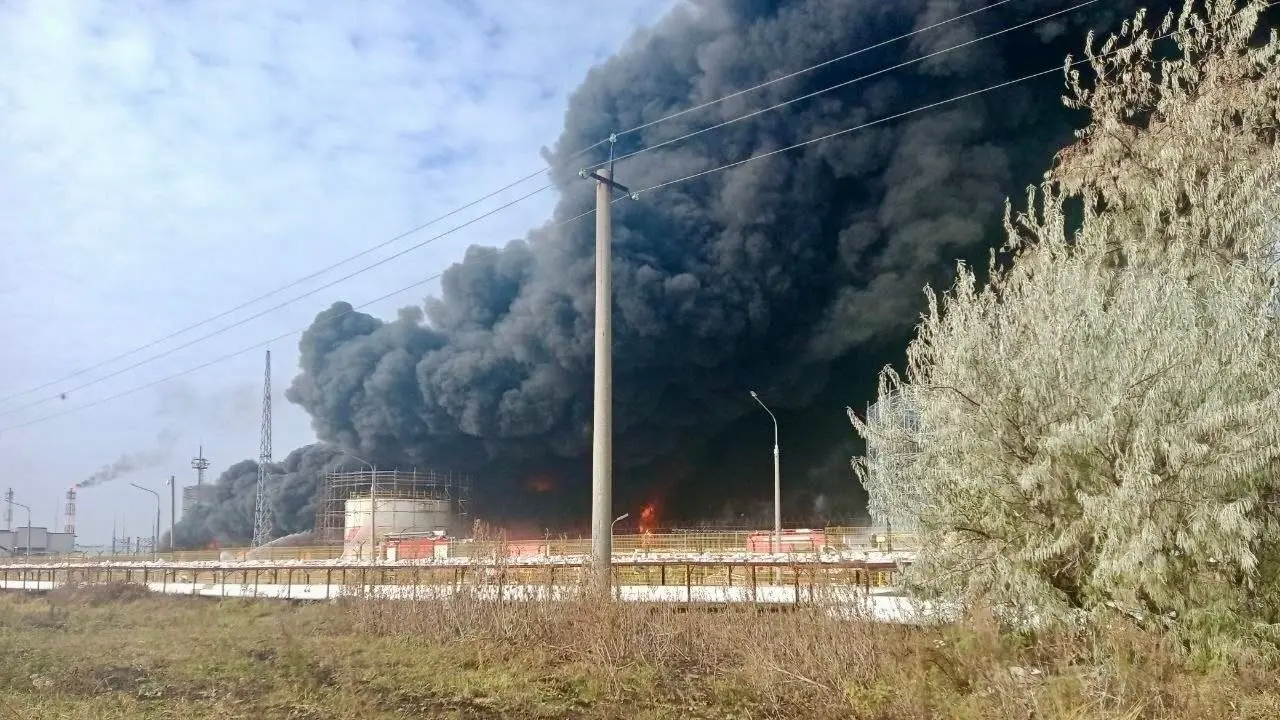
Regional Russian officials confirmed fires at both Vysotsk and Tikhoretsk — unusual candor. Russia’s Defense Ministry claimed to have intercepted 258 Ukrainian drones over Leningrad, Samara, and Krasnodar oblasts, though those refineries burned anyway, which says something about the limits of interception at this scale.
Simultaneously, in occupied Sevastopol, a large fire broke out at the Yugtorsan oil depot after a Ukrainian drone strike on fuel storage tanks. The Russian-installed governor, Mikhail Razvozhaev, acknowledged the fire while claiming only a single residual-fuel tank was hit and no one was injured — the kind of minimizing statement that has learned not to deny the fire itself.
This follows a pattern now well-established: the Tikhoretsk station, the ports at Ust-Luga, Primorsk, Sheskharis, and Tuapse have all been hit in recent months. In March, Ukraine reportedly disabled about 40 percent of Russia’s oil export capacity. This month, the campaign has intensified further — partly because the war in Iran has driven global oil prices higher, making every barrel Russia cannot export a more expensive loss.
Warships in the Dark: The Black Sea Fleet Takes Another Hit
While the oil refineries burned on the mainland, Ukraine’s Security Service — the SBU — was conducting a separate naval operation in occupied Crimea. The SBU reported that its forces struck two Ropucha-class large landing ships, the Yamal and the Azov, and a third unidentified warship. These vessels are workhorse amphibious ships — capable of transporting tanks, armored vehicles, and hundreds of troops from shore to shore. Neither is a trivial target.
The operation didn’t stop there. Ukrainian forces also struck the antenna block of a Delfin communication system — a naval command-and-control link — and an MMys-M1 radar station in unspecified areas of occupied Crimea. The SBU reported possible damage to a Grachonok-class Project 21980 anti-saboteur patrol boat as well.
The Grachonok is the kind of vessel specifically designed to intercept Ukrainian maritime drones. That one may have been damaged in a maritime drone operation carries a certain irony.
Footage published after the strikes showed the fire at the Sevastopol oil depot clearly. Explosions were also reported near the Saki airfield at Novofedorivka — where Russia maintains aircraft — and anti-aircraft fire was reported from the Kacha airfield. The overnight operation on Crimea was broad, multi-vector, and coordinated. The Black Sea Fleet, once the pride of Russia’s southern maritime power, has been methodically bled for two years. It continues.
219 Drones, One 16-Year-Old, and 380,000 Homes Without Power
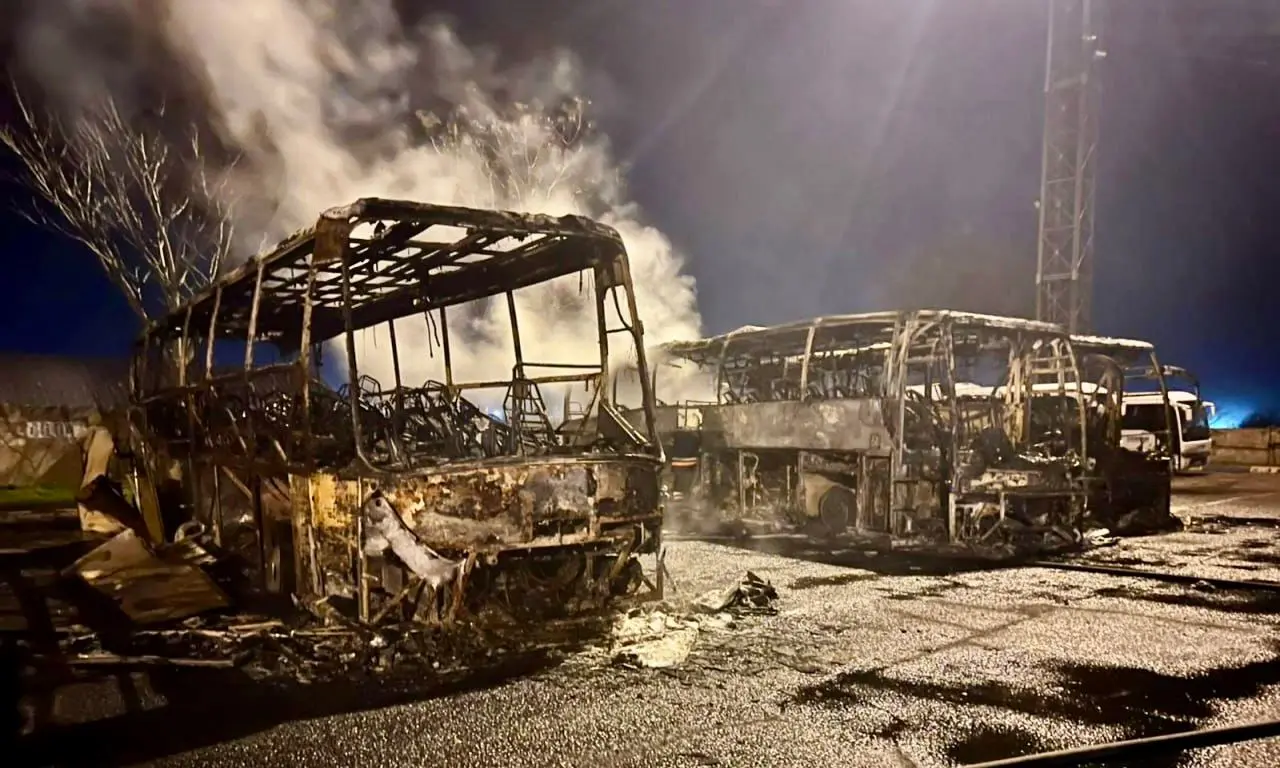
The aftermath of a Russian attack on Odesa Oblast that targeted port and industrial infrastructure facilities. (Ukraine’s State Emergency Service / Telegram)
The overnight Russian drone attack was the largest of 2026. The Ukrainian Air Force reported 219 Shahed-type, Gerbera-type, Italmas-type, and other long-range strike drones launched from six directions simultaneously: Bryansk, Kursk, Oryol, Shatalovo (Smolensk Oblast), Millerovo (Rostov Oblast), Primorsko-Akhtarsk (Krasnodar Krai), and occupied Cape Chauda in Crimea. Ukrainian air defenses downed 190 of them. Twenty-eight got through.
In Chernihiv Oblast, one drone hit an energy facility in the Nizhyn district at approximately 4:00 a.m. The city’s combined heat and power plant — the facility that provides heat and hot water to residential buildings — was forced to suspend operations. The power company, Chernihivoblenergo, reported outages across the cities of Chernihiv, Pryluky, Nizhyn, and Slavutych: 380,000 subscribers without electricity. Emergency crews began restoration work immediately, but hot water was gone.
A 16-year-old boy died in Chernihiv when Russian UAVs targeted residential areas, an educational institution, and administrative buildings. His name has not been released. He was 16.
In Odesa Oblast, drones struck port and industrial infrastructure: administrative buildings, agricultural warehouses, buses, and storage tanks. One person was injured. In Zaporizhzhia, Shahed drones struck residential areas — infrastructure, private homes, vehicles damaged. One man was hospitalized.
The previous evening had itself been violent: 172 drones and an Iskander-M ballistic missile, with 147 intercepted. Despite that high intercept rate, systemic attacks on the energy grid continued through the night. Restoration crews have learned to work while the next wave is already airborne.
Saturday’s Daylight Strikes: Moped Drivers, Minibuses, and a Fire Station
As Ukrainian cities tried to take stock of the overnight damage, Russian forces continued striking through the daylight hours of April 18 — a pattern that has become a kind of operational signature: never let the damage assessment begin before the next attack arrives.
In the Nikopol district of Dnipropetrovsk Oblast, a Russian FPV drone — a first person-view kamikaze drone about the size of a large pizza box, controlled by a pilot wearing goggles as though playing a video game — targeted a commuter minibus in the Pokrovsk community. The driver, 65 years old, was injured. So were three passengers: a 14-year-old boy, and two women aged 73 and 82. One woman was hospitalized. The child is receiving outpatient treatment. They were on a bus.
In the Shostka district of Sumy Oblast, a drone struck a fire station — the facility whose purpose is to respond to the damage caused by the strikes Russia is launching. The building and a fire tanker were damaged. Personnel survived only because they had taken shelter in time.
In Kharkiv city, a strike hit an industrial zone and a market. In Bohodukhiv, a “Molniya” drone hit a meat processing plant at 11:00 a.m., three female employees suffering acute stress reactions. An “Italmas” drone hit the village of Zolochiv, damaging three vehicles. In Kherson Oblast, a 64-year-old man was struck off his moped near Bilozerka — traumatic brain injury, multiple leg wounds, shrapnel in the head. Grave condition.
In Kramatorsk, a missile struck apartment buildings overnight — two people wounded, three others trapped by blocked doors and requiring rescue. Regional authorities reported: Zaporizhzhia Oblast, 10 injured across 46 struck settlements. Kharkiv Oblast, seven injured across 26 settlements. Donetsk Oblast, one civilian killed in Mykolaivka, four more injured. Kherson Oblast, four injured. Odesa Oblast, one injured.
“Drones That Wait”: Inside the Khartia Brigade on the Kharkiv Front
The 13th Khartia Brigade began as volunteers defending Kharkiv in February 2022. Today it has grown into a corps-level formation — infantry, artillery, and drone systems unified under one structure — operating along some of the most contested ground in the war. A reporting team spent time with two of its soldiers recently: Serpen (“August”), an infantryman who was 20 and at a military academy when the full-scale invasion began, and Khor, a former factory worker from Dnipro who enlisted a week after February 24, 2022, and became a combat medic.
They spoke from a rotation house outside Kharkiv — a requisitioned civilian home, its windows blacked out with plastic, kittens sleeping on a bench, rifles leaning against bedposts. Khor has a wife and a five-year-old daughter. He tries to call every day. “It’s not like people imagine,” he said of being a frontline medic. There is no separation between treating and fighting. He moves with the infantry, in the same positions, in the same danger.
He described evacuating a soldier who had stepped on a mine — both legs severely damaged, tourniquets applied incorrectly. “When I got him, I worked on the wounds, packed them properly, and stabilized him. In that case, it was possible to save both his legs.” Then he described what has changed: you can no longer evacuate by vehicle in clear weather. FPV drones — fiber-optic-guided now, immune to electronic jamming, able to crouch in grass along likely routes — watch the roads. They wait.
“If visibility is good, you are seen quickly. And if you are seen, you are targeted. So, you don’t move,” Khor said. “If conditions change — fog, rain — then there is a window. Not safe. But possible.” He described wounded soldiers waiting ten days to be evacuated. Not because anyone abandoned them. Because to go in during clear weather was to guarantee a second casualty.
Serpen described a day in dense fog when he was leading a group and spotted a waiting FPV drone in the brush — two or three meters of visibility. They moved around it, cut the cable, destroyed it. “That time, we saw it first.” The subtext is obvious: most times, you do not.
Both men spoke about the manpower shortage without drama, but without concealment either. “Everybody knows,” Khor said. “It is not just a number; it is that you see who is simply not there anymore.” Young men in cities have learned to avoid metro stations and crowded streets — places where military enlistment officers from Ukraine’s Territorial Recruitment Centers might be waiting. Some rarely leave their apartments.
“They don’t think about tomorrow,” Khor said. “The war will reach everyone.” Serpen put the larger frame around it: “We are the shield of Europe.” He was still a child when Russia took Crimea. Most of his life, in theory, remains ahead of him.
The Frontlines: Stalled Advances, Ukrainian Counterattacks, and a Platoon Assault Near Chasiv Yar
Ukrainian military observer Kostyantyn Mashovets published a detailed frontline assessment on April 18 that showed a consistent pattern across multiple axes: Russian forces pressing forward at considerable cost, Ukrainian counterattacks slowing or reversing those gains, and both sides absorbing punishment while neither achieves decisive breakthrough.
In the Kostyantynivka-Druzhkivka tactical area — the heaviest current fighting in Donetsk Oblast — geolocated footage showed elements of Russia’s 70th Motorized Rifle Division conducting a reinforced platoon-sized mechanized assault west of Chasiv Yar: five infantry fighting vehicles, one tank, ten motorcycles, and multiple quad bikes. Russian forces have apparently seized the villages of Pryvillya and Minkivka, though not within the past 24 hours. Russian forces also struck Kostyantynivka itself with a FAB-3000 — a guided glide bomb weighing three metric tons — while a Russian milblogger noted that Ukrainian forces still hold positions on the western outskirts of Chasiv Yar.
Near Vovchansk in northeastern Kharkiv Oblast — a city Russia has been grinding at for over a year — Mashovets reported that Ukrainian forces have halted Russian advances toward Staryi Saltiv and Bilyi Kolodyaz and are counterattacking in southeastern Vovchansk. Ukrainian strikes are preventing Russian forces from supplying positions north of Symynivka, likely degrading their ability to sustain offensive pressure.
In the Kupyansk direction, Ukrainian counterattacks near Pishchane and Kurylivka have halted Russian advances toward the rail junction of Kupyansk-Vuzlovyi. Russian forces have been unable to make progress toward Kucherivka or near Petropavlivka, forcing a roughly two-week pause on efforts to eliminate Ukraine’s bridgehead on the east bank of the Oskil River.
In the Slovyansk direction, the pace of Russian advances has slowed following Ukrainian counterattacks near Zakitne and south of Kryva Luka. Russian forces are concentrating pressure near Rai-Oleksandrivka. In northern Sumy Oblast, Russian infiltration groups are operating in Myropilske and Prokhody east of Sumy City, but do not control these settlements. Since the start of 2026, Russian forces have managed an average penetration of five to six kilometers in this area and have seized only one relatively large village, Hrabovske.
Partisans and Rear-Area Strikes: The War Behind the Front
War does not exist only along the contact line. Ukraine’s Atesh partisan network — a Crimea-based intelligence and sabotage operation — reported that its agents burned a transformer at a railway substation in occupied Luhansk City, roughly 105 kilometers from the frontline. The attack disrupted Russian logistics in the Lyman and Kostyantynivka directions — areas where Russian forces depend heavily on rail supply.
Ukrainian forces also struck Russian rear-area military assets in occupied Donetsk Oblast overnight: a fuel and lubricant storage site near Mariupol (114 kilometers from the front), and Russian repair unit locations near Hrafske (66 kilometers) and Manhush (105 kilometers). Repair units — the facilities that restore damaged armored vehicles and heavy equipment to operational status — have become priority targets. Every destroyed repair depot is Russian armor that cannot return to the fight.
In the Southern Axis, Ukrainian forces struck a Russian repair unit near occupied Tokmak and several unspecified military facilities in occupied Zaporizhzhia Oblast, as reported by Unmanned Systems Forces Commander Brovdi. A Russian milblogger claimed Ukrainian forces were targeting the port town of Skadovsk in occupied Kherson Oblast — a logistics intersection connecting Kherson Oblast, Zaporizhzhia Oblast, and Crimea.
Meanwhile, Russian forces are attempting to seize Oleksiivskyi Island and establish positions near the Antonivskyi Bridge east of Kherson City — positioning from which they could more effectively shell Kherson City across the Dnipro River.
Russia’s Air Defense Problem: Milbloggers Admit What Officials Won’t
Russia’s military blogosphere — a rough community of pro-war commentators who operate with more candor than official channels precisely because they are not official — reacted to the Ukrainian strike wave with unusual directness. A prominent milblogger published what he described as a note from a Russian air defense servicemember: Ukrainian forces were able to hit the port of Ust-Luga because Russian surface-to-air missile stockpiles are insufficient to defend against the volume of Ukrainian strike drones. Air defense units, the note alleged, are being inspected on the basis of their appearance rather than their combat readiness.
A Kremlin-affiliated milblogger separately described Leningrad Oblast’s decision to begin recruiting reservists for mobile fire groups — essentially pickup truck-mounted anti-drone teams — as “belated but smart,” urging these groups to intercept Ukrainian drones as close to the frontline as possible before they can reach critical infrastructure deeper inside Russia.
This is the operational reality Russia faces: a front line that spans hundreds of kilometers, critical infrastructure dispersed across a country the size of a continent, SAM (surface-to-air missile) stockpiles that cannot cover every potential target, and an opponent that keeps finding new corridors through the gaps. The mobile fire groups are an improvised adaptation to a structural problem. Ukraine has had months to watch which improvisations Russia tries and probe which gaps remain.
The SIM Card War: How Russia Guides Shaheds Through European Telecom Networks
A technical detail emerged on April 17 that has significant implications for the entire Ukrainian air defense effort. Serhiy “Flash” Beskrestnov, a Ukrainian Ministry of Defense advisor on drone and electronic warfare — one of the country’s most credible public voices on these systems — reported that Russia equips every Shahed long-range strike drone with a SIM card from T2, a subsidiary of the Russian state telecoms giant Rostelecom.
The SIM cards are not for navigation. They are for control: they allow Russian operators to manage the drones remotely and receive real-time telemetry and video feedback from the drone during flight. Ukraine has blocked T2 SIM cards from roaming within its territory — a standard countermeasure. But here is the problem Beskrestnov identified: Shaheds can fly close to the Belarusian, Polish, and Romanian borders, where those SIM cards connect to the cellular networks of those countries’ telecommunications operators. Russia has been leveraging Belarusian infrastructure for its drone campaign for months. Now it appears it may be exploiting loopholes in broader European telecommunications infrastructure as well.
The implications ripple outward: European telecoms operators whose networks are being used to guide weapons into Ukrainian cities. A vulnerability that exists in the civilian infrastructure of NATO member states. And a Russian military that has found a way to turn the interconnected nature of modern telecommunications into a weapon system component.
$17 Billion Week: Zelensky’s European Tour and the Long Wait for Missiles
The week ending April 18 was, by the measure of announced commitments, one of the most significant for Western military support since the war began. President Zelensky traveled to Norway, Berlin, Rome, and the Netherlands between April 14 and 16, and allies declared close to $17 billion in new, specific military assistance to Ukraine. The caveat is significant: much of it, and especially the long-range air defense interceptor missiles Ukraine needs most, will not arrive for years.
In Norway, Ukraine signed a defense partnership declaration and a joint drone production agreement. Norway announced that its 2026 military assistance to Ukraine would total approximately $10.6 billion — the largest single-country commitment of the year. Norway’s most critical contribution is deliveries of NASAMS, the National Advanced Surface-to-Air Missile System: a medium-range air defense system capable of intercepting cruise missiles and aircraft. Norway is also contributing to purchases of US military equipment through the Prioritized Ukraine Requirements List (PURL), a European collective purchasing mechanism.
In Germany, Chancellor Friedrich Merz announced a $4.7 billion defense package at a joint press conference with Zelensky. The package covers artillery ammunition, long-range PAC-2 anti-aircraft missiles purchased through PURL, additional IRIS-T medium-range air defense systems (German-made, combat-proven in Ukraine), and the production of approximately 5,000 AI-equipped mid-range strike drones under an initiative called “Build with Ukraine.” An additional $354 million goes toward expanding Ukraine’s domestic arms manufacturing.
The Netherlands committed $268 million specifically for drones and reiterated readiness to finance more PURL purchases. In the Netherlands and elsewhere, talks focused on sustaining F-16 operations — the Dutch taxpayers funded the jets; keeping them flying requires continued support. Italy’s meeting was warm; no arms deals were announced.
The Ukraine Defense Contact Group — the Ramstein Format — met online on April 15, with defense ministers from roughly 50 nations, though US Defense Secretary Pete Hegseth did not attend. In a non-binding pledge, NATO member states committed to at least $60 billion in military assistance to Ukraine in 2026, dramatically exceeding the $38 billion collective commitment made in February. Belgium, Estonia, Lithuania, and Bulgaria made specific new contributions, primarily to artillery shells, drone purchasing, and air defense. The UK separately announced a commitment to construct 120,000 drones for Ukraine — described as the largest ever drone package, though in Ukrainian terms that represents about nine to eleven days of domestic production.
The critical gap is PAC-3 missiles — the interceptors required to shoot down Russian ballistic missiles. These are manufactured exclusively by Lockheed Martin, at a single US facility and under license in Japan. Ukrainian Defense Minister Fedorov mentioned a 2027-2029 delivery timeline in public remarks. Talks are underway about licensed production in Germany — potentially Rheinmetall for missile bodies, Diehl for internal subsystems, Lockheed for guidance. Optimistic industry estimates suggest initial German production of components by late 2026; most predict 2027-2029. Russia’s ballistic missiles are arriving now.
Lavrov at Antalya: Peace Talks Are Not Moscow’s Priority
Russian Foreign Minister Sergey Lavrov appeared at the Antalya Diplomacy Forum in Turkey on April 18 and delivered what may be the most candid statement from senior Russian officials about negotiations in months: “At this point, the issue of resuming negotiations is not our top priority. We haven’t forced negotiations on anyone. We have always operated on the principle that if our partner is ready, we’re ready.”
The last substantive trilateral talks involving Ukraine, Russia, and the United States took place on February 16. A follow-up scheduled for late February was postponed when US-Israeli strikes on Iran began. It has not been rescheduled. US envoys Steve Witkoff and Jared Kushner — both heavily involved in Iran negotiations — have limited availability. Russia has indicated it would prefer talks in Turkey or Switzerland rather than the United States. Zelensky has said he does not believe negotiations have reached a dead end, and continues to call on Washington and Moscow to resume the process.
The diplomatic arithmetic is bleak: Ukraine is willing to freeze the current front line. Russia demands Ukrainian withdrawal from parts of Donbas as a precondition. Those positions are not close to each other. Lavrov’s statement — casual, unbothered, spoken at an international forum — suggested Russia sees no urgency in closing that gap.
The Russian Oil Waiver: Senate Democrats Condemn a 180-Degree Reversal
On April 17, the Trump administration extended the waiver allowing Russia to sell its existing seaborne oil cargo through May 16 — replacing an earlier exemption that had expired on April 11. Russian Direct Investment Fund CEO Kirill Dmitriev, who had recently traveled to Washington for talks with Trump administration officials, welcomed the move, saying the extension would affect more than 100 million barrels of Russian oil in transit.
Treasury Secretary Scott Bessent had stated just days earlier that the administration “will not be renewing the general license on Russian oil.” Then it was renewed. Senate Democrats Jeanne Shaheen, Chuck Schumer, and Elizabeth Warren wrote a joint letter calling the decision “shameful” and “a 180-degree reversal.” Their estimates, provided to the Kyiv Independent, suggested the initial waiver combined with elevated oil prices from the Iran war had provided Russia with roughly $150 million per day — over $4 billion by the time the first exemption expired. “Putin launched the largest aerial attack of the year so far on Ukraine, killing 18, and the administration’s response is to relax sanctions on the Kremlin yet again,” the senators wrote.
A Treasury spokesperson said the extension was tied to energy supply concerns amid accelerating US-Iran negotiations. Critics noted the circular logic: elevated oil prices from the Iran conflict were the same prices making every barrel of Russian crude more valuable to Moscow’s war machine. Vladyslav Vlasiuk, Zelensky’s sanctions adviser, described the decision simply as one that “weakens sanctions, and boosts Kremlin revenues.”
Fico Diverted: Lithuania and Latvia Block Slovakia’s Prime Minister from Flying to Moscow
Slovak Prime Minister Robert Fico announced on April 18 that Lithuania and Latvia have closed their airspace to his planned flight to Moscow for Russia’s Victory Day celebrations on May 9 — the annual parade in which Russia commemorates the Soviet defeat of Nazi Germany and, in recent years, uses as an occasion to glorify its war against Ukraine.
“Member states of the European Union do not allow the Prime Minister of another member state of the European Union to fly to these territories,” Fico said, framing the decision as a violation of EU solidarity. “I will definitely find another route as I did last year when we were torpedoed by Estonia.” Last year, Fico attended the Moscow celebrations despite calls from EU officials — including EU foreign policy chief Kaja Kallas — to boycott.
Viktor Orban, Fico’s Hungarian counterpart and Russia’s other notable EU ally, will not be attending any celebrations this year: he was voted out of office on April 12, losing to opposition leader Peter Magyar, who is expected to take office within weeks. That Hungary — which has repeatedly blocked or delayed EU support for Ukraine — is about to install a pro-European government represents a genuine shift in EU politics. Slovakia’s Fico, however, remains in power and has separately threatened to veto the EU’s upcoming 20th sanctions package against Russia unless Bratislava receives assurances about the Druzhba pipeline.
The Strait of Hormuz: Iran Closes the Waterway, Fires on Two Ships, and the War’s Global Ripple
The war in Ukraine does not exist in isolation. On April 18, Iran reimposed military control over the Strait of Hormuz — through which 20 percent of the world’s daily oil and liquefied natural gas passes — and fired on two Indian-flagged vessels attempting to transit. Both ships were hit, according to shipping sources cited by Reuters. India summoned the Iranian ambassador in New Delhi, expressing “deep concern.”
Tehran’s stated rationale: the United States, through a naval “blockade” of Iranian ports, had violated agreements reached during negotiations. Iran’s Supreme Leader Khamenei said the navy was prepared to inflict “new bitter defeats” on its enemies. The announcement came one day after Iranian Foreign Minister Araghchi said the strait was “completely open” — a statement that had briefly pushed oil prices down. Prices moved back up.
The connection to the Ukraine war is direct. Russia’s oil revenues have nearly doubled since the Iran war began, as elevated global oil prices and increased demand for alternatives to Iranian crude have boosted Kremlin income. The renewed waiver on Russian oil — extended the same day the Strait of Hormuz was being fired upon — adds to a picture in which the war in Iran is being monetized by Moscow. US President Trump said on April 18 that there was “some pretty good news” regarding Iran, though he did not elaborate, while warning that fighting could resume if no agreement is reached before a two-week ceasefire expires on April 22.
Zelensky’s Warning: Russian Artillery Is Being Positioned Along the Belarusian Border
President Zelensky warned on April 17 that Russian forces are preparing artillery positions along roads approaching the Belarusian-Ukrainian international border. He stated that Russia may be attempting to bring Belarus into active participation in the war against Ukraine.
Belarus has hosted Russian strike aircraft and served as a launch corridor for Russian drones and missiles throughout the war. Its military has not directly engaged in combat operations, but the infrastructure of Russian escalation — airbases, logistics networks, telecommunications relays — has expanded steadily on Belarusian territory. The SIM card story, separately reported the same day, showed Belarusian cellular networks being used to relay Shahed drone telemetry. Artillery positions along border roads would represent a different order of threat: direct fire potential across the northern border.
Ukraine’s northern frontier is long and not fully fortified. Kyiv lies 80 kilometers from Belarus. The warning adds to a week in which Norway’s military assistance announcement, Germany’s defense package, and the Ramstein commitments all carried an undercurrent of urgency about what the next phase of this war might look like.
What April 18 Means
Six people died in a Kyiv supermarket at the hands of a Moscow-born gunman on the same day that Russia launched 219 drones across Ukraine and Ukraine launched strikes deep into Russian territory that burned refineries in Samara, hit warships in Crimea, and severed power to 380,000 homes. A 16-year-old died in Chernihiv. A 64-year-old man bled on a road in Kherson. Two women in their seventies and eighties sat injured on a minibus in Dnipropetrovsk.
At a diplomacy forum in Turkey, Russia’s Foreign Minister said peace is not a priority. In Washington, an oil waiver was quietly extended. In Brussels, a sanctions package is being held hostage over a pipeline. In a rotation house outside Kharkiv, two soldiers talked about drones that wait in the grass. In Kyiv, police KORD officers moved through a supermarket to end a siege. In Samara, a refinery burned.
The war has no distance anymore. It reaches everyone. As Khor put it — and he knows what he is talking about — “you cannot walk away from this.”
A Prayer for Ukraine
1. For the Six Who Died in a Supermarket on a Saturday Morning
Lord, we bring before you six people who walked into a grocery store and did not walk out. Four on the street. One inside. A woman who died in a hospital before anyone could learn her name. We do not know why the gunman came. We know only that they were there — shopping, passing through, living their small Saturday lives — and then they were not. Receive them. Comfort those who loved them, who are tonight learning what they have lost. And grant the injured — including a 12-year-old boy who should not have been anywhere near this — the grace of full healing.
2. For the 16-Year-Old Who Died in Chernihiv
Father, there is no way to say this that makes it bearable. A 16-year-old child is dead, killed by a Russian drone in the night. He had a home, and it was destroyed. He had a future, and it was taken. We do not know his name. We know his age. We know that someone — a parent, perhaps, or a sibling — has been carrying that knowledge since the early hours of this morning, and will carry it for the rest of their lives. Hold them, God. Hold him. Let him not be forgotten in the arithmetic of this war.
3. For Serpen and Khor, and Every Soldier Waiting for Fog
God of the living, we pray for the men and women in rotation houses near every front line — sleeping in someone else’s home, rifles against bedposts, kittens on benches, phones lighting up with messages from people they love. We pray for Serpen, who was 20 when this war began and has never known an adult life without it. For Khor, who tries to call his wife and daughter every day from positions where the drones are watching the roads. For the medics who wait for fog to evacuate the wounded. For those who have seen too much and keep standing anyway. Sustain them.
4. For the Diplomats Who Must Find Words for This
Lord, we pray for those in conference rooms and international forums who carry the weight of negotiation: the Ukrainian officials who must translate burned cities and dead children into diplomatic language without losing what those cities and children actually mean; the Western defense ministers making commitments for missiles that will not arrive for three years while the missiles that exist are landing now; and even, Lord, those in Washington and Brussels making choices — some of them wrong, some of them shameful — that will shape whether this war ends or deepens. Grant clarity. Grant courage. Grant them the imagination to understand what they cannot yet see.
5. For Justice, and the Long Arc
God of justice, we know that justice in war is slow, and that the slow arc sometimes bends the wrong way before it bends toward what is right. We pray for accountability — for every atrocity documented and every war crime recorded, that evidence survives and that someday it reaches courtrooms. We pray for the oil workers in Samara looking at burning refineries, and for the civilians of Chernihiv sitting in the dark, and for the people of every city and village that has been struck deliberately and systematically for three years. We pray that the world does not grow used to this. That the numbers do not become abstractions. That the 16-year-old’s death is not a data point.
In Your mercy, in Your justice, in Your time — bring this war to its end, and let the ending be worthy of what Ukraine has endured.
— END OF BRIEFING —