
Ukraine Daily Briefing | April 30, 2026 | Day 1,527 of the Full-Scale Invasion
Vladimir Putin proposed a ceasefire for May 9 — a few hours of calm around Russia’s military parade — and Zelensky answered with a counter-proposal for a long-term, verified peace, saying Ukraine does not want any truce to become “a tactical deception” that shields Moscow’s parade and then resumes the killing. On the same day, Ukrainian drones struck Perm for the second consecutive night — this time hitting the Lukoil refinery’s primary crude processing unit and rendering it inoperable — while a Russian drone development complex on the Sea of Azov coast was destroyed, and two FSB patrol boats near the Kerch Strait were sunk. The Panormitis — the vessel carrying stolen Ukrainian grain — left Haifa Bay without unloading, turned away by Israel’s Grain Importers Association in what Ukraine called a diplomatic victory. And the Pentagon’s own chief testified to Congress with figures on U.S. aid to Ukraine that were, by official U.S. government records, off by a factor of three.
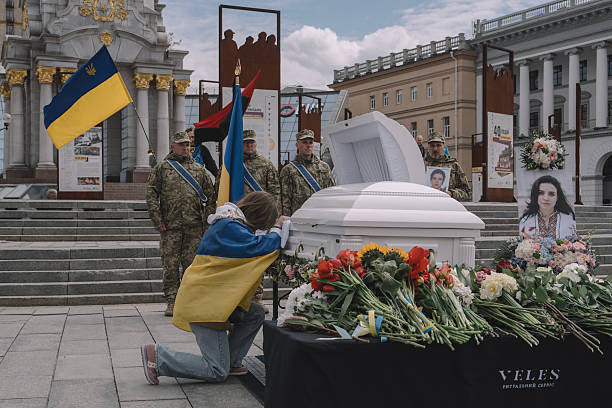
Relatives, friends, and other attendees mourn next to the coffin of Viktoria ‘Kvitka’ Bobrova, 32, callsign “Flower,” a Ukrainian producer and military press officer of the 10th Mountain Assault Brigade “Edelweiss,” who was killed in eastern Ukraine, during her funeral in Kyiv. (Andrew Kravchenko/Global Images Ukraine via Getty Images)
The Day’s Reckoning
The proposal came from the Kremlin through Dmitry Peskov: Putin would declare a unilateral ceasefire for May 9. It would apply to that day only. Putin did not need a Ukrainian response. He would do it regardless.
Zelensky’s answer was immediate and deliberate. Ukraine proposes a long-term ceasefire — reliable, guaranteed, verifiable. Not a few hours for a parade that has already been stripped of its tanks because Russia cannot afford to remove them from the front. A real ceasefire. Ukraine has asked its negotiators to contact Washington to clarify what exactly Moscow is proposing — “a few hours of security for a parade, or something more.”
The divergence is not incidental. Russia’s record on announced ceasefires includes more than 400 violations of the Easter truce within its first twelve hours. The May 9 proposal, in the pattern Ukraine has documented, serves one function: to create a brief window in which strikes against Moscow’s parade can be framed as Ukrainian aggression, before Russian drones resume their nightly routes to Ukrainian cities.
On the same day, Ukrainian drones reached the Lukoil oil refinery in Perm for the second night in a row. The AVT-4 primary crude processing unit — the heart of a refinery capable of handling millions of tons of oil annually — was hit and rendered inoperable. In the Black Sea, two FSB patrol boats guarding the Kerch Bridge were struck. On the Sea of Azov coast, a Russian drone development complex producing unmanned ground vehicles and electronic warfare equipment was destroyed. The stolen grain ship left Haifa empty. And the U.S. Secretary of Defense told Congress, under oath, that America had sent Ukraine $300 billion — a number that official U.S. government records show is roughly three times the actual figure.
Perm, Second Night: The Lukoil Refinery’s Processing Unit Is Rendered Inoperable
Ukraine’s Security Service reported on April 30 that Ukrainian forces struck Perm Krai for the second consecutive night, hitting two targets: the Transneft Perm Linear Production Dispatch Station — already struck on April 29 — for additional damage, and the AVT-4 primary crude processing unit of the Lukoil-Permnaftoorgsintez oil refinery. Geolocated footage published on April 30 showed fire and smoke at the AVT-4 unit. Perm Krai Governor Dmitry Makhonin acknowledged on April 30 that Ukrainian forces had struck industrial infrastructure in the region.
The AVT-4 is a primary crude oil processing unit — the initial stage in refining crude into usable fuel products. Rendering it inoperable means the Lukoil-Permneftorgsintez refinery cannot process incoming crude until the unit is repaired. The Transneft dispatch station, hit for the second time in 24 hours, sits at the junction of pipelines distributing oil in four directions across Russia’s interior, including to this same refinery. Two consecutive strikes against overlapping infrastructure in the same region are not coincidental — they are a methodical effort to compound damage and prevent rapid repair.
Russian opposition outlet Astra also reported on April 30, with footage, that Ukrainian forces struck the Sverdlov Plant in Dzerzhinsk, Nizhny Novgorod Oblast. Nizhny Novgorod Oblast Governor Gleb Nikitin acknowledged the strike. The Sverdlov Plant is a major Russian defense industrial facility involved in the production of explosives and propellants.
Separately, Planet Labs satellite imagery collected on April 21 and April 30 — published on April 30 — confirmed that the April 28 Ukrainian strike on the Tuapse Oil Refinery destroyed six fuel reservoirs and burned adjacent infrastructure. The imagery provides the clearest post-strike damage assessment yet: six reservoirs destroyed in a single night, on top of the 24 already destroyed in the April 19-20 strike.
Two FSB Patrol Boats Struck Near the Kerch Strait
The Ukrainian Navy reported on April 30 that it struck two Russian Federal Security Service Border Service patrol boats near the Kerch Strait: a Project 12150 Mangust-class patrol boat named Sobol, and a Project 21980 Grachonok-class patrol boat. Both vessels belong to the FSB Border Service — a paramilitary law enforcement force that operates patrol boats in Russian coastal waters — rather than the Russian Navy’s Black Sea Fleet. Their mission includes monitoring maritime traffic through the Kerch Strait, the narrow waterway connecting the Black Sea to the Sea of Azov that passes under the Kerch Bridge.
Striking patrol boats guarding the bridge serves two simultaneous purposes: it eliminates vessels that provide early warning and interdiction capability against Ukrainian naval drones approaching the strait, and it signals that the perimeter Russia has established around the Kerch Bridge is penetrable. Ukrainian naval drones have been steadily working through Russia’s layered defenses around the peninsula’s maritime approaches since 2022; the April 30 strike adds two more holes to that perimeter.
BARS-Sarmat Drone Complex Destroyed on the Azov Coast
Ukraine’s 413th “Raid” Regiment of the Unmanned Systems Forces reported on April 30, with footage, that Ukrainian forces struck facilities of the BARS-Sarmat Special Purpose Center — a Russian drone research, development, and production complex located on the Sea of Azov coast in occupied Zaporizhzhia Oblast. The center, established in 2024 as part of Russia’s Unmanned Systems Forces, develops drones, unmanned ground vehicles, and electronic warfare and command equipment. Multiple workshops that manufactured and equipped technology were confirmed damaged in the strike.
The BARS-Sarmat Center is not a frontline position — it is a facility where Russia designs and builds the weapons it then deploys against Ukraine. Destroying it upstream, before its products reach the battlefield, is a different kind of interdiction than hitting an ammunition depot: it degrades Russia’s capacity to innovate and scale new drone systems at the precise moment when the drone arms race is accelerating on both sides.
206 Drones, One Ballistic Missile, Four Killed, Sixty-Eight Wounded
Russian forces launched one Iskander-M ballistic missile from Rostov Oblast and 206 drones — approximately 140 of them Shahed-type, including jet-powered variants — against Ukraine overnight on April 29 to 30, from Bryansk, Oryol, Kursk, Smolensk Oblast, Rostov Oblast, Krasnodar Krai, and occupied Crimea. Ukrainian air defenses downed 172 drones. The ballistic missile and 32 drones struck 22 locations; debris fell on nine more. Power outages affected seven oblasts: Mykolaiv, Zaporizhzhia, Dnipropetrovsk, Kherson, Odesa, Sumy, and Kharkiv.
At least four people were killed and 68 others injured across Ukraine over the reporting period. In Dnipropetrovsk Oblast, a morning Russian strike on April 30 at approximately 10:45 a.m. killed one person and injured at least 15 in the Dniprovskyi district, destroying a bus and two passenger cars, damaging eight other vehicles, a store, and an apartment building. An earlier overnight strike in the oblast killed one more and injured others. In Donetsk Oblast, Russian strikes killed one person and injured two in Druzhkivka, and another was injured in Kramatorsk. In Odesa, at least 20 people were injured — including a minor — in drone strikes hitting apartment buildings, houses, a hotel, a kindergarten, an administrative building, and parking areas. In Kharkiv Oblast, nine people were injured across 25 settlements including the city. In Kherson Oblast, 12 people including a child were injured across 37 attacked settlements. In Zaporizhzhia Oblast, three were injured in Zaporizhzhia district; Russian forces launched 1,062 strikes across 39 settlements in the oblast. In Sumy Oblast, two men were injured; Russian forces carried out more than 60 attacks on 38 settlements. In Chernihiv Oblast, two men were injured; agricultural machinery at an educational institution was destroyed.
The Energy Ministry reported that one energy worker was injured in Sumy Oblast and a drone struck a vehicle carrying energy workers in Kharkiv Oblast. Emergency repair work began at all sites where security conditions permitted.
Zelensky Counters: Long-Term Ceasefire, Not a Parade Shield
President Zelensky responded on April 30 to Putin’s Victory Day ceasefire proposal — conveyed through Trump and confirmed by Kremlin spokesman Peskov — with a direct counter-proposal: Ukraine wants a long-term ceasefire, with reliable and guaranteed security for civilians, and a path to lasting peace. He instructed Ukrainian negotiators to contact the U.S. side to clarify what exactly Moscow is proposing.
“We will clarify what exactly this is about — a few hours of security for a parade in Moscow, or something more,” Zelensky said. “Our proposal is a long-term ceasefire, reliable and guaranteed security for people, and a lasting peace.” He added: “They want the parade to go smoothly for a few hours and then resume the attacks. We do not want any ceasefire to become a tactical deception on the part of the Russian Federation.”
Peskov confirmed on April 30 that Putin will declare the truce unilaterally for May 9 and does not require Ukraine’s agreement. The timing and duration of the truce remain unspecified. Ukraine has documented more than 400 Russian violations of the Easter ceasefire within its first twelve hours, including assault operations, drone strikes, and guided bomb attacks. Russia also stockpiled drones and missiles during the Easter truce and launched two large strike series within 48 hours of its end.
Zelensky also warned on April 30 that Russia may attempt to use ceasefire negotiations to extract sanctions relief — including SWIFT access for Russian banks — as part of a truce package. “I think that Russia can raise the issue of a ceasefire in exchange for lifting sanctions on certain enterprises,” he said in an interview with Bloomberg. “For Ukraine, this is all a big risk.”
Medvedev and Lavrov: The Kremlin States Its Terms After the Trump Call
The day after Putin’s call with Trump, two senior Russian officials used April 30 to deliver the Kremlin’s actual position — with less diplomatic camouflage than the Trump readout allowed. Dmitry Medvedev, speaking at a federal educational marathon in Moscow, declared that Russia is in a conflict with the West that is “a question of existence” and will not end “within a generation.” He labeled the United States as Russia’s main geopolitical rival. He rejected American mediation of Ukraine peace talks. He claimed Russia’s victory in Ukraine is inevitable and will allow Moscow to address its domestic economic, demographic, and social crises.
ISW’s assessment is direct: Medvedev’s statements are designed to make Putin’s false battlefield claims seem moderate by comparison, and to reinforce to the Russian population that the Kremlin’s justifications for the war are existential rather than territorial — making any negotiated compromise politically harder to sell at home.
Russian Foreign Minister Sergei Lavrov, on April 30, again stressed the need to address the so-called “root causes” of the war — Kremlin shorthand for Russia’s maximalist demands, including a neutral Ukraine permanently barred from NATO membership and stripped of its eastern territories — as a precondition for any long-term peace agreement. Lavrov has repeated this formulation multiple times in April 2026. It is not a diplomatic position. It is a refusal to negotiate on terms that any Ukrainian government could accept.
$400 Million Released; Hegseth Testifies With False Figures
U.S. Defense Secretary Pete Hegseth announced on April 29 that the Pentagon had released $400 million in previously authorized Ukraine Security Assistance Initiative funds — money Congress had already allocated in 2025 that had been sitting unused. The funds are used to purchase weapons for Ukraine from U.S. defense firms.
On April 30, Hegseth appeared before the House Armed Services Committee to defend a $1.5 trillion defense budget request for fiscal year 2027 — the largest in modern American history. During the hearing, he made three verifiably false claims about U.S. support for Ukraine.
On weapons accountability: Hegseth claimed the Biden administration sent weapons to Ukraine “without any accountability.” This is false. The U.S. ran an Enhanced End-Use Monitoring system with more than 400 personnel tracking high-value items by serial number. The system had documented gaps, but it existed and functioned.
On the total amount of weapons sent: Hegseth claimed the U.S. gave “hundreds of billions of dollars” of weapons to Ukraine. Official U.S. Defense Department records show approximately $66.9 billion in total military assistance as of late 2025. The independent Kiel Institute places the total at $75.3 billion. CSIS estimates $75.9 billion committed.
On total U.S. support: When asked by a congressman how much the U.S. had spent on Ukraine in total, Hegseth said “up to $300 billion.” Official U.S. State Department figures show total U.S. assistance — military and financial — at approximately $183-188 billion allocated, with $130-175 billion actually disbursed. The value of physical assistance that has actually reached Ukraine is estimated at $70-120 billion.
Hegseth also avoided directly answering a question about whether easing sanctions on Russia would allow Putin to fund his war, instead pivoting to discuss U.S. military capabilities. When pressed again, he answered: “We have the best energy team in the planet.”
Russia Confirmed Supporting Iran: The Chairman of the Joint Chiefs Speaks
General Dan Caine, Chairman of the U.S. Joint Chiefs of Staff, confirmed on April 30 before the Senate Armed Services Committee that Russia is actively supporting Iran in the ongoing U.S.-Israeli war. “There’s definitely some action there,” Caine told senators, adding that Russia has undertaken “actions and activities” but declining to specify details in an open hearing. Republican Senator Roger Wicker stated: “There is no doubt that Putin’s Russia is taking serious steps to undermine our efforts to achieve success in Iran.”
The confirmation from the Chairman of the Joint Chiefs is the highest-level official acknowledgment to date of Russia’s active assistance to Iran during the conflict that began in late February. Previous reporting indicated Russia supplied Iran with satellite imagery to target American and Israeli military assets in the Middle East. Ukraine has been saying this for months; Zelensky stated in April that Washington was overlooking credible evidence because it “trusts Putin.” The April 30 Senate hearing put that evidence on the public record.
The Panormitis Leaves Haifa Empty: Ukraine Claims a Diplomatic Victory
The Panama-flagged bulk carrier Panormitis — which Ukraine says was carrying 6,200 tons of stolen wheat and 19,000 tons of stolen barley looted from Russian-occupied Ukrainian territory — departed Haifa Bay on April 30 without unloading its cargo. The vessel was turned away after Israel’s Grain Importers Association rejected the cargo, and the Israeli importer Zenziper declined to accept it.
“The Russian supplier of the cargo will have to find an alternative destination to unload it,” the Israeli Grain Importers Association said. Ukrainian Foreign Minister Sybiha called it a “clear signal to all other vessels, captains, operators, insurers, and governments: do not buy stolen Ukrainian grain. Do not become part of this crime.”
Zelensky said on April 30 that Ukraine is “building a system to counter the shadow grain fleet,” coordinating sanctions with allies targeting both the shadow grain trade and oil exports. Between January and April, 25 vessels from the Russian grain fleet made 50 voyages from occupied Ukrainian ports, exporting over 850,000 tons of grain. The Prosecutor General’s Office confirmed it will continue monitoring the Panormitis and its cargo in any jurisdiction it enters.
Ukraine Ratifies International Claims Commission; European Parliament Endorses Both Justice Bodies
Ukraine’s Verkhovna Rada became the first country in the world to ratify the establishment of the International Claims Commission — the international body that will allow victims of Russia’s war of aggression to seek financial compensation — on April 30. On the same day, the European Parliament voted overwhelmingly to endorse EU participation in both the International Claims Commission and the Special Tribunal for the crime of aggression against Ukraine.
The tribunal, which prosecutes the specific crime of ordering an aggressive war — a category outside the ICC’s jurisdiction for non-Rome-Statute states — now has the 16 Council of Europe countries required to become operational. The Claims Commission requires 25 countries to ratify before it can function; Ukraine is now number one. Foreign ministers of all 46 Council of Europe member states are expected to advance both bodies at their May 15 meeting in Chisinau, Moldova.
Lithuanian MEP Petras Austrevicius, who pushed for the April 30 resolution, said the decisions “aim to send a very clear message: Russia and its allies responsible for terror and massive destruction in Ukraine must pay.” He also expects the Claims Commission to “reopen the debate on how best to utilize Russia’s frozen assets to fund war reparations” — and to require Russia to pay the €500 million it caused in damage to the Chornobyl protective shelter.
Syrskyi Orders Mandatory Rotation: No Soldier Beyond Two Months on the Line
Commander-in-Chief Oleksandr Syrskyi issued a formal order on April 30 requiring mandatory rotation of Ukrainian soldiers from front-line positions: commanders must ensure service members can remain in positions for up to two months, followed by a mandatory rotation within the next month. The order also requires immediate medical examinations upon rotation and continuous supply of essentials while in position.
The order is a direct response to findings that have accumulated publicly over recent weeks: the military ombudsman’s April 27 assessment that soldiers stop caring whether they survive after 40 days on the line; reports of the 14th Mechanized Brigade where soldiers were left emaciated without food and water; the Defense Ministry’s April 28 supply inspection order. Increasing drone saturation above front-line positions has made rotation movements progressively more dangerous — soldiers are walking more than 15 kilometers to and from positions, through terrain covered by enemy drones and mines.
Syrskyi did not specify additional measures to increase the overall pool of infantry replacements — the underlying shortage that makes the two-month standard difficult to enforce without more personnel to rotate in.
F-16 Mobile Simulators Delivered; 8,000 Octopus Interceptors Purchased
Ukraine’s Defense Ministry announced on April 30 that Ukrainian forces have received their first mobile F-16 flight simulators, adapted for Ukraine’s geography and operating conditions. Defense Minister Fedorov stated that mobile simulators allow rapid deployment, shortening the gap between training and combat use and improving the speed with which pilots can be trained to intercept Russian missiles and drones.
The Ministry also announced on April 30 the purchase of 8,000 Octopus interceptor drones — Ukrainian-made self-guided systems designed to destroy Shahed-type strike drones by collision. Ukraine began mass-producing Octopus drones in fall 2025. The current procurement contract involves 29 Ukrainian companies with relevant licenses partnering with the U.K. government in the production effort, with four manufacturers signed to state contracts. Fedorov described the project as an example of “rapid scaling” from combat-tested technology to serial production.

An image of Ukraine’s Octopus interceptor drones published by the Defense Ministry. (Defense Ministry)
CORPUS Coalition Launched: Finland, Italy, Norway, Sweden, UK Join Ukraine’s Procurement Alliance
Ukraine’s Defense Procurement Agency announced on April 30 the launch of CORPUS — the Coalition for Resilient Procurement and Unified Support — a joint procurement initiative with procurement agencies from Finland, Italy, Norway, Sweden, and the United Kingdom. The coalition initially focuses on information sharing between partner procurement bodies, with the possibility of expanding into joint procurement mechanisms.
The launch follows Zelensky’s April 28 statement that “exports of Ukrainian weapons will become a reality” and that all details have been agreed at the state level. Agency head Zhumadilov said at the April 30 signing: “We are starting with the exchange of experience and best practices to build coordination mechanisms, mutual trust, and plan for the future. This does not exclude that at later stages we may discuss, for example, joint procurement.” The CORPUS framework creates a formal institutional basis for coordinating Ukrainian defense procurement with European allies — a step toward integrating Ukraine’s defense industrial base into NATO-adjacent supply chains while the war continues.
Melania Trump Has Facilitated the Return of 26 Abducted Ukrainian Children
Ukraine’s Human Rights Ombudsman Dmytro Lubinets stated on April 30 at the Civil Society and Expert Day event in Kyiv that U.S. First Lady Melania Trump has become a key partner in negotiating the return of Ukrainian children abducted by Russia, facilitating the return of 26 children to date. Lubinets said Russia “can’t avoid” responding to Ukrainian requests when they are relayed through the First Lady, and that Ukraine holds weekly talks with her team on the issue.
The Bring Kids Back UA initiative has returned more than 2,100 children since 2023. Ukraine has identified 20,570 children taken by Russia; the actual number is estimated between 150,000 and 300,000. The ministerial-level meeting of the International Coalition for the Return of Ukrainian Children is scheduled for Brussels on May 11. The ICC issued arrest warrants for Putin and Russia’s Commissioner for Children’s Rights in March 2023 for the mass abduction.
Ukrainian Military Cemetery Law Passed; 15 Million Need Psychological Support
Ukraine’s Verkhovna Rada passed a law on April 30 creating regional sections of the National Military Memorial Cemetery — establishing standardized rules for the burial of the country’s war dead, following the example of Western countries after the World Wars. The national cemetery outside Kyiv, which opened in late 2025, has space for 6,000 graves in its initial phase and capacity for up to 100,000. Most Ukrainian soldiers are currently buried in their home communities without a standardized national war graves system.
The International Rescue Committee published an assessment on April 30 estimating that 15 million people in Ukraine now need psychological support. Based on more than 5,000 consultations, IRC found that 60% of those seeking help struggle with anxiety and one in five with depression. Approximately 80% of those identified as needing support are over 40. Women remain the majority of those seeking help; stigma continues to prevent many men from doing so. IRC mental health specialist Dr. Hazim Mostafa noted that the mental health burden has shifted from displaced populations to the entire national population: “People in Ukraine are no longer seeking one-off crisis assistance — they require long-term, specialized care.”
Leningrad Oblast Declares Itself a Front-Line Region; Ukraine’s GDP Forecast Cut
In a televised briefing on April 30, Leningrad Oblast Governor Alexander Drozdenko briefed Medvedev on the deteriorating situation at regional energy facilities following Ukrainian strikes. “Leningrad Oblast is now not only a border region but also a front-line region,” Drozdenko said, noting that Ukrainian strikes on fuel and energy facilities and port infrastructure in Ust-Luga and Primorsk have been intensifying since March. He stated that 343 drones were downed over the oblast in the first three months of 2026.
Ust-Luga and Primorsk are Russia’s primary oil export hubs on the Baltic Sea, handling tens of millions of tons of crude and petroleum products annually. Zelensky noted on April 29 that Ust-Luga is operating at 43% below capacity and Primorsk at 13% below capacity as a result of Ukrainian strikes — figures that a regional governor confirmed to Medvedev in a formal briefing on April 30.
Ukraine’s National Bank cut the country’s GDP growth forecast for 2026 to 1.3% on April 30, down from 1.8% projected in January, citing the impact of the Middle East energy crisis following U.S.-Israeli strikes on Iran driving global energy prices higher. The bank held its key interest rate at 15%, joining the U.S. Federal Reserve, Bank of England, Bank of Japan, and ECB in holding rates steady. Inflation rose to 7.9% in March, above expectations, and the bank signaled readiness to raise rates if prices spike further.
Press Freedom Index: Ukraine Overtakes the United States and Six EU Countries
Reporters Without Borders released its 2026 Press Freedom Index on April 30. Ukraine climbed seven places to 55th worldwide — overtaking the United States, which dropped seven places to 64th. Ukraine also ranked above six EU member states: Italy, Malta, Bulgaria, Hungary, Cyprus, and Greece. Moldova climbed four places to 31st, the highest score among EU candidate countries.
RSF attributed Ukraine’s improvement to its “dynamic media sector and the investigative work carried out by Ukrainian outlets to strengthen transparency in the country’s political life.” Ukraine’s ranking remains in the “problematic” category — press freedom is not fully protected — with the EU criticizing Ukraine for failing to abolish the wartime TV Marathon state broadcast channel. The United States’ seven-place drop was attributed to attacks on journalists doubling in 2025 and the White House censoring government data and pressuring independent media. Russia ranked 172nd — second-worst globally, and the world’s largest prison for foreign journalists, all of whom RSF notes are Ukrainian.
China Provides 90% of Russia’s Sanctioned Technology; Pro-Russian MEP Invites Colleagues to St. Petersburg
Bloomberg reported on April 30, citing sources familiar with the matter, that Russia is now sourcing more than 90% of sanctioned technologies through China — up from approximately 80% the previous year. The increase was driven by the EU’s crackdown on Russia’s previous sanctions-evasion routes through Central Asian and Gulf intermediaries. Chinese companies are providing geospatial intelligence data, satellite imagery of military targets, and drones to Russia, while reducing exports of drones to Ukraine and other countries. EU member states have remained reluctant to impose tougher secondary sanctions on China due to fears of economic retaliation from Beijing.
Separately, Luxembourg MEP Fernand Kartheiser — who has a history of contacts with Russian and Soviet intelligence dating to the 1980s and was expelled from the ECR parliamentary group in June 2025 after a trip to Russia — sent an email to European Parliament colleagues on April 30 inviting them to an in-person meeting with members of Russia’s State Duma on the margins of the St. Petersburg Economic Forum. Liberal MEP Petras Austrevicius described the invite as “a deplorable act of mediation” and “an example of Europe’s betrayal” of Ukraine. The European Parliament has had no institutional cooperation with the Duma since 2014; Kartheiser’s outreach is in his individual capacity.
Venice Biennale Jury Resigns; Umerov Corruption Scandal Escalates; Frontlines
The five-member jury of the Venice Art Biennale announced on April 30 that it would resign in protest, one week after stating it would not consider works from countries whose leaders face ICC arrest warrants — a measure covering both Russia and Israel. The jury’s resignation comes one day after the EU culture commissioner announced he would boycott the opening. The European Commission’s process to terminate its €2 million grant to the Biennale continues; the organizers have until mid-May to respond. Ukraine sanctioned five members of the Russian pavilion on April 10.
Ukraine’s Defense Ministry’s Public Anti-Corruption Council called on April 30 for President Zelensky to suspend Rustem Umerov — currently Secretary of the National Security and Defense Council and former Defense Minister — and to nationalize drone manufacturer Fire Point, following leaked recordings published by Ukrainska Pravda on April 28 allegedly showing Umerov allowing sanctioned businessman Tymur Mindich to influence defense contracts. Umerov’s spokesperson denied the accusations as based on “unverified public interpretations.” Fire Point’s co-founder described the report as a “discrediting” campaign. The Defense Ministry declined to comment. The President’s Office did not respond.
On the frontlines, Ukrainian forces recently advanced in the Slovyansk direction — geolocated footage shows positions south of Kolodyazi — and in the Kostyantynivka-Druzhkivka tactical area, including eastern Kostyantynivka. Russian forces continued offensive operations across all axes on April 30 but made no confirmed advances. In Kharkiv Oblast, Russian forces continued attempting to cross the Vovcha River in small boats and by swimming, without success. In Kupyansk, Russian pipeline infiltration missions continued with up to 70% casualty rates. Russian forces attempting assault operations in the Pokrovsk direction are conducting tens of assaults daily with heavy losses. A Ukrainian brigade commander in the Slovyansk direction reported Russian forces using African mercenaries and recycling previously wounded personnel due to manpower shortages.
The Weight of the Day
Putin proposed a ceasefire for a few hours on May 9. Zelensky proposed a real one. The gap between these two proposals is the gap between a state that needs a pause to protect a parade and a country that has been burying its dead in fields that are running out of room.
The Perm refinery’s main processing unit is inoperable. The Lukoil plant that processes millions of tons of crude oil will not be processing it tonight. The Panormitis is somewhere in the Mediterranean, heading west with 25,000 tons of stolen grain it could not unload. The FSB patrol boats that guarded the Kerch Bridge have been struck. The BARS-Sarmat drone design center on the Azov coast no longer has functioning workshops.
Sixty-eight people were injured across Ukraine overnight and into the morning. Four were killed. Fifteen million people in Ukraine need psychological support. A commander-in-chief ordered on April 30 that no soldier should remain on the front line for more than two months. The order exists because the reality is much worse than two months. The calendar turned. The war continues. Ukraine’s proposal is still on the table.
A Prayer for Ukraine
1. For the Four Killed on April 30 — and the Sixty-Eight Wounded
Lord, four people died on April 30 in Dnipropetrovsk Oblast and Donetsk Oblast under strikes timed to fall while the world was watching diplomatic proposals and parliamentary votes. We do not know their names yet. We know that in Dnipropetrovsk, the attack came at 10:45 in the morning — not overnight, not in the dark, but in a normal hour of a normal workday, when a bus was destroyed and cars were shattered and a store and apartment building were struck. Hold the four who died. Hold the 68 who were injured — the 15 in Odesa Oblast’s hospital, the nine in Kharkiv, the 12 in Kherson, the three in Zaporizhzhia. Each one is a person, not a number in a report.
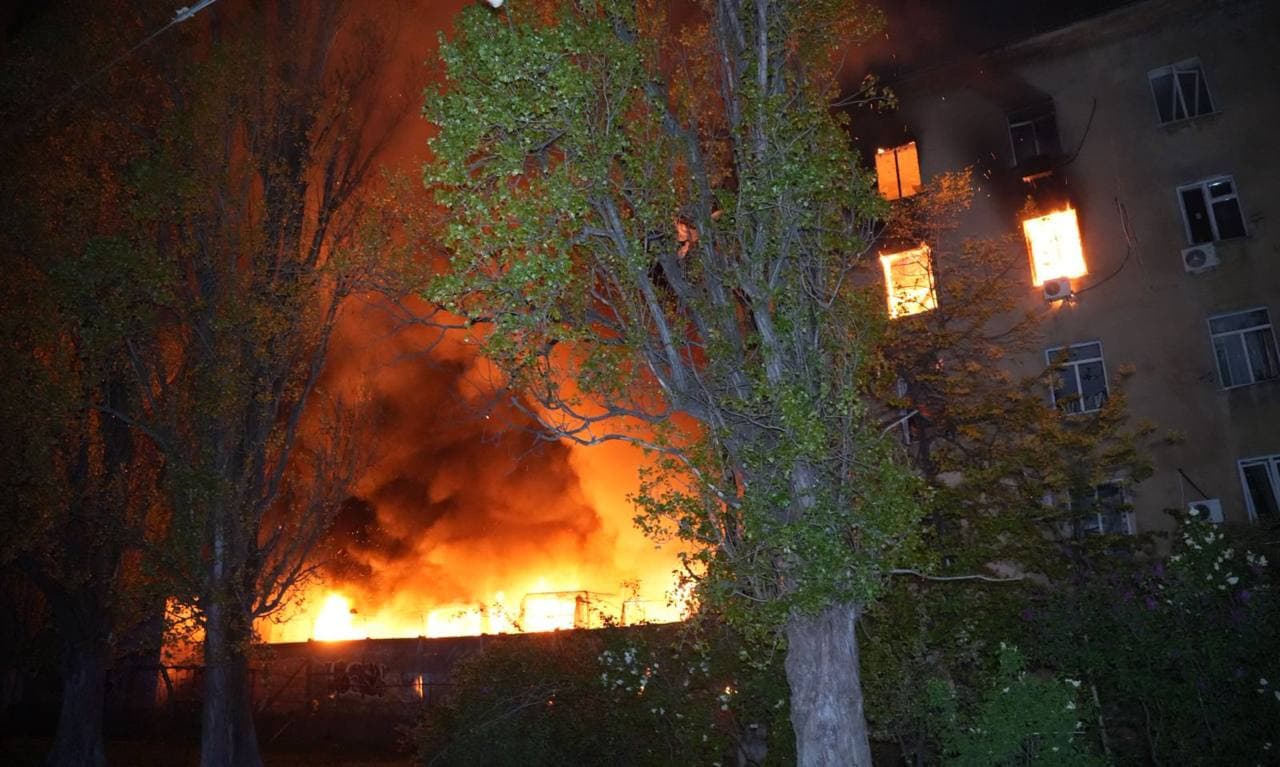
A residential building caught fire following a Russian mass overnight drone attack on Odesa. (Local authorities/Telegram)
2. For the Fifteen Million
Father, the International Rescue Committee said on April 30 that fifteen million people in Ukraine now need psychological support. Fifteen million. Sixty percent struggling with anxiety. One in five with depression. Eighty percent of them over forty. Elderly people, isolated and bereaved and unable to plan a future. Women who come because the stigma is lower. Men who do not come because the stigma is too high. We cannot hold fifteen million people in a single prayer without acknowledging that we are speaking of an entire nation’s interior life, ground down by the fifth year of a war that has no clear end. Be near each one of them. In the sleepless nights, in the grief that doesn’t announce itself, in the exhaustion of continuing. Be near.
3. For the Soldiers Waiting for Rotation
God of the exhausted, a Commander-in-Chief issued an order on April 30 that soldiers must rotate out of front-line positions after two months. He issued it because the reality is sometimes triple that. Soldiers are walking fifteen kilometers to their positions through drone-watched terrain. They are being supplied by boats and drones because the roads have been made impassable. They are living in positions where individual infantry assaults now come in intervals instead of groups, where Russian soldiers navigate by handwritten directions because GPS is jammed. Hold these people in their positions tonight. Move the military and political leadership to supply the replacements that make the rotation order real rather than aspirational.
4. For the 26 Children Returned — and the Hundreds of Thousands Not Yet Home
Lord, 26 children were returned because a First Lady wrote a letter and a country kept asking. Twenty-six. Ukraine has identified 20,570 taken by Russia, and estimates the true number at up to 300,000. The gap between 26 and 300,000 is the distance between what has been done and what must be done. We give thanks for the 26. We hold the hundreds of thousands whose files are still open, whose photographs are somewhere on platforms investigators are searching, whose connection to their own identity is being systematically severed. We ask not for patience. We ask for the legal mechanisms, the political will, and the diplomatic pressure to keep going until every child is accounted for.
5. For the April That Is Ending
God of time, April 2026 ends tonight. In this month: Odesa was struck on multiple nights. Perm was struck twice. Tuapse burned for sixteen days. The Kerch Bridge’s guards were hit. A drone advisor survived an assassination attempt from his hospital bed and kept writing analysis. A king stood before Congress. A drone flew 1,400 kilometers and reached the Urals. A stolen grain ship left a harbor empty-handed. A parliament ratified a claims commission for the first time in history. Four people died today; thousands died this month. The war is not ending tonight. But April is. In Your mercy, in Your justice, in Your time — bring this war to its end, and let the ending be worthy of what Ukraine has endured.