
Ukraine Daily Briefing | May 2, 2026 | Day 1,529 of the Full-Scale Invasion
Russian drones struck two public buses in Kherson city within hours of each other on May 2 — the first killed a municipal worker and a woman at 7:00 a.m., wounded seven others, and later two teenage boys were critically injured in a separate drone strike, doctors fighting for their lives — as a Russian drone crossed into Romanian airspace and F-16s were scrambled from Fetesti in the first confirmed NATO-airspace incursion since April 25. ISW confirmed on May 2 that Russia lost a net 116 square kilometers of controlled territory in April 2026 — the first net territorial loss since Ukraine’s Kursk incursion in August 2024 — while Ukraine struck two more shadow fleet tankers near Novorossiysk and Ukrainian forces confirmed that a months-long covert intelligence operation had destroyed 41 Chechen Akhmat soldiers and over 160 vehicles. And the United States warned its European allies that HIMARS and NASAMS missile deliveries will be significantly delayed — weapons already purchased and paid for — as Trump said troop withdrawals from Germany will go far beyond the 5,000 already announced, and Poland’s Prime Minister condemned the “disintegration” of NATO from within.
The Day’s Reckoning
The first bus was struck at 7:00 in the morning. Kherson’s trolleybuses were out of service for repairs, so 35 buses were running across 14 routes, filled with people going to work. A drone found one of them in the Dniprovskyi district. A municipal worker died. A woman died. Seven people were hospitalized with blast injuries — four of them also municipal workers. Hours later, a second drone struck another bus in the Central district, wounding the driver.
In the afternoon, a drone struck a residential area and critically injured two teenage boys — shrapnel wounds and traumatic brain injuries. A teenage girl was also hurt. Doctors were fighting for the boys’ lives. Zelensky called it a “brutal safari on people.” It was May 2, a Saturday, in a city that has been on the front line since Russia retreated from its right bank in late 2022.
In the Black Sea, Ukrainian naval drones struck two Russian shadow fleet tankers at the entrance to Novorossiysk port. In Kharkiv, Russian drones hit four gas stations in the afternoon, injuring six people, following an overnight strike on apartment blocks that injured three more. In Romania, a Russian drone crossed the border, F-16s were scrambled, and NATO’s easternmost frontier got a reminder that Ukrainian airspace and Romanian airspace share a river.
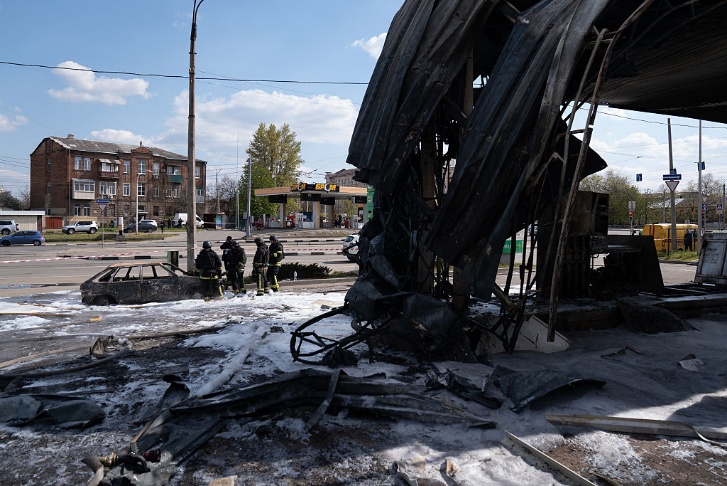
Firefighters work at the site of a Russian drone strike on a gas station in Kharkiv. (Yana Sliemzina/Gwara Media/Global Images Ukraine via Getty Images)
And ISW published its monthly assessment: Russia lost a net 116 square kilometers of controlled territory in April 2026. The first net loss since Ukraine’s August 2024 Kursk incursion. The Russian rate of advance — 9.76 square kilometers per day in the first four months of 2025 — fell to 2.9 square kilometers per day in the first four months of 2026. The offensive the Kremlin called inevitable is not advancing. It is, in April, receding.
Kherson’s Buses: A Municipal Worker, a Woman, Two Teenagers Fighting for Their Lives
The first drone struck at approximately 7:00 a.m. on May 2 in the Dniprovskyi district of Kherson city. Two people died at the scene: a male municipal employee and a woman whose identity was still being established by authorities. Seven other passengers — six men and one woman — were hospitalized with blast injuries. Four of the wounded were also municipal workers, riding to their shifts. The Kherson City Military Administration reported the casualties rose to ten total as the day progressed.
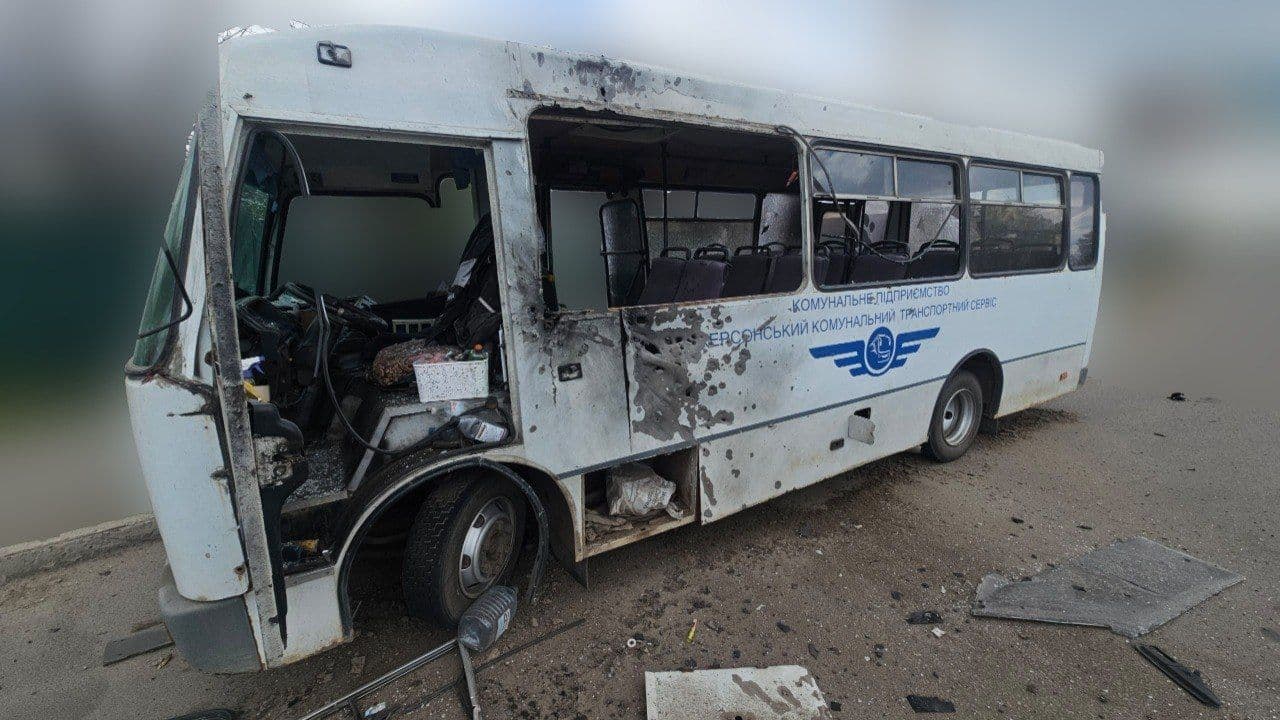
Aftermath of the second bus to be targeted by a Russian drone in Kherson. (Oleksandr Prokudin / Telegram)
Hours later, at approximately 10:40 a.m., a second Russian drone struck a bus in the city’s Central district. The driver sustained shrapnel wounds to his back and legs and was hospitalized. In the afternoon, a separate drone strike in Kherson critically injured two teenage boys with shrapnel wounds and traumatic brain injuries. A teenage girl was also injured in the same attack. Governor Prokudin said doctors were “fighting for their lives.”
Kherson Oblast reported that over the past day, Russian attacks killed at least two civilians and injured at least 10 others across the city and region, with additional artillery and drone strikes damaging private homes, high-rise buildings, educational facilities, medical facilities, and critical infrastructure. The region has been continuously attacked since Ukrainian forces liberated the right bank in November 2022. A Russian FPV drone targeting a civilian bus is not an error in targeting — it is the targeting.
Zelensky said on May 2: “All victims of the attack are civilians, and the Russians clearly understood this. In fact, such a brutal ‘safari’ on people is happening daily in our front-line and border communities.” He called for tighter international sanctions and noted that Russian operators tracked the buses using surveillance drones before striking — deliberate acquisition of civilian targets.
Two Shadow Fleet Tankers Struck at Novorossiysk
Ukrainian maritime drones struck two Russian oil tankers at the entrance to the Novorossiysk port on May 2, disabling both vessels. Novorossiysk is Russia’s primary crude oil export terminal on the Black Sea, handling tens of millions of tons of oil annually. The tankers were part of Russia’s shadow fleet — vessels used to export oil in defiance of Western sanctions, generating revenue that funds the war.
Zelensky confirmed the strikes in his May 2 evening address, saying Ukraine will continue expanding its long-range strike capabilities and building the system to counter both the shadow oil fleet and the shadow grain fleet. He thanked those working to restrict Russian sanctions-evasion schemes, noting that any weakening of pressure directly fuels the Russian war chest. The strikes follow Ukraine’s April 30 hit on the Marquise tanker 210 kilometers southeast of Tuapse — part of a sustained campaign to make Russia’s maritime oil export infrastructure operationally unreliable.
Russia Crosses Into Romania: F-16s Scrambled, NATO Airspace Violated
Romanian defense authorities confirmed on May 2 that a Russian drone briefly entered Romanian airspace overnight, during the same attack wave that struck the Izmail district across the Danube. Romanian radar systems tracked a group of approximately 20 drones moving toward the Izmail area from Russian-controlled directions. Two F-16 jets were scrambled from the 86th Airbase in Fetesti at approximately 02:00. Authorities issued RO-Alert notifications to residents in Tulcea county at 02:03, warning of potential falling debris.
The drone crossed into Romanian territory in the Kiliia area before continuing back toward Ukraine. Numerous explosions were reported on the Ukrainian side of the Danube before the air raid alert was lifted at 02:50. Romanian officials confirmed continuous contact with NATO structures to provide real-time updates. The incursion followed a similar event on April 25, when Russian drone debris damaged a farm building and an electrical pole in the Galati region.
Romania is a NATO member. Its airspace is Article 5 territory. Russian drones have now crossed into it on multiple occasions in 2026. Each incursion scrambles jets, issues civilian alerts, and requires NATO command consultations — costs that accumulate whether or not the drone was deliberately targeting Romania or simply drifting across the Danube as Ukrainian air defenses redirected its approach path.
163 Drones Overnight, 2 Killed, 40 Injured: The Night of May 1 to 2
Russian forces launched 163 Shahed, Gerbera, Italmas, and other drones overnight on May 1 to 2, from Kursk, Oryol, Millerovo in Rostov Oblast, Primorsko-Akhtarsk in Krasnodar Krai, and occupied Crimea. Ukrainian air defenses downed 142. Seventeen struck 12 locations; debris fell on two more. Russian forces also struck energy infrastructure in Mykolaiv Oblast, port infrastructure in Odesa Oblast, and residential and energy targets across Kharkiv, Dnipropetrovsk, Sumy, and Kherson oblasts.
Across all attacks on May 2, Russian forces killed at least two civilians and injured at least 40. In Kharkiv, daytime drone strikes on four gas stations injured six people — a 62-year-old man hospitalized with blast injuries, five others treated at the scene. An overnight strike on an apartment block in the city injured two men and a woman. An additional 16 people were injured across Kharkiv Oblast, including a teenage boy, in Russian attacks on civilian areas over the day. In Zaporizhzhia Oblast, Russian bombing destroyed several homes, killing one man and injuring two — including a seven-year-old girl. In Pavlohrad, Dnipropetrovsk Oblast, Russian forces struck an apartment building with drones and artillery, injuring three people in approximately 20 attacks on the region over the day. In Donetsk Oblast, Russian shelling injured one person; Ukraine evacuated 450 people including 84 children from the region. In Sumy Oblast, six people were wounded in a missile strike.
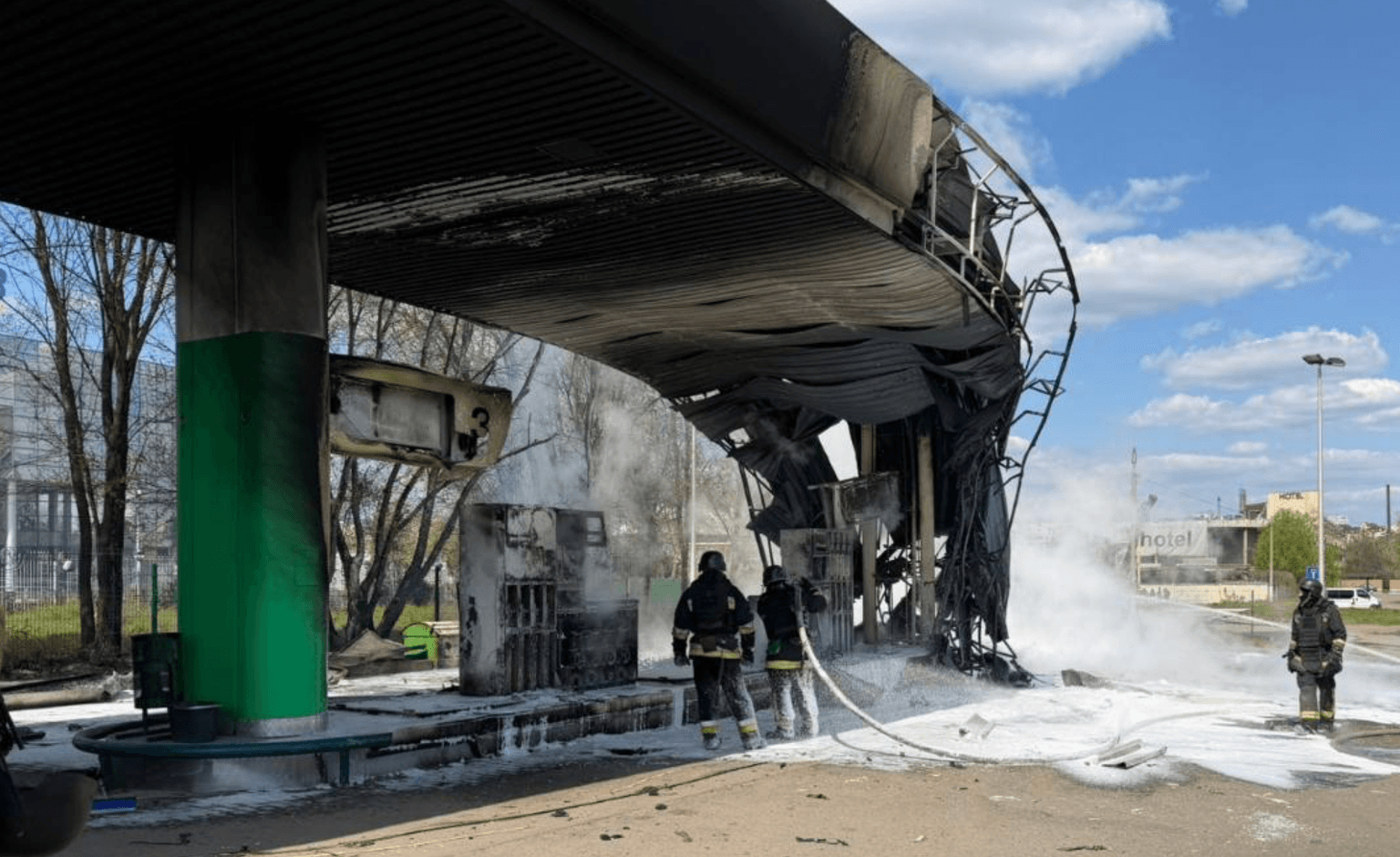
Consequnces of a Russian attack on a gas station in Kharkiv, Ukraine. (Oleh Synehubov / Telegram)
Zelensky reported on May 2 that over the previous week, Russian forces launched approximately 1,600 strike drones, around 1,100 guided aerial bombs, and three missiles against Ukraine. The Ukrainian Air Force published its April 2026 summary on May 2: Ukrainian forces destroyed over 57,000 Russian air targets in April, including 69 Kh-101 cruise missiles, 7 Iskander-M/KN-23 ballistic missiles, 8 Kalibr cruise missiles, 4,861 Shahed drones, 1,065 reconnaissance drones, and 51,110 other drone types.
April’s Verdict: Russia Lost Territory for the First Time Since Kursk
ISW published its April 2026 territorial assessment on May 2. The finding: Russian forces suffered a net loss of 116 square kilometers of controlled territory in April 2026 — the first net territorial loss since Ukraine’s incursion into Kursk Oblast in August 2024. Ukrainian ground counterattacks, mid-range strikes, and the February 2026 block on Russian use of Starlink terminals contributed to halting and reversing Russian advances across multiple axes.
The rate of Russian advances fell sharply year-on-year: from 9.76 square kilometers per day in the first four months of 2025 to 2.9 square kilometers per day in the first four months of 2026. In the six-month period from November 2025 to April 2026, Russian forces seized 1,443 square kilometers — compared to 2,368 square kilometers in the same period the previous year. Including infiltration areas, the total is 1,716 square kilometers seized or infiltrated — but ISW explicitly notes that infiltration areas are not controlled terrain, and that Russian forces use infiltration tactics specifically to exaggerate advances for Kremlin cognitive warfare purposes.
ISW also noted that the seasonal rasputitsa — the spring mud period when melting frozen ground degrades conditions for mechanized movement — may account for part of the April slowdown, and that Russian forces have historically increased their advance rates in May and June as ground dries. Whether that seasonal pattern will repeat in 2026, given the structural degradation of Russian military capacity, remains to be seen.
The Akhmat Intelligence Operation: 41 Killed, 87 Wounded, 160 Vehicles Destroyed
Ukraine’s Main Military Intelligence Directorate published the details on May 1 of an intelligence operation that had been running since February 2026: Ukrainian forces cooperated with an Akhmat servicemember who installed a listening device in the Chechen unit’s meeting room in the Sumy direction. Over the following months, intelligence gathered from that device provided targeting information for a sustained strike campaign against the unit.
The results, confirmed by GUR on May 2: 41 Akhmat soldiers killed, 87 wounded, and over 160 armored and motor vehicles destroyed, along with more than 25 drones, communications systems, electronic warfare equipment, engineering machinery, weapons, and fuel depots. Geolocated footage confirmed a strike against an Akhmat concentration point in southern Nekislitsa, Bryansk Oblast — along the international border northwest of Sumy City.
The operation is significant beyond its immediate tactical results. Akhmat units — Chechen forces under Ramzan Kadyrov’s command — have been deployed to the Sumy direction as part of Russia’s effort to establish a buffer zone along the border. The ability of Ukrainian intelligence to insert a source inside the unit’s command structure, maintain access for months, and feed targeting data directly to strike teams reflects an intelligence penetration capability that extends well beyond drone surveillance.
Frontlines on May 2: Crimea Struck Again, Ukrainian Advances Confirmed
The Ukrainian General Staff reported on May 2 a series of overnight strikes on Russian military assets in occupied Crimea: a Russian Iskander ballistic missile system tactical group deployment point near Druzhne (222 kilometers from the front line); a Mys-M1 coastal radar station near Mayak (135 kilometers); and a Podlyot radar station near Yevpatoriya (167 kilometers). The General Staff also confirmed that the April 29 strike on the Kacha airfield destroyed an ammunition depot there. In occupied Kherson Oblast, Ukrainian forces struck a Russian ammunition depot near occupied Ivanivka (73 kilometers from the front line). In occupied Luhansk Oblast, Ukrainian forces struck a Russian repair unit near occupied Kadiivka (57 kilometers from the front line).
Geolocated footage published on May 2 confirmed Ukrainian forces hold positions in southern Rodynske, north of Pokrovsk — indicating that previous assessments of Russian presence in the settlement were the result of infiltration missions rather than seizures. Ukrainian forces recently advanced in southern Dovha Balka, southwest of Kostyantynivka. In western Zaporizhzhia Oblast, geolocated footage shows Russian forces striking Ukrainian positions south of Stepnohirsk, northwest of Orikhiv — indicating Russian forces have advanced into the area. Russian forces marginally advanced in western Rodynske and in northwestern Novoserhiivka, northeast of Novopavlivka.
Russian forces continued offensive operations across all axes on May 2 but made no confirmed net advances. The Russian MoD claimed on May 2 the seizure of Myropillya, northwest of Sumy City, after fighting throughout April — Russian milbloggers noted separately that Russian forces do not hold a firm presence in Mala Korchakivka or Korchakivka despite the April 30 MoD claim of seizure. In the Kupyansk direction, Russian forces continue pipeline infiltration missions and maintain encircled personnel inside Kupyansk city who are disguising themselves as civilians. In the Hulyaipole direction, Ukrainian forces observed Russian drone operators and rear support personnel being committed to infantry assaults due to personnel shortages — commanders satisfying exaggerated advance claims to command.
Commander-in-Chief Syrskyi reported on May 2 that Russian forces intensified activity in the Kostyantynivka-Druzhkivka tactical area in April 2026, conducting 83 attacks in the Kostyantynivka direction in the last week alone. In the Kherson direction, Russian forces struck a minibus with an FPV drone in the Dnipro River Delta area — described by ISW as part of pervasive “human safari” tactics deliberately targeting civilians.
US Warns Allies: HIMARS and NASAMS Deliveries Will Be Delayed
The United States has informed the United Kingdom, Poland, Lithuania, and Estonia that weapons deliveries — including munitions for HIMARS multiple rocket launchers and NASAMS air defense systems — will be significantly delayed, the Financial Times reported on May 2, citing multiple sources. The delays are the result of U.S. weapons stocks being drawn down in the U.S.-Israeli war against Iran, which began in February. Two sources told the FT the delays may also affect weapons deliveries to Asia.
The weapons in question were purchased by European countries under the PURL agreement — the U.S. sells arms to European allies, who then supply them to Ukraine. HIMARS is used to strike Russian positions and logistics hubs 70-80 kilometers behind the front line. NASAMS is a medium-range air defense system Ukraine uses to intercept cruise missiles and drones over cities. Ukraine is already running critically low on air defense interceptors after 57,000 Russian aerial attacks in April alone. Delays in NASAMS replenishment directly affect how many Russian missiles and drones reach Ukrainian cities.
Bohdan Popov of Ukrainian defense advisory firm Triada Trade Partners told the Kyiv Independent: “Washington delaying delivery of HIMARS and NASAMS — systems that European allies have already paid for under Foreign Military Sales contracts — marks a fundamental shift in how the United States now functions in the alliance architecture. The reliable senior partner is being replaced by a transactional player that reallocates contracted shipments according to current operational priorities.”
Trump dismissed shortage concerns: “We have inventories all over the world. We can take that if we need it.” An anonymous Ukrainian official confirmed to the FT that the Iran war has caused some weapons delays to Ukraine. On April 21, CSIS reported that the United States had burned through more than half its stockpiles of key air defense missiles — Patriots and THAAD — in under two months of the Iran war.
Trump: Troop Withdrawals From Germany Will Go “Way Down” Beyond 5,000
Speaking outside Air Force One on May 2, Trump said the U.S. withdrawal of troops from Germany will go far beyond the 5,000 announced on May 1. “We’re going to cut way down, and we’re cutting a lot further than 5,000,” Trump said, without providing a number or timeline. The announcement followed Trump’s stated disappointment that European allies did not assist with the Iran war, calling it “a European problem as much as anybody’s.”
Polish Prime Minister Donald Tusk responded directly on May 2: “The greatest threat to the transatlantic community are not its external enemies, but the ongoing disintegration of our alliance. We must all do what it takes to reverse this disastrous trend.” In an April 1 interview, Trump had said he is “beyond reconsidering” U.S. membership in NATO and that he “was never swayed by NATO.”
The withdrawal announcement, combined with the weapons delivery delays, the 25% EU car tariff announced May 1, and the HIMARS/NASAMS delay notification, forms a coherent picture for European defense planners: American military guarantees that formed the basis of NATO planning since 1949 are now subject to unilateral revision by a transactional White House. European defense spending decisions, production line investments, and procurement strategies are being remade in real time around that reality.
Zelensky Invites Fico to Kyiv; Sanctions His Former Chief of Staff
Zelensky called Slovak Prime Minister Robert Fico on May 2 and invited him to Kyiv — one week before Fico’s planned trip to Moscow for the May 9 Victory Day parade. The call was substantively warmer than the two leaders’ relationship has typically been: Zelensky thanked Fico for supporting Ukraine’s EU accession bid, Fico said no peace agreement is possible without Ukrainian consent, and both agreed to meet briefly in Yerevan on May 4 at the European Political Community summit before arranging capital visits. It was the first positive Ukraine-Slovakia diplomatic exchange in months, following a winter standoff over the Druzhba pipeline.
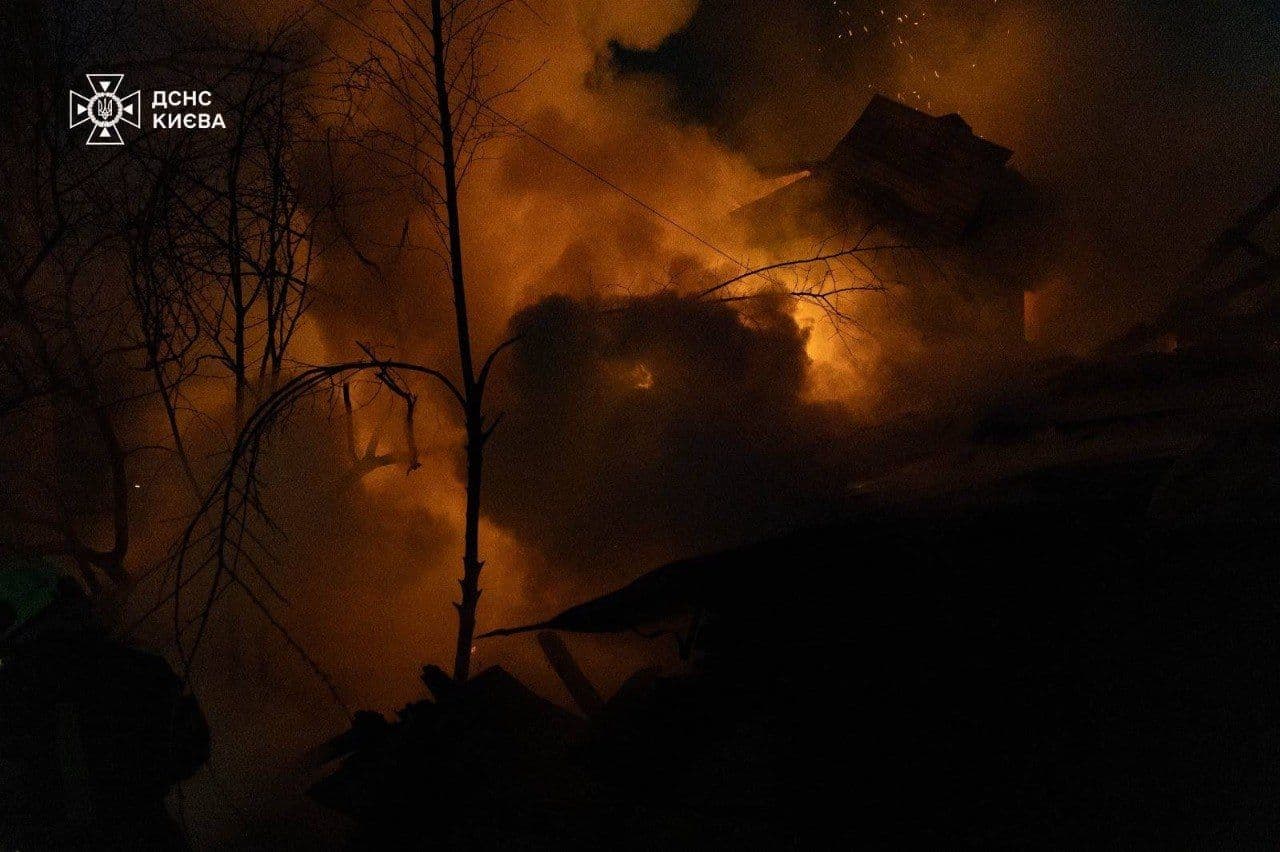
A fire burns in the aftermath of a Russian drone attack against Kyiv late. (State Emergency Service/Telegram)
On the same day, Zelensky signed a sanctions decree imposing asset freezes, travel restrictions, and license terminations against five individuals — including Andriy Bohdan, his former Presidential Office chief from 2019 to 2020. The decree did not specify the grounds for sanctions against Bohdan, citing only “threats to national interests, security, sovereignty, and territorial integrity.” Legal observers noted that Ukrainian sanctions law permits sanctions only against non-Ukrainian citizens or those involved in terrorism — Bohdan is a Ukrainian citizen. The other four sanctioned individuals include Russian Olympic Committee President Stanislav Pozdnyakov and Russian Wrestling Federation President Mikhail Mamiashvili.
The Bohdan sanctions arrive amid ongoing scrutiny of Zelensky’s circle following the Mindich corruption tapes published April 28, which appear to show then-Defense Minister Rustem Umerov allowing sanctioned businessman Tymur Mindich to influence defense contracts. The President’s Office has not commented on the tapes. Neither Umerov nor former Presidential Office head Yermak — both under investigation for corruption — have been charged as of May 2.
Belarus Border Activity; Peru Opens Human Trafficking Investigation
Zelensky reported on May 2 that “specific activity” was recorded on the Belarusian side of the Ukraine-Belarus border. He said Ukrainian forces are carefully documenting and controlling the situation, and warned that Ukraine is prepared to react to any attempts to draw Belarusian forces into aggressive actions against Ukrainian sovereignty. He announced that Ukraine is preparing new sanctions packages to be implemented immediately and in the near future, and said he expects “weighty results” from high-level talks scheduled for May.
Peru’s Specialized Prosecutor’s Office for Human Trafficking Crimes announced on May 2 the opening of a formal investigation into a network that allegedly recruited Peruvian citizens for Russia’s war against Ukraine under false pretenses. Recruits were reportedly offered well-paid security or general employment in Russia, with monthly salaries of $2,000 to $3,000. Upon arrival, many were allegedly coerced into combat operations. Approximately 600 Peruvians may have departed for Russia since October 2025; at least 13 are confirmed dead. The Peruvian Ministry of Foreign Affairs has requested information from the Russian Embassy, which acknowledged some Peruvians signed military contracts but characterized the enlistment as voluntary. The State Department has separately estimated 1,000 to 5,000 Cuban nationals currently serve in Russian armed forces.
Mariupol Port: 60,000 Tons of Stolen Grain, Kremlin Plans Capacity Expansion to 2040
The Mariupol City Council reported on May 2 that eight cargo ships have departed the occupied port of Mariupol with grain shipments since January 2026, exporting nearly 60,000 tons of stolen Ukrainian wheat. Russian occupational authorities are also using the port to export stolen metal and other cargo. Local officials described Mariupol port as “transformed into a tool for plundering occupied territories and a vital element of Russian military logistics.”
The Kremlin has reportedly developed a development strategy for the seized port through 2040, aiming to increase vessel lifting capacity from the current 3,000–10,000 tons to 25,000 tons — a threefold increase designed to solidify Mariupol as a primary logistics hub for Russia’s operations in occupied Ukraine. The announcement comes as Ukraine counts that over 850,000 tons of stolen grain worth tens of millions of dollars were exported from occupied ports in the first four months of 2026 alone.
Russian Air Campaign: Glide Bomb Problems Acknowledged by Moscow’s Own Milbloggers
Russian military bloggers affiliated with the Russian Aerospace Forces acknowledged on May 1 to 2 that the VKS faces structural constraints preventing it from increasing its glide bomb strike rate. An Su-34 carrying a new mixed load of six bombs per sortie — combining UMPKs and UMPBs — would theoretically allow Russia to increase monthly glide bomb strikes from 10,000 to 15,000–16,000. But the same milbloggers noted that Russian forces lack sufficient aircraft, are running short of maintenance personnel, have sent trained engineers to infantry units, and are using aviation specialists to guard airfields.
A Kremlin-affiliated milblogger added that even if bombing capacity increased, Russian forces are misusing what they have — switching target sets without completing objectives, and wasting guided munitions on “basements housing single infantrymen.” The self-criticism from inside Russia’s own military analyst community on May 2 is consistent with ISW’s April territorial assessment: the offensive is underperforming not only because Ukraine is defending effectively, but because Russia’s own command and logistics are degrading the performance of assets it possesses.
The Weight of the Day
A woman died on a bus at 7:00 a.m. A municipal worker died on the same bus. Seven others were hospitalized. Hours later, another bus. Then two teenage boys with traumatic brain injuries, doctors fighting for their lives. A Ukrainian president called it a safari. He was right.
ISW said Russia lost ground in April — net, for the first time since Kursk. The Kremlin’s narrative of inevitable advance does not match the maps. The rate of Russian daily seizures fell from 9.76 square kilometers to 2.9. Infiltration tactics — soldiers creeping through pipelines, through forests, pretending to have seized towns they have not seized — are how Russia disguises the failure of its offensive.
Washington told London, Warsaw, Tallinn, and Vilnius that the weapons they paid for will arrive late. Trump said the troop withdrawals from Germany will go way beyond 5,000. A Polish prime minister said the alliance is disintegrating from within. A drone crossed into Romania. F-16s scrambled. The fire in Tuapse was declared extinguished four days ago.
A Prayer for Ukraine
1. For the Woman and the Municipal Worker Who Died on the Bus
Lord, they were on their way somewhere. A woman. A man doing his job keeping a city running. The bus was full — 35 buses on 14 routes because the trolleybuses were down for repairs, and the city needed to move. A drone found the bus at 7:00 on a Saturday morning. Receive them with the fullness of your mercy, both of them, the ones whose names we do not yet have. And hold the seven who were hospitalized, the four municipal workers among them who were on their way to their shifts.
2. For the Two Teenage Boys Fighting for Their Lives
Father, two boys are in hospital tonight with traumatic brain injuries and shrapnel wounds. Doctors are fighting for their lives. We do not know their names, how old they are, what they were doing when the drone found their street. We know they are teenagers in a city on a front line, and that they may not survive the day we are praying for. Be with them in the hospitals. Be with the doctors who have been fighting for people in Kherson since 2022. Be with the families waiting in corridors. And be with the teenage girl who was also injured — whose name is also not in the headlines.
3. For the People in Romania’s Tulcea County — the Civilians Who Were Not in the War
God of borders and those who live beside them, Romanian civilians in Tulcea county received an alert at 02:03 on May 2 warning of potential falling objects. They live across the Danube from a war they did not choose to be near. They can hear the explosions on a clear night. A Russian drone crossed their airspace. F-16s flew over their homes before dawn. This is what proximity to Russia’s war does to people who are not participants in it. Hold the people of Tulcea and the Danube delta — the farmers and fishermen and families on the NATO side of the river who are learning that the side of a river is not the same as safety.
4. For the People of Kherson — Still There After All of It
Lord, Kherson was liberated in November 2022. It has been under daily attack since. The buildings are damaged. The trolleybuses are down for repairs. The buses that replaced them got hit. A drone struck a hospital here in April. Another struck a post office. People are still in this city — living, working for the municipality, riding buses to their Saturday shifts — because leaving a city is not always possible, and because staying in a city you love is not a failure of judgment. It is an act of belonging. Hold the people of Kherson who have stayed. They have been holding the city with their presence for over two years.
5. For the Alliance That Is Being Asked to Hold
God of nations, on May 2 a Polish prime minister said the greatest threat to the transatlantic alliance is not its external enemies but the disintegration from within. He said it publicly, in direct response to an American president saying withdrawals from Germany will go way beyond 5,000. Weapons that have been purchased and paid for will not arrive on time. The architecture that has kept Europe free of major war since 1945 is being renegotiated by a single executive who said he was never swayed by it. We do not ask you to fix alliances — that is human work. We ask that the people doing that work find the clarity, the courage, and the coalition to do what this moment requires. In Your mercy, in Your justice, in Your time — bring this war to its end, and let the ending be worthy of what Ukraine has endured.