
Ukraine Daily Briefing | May 3, 2026 | Day 1,530 of the Full-Scale Invasion
Ukrainian forces struck a Karakurt-class missile warship, a patrol boat, a shadow fleet tanker, and oil-loading port infrastructure at Primorsk in Leningrad Oblast on the night of May 2 to 3 — the deepest confirmed simultaneous naval and port strike of the war, 1,000 kilometers from Ukraine’s border — while separately striking two more shadow fleet tankers near Novorossiysk, destroying 70% of the Perm oil dispatch station confirmed by satellite, and advancing northwest of Orikhiv in Zaporizhzhia. Russia answered with 268 drones and a ballistic missile that killed ten Ukrainians — two in Odesa, two in Donetsk Oblast, two in Zaporizhzhia, two in Kherson, one in Sumy, one in Dnipropetrovsk — and struck a bus carrying 40 children near Krynychky, a police car in Bilopillia, and a university dormitory in Dnipro. On the same day, an unidentified drone violated Finnish airspace for the fifth time, Latvia and Estonia issued civilian alerts, Sweden seized its fifth shadow fleet vessel in the Baltic, and Zelensky flew to Yerevan for the European Political Community summit — his first visit to Armenia since taking office.
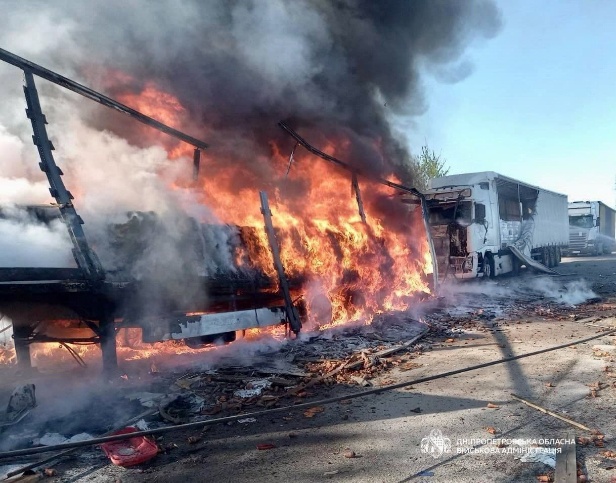
The aftermath of a Russian attack on Dnipropetrovsk Oblast, Ukraine. (Dnipropetrovsk Oblast Military Administration)
The Day’s Reckoning
The Karakurt-class ship was armed. Ukrainian Special Operations Forces confirmed it was carrying a launcher and eight Kalibr cruise missiles — each with a range of up to 2,000 kilometers, capable of reaching any Ukrainian city from the Baltic Sea — and a Pantsir-M naval air defense system. It was in the port of Primorsk in Leningrad Oblast, 1,000 kilometers north of Ukraine’s border. On the night of May 2 to 3, Ukrainian drones found it.
Along with the warship, a patrol boat and a shadow fleet tanker were struck in the same operation. The oil-loading infrastructure at Primorsk port — one of Russia’s primary Baltic crude export terminals — sustained significant damage. Heat anomalies at the site were visible in NASA satellite data. Leningrad Oblast Governor Drozdenko acknowledged fires near the port on May 3, claiming 60-plus drones had been downed. The SBU’s acting head briefed Zelensky directly on the strike’s results.
The Primorsk strike arrived on the same day Zelensky confirmed that Ukrainian naval drones had struck two more shadow fleet tankers at the entrance to Novorossiysk on the Black Sea — and that satellite imagery had confirmed the Perm Linear Production Dispatch Station burns across 70% of its territory, all tanks of 50,000-cubic-meter capacity destroyed, operations halted for an unspecified period.
Across Ukraine on May 3, ten people died. A man was killed in his car in Kherson by a drone while a 63-year-old woman and three other men nearby sustained injuries. Two people died in Odesa from strikes on residential buildings and port infrastructure. Two died in Donetsk Oblast. Two in Zaporizhzhia. One in Sumy. One in Dnipropetrovsk Oblast. A bus of 40 children was struck near Krynychky — the children had evacuated moments before impact; a 10-year-old boy was injured. A police car in Bilopillia was destroyed by an FPV drone; one officer is in critical condition.
By evening, Zelensky was in Yerevan. Europe’s leaders were gathering. The summit’s agenda: ending the wars in Ukraine and Iran. The day’s results were still being counted.
Primorsk: A Kalibr-Armed Warship, a Port, and the 1,000-Kilometer Strike
Ukraine’s Security Service acting head Yevhen Khmara briefed President Zelensky on May 3 on the results of the overnight operation against the port of Primorsk, Leningrad Oblast. The targets struck: a Karakurt-class small missile ship, a Russian FSB patrol boat, a shadow fleet oil tanker, and the port’s oil-loading infrastructure. The SBU confirmed the operation; NASA FIRMS thermal data showed heat anomalies at the port on May 3. Leningrad Oblast Governor Drozdenko acknowledged fires near Primorsk while claiming Russian air defenses had downed over 60 drones overnight.
The Karakurt-class ship is a significant target in its own right. At the time of the strike, Ukrainian Special Operations Forces confirmed it was equipped with a launcher and eight Kalibr cruise missiles — subsonic precision-strike weapons with a range of up to 2,000 kilometers, capable of reaching any point in Ukraine from the Baltic Sea — and a Pantsir-M naval air defense system. Destroying or disabling a Karakurt-class ship armed with eight Kalibrs eliminates a salvo that could have killed dozens of people anywhere in Ukraine. Zelensky called it a meaningful limitation of Russia’s war potential.
Primorsk is one of Russia’s two primary oil export terminals on the Baltic Sea — the other is Ust-Luga, also repeatedly struck. Together they handle a substantial share of Russia’s crude oil exports to European and Asian markets. Zelensky reported on May 3 that significant damage was caused to the port’s oil-loading infrastructure. Ukraine has been methodically targeting both terminals since March 2026; Zelensky previously reported Primorsk operating at 13% below capacity and Ust-Luga at 43% below capacity. May 3’s strikes add to that degradation.
ISW assessed that Ukrainian forces have been steadily increasing the range, volume, and intensity of long-range strikes since mid-March 2026, heavily targeting port and oil infrastructure in Leningrad Oblast and Krasnodar Krai. Ukrainian domestic drone production has enabled the intensification. Continued strikes are degrading Russia’s ability to store and transport oil and impacting export revenues — which may partially offset elevated Russian revenues from global oil price spikes driven by the Iran war.
Perm: 70% Burned, All Large Tanks Destroyed, Operations Halted
Planet Labs satellite imagery captured on May 3 provided the clearest battle damage assessment yet of Ukraine’s strikes on the Transneft Perm Linear Production Dispatch Station in Perm Krai. The imagery shows that the April 28 to 29 and April 30 to May 1 Ukrainian strikes burned roughly 70% of the station, destroyed all tanks with 50,000 cubic meter capacity at the facility, and halted operations for an unspecified period. The station sits at the junction of four oil pipeline directions across Russia’s interior, including to the Lukoil-Permneftorgsintez refinery, whose primary AVT-4 processing unit was also struck and rendered inoperable on April 30.
Three nights of consecutive strikes against overlapping infrastructure — the dispatch station, the refinery, and the station again — have produced a result visible from orbit: a facility that once distributed crude oil in four directions across Russia’s interior is now 70% ash and debris, its large storage tanks destroyed, its pipeline operations at a standstill. The satellite confirmation on May 3 closes the loop on a week of strikes that ISW assessed as part of at least 18 oil infrastructure attacks across 19 Russian federal subjects in April alone.
Novorossiysk: Two More Shadow Fleet Tankers Struck
Zelensky confirmed on May 3 that Ukrainian naval drones struck two Russian shadow fleet tankers at the entrance to Novorossiysk port — Russia’s primary crude oil export terminal on the Black Sea — disabling both vessels. Zelensky published footage of a maritime drone approaching a tanker. He thanked General Staff Chief Andrii Hnatov, SBU counterintelligence officers, and the Ukrainian Navy for the operation. “These tankers were actively used to transport oil. Now they won’t be,” he said.
The Novorossiysk strikes follow the May 2 hits on two shadow fleet tankers at the same port, and the April 30 strike on the Marquise tanker 210 kilometers southeast of Tuapse. In a single week, Ukraine has disabled or damaged at least five shadow fleet vessels across two ports, while simultaneously striking the port infrastructure of a third — Primorsk on the Baltic. The shadow fleet — which Russia assembled after 2022 to bypass Western sanctions on oil exports — is being systematically removed from operational service.
Sweden Seizes the Jin Hui: Fifth Shadow Fleet Intervention in Baltic Waters
Swedish Coast Guard and Police boarded and seized the tanker Jin Hui in the Baltic Sea south of Trelleborg on May 3. Swedish Prime Minister Ulf Kristersson confirmed it was the fifth such intervention in recent months. “The vessel is suspected of being part of the Russian shadow fleet and for sailing under false flag. The vessel is included on the sanctions lists of the EU, the UK, and Ukraine. We protect our waters,” Kristersson wrote.
Coast Guard Deputy Chief of Operations Daniel Stenling noted that ships with suspected seaworthiness deficiencies continue to transit Swedish waters: “This is not acceptable. We have intervened before, now we are intervening again.” Previous Swedish seizures include the Caffa and Sea Owl. France, Germany, and Italy have taken similar actions against Russian-linked vessels in recent months. The Jin Hui seizure on May 3 arrives while Ukraine simultaneously strikes shadow fleet vessels at Primorsk and Novorossiysk — a coordinated, multi-front campaign closing the maritime corridor that Russia uses to fund its war.
268 Drones, One Ballistic Missile, Ten Killed, 76 Wounded
Russian forces launched one Iskander-M ballistic missile from Kursk Oblast and 268 Shahed, Gerbera, Italmas, and other drones — roughly 160 of them Shahed-type — overnight on May 2 to 3, from Kursk, Oryol, Shatalovo in Smolensk Oblast, Primorsko-Akhtarsk in Krasnodar Krai, and occupied Crimea. Ukrainian air defenses downed the ballistic missile and 249 drones. Nineteen struck 15 locations; debris fell on one more. Russian forces damaged residential buildings, transportation infrastructure, and civilian infrastructure in Dnipropetrovsk, Kharkiv, Mykolaiv, Odesa, Sumy, and Zaporizhzhia oblasts.
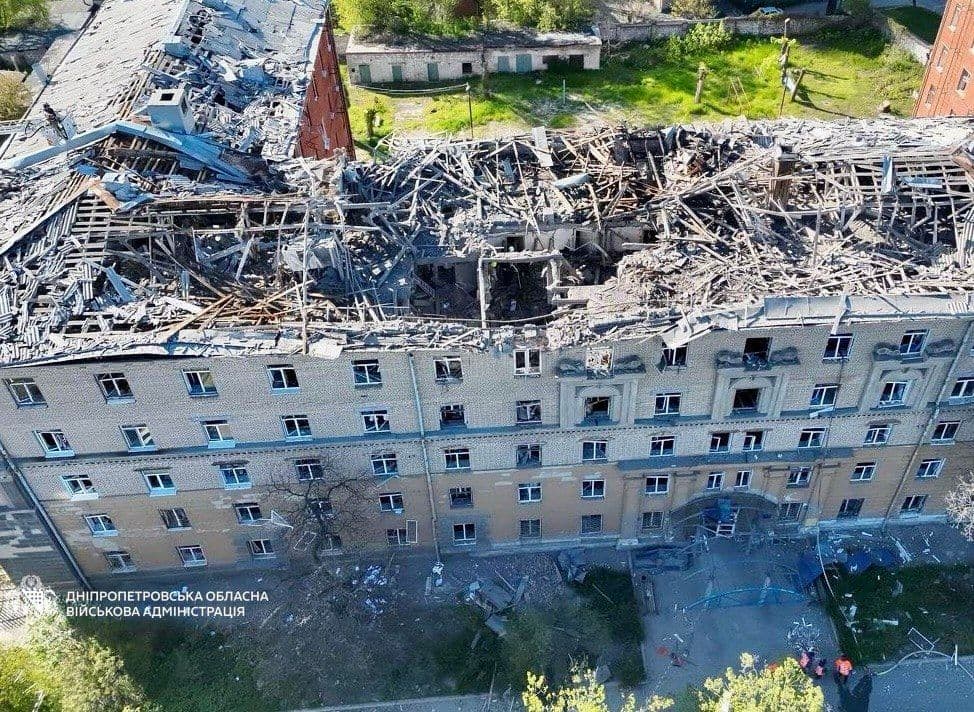
The aftermath of a Russian strike on Dnipro, the capital of Dnipropetrovsk oblast. (Dnipropetrovsk Regional Military Administration / Telegram)
Russian attacks killed at least ten people and injured at least 76 across Ukraine on May 3. In Kherson Oblast: two people killed — a man struck in his car in Kherson by a drone in the morning, plus one more; 26 injured including three children across 39 attacked settlements. In Odesa Oblast: two killed, five injured — strikes on three residential buildings and port facilities. In Donetsk Oblast: two killed in Dobropillia and Mykolaivka, nine injured. In Zaporizhzhia Oblast: two killed, nine injured including a child — drones and guided bombs destroyed five private homes. In Sumy Oblast: one killed — a 45-year-old man in Krasnopillia community; nine injured including a two-year-old child and boys aged 10 and 11; six more wounded in a missile strike on Krolevets; a police car destroyed by FPV drone in Bilopillia with two officers seriously injured, one in critical condition. In Dnipropetrovsk Oblast: one killed, 25 injured including four children — at least 30 Russian attacks on five districts using missiles, drones, and artillery.
In Dnipro city, Russian forces struck a dormitory of Dnipro National University housing students and internally displaced persons, injuring 11 people, six of whom were hospitalized. In Krynychky, Dnipropetrovsk Oblast, a strike near a gas station injured six people including a 10-year-old boy in moderate condition and a 21-year-old pregnant woman — a truck caught fire and a bus carrying 40 children was damaged; the children had evacuated moments before impact. In Kryvyi Rih, a strike on a high-rise apartment building sparked a fire, injuring five people including two children from smoke inhalation. In Mykolaiv, a morning ballistic missile attack wounded five people and damaged 17 private homes and a multi-story building. In Chernihiv Oblast, a 17-year-old boy was targeted and injured by an FPV drone in Semenivka.
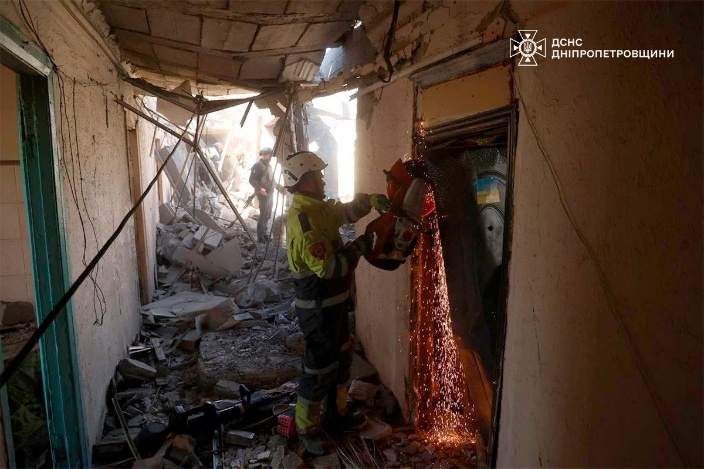
Firefighters work through the site of a Russian attack on Dnipro that killed one person and injured 11 others. (Ukraine’s State Emergency Service/Telegram)
Drones Cross Into Finland, Latvia, and Estonia: NATO’s East on Alert
On the night of May 2 to 3, drone alerts were issued simultaneously in three NATO member states on Russia’s western border. In Finland, the Ministry of Defense confirmed an unidentified drone violated Finnish airspace near the municipality of Virolahti — which borders Russia’s Leningrad Oblast — marking the fifth such incursion in Finland. Finnish Border Guard launched a formal investigation; the military established a temporary restricted aviation zone over waters near the ports of Kotka and Hamina between 01:57 and 08:00.
In Estonia, the Ministry of Internal Affairs issued civilian alerts to the Virumaa and Ida-Virumaa counties at approximately 03:00 local time, explicitly linking the precaution to Russian military actions against Ukraine. Estonian defense forces canceled the alarm at 05:30, confirming no immediate threats in their airspace. In Latvia, similar alerts were sent to residents of Aluksne, Balvi, Ludze, Rezekne, and Kraslava at approximately 04:00. The Latvian National Armed Forces stated they remain in constant NATO coordination: “As long as Russian aggression against Ukraine continues, foreign unmanned aerial vehicles may repeatedly approach or enter Latvian territory.”
The simultaneous alerts across Finland, Estonia, and Latvia on the same night as a major Russian strike wave against Ukraine — and the same night Ukrainian drones were striking Primorsk in Leningrad Oblast, directly adjacent to Finnish and Estonian waters — illustrate the indivisibility of Baltic security from the Ukrainian war. The drone that crossed Finnish airspace near Virolahti was doing so while Ukrainian drones were hitting a Russian port 200 kilometers away.
Russia’s Air Defense Moves to Moscow: S-400s Repositioned for May 9 Parade
A Russian Telegram channel published images on May 3 showing what appeared to be a Russian air defense system driving through Moscow City, assessed by Ukrainian defense outlet Militarnyi as likely an S-400. ISW noted on May 3 that Russia’s SEAD/DEAD campaign — the systematic Ukrainian effort to destroy Russian air defense systems — and deep-rear drone strikes have overstretched Russian air defenses across the country, forcing difficult prioritization decisions about where to allocate assets.
Moving S-400s to Moscow for the May 9 parade means removing them from positions where they have been defending Russian military and industrial assets elsewhere. The parade that will have no tanks now requires air defense redeployment to protect the foot column and aircraft flyover — an irony visible in the same satellite imagery that shows Primorsk burning and the Perm station at 70% ash. Russia’s air defenses are being pulled from its oil infrastructure to protect a parade from the country whose drones are destroying that infrastructure.
Frontlines on May 3: Ukrainian Advance Northwest of Orikhiv, Russian Infiltrations Continue
Ukrainian forces advanced south of Lukyanivske, northwest of Orikhiv, according to geolocated footage published on May 3. Russian milbloggers confirmed Ukrainian advances southwest of Lukyanivske and north of Stepove, west of Orikhiv, and acknowledged that Russian forces no longer fully control the Lukyanivske-Novoyakovlivka area — that it is now roughly equally interspersed with Ukrainian and Russian positions. A Kremlin-affiliated milblogger noted that Russian forces are “showing no signs of correcting the situation” in the area. ISW expanded its Ukrainian counteroffensives polygon northwest of Orikhiv based on Russian milblogger reporting and Ukrainian military observer Mashovets’ assessment.
In occupied Luhansk Oblast, Ukrainian Unmanned Systems Forces Commander Major Brovdi reported on May 3 strikes on a Russian Tor air defense system in occupied Markivska (120 kilometers from the front), a P-18 radar in occupied Herasivka (120 kilometers), and a Russian repair base in occupied Kadiivka (55 kilometers). The Atesh partisan group reported that its agents burned a KamAZ logistics truck of the Russian 2nd Separate Motorized Rifle Brigade in occupied Luhansk City. In occupied Donetsk Oblast, Brovdi reported strikes on a Pantsir-S1 air defense system near Novyi Svit (44 kilometers), the bases of the Russian Shtorm detachment near Kamyanuvate (120 kilometers), a Rubikon Center unmanned technologies unit near Mariupol (115 kilometers), and a telecommunications center in Mariupol. A TV tower in southern occupied Mariupol was also struck.
In occupied Zaporizhzhia Oblast, Brovdi reported strikes on a P-18 radar in occupied Sofiivka (78 kilometers) and a command post in occupied Stepok (145 kilometers). In the Slovyansk direction, Ukrainian forces reported Russian forces intensifying attempts to seize heights near Zakitne from which Ukrainian artillery and drones strike Russian forces in low-lying terrain; Russian forces resumed night assaults using anti-thermal cloaks and intend to commit rear-area personnel due to heavy casualties. In the Kupyansk direction, Ukrainian Joint Forces Task Force Spokesperson Trehubov reported that Russian forces have increased pressure from the north and east after a February-March lull, exploiting spring foliage cover and poor drone weather.
In northern Sumy Oblast, Russian forces continued offensive operations on May 3 but did not advance; Trehubov reported Russian attempts around Hrabovske and Myropilske. A Russian source claimed activity south and southwest of Borova. ISW noted a named Russian barrier detachment — the Krystal Special Barrier Detachment of the Eastern Grouping of Forces — operating in Zaporizhzhia Oblast, striking Ukrainian forces but also apparently positioned to shoot at Russian troops who retreat or refuse to advance. Barrier detachments are specialized units that compel Russian forces to fight by shooting their own personnel. ISW assessed this as a notable named identification of a unit whose function is to prevent Russian soldiers from leaving their assault positions alive if they try.
Belarus Relay Balloon and the Drone Corridor Through Belarusian Airspace
Ukraine’s State Border Guard Service reported on May 3 that a balloon carrying a signal repeater for Russian strike drones flew into Ukrainian airspace from Belarus on the evening of May 2. The balloon was designed to extend the communication range for drones conducting long-range strikes against Ukraine, compensating for signal degradation over distance. Spokesperson Andriy Demchenko stated that Russian forces are increasingly using Belarusian telecommunications infrastructure to facilitate their long-range strike campaign against Ukraine.
Demchenko noted that while there is currently no large-scale buildup of Russian military forces on Belarusian territory, Ukraine is preparing for potential provocations and destabilization attempts. The balloon relay follows Zelensky’s May 2 warning about “specific activity” on the Belarusian side of the border and the Belarus border committee’s confirmation that Russian draft-eligible men cannot exit through Belarusian crossings. Belarus is not a passive geography in this war — it is an active relay station, launch platform, and logistical corridor.
Zelensky in Yerevan: Air Defense, the EU Loan, and the EPC Summit
President Zelensky arrived in Yerevan on May 3 for the European Political Community summit — his first visit to Armenia since taking office in 2019. Leaders from more than 40 European countries gathered to discuss strategies for ending the wars in Ukraine and Iran. Zelensky held bilateral meetings on May 3 with the prime ministers of the United Kingdom, Norway, Finland, and the Czech Republic, with additional meetings scheduled for May 4.
Zelensky said his objectives from the first day of meetings were focused on three areas: strengthening Ukraine’s air defense, providing energy support ahead of next winter, and accelerating delivery of the €90 billion EU loan to Kyiv. “The key is more security and coordination for all of us,” he said. The EU loan, announced in late April and conditional partly on IMF-required tax reforms, is one of the largest single financial commitments to Ukraine since the start of the full-scale invasion. Its acceleration — before the May IMF visit that will assess Ukraine’s reform progress — is a diplomatic priority for Kyiv.
The United Kingdom opened talks on May 3 to join the €90 billion EU Ukraine support loan plan — framed as a key deliverable ahead of an EU-UK summit later this summer, and part of a broader reset in relations nearly a decade after Brexit. The UK’s potential participation would expand the pool of resources available and deepen the institutional linkage between London and Brussels on Ukraine policy.
Project Freedom: Trump Announces U.S. Escort of Ships Through the Strait of Hormuz
U.S. President Trump announced on May 3 the launch of “Project Freedom” — a U.S. military operation beginning May 4 to escort commercial vessels through the Strait of Hormuz, which Iran has kept effectively closed since U.S. and Israeli strikes began on February 28. CENTCOM stated the operation will use guided-missile destroyers and over 100 land and sea-based aircraft, supported by 15,000 U.S. soldiers. Trump framed it as a “humanitarian gesture” for countries whose vessels remain unable to transit the strait.
Iran warned the U.S. that the operation violates the ceasefire agreed between Washington and Tehran, CNN reported. The Strait of Hormuz carries approximately one-fifth of the world’s daily oil and LNG shipments. Its effective closure since late February has driven global energy prices sharply higher — a spike that has simultaneously elevated Russian oil export revenues and complicated Ukraine’s campaign to economically strangle Russia’s war machine. Project Freedom’s launch on May 4 will partially determine whether global energy prices ease — and whether Russia’s windfall from the Iran war continues.
Russia Shifts to Small-Group Infiltration Tactics; Barrier Detachment Identified
The Telegraph published a report on May 3 citing Ukrainian and Western analysts confirming that Russian forces are moving away from large-scale infantry assaults — the “meat grinder” tactics that produced massive casualties with minimal territorial gains — toward small groups of two to four soldiers moving on foot, often at night, with minimal radio communication to avoid drone detection. Their mission: find vulnerabilities in Ukrainian lines and quietly infiltrate the rear, accumulating enough force to strike from flanks or behind.
Keir Giles of Chatham House described this as an evolution driven by the “transparent battlefield,” where threats are identified almost instantly by drone surveillance. Ukrainian analyst Anton Zemlianyi noted that small-group infiltration “does not facilitate rapid breakthroughs — it leads to slow, localized advancement at a high cost of personnel per square kilometer.” The shift is also documented in frontline commander reports: in the Oleksandrivka direction, assault groups have been reduced from four-to-six soldiers to single infantrymen attacking one at a time. The identification on May 3 of the Krystal Special Barrier Detachment actively operating in Zaporizhzhia Oblast — shooting at its own retreating troops — suggests that even this slower, quieter infiltration approach is being enforced at gunpoint.
The Weight of the Day
A warship carrying eight Kalibr cruise missiles was struck in a Baltic port 1,000 kilometers from Ukraine’s border. A bus of 40 children was hit near Krynychky — the children had gotten off just before the drone arrived. A 10-year-old boy did not make it off in time. A police car was destroyed in Bilopillia; one officer is fighting for his life. Ten people died. Seventy-six were wounded.
Sweden seized its fifth shadow fleet tanker. Ukraine struck two tankers at Novorossiysk and a warship, a patrol boat, a tanker, and a port at Primorsk. The Perm station is 70% ash. The Tuapse refinery has been struck four times. Ust-Luga is operating at 43% below capacity. Primorsk can be added to that list now.
Drones crossed into Finland — the fifth time. Estonia and Latvia issued civilian alerts. Russia repositioned S-400s to Moscow to protect a parade from which it had already removed the tanks. The barrier detachment shoots at its own soldiers. The infiltrators move in groups of two, at night, in silence, looking for a gap in the line. Ten people were killed. Zelensky flew to Yerevan to ask for air defense missiles. The war continues.
A Prayer for Ukraine
1. For the Ten Who Died on May 3
Lord, ten people were killed across Ukraine on May 3. A man in his car in Kherson in the morning. Two people in Odesa near their homes and the port. Two in Donetsk Oblast. Two in Zaporizhzhia. A 45-year-old man in Sumy Oblast. One more in Dnipropetrovsk. We name them by number because we do not yet have their names — but you do. Each of them was going somewhere, or coming home, or simply existing in a city they did not choose to be at war in. Receive them. And hold the 76 who were injured — the 17-year-old in Chernihiv, the two-year-old in Sumy, the child and the pregnant woman near the gas station, the six people hospitalized in Dnipro, the officer fighting for his life in Bilopillia.
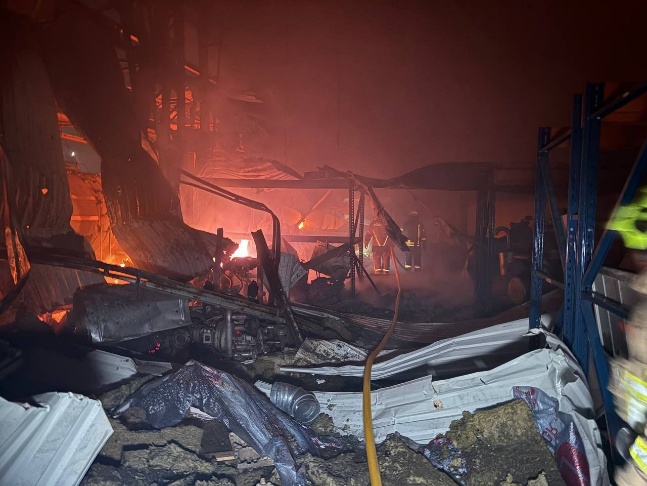
The aftermath of a Russian attack on Odesa Oblast, Ukraine, overnight. (Oleh Kiper/Telegram)
2. For the 40 Children on the Bus Near Krynychky
Father, 40 children were on a bus going to a resort in western Ukraine. The driver saw what was coming and got them off. A 10-year-old boy did not make it far enough from the bus before the strike. He is in hospital in moderate condition. We do not know his name. We know that a bus driver made a decision in seconds that saved 39 children, and that the 40th is in a hospital bed because he was close enough to the blast to be hurt. Hold him in healing. Hold the 39 who are unhurt but who will carry the memory of the moment the bus was struck. Hold the driver, who did the right thing with no time to think about it.
3. For the Police Officer in Critical Condition in Bilopillia
God of those who serve, a police officer responded to a call in Bilopillia on May 3 and an FPV drone destroyed the car he was in. His colleague was seriously injured. He is in critical condition. Police officers in frontline and border communities have been dying at the front lines of a war they were trained for a different kind of service. They drive cars. They respond to calls. They do what the job requires. Be with this officer tonight in his critical condition. Be with the doctors fighting for him. Be with his family waiting for news.
4. For the People of Finland, Latvia, and Estonia — Watching From the Edge
Lord, civilians in Virumaa woke to phone alerts at 03:00. Residents of Aluksne and Kraslava were warned of drones at 04:00. Finnish border guards are investigating a fifth airspace violation near Virolahti. These are NATO countries. They are not in the war. But the war is in their airspace, their phones, their sleep. The people of these countries live beside Russia, and living beside Russia during a Russian war means learning that the side of a border is not the same as safety. Hold them in the anxiety that comes from proximity to a war they did not choose. And hold the alliance that is supposed to mean they are not alone in that anxiety.
5. For the Weapons That Need to Arrive
God of provision, Zelensky flew to Yerevan on May 3 to ask for air defense missiles, energy support, and the acceleration of a €90 billion loan. Ukraine is running low on interceptors after destroying 57,000 Russian aerial targets in April alone. The U.S. has told European allies that HIMARS and NASAMS ammunition will be delayed. Russia launched 268 drones in a single night. The math of this — 268 in, not enough interceptors to meet the demand — leads to the ten people killed today, and the dormitory, and the bus. We ask that the decisions being made in meeting rooms in Yerevan and Brussels and London produce real deliveries before the next record-breaking wave arrives. In Your mercy, in Your justice, in Your time — bring this war to its end, and let the ending be worthy of what Ukraine has endured.