
Ukraine Daily Briefing | May 25, 2026 | Day 1,552 of the Full-Scale Invasion
Prepared by Dayana Bozhyk
Russia’s Foreign Ministry announced “systematic” new strikes on Kyiv’s defense industry and decision-making centers, told foreign diplomats to evacuate the city, and Lavrov called Rubio to deliver the threat directly — while every European mission in Kyiv said it was staying. Ukrainian OSINT sources reported that a second Oreshnik launched during the May 24 strike package malfunctioned and struck occupied Donetsk Oblast — potentially making one in four Russian Oreshnik launches defective. Putin signed a law authorizing Russian troops to deploy abroad to “protect” Russian citizens from foreign courts. Ukraine struck an enemy command post in Luhansk Oblast with Storm Shadow missiles, hit the Belets oil depot in Bryansk Oblast, launched mechanized counterattacks in the Borova direction, and advanced in Kostyantynivka-Druzhkivka and western Zaporizhzhia.
THE DAY’S RECKONING
On the morning after the largest missile strike of 2026, Russia did not wait for the rubble to be cleared. The Foreign Ministry issued a statement announcing systematic strikes on Kyiv’s defense industry — drone design facilities, production plants, command posts, decision-making centers. Foreign citizens should leave immediately. Kyiv residents should avoid military and government infrastructure. It was addressed to the world but intended, above all, to be read as strength.
It did not read as strength. The European Union’s ambassador posted two words: “We stay.” France, Germany, Poland, the Baltics, and a dozen other missions issued similar statements. Tsikhanouskaya arrived at Kyiv’s railway station on the same morning Russia told the world to leave — the Belarusian opposition leader making her first official visit to Ukraine, at Zelensky’s invitation, walking into the aftermath of a strike that her host country had just absorbed.
Meanwhile, Ukrainian OSINT sources reported something that, if confirmed, would rewrite the weekend’s ledger: a second Oreshnik may have been launched alongside the one that struck Bila Tserkva, and it apparently malfunctioned, scattering its MIRV submunitions over occupied Donetsk Oblast near Avdiivka or Yasynuvata — roughly 40 kilometers from the frontline. Russia’s own territory, hit by Russia’s own weapon. If accurate, one of every four Oreshnik launches so far in this war has failed.
And Putin signed a new law. Vague by design, it authorizes the Russian president to deploy armed forces abroad to protect “Russian citizens” being prosecuted in foreign courts or international tribunals whose jurisdiction Moscow does not recognize. The International Criminal Court — which issued arrest warrants for Putin in 2023 — is precisely such a tribunal. The law entered force ten days after publication. It says, in legal language, what Russia has been saying in operational language for a decade: the rules that apply to others do not apply to Russia.
RUSSIA’S THREAT TO KYIV: “SYSTEMATIC STRIKES,” DIPLOMATS TOLD TO LEAVE
Russia’s Foreign Ministry published a statement on May 25 announcing that Russian forces would begin systematic strikes against Ukrainian defense industry targets in Kyiv — specifically facilities involved in the design, manufacture, programming, and deployment of drones, which Moscow claims are used with NATO assistance. The statement also threatened strikes against “decision-making centers” and command posts. Foreign nationals, including diplomats, were urged to leave Kyiv as soon as possible. Ukrainian civilians were told to stay away from military and administrative infrastructure.
Russia cited the May 22 strike on Starobilsk as justification, claiming it had “exhausted Russia’s patience.” Ukraine’s General Staff maintained that the strike targeted the headquarters of Russia’s Rubikon drone unit — an elite drone operations and training center responsible for battlefield interdiction across the frontline — not a dormitory. Russia claimed 21 people, including children, were killed; Ukraine denied targeting civilians. ISW cannot independently verify the target or casualty figures.
ISW’s analysis of the threat: the framing is false. Russia had been preparing the May 23–24 strike package for weeks, not days — it is not feasible to assemble 90 missiles and 600 drones in the 24 to 48 hours following the Starobilsk strike. Russia intensified strikes against Kyiv on the night of May 12–13, more than a week before Starobilsk. The threat is not retaliation. It is intimidation dressed as retaliation, designed to split Western resolve and temper the urgency of allies’ response.
Lavrov called Rubio on May 25 to deliver the threat directly, warning of systematic strikes and urging the U.S. to ensure its diplomatic staff evacuate Kyiv. It was the two officials’ first contact since May 5. The Kremlin also framed its threat as targeting the Zelensky regime specifically, encouraging Kyiv residents to distance themselves from the state — a classic information warfare stratagem designed to create a wedge between population and government.
The response from the diplomatic corps was unified and immediate. EU Ambassador Mathernova: “We stay in Kyiv. We stay with Ukraine.” Ukrainian Foreign Ministry called the threat “shameless blackmail” aimed at intimidating the international community and urged partners to increase pressure on Russia and strengthen air defense support. FM Sybiha: “Putin must understand that he will achieve nothing through military means.”
SECOND ORESHNIK MAY HAVE MALFUNCTIONED OVER OCCUPIED DONETSK
Ukrainian OSINT sources reported on May 25 that footage from May 24 shows evidence that Russian forces launched a second Oreshnik during the overnight strike package — and that it malfunctioned, with its MIRV submunitions striking a location in occupied Donetsk Oblast, likely near Russian military positions at Avdiivka or Yasynuvata, roughly 40 kilometers from the frontline. The footage reportedly shows six submunitions impacting the ground in a pattern consistent with the weapon. ISW has not yet confirmed the report.
If confirmed, the implications are significant: three Oreshniks have been used in combat, and one would have malfunctioned — a 33 percent failure rate. Ukrainian MoD agency ArmyInform estimated the May 23–24 strike package cost approximately $361 million, including $50 million for one Oreshnik. A second Oreshnik launch would raise the total cost to approximately $411 million — for a strike package that killed four people and failed to halt Ukraine’s operations for a single hour.
PUTIN SIGNS LAW TO DEPLOY FORCES ABROAD TO ‘PROTECT RUSSIAN CITIZENS’
Vladimir Putin signed legislation on May 25 authorizing Russian troop deployments abroad to protect Russian citizens facing arrest, detention, or prosecution in foreign courts or international tribunals whose jurisdiction Moscow does not recognize, and which are not based on UN Security Council resolutions. The State Duma passed the bill 381–0 on May 13; the Federation Council approved it on May 20.
The text is deliberately vague. The BBC’s Russia Service noted that the phrase “vested with powers” is ambiguous in the Russian legal context, and that the Kremlin retains maximum flexibility in how it chooses to invoke the law. The practical target is transparent: the International Criminal Court, which in March 2023 issued arrest warrants for Putin and Maria Lvova-Belova for the unlawful deportation of Ukrainian children. The Kremlin has rejected those warrants as illegitimate. This law creates a statutory basis for military force in response.
Russian lawmakers framed the legislation as countering “rampant Russophobia abroad” and linked it to the case of Russian archaeologist Alexander Butyagin, detained in Poland over illegal excavations in occupied Crimea. But the law’s scope is far broader than any individual case. Moscow has used the rhetoric of protecting Russians abroad to justify every act of aggression since Crimea in 2014. This law places that rhetoric into statute.
UKRAINE STRIKES WITH STORM SHADOW; BELETS OIL DEPOT BURNS IN BRYANSK
Ukraine’s Air Force used Storm Shadow air-launched cruise missiles on May 25 to destroy a Russian command-and-control and communications post in occupied Luhansk Oblast, the General Staff confirmed. Storm Shadow, supplied by the UK, carries advanced terrain-following navigation and has a range of 250–560 kilometers depending on variant. The General Staff stated: “This strike underscores the strategic foresight, unity of planning, and deliberate actions that prove no position of the Russian aggressor is safe on Ukrainian soil.”
Overnight May 24–25, Ukrainian forces struck the Belets oil depot in Unecha, Bryansk Oblast, roughly 58 kilometers from the international border. The facility is a link in the supply chain for Russian military fuel, the General Staff stated. Separately, the General Staff confirmed strikes against ammunition storage facilities in occupied Crimea and Donetsk Oblast, and a communications hub in Donetsk Oblast.
Ukrainian USF Commander Brovdi confirmed a strike on the rear base and logistics hub of the Russian 6th Air Force and Air Defense Army in Rovenky, occupied Luhansk Oblast — roughly 125 kilometers from the frontline. Geolocated footage confirmed a fire in southern Luhansk City, consistent with a strike on an oil depot. NASA FIRMS thermal data confirmed heat anomalies in southern Luhansk City on May 24.
UKRAINE’S SEAD CAMPAIGN: 81 AIR DEFENSE SYSTEMS STRUCK SINCE MARCH 1
The Ukrainian MoD reported on May 25 that Ukrainian forces destroyed almost twice as many Russian air defense and radar systems in April 2026 compared to October 2025. Since March 1, 2026, the General Staff confirmed Ukrainian forces have struck 81 Russian air defense systems. Since the start of 2026, 12 Pantsir systems in occupied Crimea have been struck.
ISW’s concurrent strategic assessment — published as a companion to the day’s tactical reporting — documented the systematic character of this campaign: since late 2025, Ukrainian forces have conducted a coherent SEAD/DEAD (suppression and destruction of enemy air defenses) campaign, visually confirming no fewer than 107 strikes against Russian ground-based air defense systems and radars since November 2025, 89 of which are geolocated. The Dutch Oryx project confirmed 77 Russian SAM systems and 23 radar stations destroyed in 2025 alone. Ukrainian forces conducted at least 492 strikes against air defense infrastructure and 433 against anti-access/area denial assets between June 2025 and March 2026.
THE BATTLEFIELD IS SHIFTING: ISW’S STRATEGIC ASSESSMENT
ISW published a comprehensive strategic assessment on May 25 documenting a fundamental shift in the character of the war. The headline finding: Russia’s daily rate of advance has dropped from 13.2 square kilometers per day in 2025 to 2.9 square kilometers per day in the first four months of 2026, excluding infiltrated areas — less than a quarter of the previous year’s pace. Including infiltrated areas brings the figure to 4.6 square kilometers per day between January 1 and May 21, 2026. Russia is losing more soldiers to make fewer gains.
Since December 2025, Russia’s monthly casualty rate has reportedly exceeded its recruitment rate. Bloomberg reported in February that Russia sustained 9,000 more battlefield casualties than it could replace in January 2026 alone. Ukrainian Defense Minister Fedorov stated in May that Ukraine had met its objective of inflicting casualties greater than Russia’s recruitment rate and set a new target of 50,000 Russian casualties per month — a target Ukraine is on track to meet in May.
Ukrainian forces liberated more territory than they lost in the last two weeks of February 2026 for the first time since the 2023 counteroffensive. Russian forces suffered a net loss of 116 square kilometers in April 2026. Ukrainian counterattacks in the Borova direction are currently placing mechanized equipment two to five kilometers behind previously observed Russian positions — an operational feat ISW assessed was categorically impossible 12 months ago.
The enabling factors: Ukraine’s SEAD campaign reducing Russian air defense coverage; an intensified intermediate-range strike campaign interdicting Russian logistics along the T-0509 Mariupol-Donetsk City highway and M-14 coastal highway at ranges exceeding 150 kilometers; the Hornet strike UAV, which Russian electronic warfare cannot jam, allowing persistent road interdiction; tactical drone overmatch achieved by surging 300–400 drones in small exploitation sectors; and the loss of Starlink for Russian forces on February 1, which degraded Russian command-and-control and forced operators to use larger, more visible antennas.
ISW’s conclusion: “Ukraine likely has a unique and time-constrained opportunity to exploit its current initiative while Russian forces remain vulnerable. Ukraine’s partners should expand their support to these Ukrainian efforts at a moment when Russia is reeling from both battlefield setbacks and Ukraine’s deep strike campaign.”
FRONTLINE: BOROVA COUNTERATTACKS ONGOING; KUPYANSK LOSING MOMENTUM; KRAMATORSK STRUCK THREE TIMES
In the Borova direction, Ukrainian forces continued tactical mechanized counterattacks, with Ukrainian mechanized equipment reportedly two to five kilometers behind previously observed Russian positions as of May 24. Elements of the Russian 1428th Motorized Rifle Regiment — previously tracked in the Kupyansk direction as of November 2025 — are now operating near Serednie southeast of Borova, indicating Russian reinforcement of the direction. The counterattacks were still ongoing on May 25.
Ukrainian Joint Forces Task Force Spokesperson Trehubov confirmed on May 25 that Russian forces in the Kupyansk direction are losing momentum, though they retain offensive potential and have not yet completed their spring offensive. ISW assessed that elements of the Russian 272nd Tank Division operating near Kurylivka are redeploying to the Lyman direction — the latest in a series of such transfers indicating Russia may have effectively abandoned efforts to seize Kupyansk. Russian forces are continuing to exploit spring foliage cover for infiltration missions in northern Kharkiv Oblast, with fiber optic drone range extended from 20–30 kilometers in 2025 to 50 kilometers now — sufficient to reach eastern and northern Kharkiv City.
In the Kostyantynivka-Druzhkivka direction, Ukrainian forces advanced in southern Dovha Balka and southwest of Stepanivka; Russian forces advanced in western Berestok and west of Ivanopillya. Russian forces conducted multiple infiltration missions across and near Kostyantynivka, with Ukrainian forces striking Russian positions in the southwestern, northern, and western outskirts of the city. Russian forces dropped five FAB-250 glide bombs on Kramatorsk on the morning of May 25 — the third large-scale attack on the city within a single day — injuring at least 12 civilians including an eight-year-old boy.
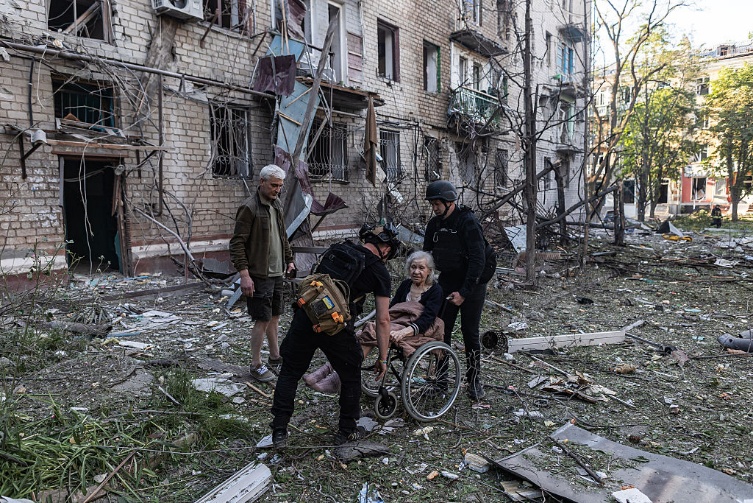
Police evacuate a woman with reduced mobility following a Russian attack using guided bombs in the centre of Kramatorsk, Donetsk Oblast. (Diego Herrera Carcedo/Anadolu via Getty Images)
In western Zaporizhzhia Oblast, Ukrainian forces recently advanced southwest of Novodanylivka south of Orikhiv. Russian forces reported a deteriorating situation near Stepnohirsk and Mala Tokmachka, with a Russian milblogger confirming that insufficient drone numbers have forced Russian forces to yield positions. The Russian military command reportedly set an unrealistic deadline of May 30 for Russian forces to approach Orikhiv — currently 20 kilometers away. Southern Defense Forces confirmed the Russian command is also using AI-generated footage to fabricate evidence of territorial gains in Verkhnya Tersa.
In the Dobropillya tactical area, Russian forces recently advanced southwest of Dorozhnie. In the Sumy Oblast border area, Russian forces conducted limited operations but did not advance. In Kherson Oblast, Russian forces continued attacks east of Kherson City and shelled a hospital in Bilozerka twice consecutively, injuring three hospital workers.
UKRAINIAN MID-RANGE STRIKES: MARIUPOL HIGHWAYS, LUHANSK DEPOTS, CRIMEAN AMMUNITION
Ukraine’s 1st Army Corps reported on May 25 that Ukrainian forces are systematically striking Russian logistics along the M-14 Mariupol-Taganrog and H-20 Mariupol-Volnovakha highways. Geolocated footage confirmed strikes against Russian vehicles along the M-14 northeast and west of Novoazovsk, north of Samsonove, southeast of Sakhanka, and north of Kholodne — all between 130 and 150 kilometers from the frontline. The 1st Azov Corps released footage of strikes near occupied Mariupol and the Russian border, stating: “The most reliable way to achieve this is to move the sanitary zone for enemy logistics closer to Russia itself and to occupied Crimea.”
In occupied Luhansk Oblast, Ukrainian forces struck the rear base and logistics hub of the Russian 6th Air Force and Air Defense Army in Rovenky. Brovdi confirmed additional strikes against ammunition and fuel depots in the Donetsk direction: a Russian S-300 launcher near Lazarivka; a 9S19 radar station in Stritenka; railway fuel tanks near Debaltseve; a material support warehouse near Dokuchayevsk; an artillery depot of the 40th Naval Infantry Brigade near Kremenivka; and a temporary deployment point near Mykilske — all between 50 and 90 kilometers from the frontline. In occupied Crimea, Ukrainian forces struck an ammunition storage depot in occupied Mizhhirya, roughly 212 kilometers from the frontline.
RUSSIAN DRONE CAMPAIGN: 262 LAUNCHED, 246 DOWNED; CASUALTIES ACROSS SIX OBLASTS
Russian forces launched 262 Shahed, Gerbera, Italmas, and Parodiya drones overnight May 24–25, from launch points in Oryol, Kursk, Bryansk, Smolensk, Rostov, Krasnodar Krai, and occupied Crimea. Ukrainian air defenses downed 246 drones. Ten struck nine locations; debris fell on seven more.
Russian attacks across six oblasts on May 25 killed at least four people and injured 69 others. In Sumy Oblast, a drone strike on a civilian car killed a 24-year-old man in Krasnopillia; four additional people were injured across the oblast during nearly 90 Russian attacks on 43 settlements. In Kherson Oblast, Russian forces targeted 34 settlements, killing two people and injuring 16. In Donetsk Oblast, one person was killed and 14 injured. In Kharkiv Oblast, strikes on Bohodukhiv and Petrivka injured 18 people, including a five-year-old girl. In Dnipropetrovsk Oblast, Russian strikes injured six people across the region; a separate morning attack on Pavlohrad injured six more, including a six-year-old boy. In Zaporizhzhia Oblast, Russian forces conducted 753 strikes on 48 settlements, injuring three civilians. In Chernihiv, overnight drone strikes injured two women.
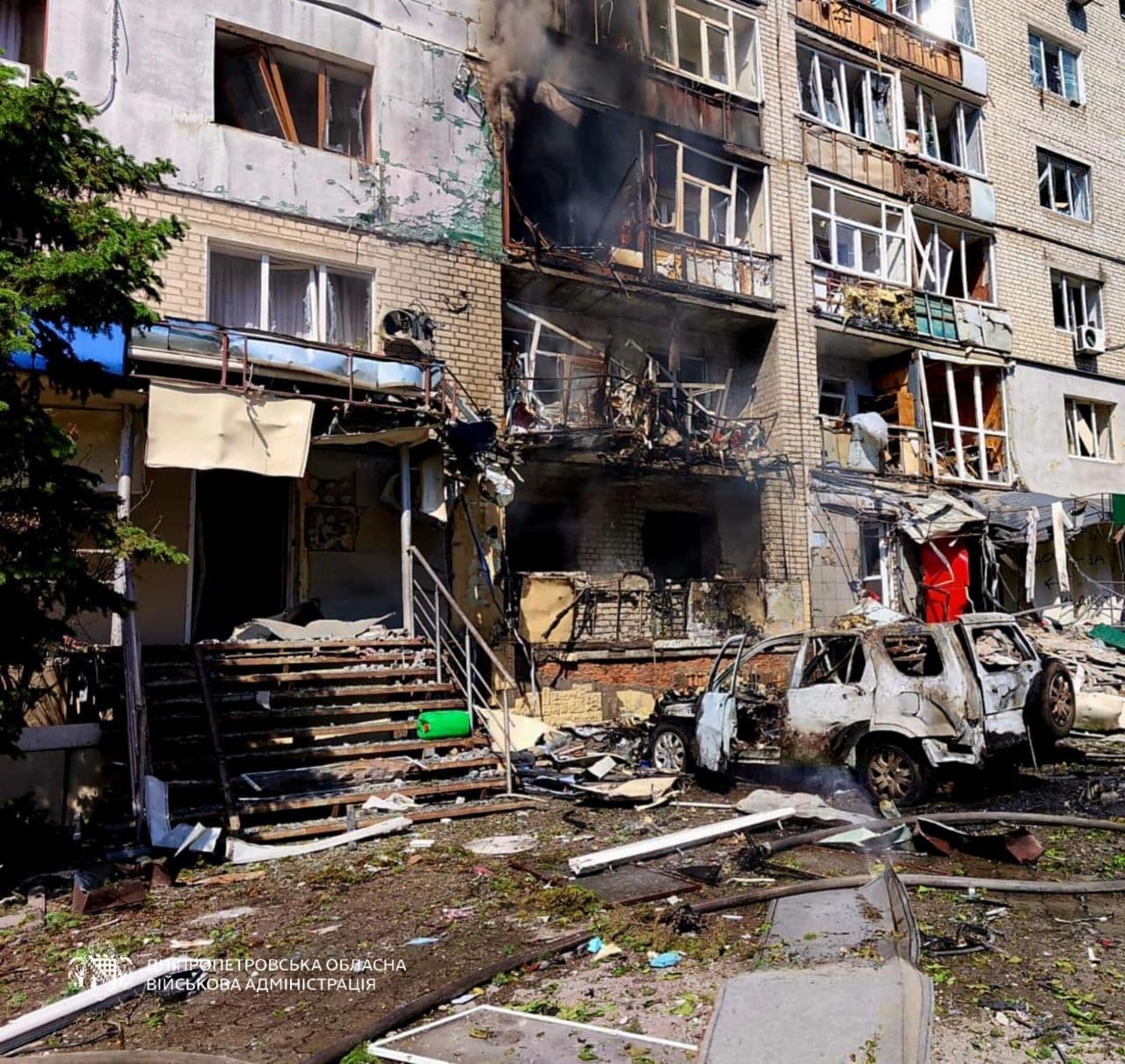
The aftermath of a Russian missile strike on a residential building in Pavlohrad, Dnipropetrovsk Oblast. (Oleksandr Hanzha/Telegram)
In Odesa, a combined missile-and-drone strike on the evening of May 25 killed one person and injured four others, damaging an infrastructure facility and nearby residential buildings. Russian forces also struck Derhachi, just northwest of Kharkiv City, with rockets on the afternoon of May 25, killing two people and injuring 19.
THE AFTERMATH IN KYIV: 87 INJURED, 300 SITES DAMAGED, 1,000 HOUSING CLAIMS FILED
Zelensky confirmed on May 25 that the overnight cleanup operation in Kyiv involved nearly 100 State Emergency Service personnel across the Shevchenkivskyi and Podilsky districts, where recovery work continued for a second day. A total of approximately 300 sites across Kyiv were damaged, including nearly 150 residential buildings. Two people were killed and 87 injured, including three children. Six Ukrainian regions were affected by the May 24 strike.
Recovery Minister Kuleba announced that 986 applications for housing compensation had been filed through the Diia eGovernment portal in Kyiv within 24 hours of the strike, with an additional 147 from Kyiv Oblast including Bila Tserkva. Kuleba urged Kyiv residents to file promptly through the eRecovery program, which provides compensation for housing damaged or destroyed since February 24, 2022. Nearly 19,000 Kyiv families have received repair compensation since the program launched; around 8,500 families have received certificates to buy new homes after total destruction.
The National Art Museum of Ukraine confirmed that its historic building, designed by architect Vladislav Horodetsky, sustained damage from the blast wave, though staff and collections were unharmed. Museum officials stated that a new restoration plan will be developed after structural analysis is complete. About 40 percent of the National Chornobyl Museum’s exhibition artifacts were reportedly lost beyond recovery; museum workers are salvaging books, embroidered shirts, and Chornobyl cleanup exhibits. The Dominican monastery in the Lukyanivka district — home to six Polish monks and two Ukrainians — had its windows shattered and doors ripped from frames; Pentecost services proceeded on Sunday morning.
LIMA EW SYSTEM: UKRAINE’S LOW-COST ANSWER TO THE PATRIOT SHORTAGE
With a global Patriot interceptor shortage constraining Ukraine’s ability to counter ballistic missiles — exacerbated, Zelensky confirmed, by the Iran-Israel conflict consuming anti-ballistic system production globally — Ukraine is deploying the Lima electronic warfare system at scale. Developed by Ukrainian startup Cascade Systems, Lima jams and spoofs GPS/GLONASS satellite navigation, causing Russian missiles and drones to veer off course or miss their targets entirely. If satellite signals are blocked, weapons revert to inertial navigation, which drifts approximately 2,000 meters per 100 kilometers traveled.
A developer identified as “Alchemist,” commander of Ukraine’s Night Watch EW unit, stated: “Some past attacks were diverted by making the incoming weapons think they are in Peru.” Each Lima unit costs up to 3 million hryvnia ($68,000); protecting a major city requires 30–100 units at a total cost of roughly $5.8 million — comparable to the cost of a single Patriot PAC-3 interceptor. Cascade Systems has supplied more than 400 units since July 2024, deployed to cover civilian infrastructure from October 2025. The company claims the system has jammed more than 20,500 Shahed drones and misdirected dozens of ballistic and cruise missiles.
A more advanced version, Lima Quant, was developed after Russia introduced Kometa anti-jamming antennas in 2025. “War evolves all the time,” Alchemist said. Ukraine’s Fire Point defense company is also developing a new ballistic missile interceptor called Freya in partnership with European partners, with first interception tests targeted for before year-end 2026. Zelensky confirmed he has discussed air defense cooperation with Macron, Norwegian PM Støre, and Finnish President Stubb.
TSIKHANOUSKAYA IN KYIV: “UKRAINE’S VICTORY WILL OPEN THE PATH TO FREEDOM FOR BELARUS”
Belarusian opposition leader Sviatlana Tsikhanouskaya arrived in Kyiv by special train on May 25, making her first official visit to Ukraine at Zelensky’s invitation. She began with a tribute to Maria Zaitseva, a Belarusian activist killed fighting for Ukraine in January 2025. She then visited the sites of the May 24 Russian strike in Kyiv, the National Chornobyl Museum, and the abandoned town of Pripyat near the Belarusian border.
At a joint press conference with FM Sybiha, Tsikhanouskaya stated: “I am sure that Ukraine’s victory will open the path to freedom for Belarus.” Sybiha confirmed the appointment of Yaroslav Chornohor as Ukraine’s Ambassador-at-Large for relations with the Belarusian democratic opposition. Ukraine’s Border Guard Service confirmed no troop buildup on the Belarusian border as of May 24, though intelligence units reported continued Russian pressure on Minsk to join the war actively. Tsikhanouskaya’s visit coincided with Lukashenko blaming her for the Kremlin’s actions — a detail she did not dignify with comment.
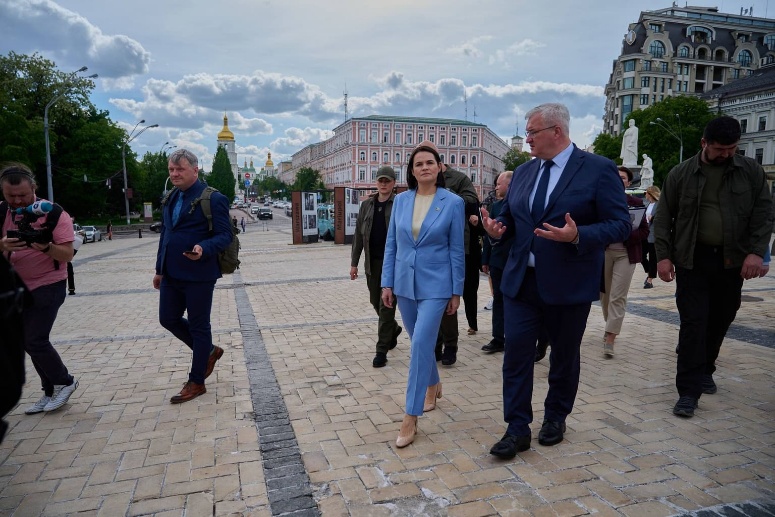
Exiled Belarusian opposition leader Sviatlana Tsikhanouskaya (fourth from the left) accompanied by Foreign Minister Andrii Sybiha (second from the right) during her visit to Kyiv, Ukraine. (The Ukrainian Foreign Ministry/Telegram)
RUSSIA FILES ICJ COMPLAINT AGAINST BALTIC STATES; RAF JET JAMMED NEAR RUSSIAN BORDER
Russia’s Foreign Ministry announced on May 25 that it would appeal to the International Court of Justice over alleged discrimination against Russian minorities in Estonia, Latvia, and Lithuania. Tallinn called it “part of Russia’s continuous pattern of behavior, a continuation of the disinformation campaign against the Baltic states.” The Estonian Foreign Ministry stated the move is “aimed at undermining support for Ukraine and discrediting democratic institutions and allies more broadly.” Russia has repeatedly used the protection of Russian speakers abroad as justification for aggression; the Baltic governments have phased out Russian-language education and tightened immigration rules as part of integration policies.
Separately, a RAF jet carrying UK Defense Secretary John Healey from his May 21 visit to Estonia had its GPS signals jammed for the entire three-hour flight near the Russian border. A UK defense source confirmed the incident as “reckless Russian interference.” Pilots used backup navigation systems. It remains unclear whether Russia deliberately targeted Healey’s aircraft.
KAZAKHSTAN REFUSES TO ENFORCE $1.4 BILLION NAFTOGAZ RULING AGAINST GAZPROM
Kazakhstan’s Justice Minister Sarsembayev confirmed on May 25 that Kazakhstan would not enforce the Astana International Financial Centre court’s recognition of the Swiss arbitration ruling awarding Naftogaz $1.4 billion in damages from Gazprom. The minister stated Kazakhstan would not serve as “a transit platform” for rulings with no legal connection to its jurisdiction. Gazprom was not registered in the AIFC system, the underlying transaction did not occur under AIFC jurisdiction, and neither party agreed to AIFC adjudication.
The underlying dispute stems from Gazprom’s refusal to pay in full for gas transit services under the 2019 Russia-Ukraine Gas Transit Agreement, which lapsed on January 1, 2025. In May 2022, Russian forces rendered the Sokhranivka transit entry point inoperable; Gazprom stopped paying in full. Naftogaz initiated Swiss arbitration in September 2022. The tribunal awarded $1.4 billion in June 2025; Gazprom’s appeal was dismissed in January 2026. Naftogaz is pursuing asset recovery across multiple jurisdictions. Gazprom has not complied voluntarily.
MELNYK REBURIED; RUSSIAN METROPOLITAN DETAINED IN CZECHIA
The remains of 20th-century Ukrainian military and nationalist leader Andrii Melnyk and his wife Sofiia Fedak-Melnyk were reburied at the National Military Memorial Cemetery near Kyiv on May 25. Zelensky attended the ceremony alongside PM Svyrydenko, Presidential Office head Budanov, and former President Yushchenko. Melnyk, born in 1890, led the OUN-M faction of the Organization of Ukrainian Nationalists after the assassination of Yevhen Konovalets. He was imprisoned in Sachsenhausen by the Nazis and died in exile in Germany in 1964; he was buried in Luxembourg. His repatriation follows exhumation in Luxembourg last week. Zelensky: “We feel in our hearts everything that Ukrainians were forced to go through, everything our people had to endure.”
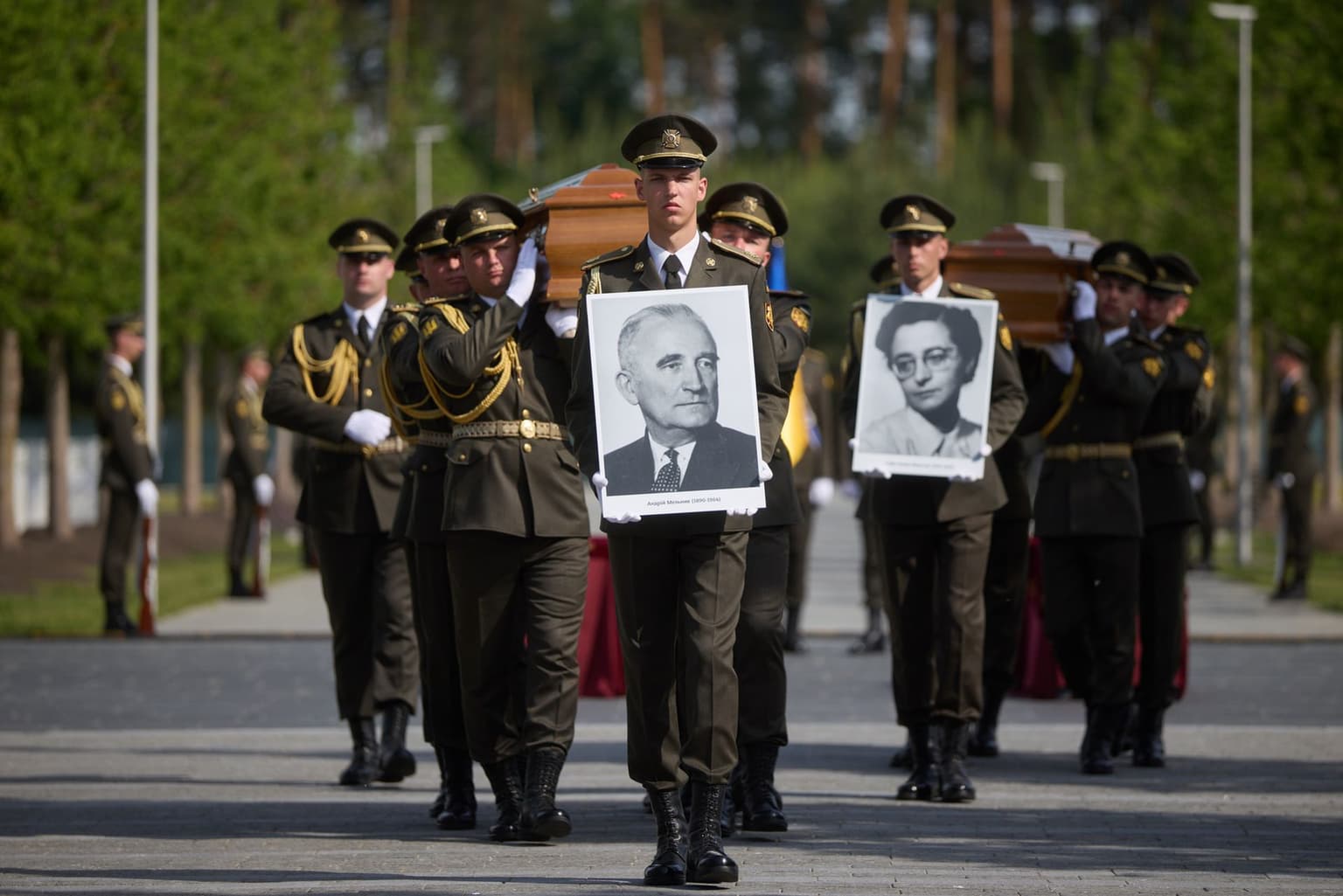
Soldiers carrying coffins of Ukrainian military leader Andrii Melnyk and his wife, Sofiia Fedak-Melnyk, during a reburial ceremony at the National Military Memorial Cemetery in Kyiv Oblast, Ukraine. (President Volodymyr Zelensky/X)
Metropolitan Hilarion — formerly the Moscow Patriarchate’s head of External Church Relations and a potential Patriarch Kirill successor before his removal in 2022 amid allegations of sexual misconduct — was detained by Czech police on May 24 after four small containers of an unidentified white substance were found in the trunk of his car in the Ustí nad Labem region. Czech police confirmed detaining two people following an anonymous tip; the substance is pending expert analysis. Hilarion denies involvement and calls the incident a provocation. Czech outlet Deník N had previously reported his ties to the Russian FSB.
Russia told the world to leave Kyiv. Every European mission said it was staying. Russia’s new law authorizes troop deployments abroad. A second Oreshnik may have struck Russia’s own occupied territory. Putin signed a bill that places a decade of aggressive rhetoric into statute. Tsikhanouskaya arrived by train to stand in the rubble of a city Russia said should be evacuated.
Ukraine struck with Storm Shadow. The Belets oil depot in Bryansk burned. Ukrainian forces are advancing in Borova. Russia’s daily rate of advance is down to 2.9 square kilometers, from 13.2 last year. Russian monthly casualties now exceed Russian monthly recruitment. The war is not won. But the character of it is changing.
Day 1,552. Kyiv is cleaning up. The rest of the world is watching where the next Oreshnik falls.
A PRAYER FOR UKRAINE
1. For the Two in Derhachi and the One in Krasnopillia
Lord, on May 25, Russian rockets struck Derhachi just northwest of Kharkiv City in the afternoon, killing two people and injuring 19. In Sumy Oblast, a drone found a civilian car and killed a 24-year-old man driving through Krasnopillia community. These were not close calls or near misses. These were ordinary deaths on ordinary roads in the middle of an ordinary afternoon. The two in Derhachi were somewhere outside when the rockets came. The 24-year-old was behind a wheel. None of them chose to be a target. Receive them. And hold the families who will now mark the afternoon of May 25 for the rest of their lives as the day that particular person did not come home.
2. For the Five-Year-Old in Bohodukhiv and the Six-Year-Old in Pavlohrad
Father, a five-year-old girl was injured in Bohodukhiv, Kharkiv Oblast, when Russian forces struck the town on May 25. A six-year-old boy was injured in Pavlohrad, Dnipropetrovsk Oblast, in a morning attack. They are children. They do not have a theory of the war or an understanding of what is being contested over their heads. They have a wound and, if they are fortunate, a parent nearby. We ask that You keep them, and every child injured across the six oblasts struck on May 25, and heal what has been broken. And we ask that the adults responsible for ending this war feel the weight of a six-year-old boy’s injury in Pavlohrad — not as a statistic, but as a moral fact that demands an answer.
3. For the Diplomats Who Stayed
God of solidarity, on the morning of May 25, Russia told every diplomat in Kyiv to leave. One by one, European missions responded publicly: we are staying. The EU ambassador: “We stay in Kyiv. We stay with Ukraine.” This was not heroism in the military sense. It was steadiness — the refusal to allow a threat to define the answer. Each ambassador who posted those words was making a choice about what kind of Europe they represent. Sustain that choice. Let it be maintained not only in the moment of crisis but in the weeks of negotiations and summits and budget discussions that follow, when steadiness is harder to maintain because no one is watching. Let the word “stay” mean something durable.
4. For the Recovery Workers in the Shevchenkivskyi and Podilsky Districts
Lord, nearly 100 State Emergency Service personnel spent their second consecutive day clearing rubble in Kyiv’s Shevchenkivskyi and Podilsky districts on May 25. They moved reinforced concrete. They ran dogs through debris. They assessed 300 damaged sites. They found two bodies — the women recovered from under the rubble, announced with the clinical language that emergency services learn because clinical language is the only kind that survives sustained exposure to this work. We do not know their names. We know they stayed, as the diplomats stayed, but in basements and rubble rather than chanceries. Give them the rest they need at the end of each day. Give them the psychological support that is rarely as available as the physical equipment. And let the country they are holding together survive long enough to be worth the holding.
5. For the Long Work of Understanding What Is Changing
God of history, ISW published a strategic assessment on May 25 documenting something that is hard to fully absorb: the character of this war is shifting. Russia’s daily advance rate has fallen to 2.9 square kilometers. Ukrainian mechanized equipment is operating in spaces that were impossible to reach a year ago. Monthly Russian casualties now exceed monthly Russian recruitment. None of this means the war is won, or that the suffering will end soon, or that the next Oreshnik will not find a target. But something structural is happening in the mathematics of attrition, and the people who understand it best are asking the world’s democracies to lean in now, while the window exists. Let the leaders with the power to act hear that. Let the exhaustion that makes people want to look away be overcome by the knowledge that this moment — however hard to see from a distance — may be the one that matters most. And let Ukraine have the time, the weapons, and the support it needs to convert what is shifting into something that holds.