
Ukraine Daily Briefing | May 28, 2026 | Day 1,555 of the Full-Scale Invasion
Prepared by Dayana Bozhyk
Sweden announced 36 Gripen fighter aircraft for Ukraine — 16 donated immediately, 20 more to follow — in a $2.7 billion package that includes long-range capabilities, electronic warfare, and nearly $400 million for drone production. ISW assessed that a leaked Russian MoD map confirms Putin’s generals have been systematically misrepresenting the frontline to him, leading him to believe his forces can seize all of Donetsk and Luhansk oblasts by fall 2026 when Russia’s actual rate of advance is less than a quarter of 2025’s pace. Russia installed new Pantsir-SMD air defense systems on Moscow skyscraper rooftops, importing gasoline from Belarus to offset collapsing domestic refinery output. Ukraine’s parliament ratified the €90 billion EU loan 298–0. Three Russian shadow fleet tankers were struck by drones in the Black Sea off Turkey. The Zaporizhzhia Nuclear Power Plant lost communications for 12 hours — the longest blackout since the invasion began.
THE DAY’S RECKONING
The most consequential document released on May 28 was a map. A leaked Russian Ministry of Defense map dated April 9 showed the Kremlin’s internal picture of the frontline in western Zaporizhzhia Oblast — and the picture was false. The map claimed Russian forces had seized Prymorske, Stepnohirsk, Richne, Veselyanka, Zaporozhets, Zapasne, and had approached Orikhiv’s railway. ISW assessed it has not observed evidence that Russian forces had infiltrated or advanced into most of those locations as of April 9, and has observed no evidence of Russian forces in Richne, Veselyanka, or Zapasne as of May 28. Russian forces have never infiltrated or advanced into Orikhiv.
This is not a discrepancy between propaganda and reality. This is the internal briefing map the Russian military uses to brief Putin. The Ukrainian cartographer who published the leak noted it is consistent with what Chief of the General Staff Gerasimov has been publicly claiming — which means the exaggerations are not a cover story for external audiences. They are the story Putin is being told. The Financial Times reported on May 28, citing sources who talk to Putin, that he believes Russian forces can capture all of Donetsk and Luhansk oblasts by fall 2026. Russia’s actual rate of advance in 2026: 2.63 square kilometers per day. Total net gains from January 1 to May 26: 104 square kilometers. In the same period of 2025: 1,619 square kilometers.
The implications are severe. A leader operating on false battlefield maps will make increasingly unrealistic demands, refuse ceasefire terms that would have been acceptable based on actual conditions, and order assaults toward positions his commanders have already told him are taken — because his commanders told him those positions were taken when they were not. Russian milbloggers have documented this exact phenomenon at Kupyansk, where Gerasimov claimed full seizure in November 2025 and then, five months later, claimed Russian forces were still fighting to eliminate the supposedly already-eliminated Ukrainian encirclement.
Meanwhile, Sweden pledged 36 Gripen fighter aircraft. Russia installed anti-drone missile systems on the rooftops of Moscow office towers. Ukraine ratified its €90 billion EU loan. Three shadow fleet tankers were struck in the Black Sea. The three-year-old girl from
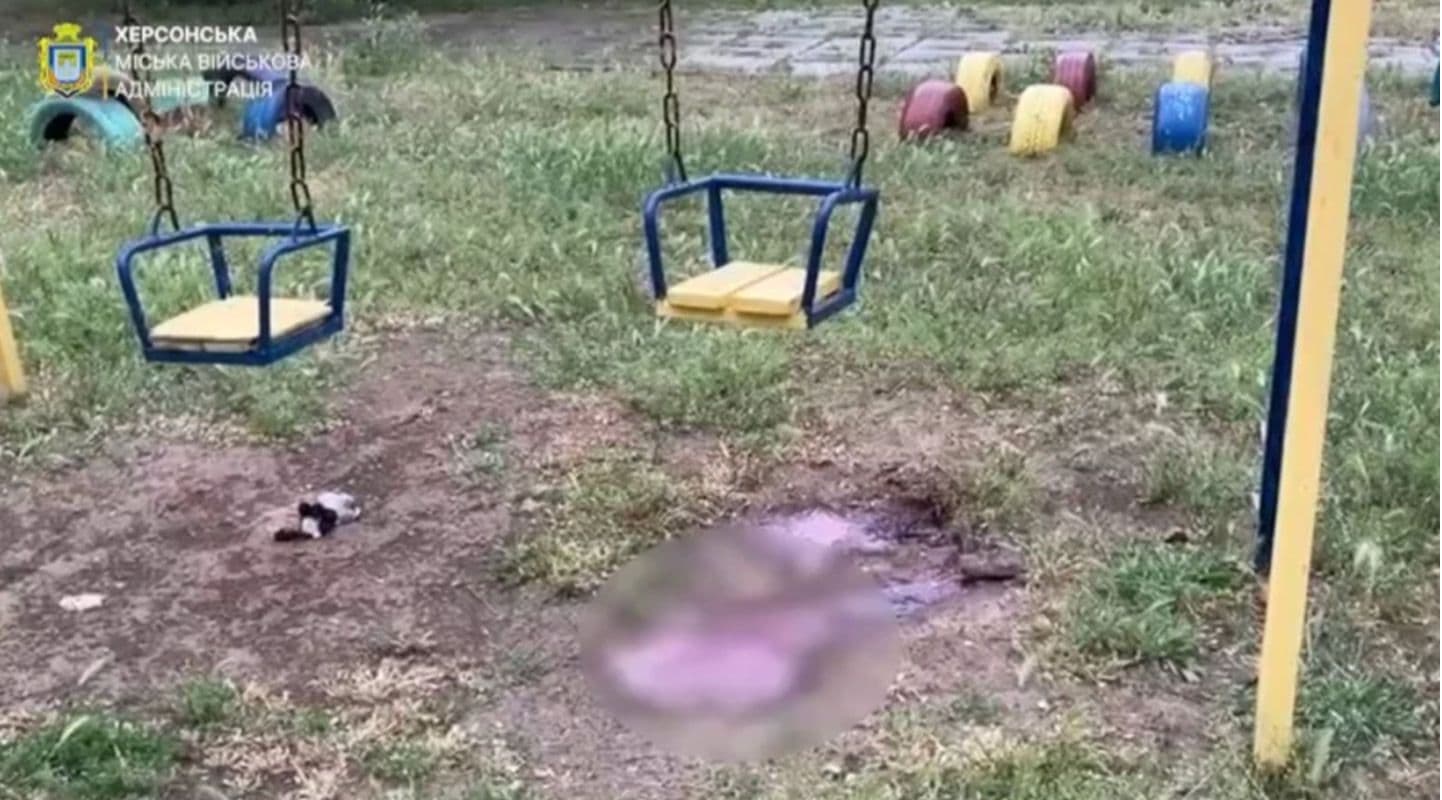
A playground in Kherson’s Korabelnyi district after a Russian strike. The attack killed a father and injured his wife and two young daughters, according to local authorities (Telegram/Kherson City Military Administration). playground — struck by shrapnel the evening before — remained in critical condition.
PUTIN’S FALSE MAPS: HOW EXAGGERATED REPORTS ARE SHAPING KREMLIN STRATEGY
ISW’s assessment of the leaked Russian MoD map is the most significant strategic intelligence disclosure of the week. The map, dated April 9 and covering the Russian Dnepr Grouping of Forces’ area of responsibility in western Zaporizhzhia Oblast, alleges Russian seizure of settlements that ISW had not observed Russian forces entering as of that date, and has not observed Russian forces entering as of May 28. The map was assessed by ISW as likely authentic.
The pattern is not isolated to Zaporizhzhia. In the Kupyansk direction: Gerasimov claimed in late August 2025 that Russian forces seized approximately half of Kupyansk. Putin claimed in October 2025 that Russian forces seized two-thirds and that 5,000 Ukrainian troops were surrounded. Gerasimov claimed full seizure in November 2025, with 3,500 Ukrainians still trapped. ISW observed, from late December 2025, that Ukrainian forces had largely liberated the town and were eliminating the remaining Russian infiltrators. Gerasimov then claimed in April 2026 that Russian forces had finally eliminated the supposedly surrounded Ukrainian troops — almost six months after the alleged encirclement.
Russian milbloggers have repeatedly documented the same feedback loop: inflated reports travel up the chain of command, orders come down to capture areas already claimed as taken, soldiers die in assaults toward positions that never fell. Russian Defense Minister Belousov ordered the Western Grouping to increase the pace of advances across the Kupyansk, Borova, and Lyman directions on May 28 — an order ISW assessed as likely designed to make battlefield reality match the exaggerated maps already shown to Putin.
The Financial Times reported that Putin believes Russian forces can seize all of Donetsk and Luhansk oblasts by fall 2026, after which he plans to escalate territorial demands. ISW’s calculated rate: at 2.63 square kilometers per day in Donetsk Oblast, the timeline is deeply implausible. Russia gained 104 square kilometers total — including infiltrated but not seized areas, this rises to 628 square kilometers — between January 1 and May 26, 2026. In the same period of 2025: 1,619 square kilometers. The Kremlin’s maps are generating a war plan built on fiction.
SWEDEN PLEDGES 36 GRIPEN FIGHTER AIRCRAFT IN $2.7 BILLION PACKAGE
Sweden announced on May 28 a $2.7 billion military support package for Ukraine headlined by 36 Gripen fighter aircraft. The structure: 16 Gripen C/D aircraft donated directly by Sweden, with delivery targeted for early 2027; and 20 Gripen E/F aircraft to be purchased by Ukraine using €2.5 billion from the EU’s Ukraine Support Loan, with delivery targeted to begin in 2030. Ukraine has already begun aircraft maintenance training and pilot preparation. Swedish Prime Minister Kristersson confirmed the timelines and stated that Sweden’s support reflects its commitment to Ukrainian security over the long term.
Zelensky stated that the Gripen’s Meteor air-to-air missile — with a 200-kilometer range — will help displace Russian aircraft from their current operating zones and undermine Russia’s ability to launch glide bomb strikes against Ukrainian territory. Russian forces have operated in a sanctuary in Russian airspace, beyond Ukrainian intercept range, from which they safely release KAB-series glide bombs against Ukrainian frontline positions and cities. Gripen aircraft can deny that sanctuary, forcing Russian aircraft deeper into Russian territory — potentially far enough back that glide bombs cannot reach their targets.
The package also includes unspecified long-range strike capabilities, ammunition, and electronic warfare systems, plus nearly $400 million earmarked for Ukrainian drone production. Ukraine has also developed a domestically produced guided glide bomb, which will likely expand its battlefield air interdiction campaign against Russian rear areas.
PANTSIR SYSTEMS ON MOSCOW ROOFTOPS; RUSSIA BUYS GASOLINE FROM BELARUS
Geolocated footage published on May 28 shows a Russian Mi-26 heavy transport helicopter installing a Pantsir-SMD air defense system on the roof of the Nordstar Tower skyscraper in northern Moscow. The Pantsir-SMD is armed with standard 95Ya6 missiles with a 20-kilometer range and TKB-1055 mini-missiles designed to intercept small drones at up to 7 kilometers. Unlike older Pantsir-S1 systems, the SMD variant carries no 30mm cannons and is optimized for counter-drone operations. The Nordstar Tower sits within 3 kilometers of the Sukhoi Design Bureau, the Moscow Garrison Military Court, GRU headquarters, and the MoD’s 6th Central Research Institute.
A Russian insider source reported that the Kremlin has shifted the cost of new Moscow air defenses to regional governments: the Russian MoD installs the systems, but the Moscow City government finances the contracts through state defense conglomerate Almaz-Antey. Russia has now deployed more than 100 additional air defense systems around Moscow since 2023. Over 40 Pantsir-S1 systems were added in 2025 alone.
Separately, Russian business newspaper Kommersant reported that traders on the St. Petersburg Exchange purchased 17,340 tons of Belarusian gasoline between May 1 and May 22, compared to just 300 tons in the same period in 2025 — a 57-fold increase. Of that volume, 8,880 tons were purchased in the single week of May 18 to 22, nearly four times the prior week. Russian refinery output in April 2026 fell to 4.69 million barrels per day, the lowest since December 2009, following months of Ukrainian drone strikes. Russia is now importing fuel from Belarus to compensate for domestic supply failures caused by the very strikes it denies are affecting its war capacity.
UKRAINE RATIFIES €90 BILLION EU LOAN 298–0; FIRST TRANCHE DUE IN JUNE
Ukraine’s parliament ratified the €90 billion EU support loan on May 28, with 298 of 310 attending lawmakers voting in favor and no votes against. The loan — expected to cover two-thirds of Ukraine’s total budgetary needs for 2026 and 2027 — will be disbursed in tranches conditional on Ukraine’s progress on agreed reform benchmarks. European Commission President von der Leyen confirmed the first disbursement will arrive in June. EC Vice President Dombrovskis said work continues on preparing that tranche.
The ratification does not resolve Ukraine’s full financing picture. A $22.8 billion hole remains in the 2026 defense budget, and one-third of overall budgetary needs are still unaccounted for. On May 22, EU leaders approved only partial payments of three separate financial assistance rounds because Ukraine’s parliament had not yet passed all required reforms. The parliament has shown signs of struggling to keep pace with the reform agenda, and the terms attached to subsequent tranches include measures Kyiv Post and other analysts have described as politically difficult domestically.
THREE SHADOW FLEET TANKERS STRUCK IN BLACK SEA OFF TURKEY
Three Russian shadow fleet tankers were struck by drones in the Black Sea approximately 80 kilometers off the northern Turkish coast on May 28. The vessels — James II, Altura, and Velora, all previously identified as shadow fleet members — were attacked near the Turkish coast. No crew injuries were reported. Ukraine did not comment. Ukrainian long-range maritime drones have previously struck shadow fleet tankers in the Mediterranean and off the Turkish Black Sea coast. Russia’s shadow fleet — aging, often underinsured tankers operating under third-country flags — is the primary mechanism through which Russia circumvents Western oil sanctions and Western officials have linked the fleet to broader Russian hybrid operations including espionage. France, Belgium, and the UK have all conducted boarding and interception operations against shadow fleet vessels in European waters in recent months.
ZAPORIZHZHIA NUCLEAR POWER PLANT: 12-HOUR COMMUNICATIONS BLACKOUT
The Zaporizhzhia Nuclear Power Plant lost both landline and internet connections for approximately 12 hours on May 27, the longest communications blackout at the facility since the start of Russia’s full-scale invasion, IAEA Director General Grossi announced on May 28. The outage occurred alongside reported attacks on the nearby Russian-occupied city of Enerhodar, where most plant employees live. During the blackout, IAEA staff on-site were unable to communicate with the outside world through normal channels.
Grossi stated: “For many hours, we were unable to contact our team of experts at the site, and the plant was unable to communicate with the outside world in the usual way. This was clearly a very concerning event in terms of nuclear safety and security.” The blackout violated the IAEA’s core principle that nuclear facilities must maintain reliable communication with regulators and outside authorities at all times. The IAEA noted separately that it had observed a significant increase in drone activity near several Ukrainian nuclear power plants in recent weeks, with no direct damage recorded but with documented risks to nuclear safety and security.
ORESHNIK DEBRIS REVEALS BELARUSIAN COMPONENTS; US LAWMAKER: STRIKE BACKFIRES STRATEGICALLY
Ukrainian officials confirmed on May 28 that components manufactured at a Belarusian factory were found inside the Oreshnik missile used in the May 24 strike against Ukraine. This followed a May 27 statement by Presidential envoy Vlasiuk suggesting the Oreshnik may contain few or no foreign-made components — an assessment now partially revised. U.S. House Intelligence Committee member Himes, visiting Kyiv, stated that recovered Oreshnik debris is being studied by Ukrainian and Western analysts and is providing intelligence value, including assessment of the system’s performance and technology. “Like many other steps taken by Vladimir Putin, this will have the opposite effect to what he is trying to achieve,” Himes said. The deployment of a nuclear-capable weapon against a non-nuclear country has generated intelligence windfall rather than deterrence.
FRONTLINE: UKRAINE ADVANCES NEAR VELYKYI BURLUK AND OLEKSANDRIVKA; SUMY AND ZAPORIZHZHIA ACTIVE
In northern Kharkiv Oblast, military observer Mashovets reported on May 28 that Ukrainian forces liberated Odradne east of Velykyi Burluk and advanced approximately 3 kilometers deep and 7 kilometers wide in the Hryhorivka-Odradne direction after counterattacking. Russian forces do not maintain stable control over Dvorichanske south of Odradne. Ukrainian forces continue to hold Hraniv, Neskuchne, and Zelene — settlements where Russia had previously claimed control. Russian forces have been equipping units in the Vovchansk direction with light motorized vehicles to increase advance tempo. Mashovets assessed Russian forces have penetrated about 3.5 to 3.7 kilometers east of Vovchansk but have not seized Zybyne, and Ukrainian forces hold at least half of Vilcha and positions near Lyman and Prylipka.
In northern Sumy Oblast, geolocated footage from May 16 and 28 shows Ukrainian forces striking Russian forces west of Popivka and in northern Novodmytrivka, indicating Russian forces recently seized Popivka and Vysoke and conducted infiltrations in Novodmytrivka. However, Ukrainian forces continue to hold most of Ryasne, and Russian infiltration missions toward Turya and Petrushivka have been unsuccessful. Ukrainian drone activity is hindering Russian advance near Zapsillya.
In the Oleksandrivka direction, geolocated footage from May 28 shows Russian forces striking a Ukrainian position in Tovste northeast of Oleksandrivka, indicating a Ukrainian advance into the settlement. A Russian milblogger’s published map acknowledges Ukrainian presence in Zelenyi Hai, Novokhatske, Andrivka-Klevtsove, Piddubne, Hrushivka, and north of Oleksandrohrad. A Kremlin-affiliated milblogger admitted on May 28 that Ukrainian strikes on Russian logistics are preventing the Eastern Grouping from concentrating forces in the Oleksandrivka area.
In western Zaporizhzhia Oblast, Russian forces made flag-raising claims in Vozdvyzhivka that were refuted by Ukrainian Southern Defense Forces. Russian forces continued infiltration missions northwest to southwest of Hulyaipole without advancing. Ukrainian forces struck a Russian drone production facility in occupied Azovskyi Raion overnight. In occupied Kherson Oblast, Russian engineer detachments from the 58th Combined Arms Army are now clearing logistics routes daily and deploying motorcycles and ATVs to escort convoys against Ukrainian drone strikes — manpower committed to counter-drone protection rather than offensive operations.
UKRAINIAN MID-RANGE STRIKE CONFIRMED: BUK-M2, NEBO-SV RADAR, RAILWAY BRIGADE DEPOT
The Ukrainian General Staff and USF Commander Brovdi confirmed a series of strikes in occupied Luhansk Oblast overnight May 26 to 27: two Buk-M2 air defense systems in occupied Kadiivka, roughly 50 kilometers from the frontline; a Nebo-SV mobile radar station in occupied Kamyanka, roughly 60 kilometers from the frontline; a logistics and support depot of the Russian 39th Separate Railways Brigade in occupied Sorokyne, roughly 140 kilometers from the frontline; and a logistics depot and temporary deployment site of the Russian 330th Separate Radio-Technical Regiment in occupied Tsvitni Pisky, roughly 95 kilometers from the frontline. Geolocated footage also confirmed a strike on a Russian artillery convoy on the M-30 Debaltseve-Luhansk highway, with an overturned truck blocking the road toward Luhansk City.
In occupied Donetsk Oblast, Ukrainian forces struck a semi-truck carrying an S-350 air defense system near Kamyanuvate, a deployment point of the Russian 9th Motorized Rifle Brigade near occupied Bezymenne on the Sea of Azov coast, and logistics targets in the Donetsk direction. The General Staff separately confirmed the Storm Shadow strikes against Russian reconnaissance automation systems near Voronezh, Taganrog, and occupied Sevastopol. Russia’s own milbloggers acknowledged on May 28 that Ukrainian mid-range strikes are targeting logistics 50 to 100 kilometers from the frontline and described roadside defenses as insufficient. One milblogger disclosed that the Russian military command has reportedly ordered military vehicles to be repainted to resemble civilian vehicles — which constitutes perfidy under the Geneva Conventions.
OVERNIGHT STRIKE: KINZHAL MISSILE AND 147 DRONES; SIX OBLASTS HIT; THREE-YEAR-OLD CRITICAL
Russian forces launched one Kinzhal aeroballistic missile from Lipetsk Oblast and 147 Shahed, Gerbera, Italmas, and decoy drones overnight May 27 to 28. Ukrainian air defenses downed 138 drones. The Kinzhal and nine drones struck seven locations; debris fell on six more. Russian attacks damaged agricultural, residential, energy, and educational infrastructure in Chernihiv, Dnipropetrovsk, Kharkiv, Poltava, and Odesa oblasts. Ukrenergo reported power outages in Sumy, Kharkiv, Donetsk, and Dnipropetrovsk oblasts.
Russian attacks across Ukraine on May 28 killed at least two people and injured 23 others. In Kherson Oblast, the three-year-old girl struck by shrapnel at the Korabelnyi playground on May 27 remained in critical condition with blast injuries and shrapnel wounds to her head, torso, arms, legs, and chest. Her six-year-old sister underwent surgery for shrapnel wounds and remained in moderate condition. Their mother was in serious condition with abdominal and head injuries. Across Kherson Oblast, Russian attacks injured 12 others and damaged apartment blocks, private homes, a bank, a restaurant, and a gas pipeline. In Donetsk Oblast, one person was killed and one was injured in Druzhkivka. Russian attacks also damaged a sports complex, administrative buildings, and transport infrastructure. In Dnipropetrovsk, three people were injured in Pavlohrad and the Bohdanivka community. In Sumy, an 11-year-old boy was injured in a drone attack on Okhtyrka. In Kharkiv Oblast, a 62-year-old man was injured in Kozacha Lopan.
UKRAINE REINFORCES ENTIRE 1,085-KILOMETER BELARUS BORDER UNDER ZELENSKY’S ORDERS
State Border Guard Service spokesman Demchenko confirmed on May 28 that Ukraine is carrying out engineering fortification works directly on the 1,085-kilometer border with Belarus, with additional defense layers being built deeper behind it, under direct instructions from Zelensky. Local authorities are participating in the effort. “The work that has already been done is now being built on further,” Demchenko stated. The reinforcement follows Zelensky’s identification of five Russian scenarios for a renewed northern offensive and his order for unprecedented security measures across Chernihiv, Kyiv, Zhytomyr, Volyn, and Rivne oblasts.
Latvia simultaneously began installing concrete dragon’s teeth anti-tank barriers on its border with Russia as part of the Baltic Defense Line, joining Lithuania — which emplaced similar obstacles in August 2025 — and Estonia, which reinforced the Narva crossing with anti-tank barriers and heavy metal gates capable of stopping traffic in both directions. NATO is reportedly preparing plans to rapidly deploy additional corps-level forces to the Baltic states in case of conflict. The moves reflect a shared strategic logic: slow any potential advance near the frontier, buy time for reinforcements, and signal that resistance is prepared.
US LAWMAKERS IN KYIV: ‘AMERICA WILL RESPOND POSITIVELY’ TO AIR DEFENSE REQUEST
U.S. Senator Blumenthal and Representative Himes visited Kyiv on May 28 and met with Zelensky. Blumenthal stated: “My hope and expectation is that America will respond positively to this request” on Patriot missiles. He said both lawmakers would advocate for additional air defense and tougher sanctions on Russia upon returning to Washington. Ukraine’s Ambassador Stefanishyna stated separately that Ukraine is prepared to financially purchase additional Patriot systems and missiles if the U.S. agrees to supply them. “The only thing that is exclusively in the hands of the US government is the ability to intercept ballistic missiles,” she said. The White House had not publicly responded to Zelensky’s letter. Republican Congressman Joe Wilson also backed Ukraine’s request, stating: “Air defense saves lives, and Ukraine is a proven partner.”
EU CYPRUS MEETING: EUROPE WILL NOT BE A NEUTRAL MEDIATOR; SCHROEDER REJECTED
EU foreign ministers met informally in Lemesos, Cyprus on May 28. Norwegian Foreign Minister Eide stated that Europe cannot serve as a mediator between Ukraine and Russia because it is on Ukraine’s side — and that any formal mediation role should be taken by actors able to maintain greater distance from the conflict. EU Foreign Policy Chief Kallas delivered a similar assessment, arguing that direct dialogue with Russia risks weakening European leverage and that EU members must first agree among themselves on what questions to raise with Moscow and what their red lines are — including reparations, the return of abducted Ukrainian children, and the withdrawal of Russian troops from occupied territories. Estonian FM Tsahkna stated that what Putin fears most is tighter restrictions limiting Russia’s ability to continue the war, and warned that a drift toward a mediator role would reduce momentum for such measures. The EU foreign ministers definitively rejected former German Chancellor Schroeder as a potential envoy, citing his ties to Russian state energy companies.
NIGERIA RECRUITS KILLED FIGHTING FOR RUSSIA; AFRICAN RECRUITMENT SCHEME DOCUMENTED
Ukrainian military intelligence confirmed that Ayebusiwa Olabode Victor, a Nigerian national, was killed fighting for Russia in the Kharkiv region. HUR stated this was part of a systematic Russian practice of recruiting African citizens through false employment offers. The documented scheme: job advertisements on Facebook and WhatsApp promise legal employment in Russia; recruits receive visas and travel to Moscow; their passports are confiscated; they are housed in hostels; when no jobs materialize, they are threatened with arrest or deportation and pressured into signing military contracts they cannot read; after approximately one week of training, they are deployed to the frontline. More than 215 Nigerian nationals are currently believed to be serving in Russian forces; at least 25 have been killed or are missing. HUR urged foreign nationals to surrender through Ukraine’s Hochu Zhit project.
IRAN-U.S. MEMORANDUM: 60-DAY CEASEFIRE, HORMUZ REOPENS; OIL PRICE IMPACT ON RUSSIA
U.S. and Iranian negotiators agreed on a 60-day memorandum on May 28 that includes a temporary ceasefire, renewed nuclear talks, and the reopening of the Strait of Hormuz, pending President Trump’s approval, according to U.S. officials. Commercial shipping through the strait — through which roughly one-fifth of global oil and LNG transits daily — will proceed without duties, delays, or Iranian attacks. Iran will remove all naval mines within 30 days; the U.S. will gradually lift its naval blockade proportionally. Iran committed not to pursue nuclear weapons development; negotiations will address the disposal of highly enriched uranium stockpiles and sanctions relief.
The deal’s strategic significance for Ukraine is indirect but real. The Iran-Israel-U.S. conflict had driven global oil prices higher, temporarily bolstering Russian export revenues and helping Russia’s budget avoid collapse. Ukraine’s NBU had described these elevated oil revenues as “financial doping.” If the memorandum holds and the Strait of Hormuz reopens, global oil prices may decline, reducing the financial oxygen sustaining Russia’s war economy at the same time that Ukrainian drone strikes continue suppressing Russian refinery output.
TRUMP ENDORSES ARMENIAN PM PASHINYAN AHEAD OF JUNE 7 ELECTION
U.S. President Trump endorsed Armenian Prime Minister Pashinyan in a Truth Social post overnight May 27, calling him “a great friend and leader” making Armenia “strong, wealthy, and very secure.” Trump cited energy corridor access from Central Asia to the United States as a material interest alongside strategic considerations. Pashinyan has frozen Armenia’s CSTO participation following Russia’s failure to protect Armenia during Azerbaijan’s 2023 Karabakh operation, hosted the European Political Community summit, signed a strategic partnership with the U.S., and received Zelensky in Yerevan. Russian President Putin had previously warned Armenia it must choose between Russia and Europe; Lukashenko stated “no one needs Armenia.” Pashinyan responded directly: “Armenia is becoming a crossroads of the world. This is no longer a country robbed by you and your partners.”
Putin’s generals have been showing him false maps. Sweden pledged 36 fighter aircraft. Russia is mounting air defense systems on office towers in Moscow and buying gasoline from Belarus. Ukraine ratified a €90 billion loan 298–0. Three shadow fleet tankers were struck in the Black Sea. The Zaporizhzhia nuclear plant went dark for 12 hours.
The three-year-old girl from the Kherson playground remained in critical condition. Ukrainian forces liberated Odradne and advanced in Oleksandrivka. The Kremlin’s war plan is built on maps that do not match the terrain. The Gripen’s Meteor missile has a range of 200 kilometers. A Nigerian man whose passport was confiscated in Moscow died on a frontline in Kharkiv Oblast.
Day 1,555. The Kremlin’s maps are fiction. Ukraine’s next fighter jets are named after Nordic birds of prey.
A PRAYER FOR UKRAINE
1. For the Three-Year-Old in Critical Condition
Lord, a three-year-old girl struck by shrapnel on a playground in Kherson remained in critical condition on May 28. Blast injuries and shrapnel wounds to her head, torso, arms, legs, and chest. Her six-year-old sister underwent surgery and is in moderate condition. Their mother is in serious condition with abdominal and head injuries. Their father was killed at the scene. This family went to a playground on the evening of May 27. We do not ask You to explain this. We ask You to keep the three-year-old alive. To give the surgeons in whatever Kherson hospital is treating her the skill and resources she needs. To hold the mother in the days she will face recovering from her own injuries while unable to go to her children. And to sustain the six-year-old who is old enough to understand that her father is not coming home.
2. For the Men Dying on False Maps
God of truth, ISW confirmed on May 28 that Putin’s generals have been showing him fabricated battlefield maps — maps that claim Russian forces hold positions they have never entered, that show advances that did not happen, that describe encirclements that collapsed before they were reported. Russian milbloggers have documented what this means in practice: orders come down to capture areas already claimed as taken, and soldiers die in assaults against positions that were never lost to begin with. We do not pray for the generals who constructed these false maps or the system that incentivizes them. We pray for the Russian soldiers sent to their deaths by orders generated from fiction. They are not the authors of this war. Many of them are young men from regions of Russia far from Moscow who signed contracts for money they needed, who were trained for a week and sent forward, who are dying in assaults whose purpose exists only on a map. Receive them. And let the men who built the system that kills them in this way one day be held to account for it.
3. For Ayebusiwa Olabode Victor
Father, a Nigerian man was killed in Russia’s war in Ukraine. His name was Ayebusiwa Olabode Victor. He was recruited with promises of employment. His passport was taken. He signed a contract he likely could not read. He received approximately one week of training. Then he was sent to the Kharkiv frontline, where he was killed. Ukrainian intelligence says more than 215 Nigerian nationals are currently serving in Russian forces; at least 25 have been killed or are missing. They are one category among many of people caught in Russia’s machinery of deception. We pray for his family in Nigeria, who received or are still awaiting news of what happened to him. And we pray that the governments of Africa’s nations find the political means to shut down the recruitment networks targeting their citizens — that their young men stop becoming “a one-way ticket” to someone else’s war.
4. For the IAEA Experts at Zaporizhzhia
Lord, the staff of the International Atomic Energy Agency at the Zaporizhzhia Nuclear Power Plant lost all communication with the outside world for 12 hours on May 27. They were on the grounds of Europe’s largest nuclear facility, occupied by Russian forces since 2022, as attacks struck the nearby city of Enerhodar. For 12 hours, no one outside could reach them and they could reach no one. The IAEA director said it clearly: this was very concerning in terms of nuclear safety and security. We pray for the monitoring staff who remain at Zaporizhzhia, who go each day to a facility that holds the potential for a catastrophe that would dwarf anything that has happened in this war so far. Sustain their vigilance. Protect their ability to communicate. And let the political pressure needed to establish genuine safety guarantees for Zaporizhzhia accumulate into the action it demands.
5. For Anna Minakova, and the Hundred People Who Went Underground to Hear Music
God of beauty, about a hundred people descended a narrow metal staircase in Kharkiv on a March evening to hear Anna Minakova play piano at a concert in an underground venue a few dozen miles from the front. They went underground not because they were afraid, but because that is where the music was. Anna rebuilt her choir after 80 percent of its members remained abroad — rebuilt it from scratch, in a city under constant threat, because she believed that accumulating the energy of many people through music was her main mission. We pray for her and for everyone who goes to rehearsal in the Polytechnic Institute’s basement several times a week. For the two men in the choir currently serving in the military. For the people with disabilities who sing alongside them. For the teachers and the displaced and the exhausted who come to sing because they need something normal to hold onto. The concert ends before midnight because the curfew begins. That is Kharkiv in 2026. And yet: ‘I want to see the blossom.’ Let her.