
Ukraine Daily Briefing — June 14, 2026
Royal Marine Commandos seized a sanctioned Russian shadow fleet tanker in the English Channel — the first such British operation in history — even as Ukrainian drones set a chemical plant ablaze in Tula Oblast and turned a strategic fuel depot in Yaroslavl Oblast into a column of fire 700 kilometers inside Russia. On the eve of the G7 summit in Evian-les-Bains, Trump called both Zelensky and Putin on the same day, the United Nations declared May the deadliest month for Ukrainian civilians since April 2022, and Russian drones struck the Kharkiv Art Museum — home to 25,000 works — leaving a one-month-old infant among the casualties.
The Day’s Reckoning
Picture a Royal Marine in full kit, rappelling onto the deck of an oil tanker in the predawn darkness of the English Channel. The vessel is the Smyrtos — flying a Cameroonian flag, carrying Russian crude, sanctioned by five countries and hunted for months. The operation lasted six hours. By dawn, the ship was in British custody, its crew under arrest, and the Kremlin was short one more vessel in the shadow fleet it uses to keep its war machine funded.
Hundreds of kilometers east, the night sky over Tula Oblast lit up as Ukrainian drones reached the Azot chemical plant in Novomoskovsk — a facility that produces nitric acid, acetic acid, and ammonium nitrate for Russian artillery shells, bombs, and missiles. Simultaneously, Special Operations Center “A” of Ukraine’s Security Service struck the Temp reserve oil depot in Rybinsk, Yaroslavl Oblast, igniting fires across a tank farm of more than 60 storage tanks, 700 kilometers (435 miles) from the Ukrainian border. Russia scrambled flight restrictions across six airports and declared air-raid alerts in 28 of its regions.
In Kharkiv, a Russian drone struck the city’s art museum — an architectural monument housing 25,000 works including Ukraine’s largest collection of Illia Repin paintings. A one-month-old infant was hospitalized. Emergency crews worked through the night to evacuate the collection while firefighters battled a blaze that consumed more than 1,200 square meters.
And at the diplomatic level, the G7 gathered in France with Ukraine’s fate hanging in the balance. Trump called Zelensky and Putin on the same day. The United Nations announced that May had been the deadliest month for Ukrainian civilians since April 2022. The war is at its most lethal. The world is trying, again, to decide what to do about it.
Boarding the Smyrtos: Britain’s First Strike on Russia’s Shadow Fleet
In the early hours of June 14, Royal Marine Commandos and specially trained officers from the National Crime Agency descended onto the deck of the Smyrtos in international waters of the English Channel. Prime Minister Keir Starmer had personally authorized the mission. The operation lasted approximately six hours and ended with the tanker in British custody — the first time the United Kingdom had seized a Russian shadow fleet vessel.
The shadow fleet is a network of more than 700 vessels — often old, often operating under obscure flags of convenience — that carries roughly 75 percent of Russia’s sanctioned oil. That oil generates the revenue that funds the missiles and drones raining down on Ukrainian cities. The Smyrtos, flying Cameroon’s flag, was sanctioned by the EU, the UK, Switzerland, Canada, and Ukraine, yet it had continued operating because no one had been willing to physically stop it — until now.
UK Defense Secretary Dan Jarvis described the income from these vessels as directly financing Russia’s attacks on civilians. After the seizure, Russian shadow fleet tankers bound for the English Channel abruptly changed course, according to ship-tracking data. The message had been received.
Zelensky thanked Starmer and called for Europe to go further — not merely detaining shadow fleet vessels but confiscating the oil they carry. “Every decision by partners that deprives Russia of money also limits the war itself,” he wrote. The UK has now sanctioned nearly 600 shadow fleet vessels. France seized one in the Atlantic on May 31. The noose is tightening, one boarding at a time.
Fire in Tula and Yaroslavl: Ukraine’s Long-Range ‘Sanctions’ Reach Deeper
The Azot chemical plant in Novomoskovsk, Tula Oblast, does not appear on many tourist maps. But Ukrainian Unmanned Systems Forces Commander Major Robert “Magyar” Brovdi knows it well. On the night of June 13 to 14, his forces struck it. The plant produces nitric acid, acetic acid, and ammonium nitrate — the raw materials of Russian artillery shells, bombs, and missiles. NASA fire-monitoring satellites confirmed heat anomalies at the facility in the aftermath. Tula Oblast Governor Dmitry Milyaev acknowledged Ukrainian drones had struck an “industrial enterprise” in Novomoskovsk, declining to mention it by name.
Seven hundred kilometers (435 miles) from Ukraine, in Rybinsk, Yaroslavl Oblast, Ukraine’s Security Service hit harder still. The target was the Temp reserve oil depot — part of Russia’s Federal Agency for State Reserves, a facility designed to hold inviolable strategic fuel stocks for wartime use. Each of its more than 60 storage tanks can hold up to 5,000 cubic meters of fuel. At least three major fires broke out across the tank farm.
The SBU called it “a successful strike on the Temp reserve oil depot” by Special Operations Center “A.” Yaroslavl Oblast Governor Mikhail Yevrayev acknowledged that drones had struck “industrial fuel storage facilities” in his region. Flight restrictions were imposed at six Russian airports, and air-raid alerts were declared across 28 Russian regions — a measure of just how deep Ukraine’s drone arm has learned to reach.
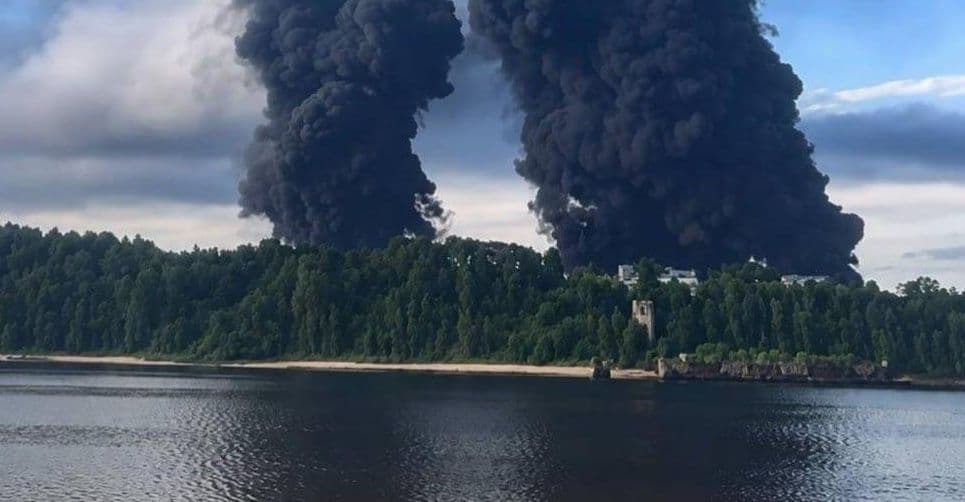
Smoke rises over the Temp oil depot in the Russian town of Rybinsk, Yaroslavl Oblast, following an overnight Ukrainian attack. (Astra / Telegram)
The strikes are part of a campaign Zelensky calls Ukraine’s long-range “sanctions” — systematic attacks on Russian oil infrastructure, military supply chains, and defense-industrial targets. In recent weeks, that campaign has also hit the Afipsky Oil Refinery in Krasnodar Krai, oil refineries in Tatarstan more than 1,000 kilometers from the front, and a military factory in Cheboksary struck with domestically-produced FP-5 Flamingo missiles.
‘Another Act of Russian Terrorism’: The Kharkiv Art Museum Burns
The Kharkiv Art Museum was designed by Ukrainian architect Oleksiy Beketov. It houses 25,000 works — paintings, graphics, sculptures, decorative arts. Among them is Ukraine’s largest collection of Illia Repin paintings, including the famous “Reply of the Zaporozhian Cossacks.” Repin was born in Chuhuiv, in what is now Kharkiv Oblast; his work is as tied to Ukraine as any artist’s could be. On the evening of June 14, a Russian drone hit the museum.
The strike injured five people: four women aged 62, 34, 28, and 22 — and a one-month-old infant, who was hospitalized. The blaze consumed more than 1,200 square meters. Kharkiv Governor Oleh Syniehubov described it as “another act of Russian terrorism.”
Emergency crews, municipal workers, volunteers, and ordinary Kharkiv residents worked through the night to evacuate artwork from the burning building. Firefighters battled the blaze under threat of the double-tap strikes Russia routinely uses to kill first responders. The fire was eventually localized, though the extent of damage to the collection remained unclear.
The museum had already survived a Russian attack in 2022. It survived this one, too — barely. Russia’s campaign against Ukraine’s cultural heritage has now damaged or destroyed museums, historic churches, theaters, and archives across the country. A May 24 attack on Kyiv damaged the National Art Museum and the Kyiv Opera Theater. The Chornobyl Museum lost more than 40 percent of its collection. What centuries built, drone strikes can destroy in seconds.
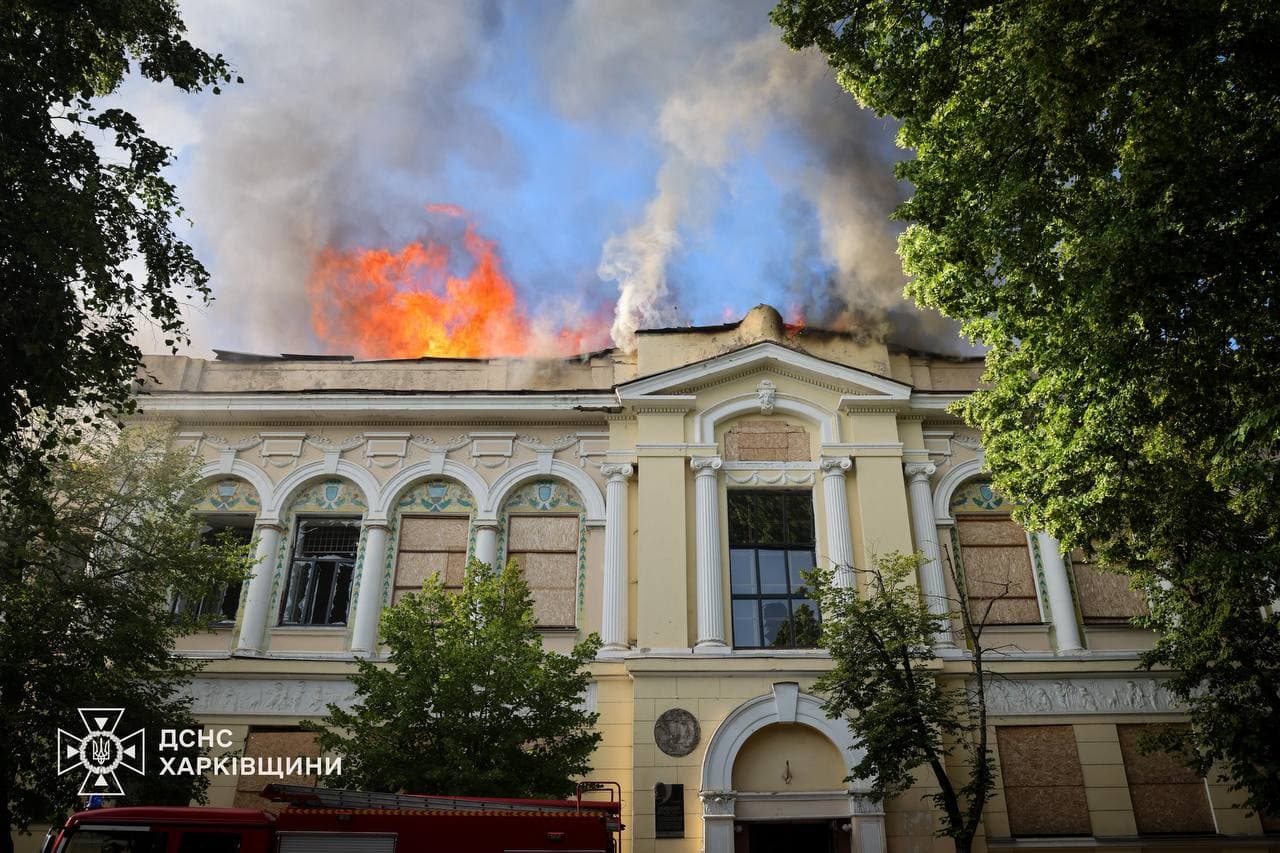
Flames engulf the Kharkiv Art Museum in northeastern Ukraine after a Russian drone attack. (Ukraine’s State Emergency Service / Telegram)
The War at Its Deadliest: UN Records Highest Civilian Toll Since 2022
The numbers came from the United Nations Human Rights Monitoring Mission in Ukraine, and they were stark: May 2026 was the deadliest month for Ukrainian civilians since April 2022 — the opening weeks of Russia’s full-scale invasion. At least 274 civilians were killed and 1,763 injured during the month, the highest monthly casualty toll in four years.
“The intensification of hostilities and the increasingly frequent use of powerful weapons in urban areas led to high numbers of civilians killed and injured across the country,” said HRMMU head Danielle Bell. The harm was not confined to the front line. Missile and aerial bomb attacks killed civilians in cities far from the fighting.
Among the deadliest documented incidents: a May 5 strike on an industrial area in Zaporizhzhia killed 12 civilians and injured 42; a May 14 missile strike on a residential building in Kyiv killed 24 people. The UN also documented civilian deaths in Russian-occupied territory, including a May 21-22 strike on a training facility in occupied Starobilsk, Luhansk Oblast, that killed 21 civilians.
Short-range drone attacks have become a particular driver of civilian harm. The UN verified at least 64 deaths and 539 injuries from short-range drones in May alone — the highest monthly total for that weapon type since the invasion began. Kherson was among the hardest hit: 14 civilian deaths and 221 injuries in a single month, as Russian drone operators systematically hunt civilians, emergency workers, and vehicles in what survivors call a “human safari.”
Nearly 2,000 Drones in a Week: Russia’s Aerial Terror Campaign
Zelensky took to Telegram with a number that staggers the imagination: in the seven days from June 7 to June 13, Russia fired 1,920 combat drones, 1,790 guided aerial bombs, and 17 missiles of various types at Ukraine. Nearly 2,000 drones. In a single week.
On the night of June 13 to 14 alone, Russian forces launched 98 Shahed-type, Gerbera-type, and Italmas-type strike drones from multiple directions — from Oryol and Bryansk in Russia’s interior, from Primorsko-Akhtarsk in Krasnodar Krai, and from occupied Crimea. Ukraine’s air defenses intercepted 91 of them. Seven got through, striking six locations. Dnipropetrovsk, Mykolaiv, and Sumy oblasts reported damage to residential, commercial, industrial, transport, and energy infrastructure.
In Sumy Oblast, Russian forces also conducted a double-tap strike against first responders at the scene of a prior attack in Putyvlya — a tactic designed to kill the people trying to save lives. In Kharkiv Oblast, Russian drones hit the Lozova railway station, injuring two train conductors. “Despite the shelling, railway workers continue to do their work and ensure stable transport connections,” Ukraine’s Ministry of Communities said — a sentence that captures something essential about how this country has refused to stop functioning under sustained assault.
Ukraine faces a critical shortage of the Patriot PAC-3 interceptor missiles it needs to counter Russian ballistic strikes. Zelensky has been pressing partners for more at every opportunity, including a personal letter to Trump in May. The G7 and NATO summits now approaching represent what Zelensky called “an opportunity to secure concrete decisions” — particularly on air defense, long-range capabilities, and expanded drone cooperation.
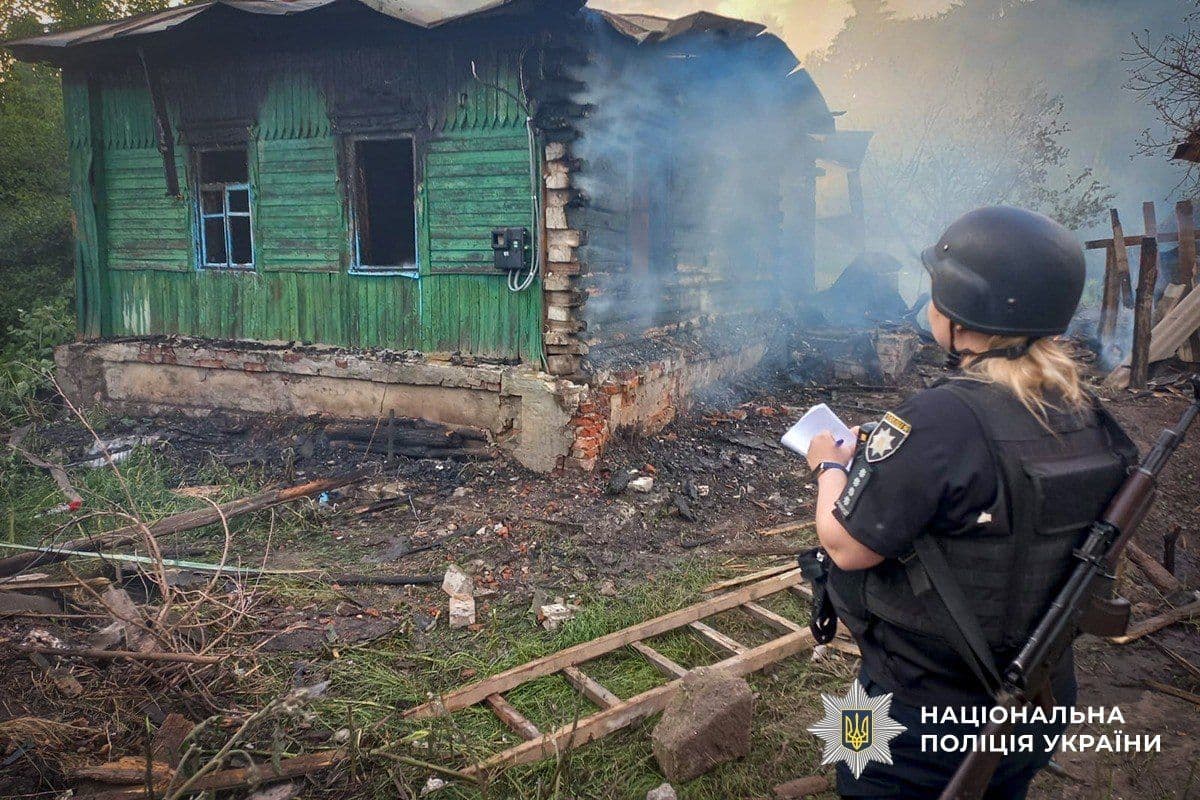
A police officer inspects the site struck by Russian forces in Sumy Oblast over the past day, published on June 14, 2026. (National Police of Ukraine)
Happy Birthday, Mr. President: Trump Calls Zelensky and Putin on the Same Day
June 14 was Donald Trump’s 80th birthday. Zelensky called to congratulate him — and stayed on the line for thirty minutes. “It wasn’t just congratulations,” Zelensky said afterward. “We discussed many key topics: about the war, its roots, diplomatic opportunities, and the positions of our partners. We talked at length. In great detail.”
The two leaders agreed to discuss peace ideas further at the G7 summit the following day. Zelensky described the conversation as “wonderful” and said he had updated Trump on battlefield developments and how Ukraine’s position had strengthened. He also thanked Trump for past military support “from Javelins to Patriots” and noted that Trump had himself called out Russia’s 2014 seizure of Crimea as the war’s true starting point — an observation Zelensky described as “absolutely spot-on.”
Hours later, Trump spoke with Putin. That call lasted 55 minutes and was described by the Kremlin as “friendly in nature.” Kremlin aide Yuri Ushakov framed Trump’s message as a promise to “exert influence” on both European partners and Ukraine — a telling characterization of whose side the Kremlin believes Trump is working. The two leaders reportedly agreed that Trump’s envoys Steve Witkoff and Jared Kushner would travel to Moscow again “soon.” Neither man has visited Kyiv even once.
The calls took place on the eve of the G7 summit in Evian-les-Bains, France — where Ukraine, the peace framework, and the question of how hard the West is willing to push Putin will all converge. The diplomatic window is real. Whether it opens further or closes depends on what happens in the next 72 hours.
Evian on the Eve: The G7’s Five-Point Gamble for Peace
The G7 summit opening June 15 in Evian-les-Bains, France, carries more weight than usual. European leaders believe a genuine, if narrow, diplomatic window has opened — and they intend to use it. The E3 nations (UK, France, and Germany) worked with Zelensky in London to formulate a five-point framework for ending the war. Its details remain classified, but its pillars are clear: an immediate ceasefire along current front lines, paired with long-term security guarantees for Ukraine enforced by a multinational force.
The European calculation is direct. “Russia cannot win militarily, and its economy is struggling,” a German government source explained. “Therefore, for the first time, a window of opportunity for diplomacy may be slowly opening.” The E3’s goal at Evian is to secure Trump’s endorsement of the framework — creating a unified American-European position that Moscow would find much harder to dismiss than European proposals alone.
One complication: Europe cannot agree on who speaks for it. Italian Prime Minister Giorgia Meloni, frustrated by institutional turf battles among EU heavyweights, has proposed Finnish President Alexander Stubb as a unified EU envoy for future peace talks. Her criteria are precise: the envoy must not represent a major EU power, must have transatlantic credibility, and must understand the war’s strategic realities. Stubb — who leads NATO’s most exposed frontier state and recently declared that “Ukraine’s in a position of strength now militarily, politically, and economically” — fits the bill in Rome’s view.
The obstacles remain formidable. Putin has refused to accept a ceasefire, insisting it would merely give Ukraine time to regroup. He continues to demand Kyiv surrender the entire Donetsk region — a demand Ukraine has categorically rejected. And he has opposed any European peacekeeping presence on Ukrainian soil. Zelensky joins the G7 leaders for a dedicated session on June 16. The world will be watching whether the room produces convergence or more delay.
The Numbers Putin Didn’t Want Anyone to See: Leaked Kremlin Polling
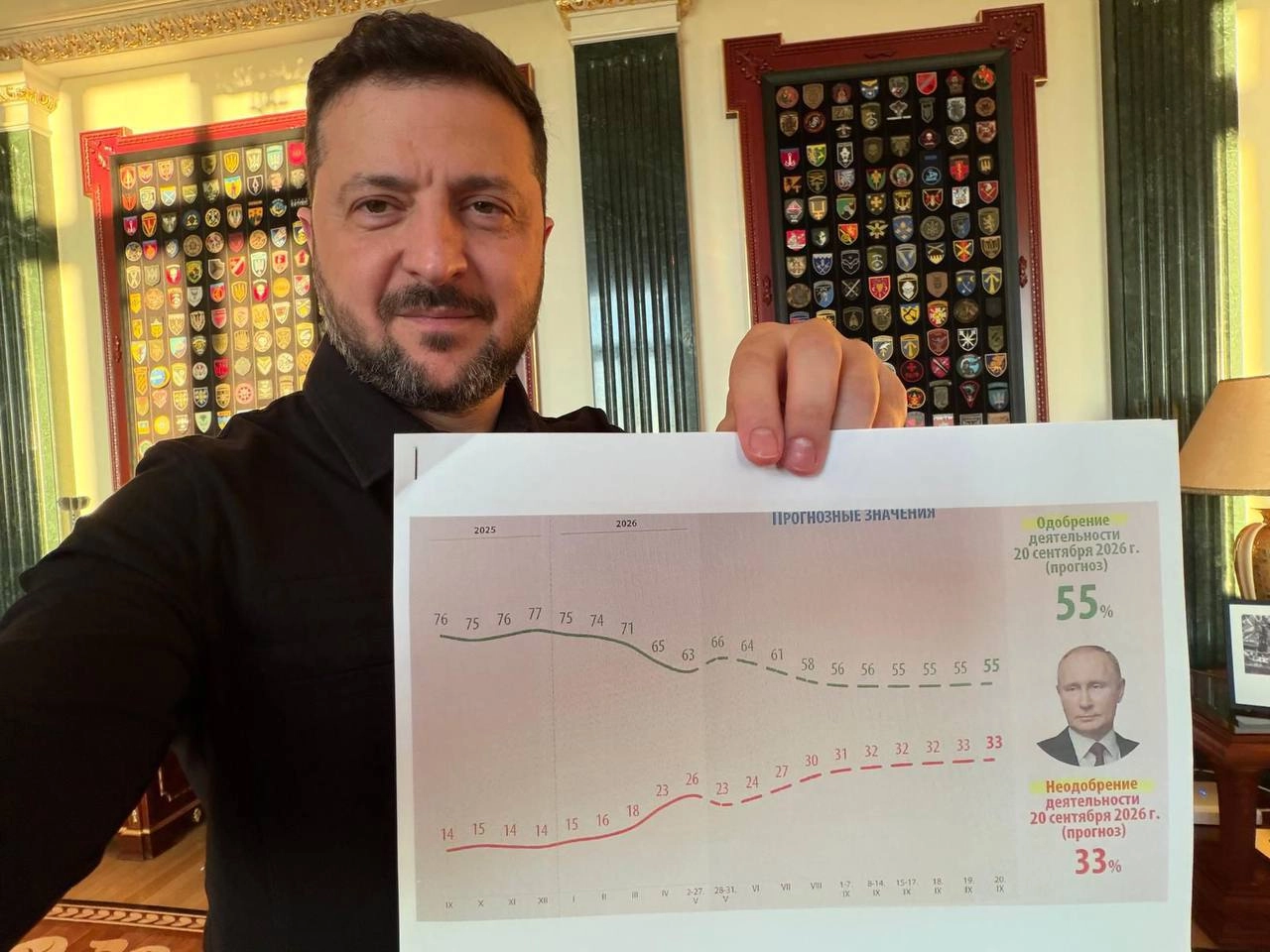
President Volodymyr Zelensky holds one of the documents reportedly brought to Vladimir Putin’s desk. (Photo by Volodymyr Zelensky/Telegram)
Ukrainian intelligence obtained what Zelensky described as classified internal Kremlin documents: forecasts of Vladimir Putin’s domestic approval ratings ahead of Russia’s September parliamentary elections. On June 14, Zelensky published them — or at least what he said they showed.
The picture is not flattering to the Kremlin. Internal analysts project that by September 20, 2026 — election day — 55 percent of Russians will approve of Putin’s actions, while 33 percent will explicitly disapprove. Support for the ruling United Russia party is described as following a “steady downward trend,” with projections acknowledging that maintaining Duma control will require “significantly more falsifications” than in previous cycles. “Substantial growth in protest sentiment in Russian regions” is documented throughout.
Zelensky noted that these projections were calculated before accounting for what may happen militarily and economically in June, July, and August. Russia’s state-controlled pollster had already quietly stopped publishing Putin’s “open” trust rating after it reportedly fell to its lowest level since the full-scale invasion began. The Russia Day celebration was moved indoors and off Red Square. Putin himself, at that event, admitted that Ukrainian drones are causing “severe, daily problems” for Russian troops — a remarkable public concession.
“If these trends continue, an agreement may eventually have to be concluded with someone else from Russia — someone who will not shut themselves off from reality,” Zelensky said. It was a pointed observation: that Ukraine’s battlefield and economic pressure may ultimately force political change in Moscow that diplomacy alone cannot achieve.
City of Shadows: The Battle for Kostyantynivka
Before the war, Kostyantynivka was home to 78,000 people. Today it is largely destroyed, and Russian forces have infiltrated its southern, eastern, western, and now northern districts. Yet they do not control it. The situation is something stranger and more difficult to describe: a city where two armies occupy the same streets.
The Russian Ministry of Defense claimed on June 14 that elements of the 3rd and 8th Combined Arms Armies seized 117 buildings in Kostyantynivka in a 24-hour period. Analysts noted that the MoD rarely posts such granular tactical detail about Kostyantynivka, and assessed the claims as part of an ongoing information effort to exaggerate Russian control. Even a Kremlin-affiliated milblogger warned that it was “premature to expect Russian forces to seize Kostyantynivka in the coming weeks,” noting that Russian forces must also approach from the east — currently blocked by Ukrainian positions in Chasiv Yar and Chervone.
Geolocated footage published on June 14 shows Ukrainian forces holding positions in southern Kostyantynivka. Ukrainian servicemembers reported only 100 to 250 Russian personnel actually present inside the city — a relatively small number relative to the number of locations where Russian troops have been spotted. Russia has men in the city. Russia does not have the city.
What makes Kostyantynivka significant is what lies beyond it. It stands on the road to Kramatorsk and Sloviansk — the last major urban centers in Donetsk Oblast still under Ukrainian control. If it falls, the axis toward those cities opens. Ukraine is defending it, but the open-source intelligence group DeepState, linked to the Ukrainian military, assessed that Ukraine does “not have enough people to contain the pressure.” The battle is slow. The stakes are not.
The Grinding Halt: Russia’s Offensive Loses Momentum
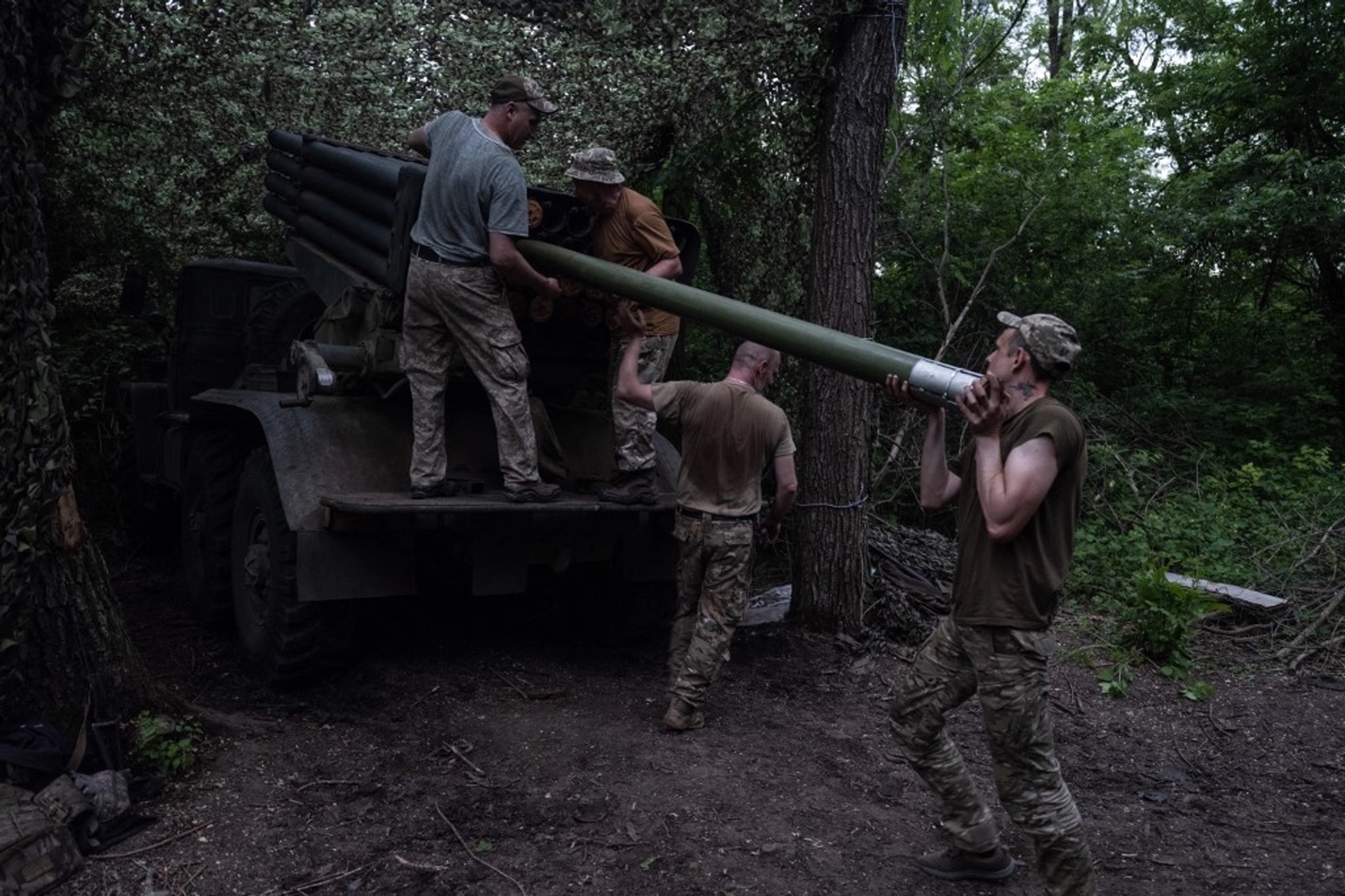
Ukrainian soldiers load ammunition into a MRLS BM-21 ‘Grad’ at an undisclosed location in the Donetsk region. (Photo by Iryna Rybakova / The 93rd Kholodnyi Yar Separate Mechanized Brigade / AFP)
Four years into its invasion, Russia’s military machine is showing measurable signs of strain. In April and May, the Russian army lost more ground in Ukraine than it gained — a reversal documented by AFP analysis of ISW data that represents the first net negative territorial balance for Russia since 2023. The advances have not stopped, but they have slowed to a near-standstill across much of the front.
“The Russian army’s advance is proceeding at an extremely slow pace,” Russian military analyst Alexander Khramchikhin told AFP. The culprit, in large part, is the drone. Both sides’ use of unmanned aerial vehicles has created what analysts describe as a “dead zone” on either side of the front line — space where massed troop movements are detected and destroyed before they can achieve decisive results. Unless Ukraine’s resources are “completely depleted,” Khramchikhin assessed, an acceleration of Russian advances is difficult to foresee.
ISW reported earlier this month that Ukrainian forces had “largely halted” Russia’s spring-summer offensive. Rather than sweeping advances, Russia has increasingly relied on infiltration operations — sending small groups of soldiers behind enemy lines to seize positions and hold them until reinforcements arrive. The tactic helped deliver Pokrovsk, but it is slow and costly.
Russia has also scaled back its stated war aims. After declaring last June that “all of Ukraine” was Russia’s, Putin has since narrowed his public objective to seizing only the Donbas regions of Donetsk and Luhansk. Ukraine, meanwhile, has adjusted its own calculus: no longer seeking a return to pre-2022 borders, Kyiv’s current objective is to freeze fighting along current lines and bring Russia to the negotiating table. “What can definitely be said is that the situation for us has stopped deteriorating,” Ukrainian analyst Mykola Bielieskov told AFP. That is not victory. It is the beginning of leverage.
Advances, Counterattacks, and the Map That Keeps Shifting
While the strategic picture shows Russian momentum stalling, the tactical map remains in motion. In the Oleksandrivka direction, geolocated footage published June 13 shows Ukrainian forces operating in multiple positions northeast and east of Ternove, indicating advances that may have liberated the settlements of Novoheorhiivka and Berezove. A Russian milblogger claimed Ukrainian forces had penetrated between five and eight kilometers in depth across the direction simultaneously — and expressed concern about a potential push toward Komar.
Near Borova, Ukrainian forces are counterattacking at Borivska Andriivka and have reportedly recaptured most of the settlement. Ukrainian forces also struck a Russian ammunition depot in occupied Stelmakhivka, roughly 11 kilometers from the front line, in geolocated footage published June 14.
In the Slovyansk direction, Russian forces continued offensive operations but did not advance as Ukrainian forces counterattacked. Geolocated footage from June 13 shows Ukrainian forces operating in northeastern Rai-Oleksandrivka in areas where Russian sources had previously claimed Russian control.
Around Kupyansk, the Russian 121st Motorized Rifle Regiment mounted a company-sized motorized assault on Petropavlivka using 10 vehicles and was repelled. In northern Kharkiv Oblast, a Russian milblogger claimed the seizure of Vovchansk — a city Russia formally declared captured in December 2025 — had been “completed,” suggesting the city had not in fact been fully under Russian control. Ukrainian forces struck a Russian manpower concentration near Vovchansk on June 13-14.
The Fleet Prepares to Flee: Black Sea Command Eyes the Exit from Crimea
Sevastopol has been the home of Russia’s Black Sea Fleet since before the annexation of Crimea in 2014. It is one of the great symbols of Russian imperial ambition in the region. And according to the pro-Ukrainian Atesh partisan group, its military command is now quietly making plans to leave.
Atesh — a group with documented agents inside Russian military facilities in Crimea — reported on June 14 that the Black Sea Fleet’s remaining command structures are planning to relocate from Sevastopol to Novorossiysk in Krasnodar Krai. The proximate cause: a sustained Ukrainian strike campaign that has hit fleet aviation headquarters, degraded logistics, and made the peninsula an increasingly inhospitable place to run a naval command. Since the May 27 strike on Black Sea Fleet aviation headquarters, “strikes on the peninsula have only intensified,” Atesh wrote.
Officers are reportedly moving their families out of Sevastopol and selling non-movable assets without waiting for official orders. Russia has also reportedly prohibited military cargo traffic along key highways connecting Crimea to the Russian mainland — a sign that ground logistics routes are themselves under threat.
ISW could not independently verify Atesh’s report, but noted it has “increasingly observed evidence that Ukrainian strikes are inhibiting Russian logistics into occupied Crimea.” If the Black Sea Fleet command does relocate, it would represent a remarkable strategic retreat — a symbol of Russian power in the Black Sea forced off the peninsula by Ukrainian drones, naval kamikaze boats, and missiles. “The coming months,” Atesh assessed, “could be the most difficult for Russian forces in Crimea since the start of the war.”
Drones Hunt Cars in Zaporizhzhia, Bombs Fall on Dnipro and Sloviansk
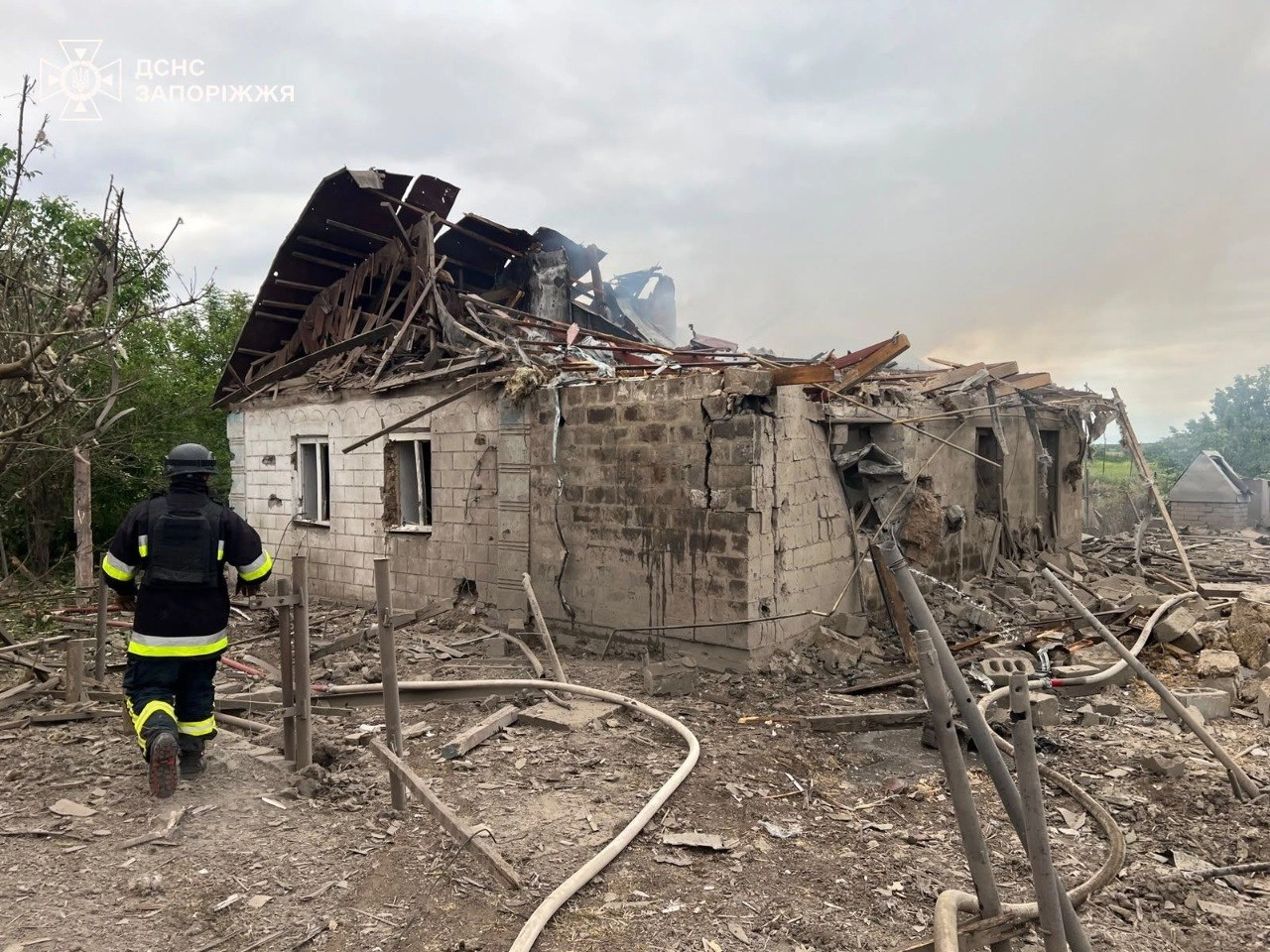
The aftermath of a Russian strike on one of the settlements in the Zaporizhzhia district. (Photo by State Emergency Service of Ukraine/Telegram)
The Russian attack on June 14 was not a single strike but a coordinated campaign across multiple regions. In Zaporizhzhia Oblast, Russian UAV operators targeted passenger cars in the Kushuhum community — not military vehicles, not infrastructure, but people driving. Three civilians were wounded: two men, aged 49 and 53, and a 55-year-old woman. In a separate Zaporizhzhia strike, a civilian man was killed and a residential house was set ablaze.
In Dnipro, a Russian strike hit a light industry enterprise on the morning of June 14, collapsing the ceiling in one workshop and destroying specialized production equipment. Seven civilians were injured; three men were hospitalized in moderate condition. The day before, on June 13, Russian tactical aircraft dropped three guided aerial bombs directly on the central district of Sloviansk — satellite-guided munitions that blew out the facades of 23 multi-story residential buildings, damaged a school, and incinerated parked vehicles. Three women were hospitalized with blast and shrapnel injuries.
In Sumy Oblast over the 24-hour period, two people were killed and four injured — all by drone strikes, including a 69-year-old man whose bicycle was attacked. In Donetsk Oblast, one person was killed and nine injured; in Kherson Oblast, five were injured in strikes on residential areas. In total, Russian attacks killed at least four civilians and injured 22 others across Ukraine on June 14 alone.
Russia used an extraordinary variety of weapons: guided aerial bombs, Shahed-type drones, Gerbera drones, Italmas drones, Molniya drones, FPV drones, and Parodiya-type decoys. The decoys are designed to overwhelm radar and exhaust interceptor stocks. The combination is deliberate — and it is working, at the cost of Ukrainian lives.
‘No Different from the Russian Position’: Ukraine’s Children Trapped in Italy
In the summer of 2022, Liubov Rudyka, director of a children’s home in Sumy, loaded 25 minors into vehicles and drove them to Naples. The front was moving. She thought it would be temporary — like a summer camp, she said. Four years later, the children are still there, many of them legally prevented from going home.
Italian juvenile courts, applying domestic child protection laws drafted during the European migrant crisis, classified the evacuated Ukrainian children as “unaccompanied minors,” granted them refugee status, and assigned them Italian legal guardians. When Ukraine tried to bring them home, the courts said no. The standoff reached a breaking point in April when a 15-year-old boy named Sasha was legally adopted by his Italian host family — despite having a biological mother in Ukraine who was actively seeking his return.
Ukraine’s Human Rights Ombudsman Dmytro Lubinets drew a stark comparison: “Their attitude is, in fact, no different from the Russian side’s position. They have taken our children away and are denying us access to them.” The parallel to Russia’s documented deportation of more than 20,000 Ukrainian children from occupied territories is deliberate and controversial — but it captures Kyiv’s fury at an ally that has, in its view, substituted legal process for common sense.
More than 4,800 children were evacuated from Ukrainian residential schools to European nations in 2022. More than 300 are currently being prevented from returning by local authorities — the majority held up in Italy, Germany, and Austria. Italian lawyers argue they are protecting children from being sent back to an active war zone. Ukrainian officials argue that children are being kept from their families and their country by courts that were never meant to adjudicate the consequences of a foreign invasion. Both sides believe they are doing what is right. The children remain in limbo.
Fasolia and Friends: The Animals the War Left Behind

Kateryna Hodunova plays with her rescued dog Fasolia from Pokrovsk, Donetsk Oblast, in Kyiv, Ukraine. (Anna Donets / The Kyiv Independent)
When people flee war zones, they often cannot take their animals with them. As the front line has shifted across Ukraine over four years, an unknown but growing number of dogs, cats, and farm animals have been left behind — stranded in combat zones, trapped in drone nets, or simply abandoned when their owners were killed. Ukrainian animal rescue organization UAnimals says the number of homeless animals has risen sharply since 2022.
A small network of volunteers continues to evacuate animals from active combat zones — not only pets but livestock caught in the fighting. The Kyiv Independent’s “Finding Home” project documented five of these rescues: Fasolia, a dog evacuated from Pokrovsk and adopted by a young couple in Kyiv; Hugo and Divchulia, dogs rescued from Irpin and the Borova area by a soldier and his wife; Multic, a front-line cat from Kostyantynivka who now lives with his owner’s mother; Misa, a kitten born at a position near Novopavlivka who survived FPV drones and glide bombs before being evacuated to Kyiv; and Lypka, a cat brought from occupied Kherson Oblast by a soldier who was later killed in action.
These animals carry something the war news rarely conveys — the texture of ordinary life interrupted and, sometimes, painstakingly reconstructed. “Sometimes I come home all upset, tears streaming down my face, and she just lies down on my chest,” said Darusia Pylypenko of Misa. “It helps.”
A Prayer for Ukraine
1. For the Infant Hospitalized in Kharkiv
Lord, she is one month old. She did not know what a drone was. She did not know what a museum was, or a city, or a war. She knew only warmth and milk and the voices that held her. On the night of June 14, those voices carried her out of a burning building while firefighters fought the flames overhead and crews evacuated 25,000 works of art around her. Be with this child. Be with all children who have learned the sound of incoming fire before they have learned to speak. Hold them in the dark when the alerts begin. Let them grow up to see the country their parents defended.
2. For the People of Kostyantynivka
Father, a city of 78,000 once stood here. What remains is contested room by room — Ukrainian soldiers in the south, Russian infiltrators moving through the east and west, and somewhere in between, whoever could not or would not leave. These are the people we cannot count because no journalist can safely reach them. We do not know their names. We know only that they are there, in a city the world is watching fall, hoping someone will notice they are still inside it. See them, Lord. Hold them in their basements and their shelters. Let them survive long enough for someone to come.
3. For the Diplomats Gathering in Evian
God of justice, the leaders of the world’s wealthiest democracies are meeting in France to decide what to do about a war they have watched for four years. Give them clarity where there is calculation. Give them courage where there is caution. Let them remember, when the negotiations grow technical and the language turns abstract, that it is a one-month-old infant who pays the price of delay. And let them understand that a peace that rewards aggression is not peace at all — it is an invitation to the next war. Give them wisdom for what they are about to decide.
4. For the Soldiers Defending the Line
Lord, they are exhausted. The drone campaigns have made the front a place where rest is impossible — where even a vehicle moving along a supply road can become a target, where every dawn brings new footage of what was lost overnight. The analysts say Russia’s offensive is slowing. The soldiers living inside that slowdown do not experience it as relief. They experience it as another day of holding. Be with them in their positions. Let their courage sustain what their numbers cannot guarantee. Bring them home.
5. For the Arc of Justice
In the English Channel, Royal Marines boarded a ship that had been carrying the oil that pays for the missiles that kill Ukrainian children. In Tula Oblast, a chemical plant that makes the ammonium nitrate for Russian shells burned through the night. In Kyiv, a Ukrainian president published the Kremlin’s own internal documents showing a government afraid of its own people. The mechanisms of accountability are slow. They are incomplete. They are contested at every step. But they are moving. Let them move faster, Lord. Let the truth that is already known become the verdict that is finally enforced.
In Your mercy, in Your justice, in Your time — bring this war to its end, and let the ending be worthy of what Ukraine has endured.