
Ukraine Daily Briefing | June 24, 2026 | Day 1,582 of the Full-Scale Invasion
Prepared by Dayana Bozhyk
Zelensky announced on June 24 that the Belarusian relay stations guiding Russian Shahed drones into western Ukraine stopped operating on June 22 — four days before his deadline — and Ukraine’s border guard confirmed a sharp drop in northern drone incursions. Ukrainian forces struck Russia’s Orenburg Gas Processing and Helium Complex overnight, confirmed damage to the Vladimir Space Communications Center, and revealed that the Baltic Fleet’s arsenal near St. Petersburg had been destroyed with 60,000 tons of ammunition. The Moscow Oil Refinery will not reopen until 2027. Russia is preparing to import gasoline from India as its fuel shortfall reaches 25,000 tons per day. Trump said Zelensky is “winning now,” meeting him at NATO in The Hague. Ukraine’s State Bureau of Investigation opened a criminal probe into the Skelia regiment following the Babel investigation. Two Norwegian People’s Aid demining specialists were killed by a Russian strike in Kherson Oblast. Russia’s overnight attack killed 10 civilians and injured 72 across Ukraine, with the Kryvyi Rih death toll rising to four.
THE DAY’S RECKONING
The deadline was June 26. The relay stations stopped working on June 22. Zelensky did not make that announcement dramatically — he made it factually, citing briefings from Commander-in-Chief Syrskyi and Ukraine’s intelligence service. “Whether it has been dismantled or not, I honestly don’t know yet,” he said. “The fact is that, as of today, the equipment is no longer operating.” Ukraine’s border guard confirmed the change in the numbers: a drop in attack drones crossing the border in northern Chernihiv Oblast, and no large Shahed raids along the Belarus-Ukraine border at all. For now.
While that quiet victory registered, Ukraine’s long-range campaign continued reaching further into Russia than ever. Overnight, drones struck the Orenburg Gas Processing Plant and Helium Complex — 1,200 kilometers from the frontline, one of the world’s largest gas-chemical complexes, responsible for 60 percent of Gazprom Pererabotka’s output. Zelensky confirmed the Baltic Fleet’s arsenal near St. Petersburg was destroyed — 60,000 tons of ammunition gone. Reuters confirmed the Moscow Oil Refinery will not reopen this year. Russia is now negotiating gasoline imports from India because its shortfall has reached 25,000 tons per day.
At NATO in The Hague, Trump told reporters that Zelensky is “winning now.” U.S. Deputy Secretary of State Levin said, ahead of the Ukraine Recovery Conference in Gdansk, that Ukraine is “entering a phase in which it is winning the war.” Meanwhile, the Kryvyi Rih death toll from yesterday’s cluster munition strike rose from three to four. Two demining specialists from Norwegian People’s Aid were killed in Kherson Oblast. And Russia’s overnight drones killed 10 more people and injured 72 across Ukraine.
BELARUSIAN RELAY STATIONS DARK SINCE JUNE 22; DRONE INCURSIONS DROP IN THE NORTH
Zelensky announced on June 24, citing briefings from Commander-in-Chief Oleksandr Syrskyi and Ukraine’s intelligence service, that the Russian-installed signal repeater stations on Belarusian territory — which allowed Russian forces to fly guided Shahed drones at extended range against energy, railway, and civilian infrastructure in Zhytomyr, Rivne, and Volyn oblasts — stopped operating as of June 22, four days before his June 26 deadline. “Whether it has been dismantled or not, I honestly don’t know yet,” Zelensky said. “The fact is that, as of today, the equipment is no longer operating.” He had previously specified that four relay stations in Gomel and Brest oblasts were mounted on communications towers and that Ukraine reserved the right to strike them if Belarus did not act.
Ukraine’s State Border Guard spokesperson Andrii Demchenko confirmed the operational effect: a measurable drop in the number of Russian attack drones entering northern Chernihiv Oblast, and no large-scale Shahed raids along the Belarus-Ukraine border since the stations went offline. The development represents a meaningful, if potentially temporary, degradation of Russia’s ability to strike western Ukraine with the precision those relay stations provided. ISW assessed that any Ukrainian strike against Belarusian infrastructure supporting Russian military operations would not be inherently escalatory — the stations were legitimate military targets — and that Lukashenko’s de facto response indicates he is still resisting fully committing Belarus to Russia’s war effort. The Kremlin framed Ukraine’s ultimatum as “utterly aggressive” interference; a WSJ report published June 23 cited Russian and European officials saying the Kremlin has been pressuring Lukashenko to allow Russia to more actively leverage Belarusian territory for drone strikes and potentially extend the frontline westward, threatening to withdraw financial support if Minsk refuses.
ORENBURG GAS COMPLEX STRUCK 1,200 KM DEEP; VLADIMIR SPACE CENTER DAMAGE CONFIRMED
Ukrainian forces struck Russia’s Orenburg Gas Processing Plant and Orenburg Helium Plant overnight on June 23 to 24, causing a fire confirmed by geolocated footage and acknowledged by Orenburg Oblast Governor Yevgeny Solntsev, who claimed Russian air defenses intercepted “several drones” over an industrial facility — while smoke was visible rising from the complex. The operation was conducted in coordination with the underground resistance movement “Chornaya Iskra” (Black Spark) operating inside Russia. The Orenburg Gas Processing Plant processes up to 45 billion cubic meters of natural gas annually, and together with the Helium Plant forms one of the world’s largest combined gas-chemical complexes — responsible for approximately 60 percent of all Gazprom Pererabotka’s gas processing output, with the helium component supplying high-tech and military industries including missile technology.
On the same night, the Ukrainian General Staff confirmed that a strike against the Vladimir Space Communications Center in Vladimir Oblast damaged two buildings and caused a fire. The General Staff published on June 24 a detailed battle damage assessment of the June 22 strike on the Dubna Space Communications Center in Moscow Oblast: a 32-meter MARK-IV satellite communications antenna, technical and administrative buildings supporting satellite communications, a nearby technical building, and the main production-administrative hardware-software building were all damaged. Zelensky additionally confirmed on June 24 that Ukraine’s earlier strikes against the Baltic Fleet’s arsenal near St. Petersburg in Leningrad Oblast destroyed approximately 60,000 tons of ammunition. “Russian forces are relocating air defense systems from Russian regions to Moscow and the Kerch Bridge to defend against Ukrainian strikes,” Zelensky said, citing military intelligence chief Oleh Ivashchenko. “In practice, these are the two areas the Russians have been ordered to defend at the expense of weakening other sectors of their territory and the temporarily occupied territories of Ukraine.” He said Russia has moved almost 90 launchers to the Valdai area — linked to Russia’s political leadership — while other Russian cities are left with only a few air defense units each.
MOSCOW REFINERY OFFLINE UNTIL 2027; RUSSIA NEGOTIATES GASOLINE IMPORTS FROM INDIA
Reuters reported on June 24, citing multiple industry sources, that the Moscow Oil Refinery in the Kapotnya district — struck three times by Ukrainian drones between June 16 and 18 and shut down indefinitely — is unlikely to resume production before 2027. “It will take at least half a year to repair,” one industry source said. The facility processed 11.6 million metric tons of crude in 2024, producing 2.9 million tons of gasoline and 3.2 million tons of diesel, and supplies approximately 40 percent of Moscow’s fuel market and aviation fuel to four of the capital’s airports.
Russia’s structural fuel shortfall is now quantified: operating refineries produce approximately 85,000 tons of gasoline per day against summer demand of 111,000 tons — a daily gap of 25,000 tons, or roughly 20 percent of domestic consumption. Wholesale gasoline prices have risen above 100 rubles per liter. Moscow City removed the requirement for fuel tankers to carry travel permits to ensure uninterrupted supply. Duma Economic Policy Committee Deputy Chairman Mikhail Delyagin acknowledged on June 24 both the shortages and the Moscow traffic jams caused by fuel deliveries. Russian airline Azimuth called the aviation fuel situation “critical.”
To bridge the gap, Russia is negotiating the purchase of approximately 50,000 tons of AI-92 gasoline from Kazakhstan, Reuters reported. More significantly, Russia is also preparing to import gasoline from India at scale: draft amendments to Russia’s Tax Code would introduce budget subsidies for oil companies importing gasoline abroad, calculated against Indian market prices plus shipping — legislation the State Duma’s budget committee backed with a possible second and third reading as early as June 25. India became Russia’s largest crude buyer after the full-scale invasion began, purchasing up to 2.66 million barrels per day in June 2026; a portion of that crude is refined and re-exported as petroleum products. The mismatch is significant: Indian gasoline contains roughly 20 percent ethanol, double Russia’s permitted standard — Russia raised its ethanol limit to 10 percent last year specifically in response to the shortage. Russian refineries are delaying maintenance, tapping untapped reserves, and removing export restrictions on diesel to manage the crisis, while state oil companies absorb the main supply burden. Further Ukrainian strikes against Russian energy infrastructure will continue to exacerbate the shortage.
TRUMP AT NATO: “HE’S WINNING NOW”; U.S. STATE DEPARTMENT: UKRAINE “IS IN A WINNING PHASE”
President Trump, speaking at NATO headquarters in The Hague on June 24 during a meeting with NATO Secretary General Mark Rutte, was asked whether he believed Ukraine was winning the war. “He’s winning now. Well, he’s doing pretty well… At least he’s holding on,” Trump said of Zelensky, adding: “I have to say he’s courageous. He’s got great equipment, he’s got great people, he’s got fighters.” Trump noted that “a lot of people are dying on both sides” and met separately with Zelensky on the NATO summit sidelines.
Speaking in Gdansk ahead of the Ukraine Recovery Conference, U.S. Deputy Secretary of State Jeremy Levin said the conflict has shifted in Kyiv’s favor: “As of now, we are in a position where Ukraine is winning the war at this moment.” He attributed the shift to Ukraine’s ongoing strikes on Russian oil infrastructure, which are increasing the cost of the war for Moscow and forcing it to divert resources from the front. “Ukrainian troops are advancing, while Russian forces are effectively waiting for winter,” Levin said, describing the present moment as critical for Ukraine to “continue to exert pressure on the battlefield.” Levin also signaled Washington is considering revisiting remaining exemptions on sanctions related to Russian oil, coordinating with European partners to tighten the measures further. Russia’s Deputy Foreign Minister Ryabkov responded by accusing Washington of moving toward the “most rabid anti-Russian policies” of the U.S.’s European allies, saying U.S.-Russia bilateral dialogue on Ukraine has “effectively stalled” as Washington increasingly links U.S.-Russia relations to Ukraine’s terms. Medvedev on June 24 dismissed Zelensky’s legitimacy and ruled out direct negotiations. Lavrov said Russia will listen to the next U.S. envoy visit but will not accept freezing the frontline.
OVERNIGHT STRIKES: 101 DRONES, KRYVYI RIH TOLL RISES TO FOUR, 10 KILLED AND 72 INJURED
Russian forces launched 101 Shahed, Gerbera, and Italmas-type drones and Parodiya decoys overnight on June 23 to 24 from Kursk, Oryol, Primorsko-Akhtarsk, and occupied Hvardiiske. Ukrainian air defenses downed 95; six drones struck five locations, with debris falling at six more. Russian strikes hit civilian infrastructure in Kharkiv and Sumy oblasts; DTEK reported a strike on an energy facility in Dnipropetrovsk Oblast.
Russian attacks killed 10 civilians and injured 72 across Ukraine over the 24-hour period. The Kryvyi Rih death toll from the June 23 Iskander-M cluster munitions strike rose to four after a fourth victim died in hospital overnight; 17 of the 30 injured remain hospitalized, five in critical condition. Authorities declared June 24 a day of mourning in the city. In Nikopol district, Russian attacks separately killed a 70-year-old man and two women, aged 40 and 44, and injured six others. In Zaporizhzhia Oblast, one person was killed and 12 injured as Russian forces carried out 1,021 strikes on 38 settlements. In Kharkiv Oblast, a 56-year-old woman was killed in a drone strike on Balakliia and six others were injured. In Kherson Oblast, one person was killed and seven injured. In Donetsk Oblast, six civilians were injured in Druzhkivka. In Sumy Oblast, two men were injured in the Sumy community and a 58-year-old woman was wounded in a drone strike on Romny. Separately from the overnight attack, a Russian drone struck Sumy on June 24 in the evening, injuring a 13-year-old boy, damaging residential buildings, vehicles, and an industrial site; a separate wave of drone strikes across Sumy Oblast on June 24 injured at least 15 civilians including three children — an 11-year-old boy in Konotop, a 6-year-old boy in Sumy, a 15-year-old teenager in Putyvl — damaging two gas stations in Sumy, a cinema in Konotop, and infrastructure in Putyvl. Russian forces also struck a beach in Zaporizhzhia City on June 24, injuring six people including three children, damaging cars and a food establishment.
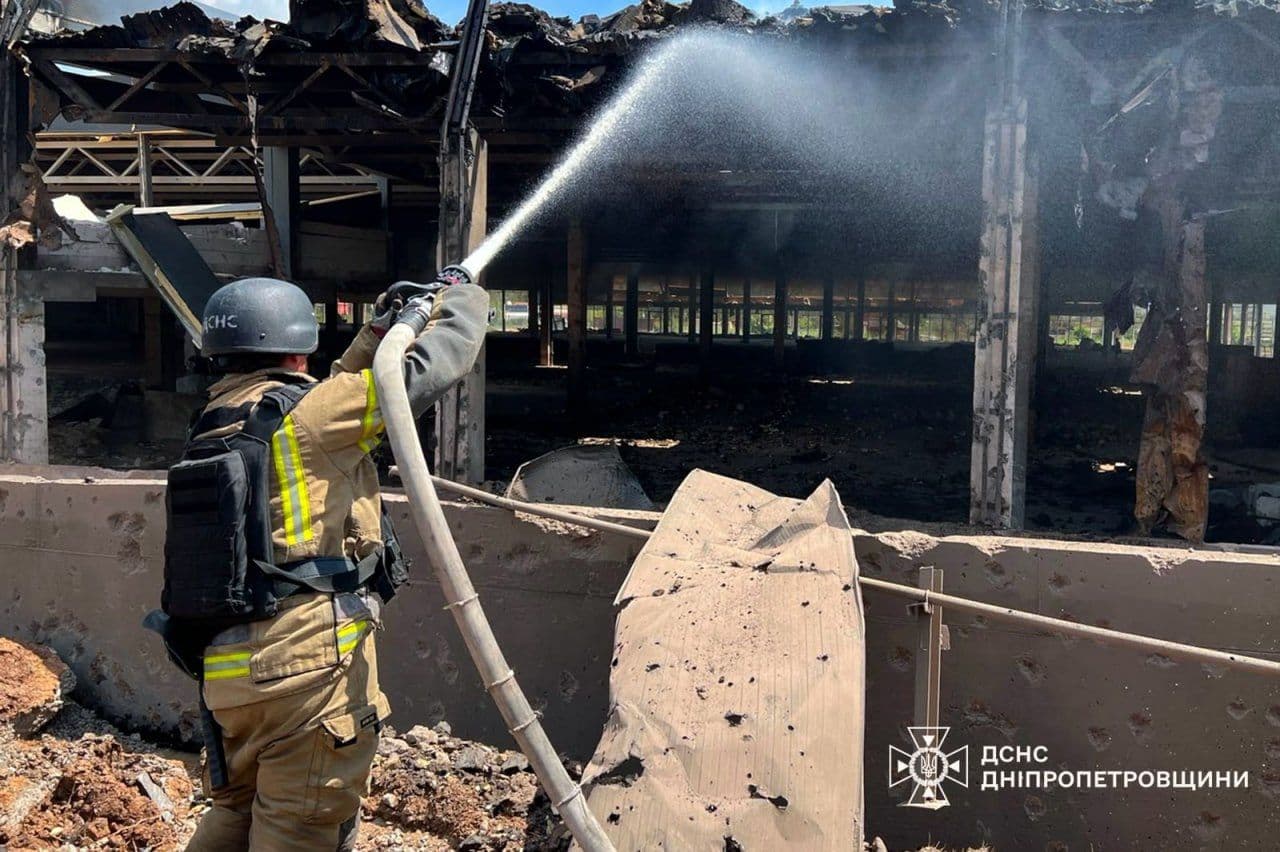 Aftermath of a Russian ballistic missile attack on the city of Kryvyi Rih, Dnipropetrovsk Oblast. (Ukraine’s Emergency Service)
TWO NORWEGIAN PEOPLE’S AID DEMINING SPECIALISTS KILLED IN KHERSON OBLAST
A Russian strike killed two international demining specialists from Norwegian People’s Aid and injured five others in Novopetrivka, Kherson Oblast, on June 24, according to Kherson Oblast Military Administration Head Oleksandr Prokudin. Norwegian People’s Aid is a humanitarian organization that has been conducting demining operations in Ukraine since the start of the full-scale invasion; its personnel work in active-conflict and post-conflict areas to clear landmines and explosive remnants of war, enabling civilians and farmers to safely return to their land. The deaths are the latest in a series of Russian strikes that have killed international humanitarian workers in Ukraine; under international humanitarian law, humanitarian demining personnel operating in civilian areas are explicitly protected from attack. No additional details on the nationalities of the victims were immediately available.
SAKY AND HVARDIISKE AIRFIELDS STRUCK; SEVASTOPOL SUBSTATION KNOCKED OUT; CRIMEA WATER CRISIS
The SBU confirmed on June 24 that drone operators from its Special Operations Center “Alpha” struck the Saky and Hvardiiske military airfields overnight, damaging four aircraft storage hangars at Saky. Near Kerch, Ukrainian forces struck two components of a Russian S-400 air defense system and two Pantsir-S1 systems. USF Commander Brovdi confirmed a strike on Sevastopol’s main electrical substation overnight, leaving the entire city without power according to the Crimean Wind monitoring channel. Krymenergo reported power outages in occupied Sevastopol, Yevpatoriia, Saky, and Dzhankoi, and in Perekop and Yevpatoriia raions. Fires broke out at a warehouse of the 133rd Logistics and Support Brigade of the Black Sea Fleet in occupied Bakhchisarai.
The power disruptions are now cascading into water supplies. Authorities in occupied Yevpatoriia introduced hourly water supply restrictions after outages forced wells offline and reduced reserves at a local pumping station. Local officials organized water deliveries for social facilities and residents. “Russian occupiers are losing control of Crimea’s skies,” the SBU said. “The SBU will continue methodically turning Crimea into a zone of constant losses for Russian forces until they leave the Ukrainian peninsula.”
FRONTLINE: OLEKSANDRIVKA ADVANCES AND SETBACKS; KUPYANSK TACTICS CHANGE; CRIMEA LOGISTICS COMPOUND
Russian forces made a marginal advance in the Oleksandrivka direction, where military observer Mashovets reported Russian forces maintaining positions at the Solena-Vovcha river confluence east of Ivanivka and occupying Voskresenka, while repelling Ukrainian counterattacks and managing to reach the left bank of the Vovcha River northwest of Oleksandrohrad. Ukrainian forces, however, advanced to the area between Sichneve and Vorone. The Russian military command reinforced the 90th Tank Division and 29th CAA with elements of several regiments to stabilize the situation northeast of Oleksandrivka and halt Ukrainian counterattacks; Mashovets assessed that Russian forces have for now stabilized this section but that the overall situation remains contested. In the Novopavlivka direction, Russian forces remain unable to advance further, with Ukrainian forces maintaining fire control over Russian supply routes.
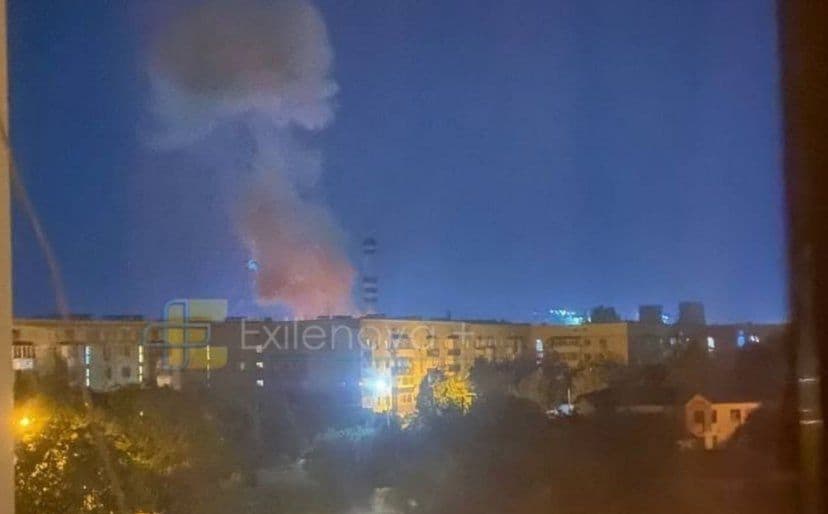 The aftermath of a Ukrainian strike in Simferopol, Crimea. (Exilenova Plus+/Telegram)
In the Kupyansk direction, a Ukrainian battalion commander reported that the heavy Russian losses — particularly in the 347th and 272nd Motorized Rifle Regiments and 26th Tank Regiment of the 47th Tank Division — forced a dramatic tactical shift: Russian assault groups that in groups of four to eight soldiers in February and March are now attacking in groups of one to two, or using ATVs and motorcycles. Russian personnel must travel five to seven kilometers on foot to deliver ammunition to the frontline. Separately, geolocated footage published June 23 confirmed Ukrainian forces striking a Russian bridging vehicle (KRAZ-2555) of the 128th Separate Motorized Rifle Brigade attempting to cross the Vovcha River in Vovchansk. Russian milbloggers claimed advances near Starytsya and northern Kozacha Lopan in Kharkiv Oblast. Russian forces conducted infiltration missions in Hlushkivka in the Kupyansk direction, in Bachkivsk, Pysarivka, and Nova Sich north of Sumy City; a Russian MoD claim to have seized Izvolzhanske was denied by Ukraine’s Kursk Group of Forces. Russian forces attacked between Zahryzove and Borova, continued glide bomb strikes on Pokrovsk — described as one of the most active frontline directions — with the Pokrovsk drone spokesperson noting Russian advances are “significantly slower compared to Winter 2026,” while the Kremlin’s cognitive warfare campaign continued publishing hyper-tactical Kostyantynivka claims.
The logistical strain from Ukraine’s Crimea campaign is materializing on the southern frontlines. A Ukrainian regiment commander in the Hulyaipole direction confirmed that strikes on the Chonhar Bridge have significantly reduced Russian supplies from Crimea, with troops now carrying artillery ammunition on foot over 50 kilometers; Russian drone reconnaissance in the direction is down by two-thirds. Ukrainian forces struck Russian drone control points near Basan and Hrozove in Zaporizhzhia Oblast, logistics vehicles on the M-18 and M-14 highways in occupied Zaporizhzhia and Kherson oblasts, a fuel tanker near Horlivka, and a drone pilot training ground near Debaltseve. The Ukrainian General Staff struck an FPV drone depot near Alekseyevka in Belgorod Oblast and a drone command point near Zhuravlevka, Belgorod Oblast.
FEDOROV AT RUSI: THREE PRIORITIES, 50,000 GRC MISSIONS, DENMARK’S 15,000 ARTILLERY ROUNDS
Defense Minister Fedorov addressed the RUSI Land Warfare Conference in London on June 24 alongside NATO officials and U.K. defense experts, identifying Ukraine’s three unchanged priorities: air defense (particularly Patriot PAC-3 interceptors), long-range artillery ammunition capable of reaching at least 30 kilometers, and Ukrainian-made drones. He noted that unmanned systems now account for approximately one in four frontline target engagements. Ukraine has conducted more than 50,000 logistics and evacuation missions in 2026 using Ground Robotic Complexes — remotely operated, AI-assisted vehicles that take over the highest-risk battlefield supply and casualty-evacuation work. Fedorov added that 2026 is expected to be a record year for Ukrainian drone production, and disclosed for the first time that Ukraine plans to begin exporting certain defense technologies to strategic partners.
Denmark agreed to supply 15,000 long-range artillery rounds to Ukraine, redirecting planned assistance from short-range to long-range munitions at Kyiv’s request. “We have three unchanged priorities: air defense, long-range artillery and Ukrainian drones,” Fedorov said. “We are fighting for every dollar of international support while seeking to ensure partners’ funds are used as efficiently as possible.” The U.K. separately announced on June 24 a £290 million ($382 million) package for Ukraine’s energy infrastructure and anti-corruption work, including £65 million to co-finance two new wind farms and loans to small businesses, and a £210 million Urenco nuclear fuel deal for Energoatom. The Energy Community separately called for 650 million euros ($740 million) to protect Ukraine’s energy infrastructure ahead of winter 2026 to 2027.
STATE BUREAU OF INVESTIGATION OPENS CRIMINAL PROBE INTO SKELIA REGIMENT
Ukraine’s State Bureau of Investigation announced on June 24 that it has opened a pre-trial investigation into the 425th Separate Assault Regiment (Skelia) following the Babel investigation published June 23. The SBI said it is examining whether military officials exceeded their authority and official powers under martial law, resulting in serious consequences. Human Rights Commissioner Dmytro Lubinets said he had requested the SBI and the Specialized Defense Prosecutor’s Office conduct “a full, objective, and impartial investigation,” adding: “My position is clear: any violations of human rights, especially under martial law, are unacceptable and require an immediate response.” Lubinets confirmed he discussed the allegations with Syrskyi; Ukraine’s Military Law Enforcement Service has already begun examining the claims, and a monitoring group from the ombudsman’s office is expected to visit the regiment. Skelia’s command said it is ready to cooperate with all law enforcement and oversight bodies.
RUSSIAN MILITARY RECRUITMENT COLLAPSES: MOSCOW DOWN ONE-THIRD, UNITS AT 30-40% STRENGTH
Russian independent outlet Verstka reported on June 24 that military contract enlistments in Moscow fell by roughly one-third in spring 2026 compared to the same period in 2025, with 1,708 contracts in April and 1,378 in May — about 1,000 fewer than the same months last year. The decline is nationwide: German Institute for International and Security Affairs researcher Janis Kluge estimated 800 to 1,000 new contracts signed daily in Q1 2026, roughly 20 percent fewer than a year earlier. Some military units are operating at 30 to 40 percent of authorized strength according to servicemembers interviewed by Verstka; newly recruited soldiers often lack training and combat experience. Regional authorities are raising recruitment bonuses and referral payments — monthly spending on recruiter bonuses more than doubled in 2026, from 358 to 802 million rubles ($10.7 million) — and increasingly targeting older applicants, foreigners, people with health issues, and those with criminal records. Some job advertisements promote military service as rear-area or humanitarian work even though recruits sign standard defense ministry contracts. Russian government and military circles are discussing possible new mobilization after parliamentary elections in September, though no decision has been made.
June 24, 2026 ended with the relay stations in Belarus quiet, the Orenburg gas complex burning, the Moscow refinery confirmed offline until next year, and the recovery conference about to open in Gdansk. “He’s winning now,” Trump said. “Ukraine is winning the war at this moment,” the State Department said. And in Kryvyi Rih, the day of mourning that authorities declared for June 24 covered four dead, not three. The arithmetic of this war keeps moving in two directions at once — Ukraine gaining ground in the campaign of attrition against Russia’s economy and air defenses, and Russia continuing to find Ukrainians to kill every single day.
A PRAYER FOR UKRAINE
1. For the Fourth Victim in Kryvyi Rih
Lord, a fourth person died in Kryvyi Rih on June 24 from wounds suffered the previous day when a Russian Iskander loaded with cluster munitions struck a civilian facility. We do not know this person’s name or age or what they were doing in the hours before the missile came. We only know that Kryvyi Rih held a day of mourning, and that city has now buried 118 civilians including 16 children since the full-scale war began, and that five people remain in critical condition in its hospitals tonight. Lord, be with them. Be with every family that is waiting for news about someone in a Kryvyi Rih ward. And be with a country that has learned to absorb this kind of grief and keep functioning anyway — not because the grief is smaller, but because stopping would mean surrendering to the people who caused it.
2. For the Two Norwegian People’s Aid Deminers
Father, two people who came from a foreign country to remove mines from Ukrainian soil so that Ukrainian families could return safely to their farms and villages were killed by a Russian strike in Kherson Oblast on June 24. They were not combatants. They were doing the opposite of war’s work: making the land safe again. We do not have their names. We pray for their families and colleagues in Norway and in NPA’s Ukraine mission, for the team members who were injured in the same strike, and for every international humanitarian worker still clearing ordnance in a country that will need decades of demining before its land is fully safe again. Let this work be protected. Let the people doing it be held.
3. For the 6-Year-Old Boy in Sumy
God of children, a six-year-old boy in Sumy City was injured by a Russian drone strike on June 24. An 11-year-old in Konotop. A 15-year-old in Putyvl. A 13-year-old in the evening strikes. This is not a day’s exception — it is a day’s record, entered into a ledger that has been filling for 1,582 days. We pray for each child injured today in Sumy Oblast. We ask for their healing — physical and otherwise. We ask for the parents who held them through the strikes, and for the doctors now treating them, and for the communities trying to explain to their youngest members why this keeps happening. Give the children of Sumy Oblast protection tonight.
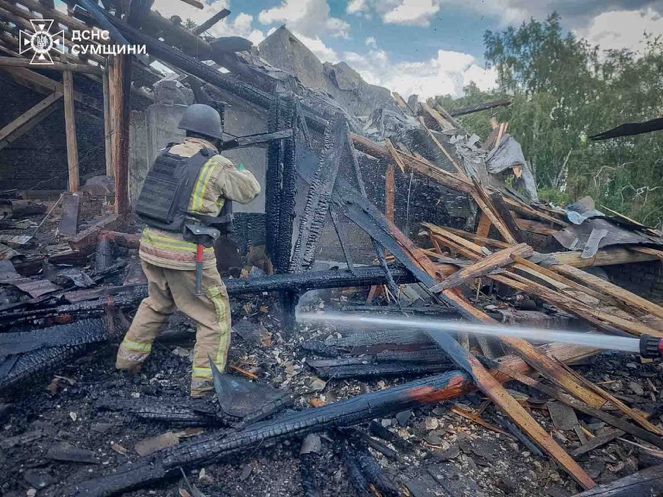 Aftermath of a Russian drone attack on the city of Konotop, Sumy Oblast, which set a cinema building on fire and injured at least six people. (State Emergency Service of Ukraine in Sumy Oblast)
4. For the Soldiers of Skelia’s Families, Now Being Heard
Lord of justice, Ukraine’s State Bureau of Investigation opened a criminal probe into the Skelia regiment on June 24. Families who believed their sons died of abuse rather than illness in a unit that was supposed to be preparing them to defend their country are now being told their accounts will be officially investigated. We do not know what the investigation will find. We ask that it be conducted fully, honestly, and without the institutional instinct to protect the institution. We pray for the families who have waited for this — who have made statements, submitted medical records, and demanded answers while simultaneously grieving. Give them a process that is worthy of what they have already carried.
5. For the Silence Along the Belarus Border
God of unexpected mercies, the Belarusian relay stations went quiet on June 22, and Ukraine’s border guard confirmed fewer drones crossed the northern border in the days that followed. We do not know how long this will last. We do not know whether the equipment was dismantled or simply switched off. We do not know what Lukashenko said to Putin when the Kremlin asked him why. We are grateful, cautiously, for a reduction in the precision of Russian strikes in western Ukraine — for trains in Zhytomyr that may run without being specifically hunted tonight. Lord, let the silence hold. And let the world note that one man, under enormous pressure from a neighbor with nuclear weapons, chose to turn off four relay stations rather than let his country be drawn into a war that would consume it.