
August 1, 2026
Prepared by Diana Bozhyk
Russia launched its second mass ballistic missile barrage on Kyiv in three days, killing nine people, wounding 30, and damaging the Lithuanian Embassy building — the first time this war has directly hit a foreign diplomatic mission in the capital. Ukrainian air defenses shot down just one of 27 ballistic missiles, a failure Zelensky attributed directly to the Patriot interceptor shortage he has been begging allies to fix for months. Ukrainian naval drones sank the Russian container ship Yanina in the Black Sea overnight, while Ukraine’s General Staff confirmed Russian forces suffered their highest monthly casualty toll of the entire war in July — 42,860 dead and wounded, for barely more ground gained than the width of a city block.
THE DAY’S RECKONING
For the second time in three days, Kyiv woke to the sound of ballistic missiles finding their targets — nine dead, thirty wounded, and this time a piece of Lithuania’s own sovereign territory caught in the blast radius, its embassy walls cracked by a strike Ukraine had no way to stop. Twenty-seven ballistic missiles came in overnight; Ukraine’s exhausted interceptor stockpile managed to catch exactly one. By midday, a Russian drone had found a warehouse full of books in Kharkiv and a logistics center full of workers in Brovary, killing one more man surrounded by parcels rather than rubble. Out at sea, Ukrainian drones evened the ledger in their own quiet way, sending a Russian container ship to the bottom of the Black Sea. And in Kyiv’s General Staff, officials released a number worth sitting with: Russia lost more soldiers in July, dead and wounded, than in any single month of this entire war — for a rate of advance so slow it would take decades to matter. Both countries are paying more for less. Only one of them is losing people at a pace that can’t be replaced.
KYIV’S SECOND MASSACRE IN 48 HOURS
Russian ballistic missiles struck Kyiv for the second time in three days, killing nine people and wounding 30, including four children, across seven city districts. The Darnytskyi district again took the worst of it — seven dead, 14 wounded, an administrative building destroyed, a crater torn into a public square. Solomianskyi lost two more, with a five-story residential building partially collapsing into fire; rescuers evacuated 35 people from its upper floors before the structure gave way further. In total, strikes and falling debris damaged 18 apartment and private homes, a medical clinic, a film studio, and several supermarkets.
For the first time in this war, the damage reached a foreign embassy directly: a missile exploded near the Lithuanian Embassy, cracking its building and prompting Lithuania’s president, Gitanas Nauseda, to confirm the damage personally. Vilnius summoned Russia’s ambassador in response. The strike also hit the Kyivmedspetstrans emergency medical transport organization twice, destroying five ambulances outright and damaging another 20 vehicles that service the city’s hospitals — a blow to the very fleet meant to answer calls like the ones this same night generated. Kyiv’s chief mufti reported that the city’s main mosque was damaged for the third time. “Russian terror spares no one and respects no international norms, including the provisions of the Vienna Convention,” Foreign Minister Andrii Sybiha wrote, offering Lithuania Ukraine’s assistance rather than the other way around.
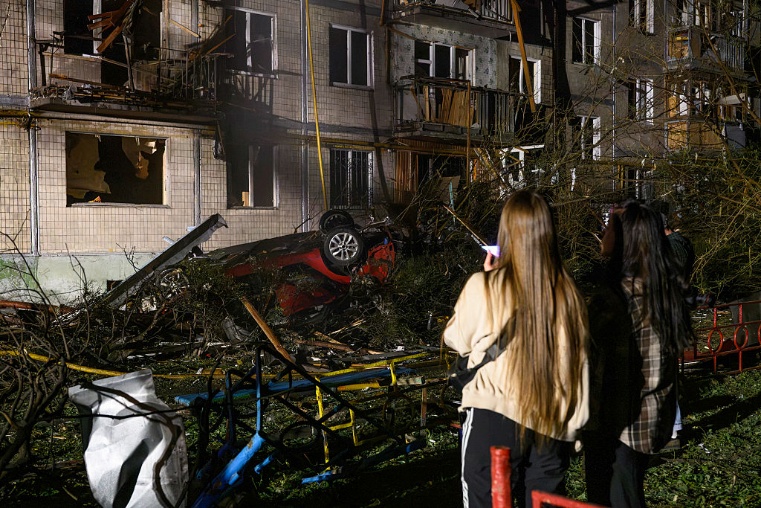
Residents stand near a residential building damaged by a Russian ballistic missile strike in Kyiv, following an overnight attack that killed nine and injured 33 others. (Maxym Marusenko/NurPhoto via Getty Images)
DAYTIME FOLLOW-UP: ROZETKA, BUCHA, AND ODESA’S BURNS
The overnight barrage wasn’t the day’s last violence. Around midday, a Russian drone struck a Rozetka logistics warehouse in Brovary, just northeast of Kyiv, where 270 people were working at the time. “Our colleague, Volodymyr Melnychenko, was killed,” company co-founder Iryna Chechotkina wrote, confirming seven more employees were injured, one seriously. “Nothing will bring this person back to life,” she said, promising support for his family and confirming Rozetka would keep operating. It’s a strike that echoes, almost exactly, the campaign Ukraine has run against Russia’s own Wildberries warehouses for weeks — this time reversed, aimed at Ukraine’s largest online retailer instead.
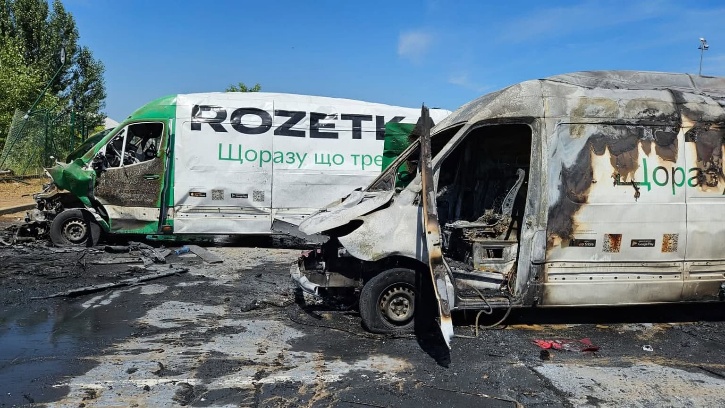
Damage to Ukrainian retailer Rozetka after being struck by Russian drones in Kyiv Oblast. (Rozetka co-founder Iryna Chechotkina / Facebook)
Elsewhere the same day, a Russian strike sparked a fire at an industrial facility in Bucha, injuring three people; specialized robotic equipment joined firefighters at the scene. In Odesa, a Russian drone hit a high-rise apartment building in the city center, injuring an 18-year-old and a 28-year-old man with thermal burns, with a third victim, a 30-year-old man, confirmed wounded later in the day. None of these three strikes made the kind of headlines Kyiv’s overnight toll did. Together, they’re a reminder that this war’s violence rarely waits for the news cycle to catch its breath.
KHARKIV’S BOOKS BURN AGAIN
A Russian drone struck a warehouse belonging to Ranok, a Ukrainian publishing house, in Kharkiv, setting fire to roughly 10,000 square meters of stored books; one man was injured, and a female employee initially unreachable by phone was later confirmed safe. The same warehouse served KnyhoLand, one of Ukraine’s largest bookstore chains, for order processing. “Everything is on fire,” a company representative wrote, asking customers to visit physical stores while online orders paused.
It’s part of a pattern too steady to call coincidence: Ukraine’s Book Institute says Russian strikes destroyed more than 1.5 million Ukrainian books in July alone, following an 800,000-book loss at publisher BookChef on July 2 and a 250,000-book loss at Knyholove on July 19. Whether any of these warehouses hold genuine military significance is a question Russia has never bothered answering. The books keep burning regardless.
RADUSHNE, STILL BEING MOURNED
Two days after the strike that erased the Voronov family, residents kept adding to the memorial at what used to be their home — toys, flowers, children’s drawings left at a foundation that used to be a house. The ruins have become the kind of place a whole district visits now, less a crime scene than a shrine, a way of grieving something too large for any single family to hold alone.
FRONTLINE: TORSKE FALLS, KOSTIANTYNIVKA HOLDS
Russian forces made a rare confirmed gain west of Kostiantynivka, with milbloggers on both sides converging on the same claim: Russian troops seized the settlement of Torske and pushed slightly beyond it, alongside claimed advances near Pryiut and southwest of Novopavlivka. Near Dobropillya, Russian forces reportedly took the small settlement of Matyasheve just southeast of the town, part of a continued effort to approach Dobropillya’s edges after repeatedly failing to enter the town itself; Ukrainian counterattacks near Shevchenko pushed back in the same window. In the Hulyaipole direction, Russia’s Defense Ministry credited its 36th Separate Guards Motorized Rifle Brigade with seizing Lyubytske, northwest of the town.
None of it amounts to much by the numbers. ISW’s own tally puts Russia’s entire July advance, including unconfirmed infiltrations, at just over 121 square kilometers for the whole month — a fraction of the 455 square kilometers Russian forces took in July of last year, and smaller than many single days of fighting in 2022. Ukrainian brigades operating near Zaporizhzhia City warned Russian forces may attempt a more concentrated push there in August and September, but even that warning comes with a caveat: nothing in current troop movements suggests Russia is actually preparing for one yet.
DEEP STRIKES: UFA’S REFINERIES, CRIMEA’S BRIDGES AND RADARS
Ukraine’s Security Service struck three refineries at once in Ufa, Bashkortostan — Bashneft-UNPZ, Bashneft-Novoil, and Bashneft-Ufaneftekhim — together forming one of Russia’s largest refining clusters, with a combined annual capacity above 23 million tons. “These refineries process millions of tons of oil each year. Our long-range sanctions plan is being implemented step by step,” Zelensky wrote. The strikes triggered flight restrictions at Ufa’s airport and multiple fires visible in satellite imagery, roughly 1,600 kilometers from Ukraine’s border — among the deepest strikes of the campaign to date. The SBU separately hit four radar systems in Krasnodar Krai.
Closer to the front, Ukraine’s General Staff confirmed strikes on two Crimean railway bridges — the Syvash bridge near Chonhar and another near Vladyslavivka — both critical logistics links between the peninsula and Russian-held southern Ukraine, alongside a Black Sea Fleet electronic intelligence unit in Sevastopol, a naval drone storage depot near Chornomorske, and a repair base near Pervomaiske. The independent monitoring group Crimean Wind reported eight explosions and active fires at Cape Fiolent, home to a Russian electronic warfare center equipped with Murmansk-BN and Krasukha jamming systems — the second time that specific facility has been hit in a week.
TWO SHIPS GO DOWN: YANINA SINKS, BOURDA’S STRANGE DETOUR
Ukrainian naval drones sank the Yanina, a sanctioned Russian-flagged container ship with a capacity above 100,000 metric tons, roughly 130 nautical miles from Novorossiysk. “Our targets are consistently defined facilities that sustain the war effort,” Zelensky wrote, thanking the crews involved. Russia’s state nuclear company Rosatom confirmed the sinking and said all 17 crew members were rescued, calling the strike “piracy” and claiming the ship carried only frozen food and construction materials; maritime tracking data reviewed independently shows the Yanina switched off its identifying transponder the day before the strike, after sailing with it active for months and visiting Indian ports at Mumbai and Mundra.
A second vessel, the Liberian-flagged tanker Bourda, was struck by a Ukrainian drone the same day after behaving almost as suspiciously — killing its own transponder off the coast of Sochi, loitering there for hours, then abruptly reversing course and claiming Istanbul as its destination despite having left Istanbul just two days earlier, on a route that had been heading toward Taman. Whatever cargo either ship carried, neither one behaved like an innocent vessel caught in the wrong place at the wrong time.
RUSSIA’S WORST CASUALTY MONTH YET
Ukraine’s General Staff reported that Russian forces suffered 42,860 casualties in July — the highest monthly total of the entire war, and a number that’s climbed steadily every month since February, when it stood at 26,090. Set against ISW’s territorial tracking, that works out to roughly 353 Russian casualties for every square kilometer Russia advanced or infiltrated in July, and a staggering 1,132 casualties for every square kilometer actually seized outright. Zelensky separately put Russia’s cumulative losses since 2022 at nearly 700,000 killed and 1.6 million total casualties.
The Kremlin’s own informational response has been to simply claim more ground than it’s taking — Russian state media and the Defense Ministry issued exaggerated settlement-seizure claims on July 31 that even some of Moscow’s own military bloggers have started publicly disputing. ISW’s assessment is blunt: even Russia’s own inflated claims amount to an advance of barely 18 square kilometers a day, walking pace, nowhere near what Moscow would need to actually collapse Ukrainian lines before the year is out.
RUBIO: “WE WILL SEE SOME EFFORTS”
Secretary of State Marco Rubio told Fox News that Washington will make a renewed diplomatic push “over the next few weeks” to see whether talks between Kyiv and Moscow can restart, while acknowledging how far apart both sides remain. “Until we can get those red lines a little closer together, we’re not going to get the desired result,” he said. The remarks align with preparations already underway for Trump envoys Steve Witkoff and Jared Kushner to make their first-ever visit to Kyiv in the second half of August, possibly timed to Ukraine’s Independence Day on the 24th — a trip meant to correct an imbalance that has seen Witkoff travel to Moscow at least eight times without once setting foot in the Ukrainian capital.
Trump added his own complication to the diplomatic backdrop, telling a conservative broadcast that the 2025 US-Ukraine minerals agreement lets Washington access Ukraine’s rare earth resources “at any time” and “take pretty much whatever we want,” estimating its value above $300 billion. The actual text of the deal contradicts him on several points: Ukraine retains full sovereign ownership of its subsoil resources, the revenue-sharing arrangement applies only to newly issued licenses rather than existing state enterprises, and Kyiv owes no debt repayment for wartime aid despite Trump’s past claims otherwise. It’s the kind of gap between rhetoric and text that Ukrainian officials have learned, this year, to simply let sit unaddressed rather than contradict directly.
WILDBERRIES: PRICES SURGE AS THE FIRES KEEP SPREADING
The economic fallout from Ukraine’s warehouse campaign kept widening. The Moscow Times reported that prices on Wildberries and rival platform Ozon have climbed 10 to 30 percent in recent days, with some sellers describing cart totals up 35 percent over the past week — not because base prices changed, but because Wildberries quietly canceled the platform-funded discounts it had been absorbing. “It is struggling to restore logistics and has to compensate for the losses from burned warehouses,” one seller said. Delivery times have stretched from two-to-four days to as long as ten, and commission rates on some categories, like clothing and footwear, now exceed 60 percent — squeezing sellers from both directions at once.
The damage behind those numbers keeps accumulating: 18 strikes on Wildberries facilities over two weeks have now hit 10 of the company’s 26 largest warehouses, representing 38 percent of its major storage capacity, with 64 percent of its warehouses west of the Urals having been targeted in some form. Ozon’s own network remains largely untouched physically, yet its prices are rising in step anyway — evidence that a strike campaign aimed at one company’s logistics can still ripple through an entire market that depends on it.
ZELENSKY RESHAPES THE NATIONAL SECURITY COUNCIL
Zelensky signed a decree formally updating Ukraine’s National Security and Defense Council, adding Commander-in-Chief Mykhailo Drapatyi, Prime Minister Serhii Koretskyi, and acting ministers Yevhenii Khmara, Andrii Sybiha, and Oleksandr Poklad, while removing former Commander-in-Chief Oleksandr Syrskyi, former Defense Minister Mykhailo Fedorov, and former Prime Minister Yuliia Svyrydenko from the council entirely. It’s the paperwork finally catching up to a month of upheaval — formalizing, in a single decree, everyone this war’s internal politics have replaced since mid-July.
A CANE IN GDYNIA
A 40-year-old Ukrainian woman was hospitalized after an unidentified man struck her twice in the head with a wooden cane on a street in Gdynia, Poland, then fled before she saw his face. Witnesses described him as elderly, somewhere between 70 and 80; police haven’t yet determined whether the attack was motivated by anti-Ukrainian hostility, though it lands squarely inside a documented rise in such incidents, including recent verbal assaults on Ukrainian minors on public transit in two other Polish cities. The attack came just after a neighboring city council passed a resolution specifically urging Poland’s government to confront rising xenophobia toward Ukrainians — a resolution that, within days, described exactly the kind of incident it was written to prevent.
AN EXPLOSION IN MOSCOW
Three people were killed and 21 injured when an improvised explosive device detonated at a restaurant on Moscow’s Kudrinskaya Square, Russian authorities said. An unidentified woman attempted to carry the device inside before a security guard stopped her; it detonated at the entrance, killing the suspect, the guard, and one restaurant patron. Russian officials offered no motive and no indication of who the woman was or who she may have been working for. It’s a rare piece of violence inside Moscow itself that has nothing directly to do with Ukraine’s own strikes — a reminder that the war has created more than one kind of danger inside Russia’s borders, some of them entirely homegrown.

What purports to be the aftermath of a Moscow explosion. (Astra/Telegram)
WHAT THIS WEEKEND KEEPS CONFIRMING
By the time Saturday’s fires were finally out, Kyiv had absorbed its second mass-casualty night in three days, a foreign embassy had taken damage for the first time in this war, and Russia had posted its worst month of losses without gaining ground worth the name. Ukraine sank a ship, burned three refineries, and kept losing books and warehouses of its own to strikes that never seem to pause for breath on either side. Nothing about the war’s basic shape moved this weekend. It simply kept proving, once more, exactly how much both countries are willing to keep paying to avoid being the one who stops first.
A PRAYER FOR UKRAINE
1. For Every District Counting Twice in Three Days
Lord, Kyiv absorbed a second night of ballistic missiles before it had finished grieving the first, and this time even a foreign embassy wasn’t spared. Hold every family now doing this arithmetic again, and every ambulance crew whose own vehicles were destroyed in the very attack they would have responded to. Let the city’s exhaustion be met with rest, eventually, and not simply with another night like this one.
2. For Volodymyr, Killed Among the Parcels
Father, a man went to work at a warehouse full of packages and did not come home, one of 270 people whose ordinary Saturday became the day this war reached them directly. Comfort his family and his colleagues, and hold Rozetka’s workers as they return to a building that will never quite feel the same again. Let his name be remembered by more than a company statement.
3. For the Books That Keep Burning
Lord of every quiet, ordinary thing this war destroys, more than a million and a half books turned to ash in a single month, and few outside Ukraine will ever know their titles. Grieve with the publishers, the booksellers, and the readers who lost something that can’t be counted in casualties but is still a real loss. Let knowledge and story keep finding their way to people, whatever keeps being burned to stop them.
4. For an Attack Answered by a Statue, Not a Sword
Lord of comfort, residents keep returning to a foundation in Radushne with nothing more than flowers and children’s toys, because there is nothing else left to give. Receive that offering as the prayer it actually is. Hold this community as it learns to grieve in public, together, what one family lost all at once.
5. For a Country Still Waiting on a Diplomatic “Next Few Weeks”
God of patience, tonight Ukraine hears, again, that real talks might restart soon, while missiles that could have been stopped keep finding apartment blocks and embassies alike. Move the people gathering in rooms Ukrainians cannot see into, and let “next few weeks” become an actual date rather than another phrase to wait out. Give this country the endurance to keep hoping without letting that hope curdle into exhaustion.
In Your mercy, in Your justice, in Your time — bring this war to its end, and let the ending be worthy of what Ukraine has endured.