
August 27, 2026
Prepared by Diana Bozhyk
Russia’s chief of the general staff, Valery Gerasimov, publicly claimed sweeping advances toward Slovyansk and Kramatorsk that satellite evidence shows are exaggerated by a factor of three or more, even as Russian forces launched 258 drones and fresh ballistic missiles at Kyiv for the second time this week, striking supermarket warehouses, a steel plant, and a power station. President Trump dismissed reports that CIA Director John Ratcliffe traveled to Moscow to warn Russia against attacking a NATO member, even as Bloomberg reported Kremlin insiders now see nuclear weapons as a possible last resort and are preparing to mobilize up to 600,000 more troops. Zelensky marked Moldova’s Independence Day alongside Presidents Sandu and Dan in Chisinau, hours after five more Russian drones crossed into Moldovan airspace.
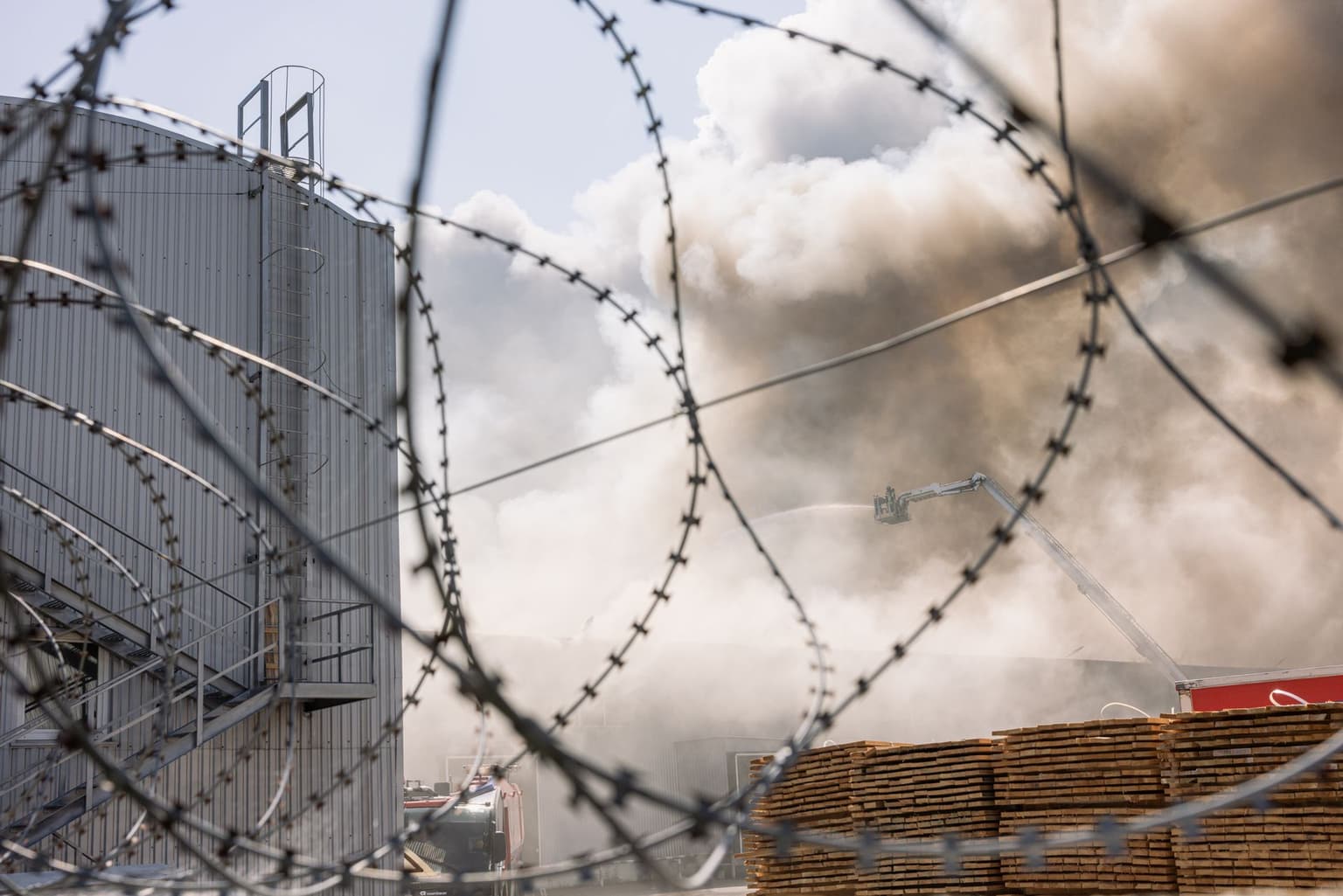
Emergency services work at the scene of a Russian drone attack in the Boryspil district in Kyiv. Drones hit a warehouse and home, while others were intercepted. (Diego Fedele/Getty Images
THE DAY’S RECKONING
Picture Russia’s top general standing in front of cameras today, describing a battlefield that doesn’t exist — Russian troops supposedly fighting inside a city they’re actually still 14 kilometers from, supposedly seizing 100 square kilometers that, by independent count, come closer to 52. That’s Valery Gerasimov’s version of this war. It’s a version built for people who will never check the math.
The real math told a harsher story. Kyiv absorbed its second major barrage in a week, waking to ballistic missiles and going to bed with drones still buzzing overhead, while supermarket warehouses, a steel plant already struck two weeks earlier, and a power station all took hits on the same day. In Washington, President Trump waved away reports that his own CIA director had just flown to Moscow with a warning about NATO. In Moldova, President Zelensky stood beside two allied leaders on Independence Day while, hours earlier, five more Russian drones drifted uninvited into Moldovan skies. Nothing about today suggested restraint on any side. Everything about it suggested both sides are settling in for whatever comes next.
GERASIMOV’S CHOREOGRAPHED LIE ABOUT THE FORTRESS BELT
Russia’s top military officer staged a carefully choreographed inspection today, using it to describe a Ukrainian collapse that independent evidence simply doesn’t support.
General Valery Gerasimov, chief of Russia’s General Staff, toured the Southern Grouping of Forces and claimed Russian troops had seized several villages east and southeast of Slovyansk, stood just four kilometers from the city’s eastern edge, and were fighting three kilometers from Kramatorsk itself. Independent researchers tracking the front found no evidence Russian forces hold any of the villages Gerasimov named, and assessed the real distance from both cities at roughly 14 kilometers — meaning Russian forces have advanced only about four kilometers in two months, even by their own commander’s earlier claims from July. Gerasimov also claimed Russian forces seized more than 100 square kilometers around Druzhkivka alone in July and August; independent tracking puts the true figure for all of Donetsk Oblast during that window at roughly 52 square kilometers.
The performance fits a pattern researchers have tracked monthly since January: senior Russian commanders staging public claims of sweeping advance specifically to convince Western audiences that Ukraine’s position is collapsing and that a ceasefire on Russian terms is simply inevitable. The gap between the performance and the reality matters because it’s aimed less at Ukrainian troops than at Western decision-makers weighing how much further support Kyiv actually needs — a campaign to shape distant political judgment using battlefield claims nobody nearby believes.
TRUMP DOWNPLAYS THE NATO WARNING AS BLOOMBERG REPORTS RUSSIA WEIGHS ITS NUCLEAR OPTION
President Trump dismissed as overblown the reports that CIA Director John Ratcliffe traveled to Moscow specifically to warn Russia against testing NATO’s Article 5 commitment, even as separate reporting suggested the Kremlin’s own options are narrowing toward genuinely alarming territory.
“There was no message and there was nothing unusual,” Trump told Axios, adding that Ratcliffe and his Russian counterpart “have a very good relationship” and meet roughly once or twice a year. Russia’s foreign intelligence chief, Sergey Naryshkin, separately confirmed meeting Ratcliffe, describing the exchange as routine. The comments directly contradict earlier reporting from the Wall Street Journal and Politico, which cited sources describing a deliberately urgent trip — Ratcliffe traveled by military transport and American motorcade rather than through normal diplomatic channels — meant specifically to warn Moscow against any provocation targeting Estonia, Latvia, or Lithuania.
Separately, Bloomberg reported that Kremlin insiders now describe peace negotiations as having reached a “dead end,” with Moscow weighing intensified ballistic missile strikes on Kyiv and other Ukrainian infrastructure as its primary remaining lever. Four people close to the Kremlin told Bloomberg that a growing number of Russian officials now view tactical nuclear weapons as a possible last resort, reasoning that for Putin, losing the war outright would be worse than any escalation short of that. Bloomberg noted no evidence Russia is actually preparing to use such weapons, but the mere fact that officials are discussing the option marks a notable shift in how Moscow frames its own remaining choices.
MOSCOW PREPARES FOR A 600,000-STRONG MOBILIZATION
Ukrainian intelligence agencies said today that Russia is preparing a mobilization wave that could ultimately bring 600,000 additional troops into the war across 2026 and 2027 — nearly double the figure Ukrainian officials cited just days earlier — with the pool now reportedly expanded to include women serving sentences in prisons and penal colonies.
The estimate lands alongside other evidence the machinery is being tested, if not yet activated. Western intelligence officials told the Wall Street Journal that Russian officers conducted a mobilization-readiness exercise in Kaliningrad in July, testing whether the region could house, feed, and arm a large influx of new recruits — one of several similar drills reportedly run across the country. None of this confirms Putin has ordered a call-up. It confirms the administrative system is being prepared in case he does, which Ukrainian officials expect would happen only after September’s parliamentary elections conclude, to avoid the domestic backlash Russia’s only prior mobilization triggered in 2022.
Russian officials, for their part, keep denying it in terms eerily similar to what they said in the weeks before that 2022 call-up. Former President Dmitry Medvedev called the rumors “nonsense.” Russia’s UN ambassador said mobilization was “not planned or expected, as far as I know,” before adding, tellingly, “let’s see what happens after the elections.” Kremlin spokesperson Dmitry Peskov dismissed the reports as Ukrainian disinformation. In September 2022, Peskov made the identical denial eight days before Putin announced mobilizing 300,000 reservists.
KYIV UNDER FIRE FOR THE SECOND TIME IN A WEEK
Russia launched 258 Shahed-type and Gerbera-type drones, Banderol loitering munitions, two Onyx anti-ship missiles, and an unspecified number of Iskander-M and North Korean KN-23 ballistic missiles at Ukraine overnight. Ukrainian forces intercepted seven ballistic missiles — the first successful ballistic intercepts reported since August 1 — along with the Onyx missile, three Banderols, and 222 drones; the rest struck 15 locations, with debris landing at 11 more.
Kyiv absorbed the worst of it. Six explosions rang out across the capital around 3 a.m., with debris damaging two schools in the Podilskyi and Shevchenkivskyi districts. The barrage continued well past sunrise: jet-powered drones kept triggering air-raid sirens through the morning and afternoon, a drone crashed onto a main road in the Holosiivskyi district injuring four people, and a residential building in Podilskyi took a direct hit in the early evening. “The all-clear sounds, and then another alert follows,” one Kyiv resident sheltering in a metro station told reporters. Ukrainian Railways reported delays of up to 13 hours on some routes.
The strikes deliberately targeted Ukraine’s retail supply chain: warehouses belonging to supermarket chains Fora and Kolos, distribution centers for Toy House and appliance retailer Comfy, an Avrora multimarket warehouse in Kyiv Oblast — its second hit in under a week — and a Roshen confectionery warehouse near Boryspil. In Kharkiv, a jet-powered drone struck an Epicentr hypermarket directly, killing a 40-year-old man and injuring five more people.
ZAPORIZHSTAL HIT AGAIN, SAME TARGET AS TWO WEEKS AGO
Russia struck the Zaporizhstal steel plant with ballistic missiles overnight for the second time in barely two weeks, hitting precisely the same targets — the plant’s blast furnace shop and its energy and transport infrastructure — that a strike on August 11 had already damaged.
A Ukrainian lawmaker said the overnight attack used five North Korean-made missiles. Metinvest, the steel giant that owns the plant, called the repeat strike “unprecedented in its consequences,” noting the facility hadn’t even finished recovering from the first hit before the second one landed on the identical spot. “People are alive — that’s the most important thing,” the company said in its statement, a line that says as much about the scale of what could have happened as about what actually did.
The repeat targeting fits a broader pattern Russia has increasingly used against Ukraine’s industrial base this year: rather than simply damaging a facility once and moving on, Russian forces are returning to strike the same production lines and infrastructure repeatedly, timed specifically to prevent recovery between attacks. For a steel plant that employs thousands and anchors Zaporizhzhia’s economy, the message is less about any single strike than about denying the company the recovery window it needs to fully restart, again and again, for as long as Russia is willing to keep spending missiles on the same coordinates.
KHERSON’S POWER PLANT DESTROYED
Russian glide bombs destroyed all remaining equipment at the Kherson Thermal Power Plant overnight, according to Ukraine’s state energy company Naftogaz — a complete loss of a facility that had already absorbed repeated damage throughout the war.
Ukraine’s economy minister used the strike to issue a blunt warning: this coming winter will be genuinely difficult, and a sustained Russian campaign against energy infrastructure would deal further damage to an economy that’s already contracted 0.6 percent in the year’s first four months specifically because of earlier energy strikes. Officials urged Ukrainians to prepare for “worst-case scenarios” rather than assume previous winters’ patterns of rolling blackouts and emergency repairs would simply repeat without getting worse.
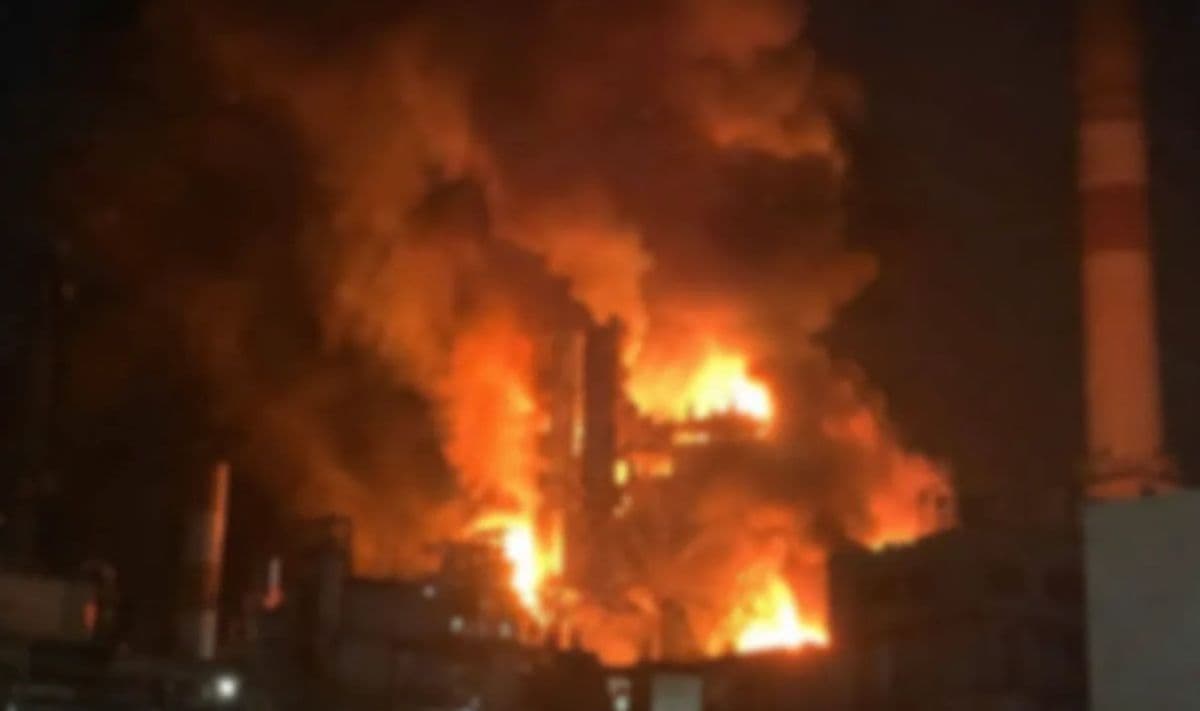
The Kherson thermal power plant after a Russian attack. (Naftogaz)
Kherson City sits close enough to the front line that its infrastructure has absorbed disproportionate punishment throughout the war, and a fully destroyed thermal plant — as opposed to a damaged one that can eventually be patched — represents a different order of loss. Where earlier strikes left something to repair, this one appears to have left nothing, meaning residents in one of Ukraine’s most exposed frontline cities now face winter with meaningfully less generating capacity than they had even a day earlier, layered on top of a summer that already tested the city’s ability to keep basic services running under near-constant fire.
ZELENSKY, SANDU, AND DAN STAND TOGETHER IN CHISINAU
President Zelensky traveled to Moldova’s capital today to join Moldovan President Maia Sandu’s Independence Day celebrations, standing alongside Romanian President Nicusor Dan in a trilateral show of regional solidarity that unfolded hours after Russian drones once again violated Moldovan airspace.
Sandu said five Russian drones crossed into Moldovan territory ahead of the day’s festivities, calling the incursions “intimidation” while reaffirming Moldova’s determination to keep pursuing EU membership regardless. It’s a now-familiar pattern: a similar drone briefly entered Moldovan airspace on August 16 before continuing into Romania, where a Spanish F-18 on NATO patrol shot it down — the fourth such intercepted drone over Romanian territory this year. During their joint appearance, Sandu referenced the Order of the Republic, Moldova’s highest state honor, which she’d awarded Zelensky just three days earlier during Ukraine’s own Independence Day. “While Ukraine is fighting there, in the east, Moldova can sleep peacefully,” she said, crediting Zelensky’s leadership directly.
“A few days ago, the president of Moldova was with us in Ukraine on our Independence Day. Today, Ukraine stands with Moldova on its Independence Day,” Zelensky said, noting the two nations mark the same 35th anniversary just three days apart and are pursuing EU accession on intertwined tracks. The three leaders discussed energy cooperation, shared infrastructure, and security capabilities — practical cooperation dressed in the symbolism of three neighbors choosing, deliberately and publicly, to be seen standing together.
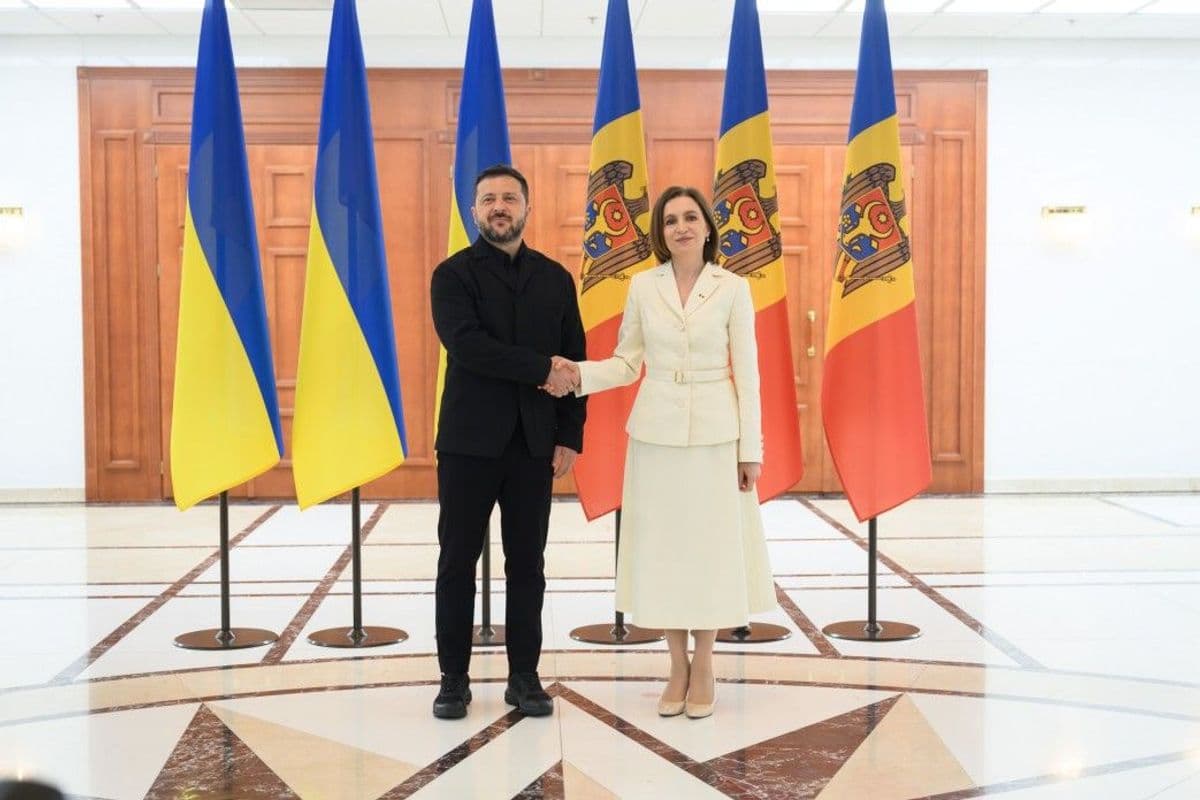
President Volodymyr Zelensky and Moldovan President Maia Sandu in Chisinau marking Moldova’s Independence Day. (President’s Office)
RUSSIA THREATENS BRITAIN OVER LONG-RANGE STRIKES
Russia’s Foreign Ministry accused the United Kingdom and France today of “playing with fire” by providing Ukraine with the technology behind its long-range strike campaign, explicitly threatening retaliatory strikes against British military targets both inside and outside Ukraine.
The threat reflects a broader shift in how Moscow now frames Ukraine’s deep-strike campaign: not as a Ukrainian operation Russia must simply defend against, but as an extension of direct NATO involvement in the war, given the intelligence-sharing and technology transfers underpinning many recent strikes. It’s a framing that conveniently avoids acknowledging that Ukraine’s strikes are aimed at legitimate military and dual-use economic targets funding Russia’s own invasion — but it’s also a framing that raises real questions about how seriously to take a threat against a NATO member’s military assets, at a moment when US intelligence is already reportedly warning that Russia may be probing for exactly this kind of escalatory opportunity elsewhere along NATO’s eastern edge.
Neither the UK nor France had issued a formal response as of this report. The threat lands the same week Russia’s own foreign ministry spokesperson was publicly denying any intention of aggression against NATO members — a contradiction that illustrates just how much of Moscow’s public messaging on this question functions as pressure and signaling rather than a coherent, consistent position.
CONFIRMED: ALL OF LUKOIL’S REFINERIES ARE OFFLINE
Ukraine’s deep-strike campaign against Russian oil, e-commerce, and military infrastructure kept pace with everything Russia threw at Ukraine today, hitting targets across four separate Russian regions in a single 24-hour window.
Ukrainian drones struck Ozon logistics facilities in Ufa and Orenburg overnight, with the company confirming evacuations and no casualties at either site, while a separate strike hit an Ozon warehouse in Blagoveshchensk, Bashkortostan, nearly 750 miles from the border. Since mid-July, more than 20 Wildberries distribution centers across 16 Russian regions have come under Ukrainian attack, with at least seven of the company’s ten largest warehouses now knocked offline entirely — losses analysts estimate at up to $10 billion once seller losses are included, alongside Wildberries losing roughly a third of its total warehouse capacity. Separately, Ukraine confirmed updated damage assessments showing an August 25 strike on the Afipsky oil refinery in Krasnodar Krai damaged a key processing unit, gas fractionation equipment, and a pipeline section, while Reuters confirmed the earlier NORSI refinery strike in Nizhny Novgorod has forced Lukoil to suspend crude processing indefinitely — meaning every major refinery Lukoil operates inside Russia is now offline.
Putin has publicly insisted the strikes have caused no “critical consequences,” even as he quietly signed a decree granting the state authority to seize temporary control of businesses that fail to adequately protect themselves from drone strikes — a measure that reads less like confidence and more like an admission that private companies can no longer manage the threat on their own.
TWO YOUNG GENERALS TAKE COMMAND OF UKRAINE’S HARDEST FIGHT
President Zelensky’s decision yesterday to hand Ukraine’s most contested defensive sector to two comparatively young battlefield commanders is drawing detailed scrutiny today, as analysts sketch out just how unusual — and how urgent — the move actually is.
Brigadier Generals Denys Prokopenko, 35, and Andriy Biletsky, 47, will lead two newly reorganized force groupings defending Donetsk Oblast, effectively skipping over a generation of more senior officers in favor of commanders whose reputations were built entirely in this war rather than in Soviet-era institutions. Prokopenko survived the siege of Mariupol and Russian captivity before rebuilding the Azov Corps into one of Ukraine’s most effective formations; Biletsky’s 3rd Army Corps has held a 93-mile stretch between Lyman and Borova largely intact, launching successful counterattacks around Lyman as recently as this summer. Robert Brovdi, commander of Ukraine’s Unmanned Systems Forces, welcomed the appointments in characteristically blunt terms on his Telegram channel: “This is Smart War… There will be total synchronization with the USF. The time chain between sensor and shooter will be minimal. Worms, cover your eyes!”
The urgency behind the reshuffle isn’t subtle. Military journalist Yuriy Butusov called the situation in Donbas “the biggest challenge we have faced during the war,” noting Russian forces are “practically on the outskirts of Slovyansk” along what remains Ukraine’s best natural defensive line. Independent monitor DeepState identified Kostyantynivka as the current epicenter of fighting, with Russian troops infiltrating house to house through ruins as Ukrainian forces conduct constant reconnaissance simply to locate them.
MEANWHILE, AT THE ACTUAL FRONT
Away from the command reshuffle and the Kyiv barrage, the ground war produced its usual mix: contested inches, refuted Russian claims, and one confirmed strike deep behind Russian lines.
In northern Sumy Oblast, Russian forces advanced east of Bezsalivka, while further east in Kupyansk and Borova, Ukrainian counterattacks reportedly pushed back against Russian pressure, with sources on both sides describing Ukrainian forces expanding contested ground near Ridkodub, Katerynivka, and Nove. Russian vehicles reportedly can no longer travel safely within 25 miles of the front line in occupied Luhansk Oblast, according to a source tracking Russian forces there, a testament to how thoroughly Ukrainian drones have degraded Russian rear-area logistics even in sectors far from active combat. Near Kostyantynivka, Russian forces advanced further into the town’s western districts, continuing the slow, costly infiltration that’s defined fighting there for nearly a year.
Ukraine’s own strikes reached deep behind the front as well: Ukraine’s General Staff confirmed air-to-surface missiles hit the main and reserve command posts of Russian formations in occupied Donetsk Oblast, with Russian sources accusing Ukraine of striking a shopping mall in Donetsk City instead — a claim Ukrainian sources dispute, saying the actual target was the headquarters of Russia’s 51st Combined Arms Army nearby, with a since-deleted Russian news post reportedly acknowledging Russian soldiers had been killed in the strike.
UKRAINE’S HARVEST AT RISK
Russia’s campaign against Ukrainian ports and agricultural logistics is now threatening the actual physical size of Ukraine’s next harvest, not just its ability to export the current one.
Agriculture Minister Taras Vysotskyi warned that the area Ukrainian farmers plant for the coming season could shrink by 5 to 7 million hectares, as blocked exports squeeze the profits farmers need to justify planting at full scale. Agriculture accounted for 17 percent of Ukraine’s GDP last year, and the country’s agriculture ministry estimates a storage capacity shortfall of 11 million metric tons this fall alone, requiring roughly $44 million in financing farmers largely can’t access through conventional bank loans given wartime risk. The United Nations has stepped in to help, offering specialized financial support tools for small and medium farmers and delivering 10,000 storage sleeves and prefabricated storage units to prevent harvested grain from simply rotting for lack of anywhere to put it.
The crisis compounds an already difficult picture for Ukrainian business more broadly. During a Kyiv visit, US Senator Richard Blumenthal noted that roughly half of American companies operating in Ukraine have suffered damage from drones or missiles, urging them to press the Trump administration harder for increased pressure on Russia — a reminder that the economic toll of this war extends well past Ukraine’s own companies and into the interests of allies who might otherwise see the conflict as someone else’s problem.
LUKASHENKO MEETS PUTIN AS BUDANOV FLOATS SEPTEMBER TALKS
Belarusian President Alexander Lukashenko arrived in Russia today for direct talks with Vladimir Putin, covering bilateral cooperation and regional security, alongside a separate meeting with Russian Prime Minister Mikhail Mishustin focused on trade and industrial cooperation between the two countries.
The visit came the same day Ukraine’s presidential chief of staff, Kyrylo Budanov, said a new round of talks between Ukrainian and Russian delegations could take place as early as September, describing current negotiations as paused but potentially “revived” soon. “And with the Americans too. We can’t do without them,” Budanov said, underscoring how central US involvement remains to any realistic path back to the table. President Zelensky has confirmed Ukraine has submitted new proposals to Washington built around three elements he says international partners have already agreed on: a ceasefire, the creation of a free economic zone, and security guarantees involving the EU and NATO.
Russia’s own public posture offers little encouragement for that timeline. Putin has said repeatedly he sees no reason to resume talks until Russian forces control the rest of Donetsk Oblast, and has explicitly rejected proposals for a more limited de-escalation, including a prior offer to halt long-range strikes in exchange for confining fighting to already-occupied regions. Diplomats increasingly view even a narrow pause in long-range aerial attacks as one of the only realistically achievable confidence-building steps left — a low bar that Russia has so far declined to clear regardless.
OCCUPIED TERRITORIES: CHILDREN’S WAR GAMES AND A PRISONER SENT TO A NOTORIOUS CELL
Behind the day’s strikes and diplomacy, Russia’s occupation apparatus continued its quieter, longer-term work of embedding the war into daily life across occupied Ukraine.
Russian federal agencies, including the Ministry of Defense, sponsored the transfer of youth teams from occupied Donetsk Oblast to Volgograd for the finals of “Zarnitsa 2.0” — a revived Soviet-era military games program that trains children as young as seven in tactical drills, drone operation, and combat medicine, running through September 7. Separately, Crimean Tatar prisoner of war Seryan Asanov was deported to Russia’s notorious Vladimir Central prison after being sentenced to 20 years for treason over his affiliation with a Ukrainian battalion Russia has designated a terrorist organization — a designation rights monitors say Russia weaponizes specifically to strip captured Ukrainian soldiers of the POW protections international law otherwise guarantees them.
In occupied Crimea, inflation has reached nearly 16 percent, more than double Russia’s claimed national average, driven substantially by a 211 percent spike in gasoline prices over the past year as Ukrainian strikes continue isolating the peninsula’s fuel supply. In Mariupol, occupation officials announced plans to deputize civilian volunteers into a “people’s militia” to patrol public spaces — a tactic Russia has used elsewhere in occupied Ukraine since 2022 to extend surveillance and suppress dissent under the guise of community policing.
REGIONAL CASUALTIES ACROSS THE COUNTRY
Beyond the day’s headline strikes, Russian attacks spread damage and injury across multiple regions in ways that rarely make international headlines individually but add up to a genuinely brutal daily total.
In Dnipropetrovsk Oblast, Russian forces struck the Nikopol and Synelnykove districts nearly 40 times using drones, artillery, and guided bombs, damaging a lyceum, a college, shops, vehicles, and private homes. Six people were injured in central Nikopol, three of them hospitalized, while strikes on the Marhanets, Pokrovske, and Chervonohryhorivka communities damaged further civilian infrastructure and injured two more people, including a 65-year-old man hospitalized in moderate condition. In the Synelnykove district, strikes on the Vasylkivka and Petropavlivka communities damaged private homes without officials specifying the weapons used.
The pattern is now familiar enough to describe without much elaboration: a lyceum here, a handful of private homes there, an elderly man hospitalized, a college damaged, none of it likely to register nationally but all of it part of the same daily arithmetic Ukrainians in frontline and near-frontline regions have learned to expect, absorb, and, as much as possible, simply continue living through. What distinguishes today’s toll isn’t its severity relative to the war’s worst days, but its sheer geographic spread — strikes reaching multiple separate districts within a single region, each requiring its own emergency response, its own damage assessment, its own quiet accounting of what’s broken and what still, somehow, isn’t.
A CAR EXPLODES IN ST. PETERSBURG, A DANISH SHIPYARD KEEPS SERVICING RUSSIA’S FLEET
A Russian lieutenant colonel died today when his car exploded near a supermarket in St. Petersburg’s Shushary neighborhood, according to local outlet Fontanka. His wife, reportedly in the vehicle at the time, was critically injured. Russian authorities opened an investigation but described the incident only as a “vehicle fire” rather than an explosion, and haven’t named the victim or identified any suspects. Ukraine has not commented.
It’s the latest in a pattern of unexplained deaths and attacks targeting Russian military-linked figures this year, following the June car bombing that killed Damir Davydov, an official responsible for supplying missile and artillery ammunition to Russian forces, outside Moscow. Ukrainian intelligence services have previously been linked to similar killings of Russian officials tied to war crimes or military logistics, though Kyiv typically neither confirms nor denies involvement in any specific case.
Separately, sanctions-monitoring group Urgewald said Denmark’s Fayard shipyard is set to service a third Russian-linked liquefied natural gas tanker this summer — the Cyprus-flagged Boris Davydov — even as the company prepares to represent Denmark at an international trade fair. “Denmark is speaking with two voices,” Urgewald campaigner Alexander Kirk said, noting the Danish government has publicly condemned the shipyard’s work while allowing it to continue under the national flag. Denmark’s prime minister has separately called it “incomprehensible” that a Danish shipyard could be servicing vessels tied to Russia’s war economy, urging Fayard to stop — a public rebuke that, so far, hasn’t translated into the shipyard actually halting the work.
A GENERAL’S LIE, A NATION’S CAUTION, A CHOICE TO STAND TOGETHER
By nightfall, the day’s contradictions sat plainly side by side. Russia’s top general described a battlefield collapse that satellite evidence flatly contradicts. Russia’s foreign ministry threatened a NATO member’s military while insisting, in the same week, that it harbors no aggressive intent. And in Chisinau, three presidents stood together anyway, choosing visible solidarity over the quiet caution fear might otherwise recommend.
A steel plant in Zaporizhzhia took the same hit twice in two weeks. A power station in Kherson has nothing left to repair. And somewhere in Kyiv tonight, families are settling into a fourth-floor apartment with a hole in it, waiting to learn if anyone was inside when the missile hit. Nothing today ended. Everything today confirmed how much both sides are still prepared to spend proving they haven’t.
A PRAYER FOR UKRAINE
1. For the Man Killed in a Kharkiv Hypermarket
Lord, a 40-year-old man died today in an ordinary Kharkiv store, killed by a drone while doing nothing more remarkable than being present in his own city. We grieve a death this sudden, this unremarkable in every way except its cause. Receive him, comfort whoever mourns him tonight, and hold the five others injured alongside him as they heal from wounds both physical and otherwise.
2. For a City Bracing for a Winter Without Power
Father, we lift up the people of Kherson, now facing winter with a power plant that has nothing left to repair. Give them warmth they cannot generate themselves, and give the officials responsible for their care wisdom and speed in whatever comes next. Let a city that has already endured so much find enough resilience for one more hard season.
3. For Farmers Watching Their Fields Shrink
Lord of the harvest, we pray for Ukraine’s farmers, forced to plant less because the ports meant to carry their grain keep coming under fire. Provide for those whose livelihoods depend on a season they can no longer fully trust. Give Ukraine’s partners generosity in filling the gaps this crisis creates, and let the country’s fields keep feeding both itself and the world despite everything working against that.
4. For Every Leader Weighing Words Against Consequences
God of wisdom, we pray for those navigating this moment’s dangerous rhetoric — threats made, threats dismissed, warnings given in rooms the rest of us can’t see into. Give leaders on every side the restraint not to let posturing become genuine escalation. Protect the people who would bear the actual cost if words like these ever turned into something worse.
5. For the Children Being Prepared for a War Not Yet Theirs
Lord of the innocent, we pray for the children in occupied territory being trained, even now, for a war their own government started. Protect their capacity for childhood despite every system built to erase it. Give them, eventually, a chance to choose their own future rather than the one being built around them without their consent.
In Your mercy, in Your justice, in Your time — bring this war to its end, and let the ending be worthy of what Ukraine has endured.