
September 3, 2026
Prepared by Diana Bozhyk
A Ukrainian naval drone struck a Russian support vessel in the port of Sochi, 820 kilometers from Ukrainian-controlled coastline, hours after an unknown assailant shot and critically wounded the Russian bomber commander Ukraine’s security service had charged with ordering the 2024 missile strike on Kyiv’s largest children’s hospital. Vladimir Putin offered contradictory signals on peace talks, claiming there’s a genuine chance for negotiations while his own foreign minister reiterated demands amounting to Ukrainian capitulation, and Russian airports near Moscow suffered a second consecutive night of flight disruptions following Zelensky’s warning about Ukrainian drones. Russia struck a Coca-Cola bottling plant outside Kyiv on the capital’s eighth consecutive day under attack, which Zelensky called “a clear Russian signal to America,” while mourners in Kyiv buried a 25-year-old combat medic killed rescuing survivors of an earlier Russian strike.
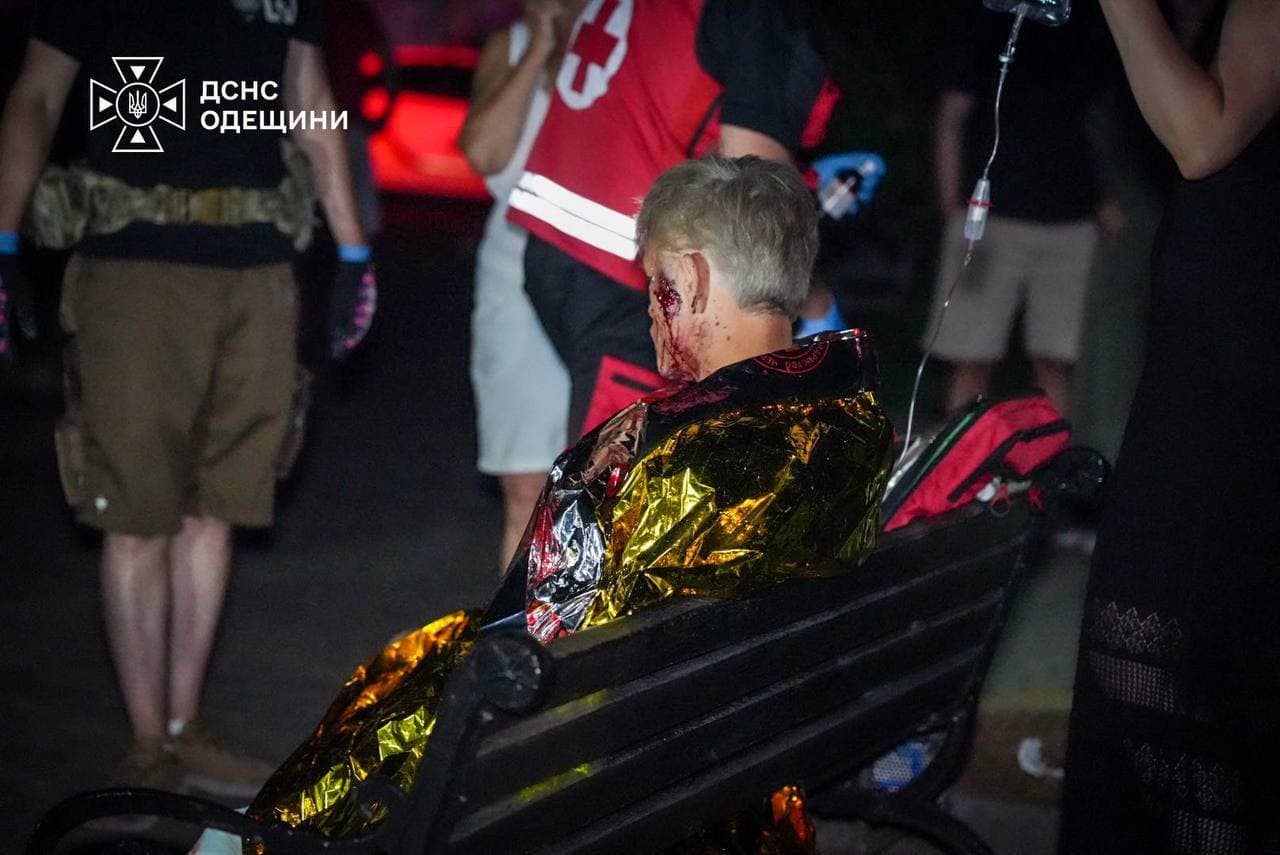
A person receives medical assistance following a Russian attack on Odesa Oblast overnight. (State Emergency Service of Ukraine in Odesa Oblast/Telegran).
THE DAY’S RECKONING
Vladimir Putin stood at a podium today and said there’s a real chance for peace talks. His own foreign minister, hours earlier, restated demands that amount to Ukraine simply surrendering. That’s not a contradiction Putin is trying to hide — it’s a strategy, one he’s used for years: sound reasonable to the world while asking for the impossible from Kyiv.
Everything else about today moved with the same restless energy that’s defined this war for weeks. A Ukrainian drone boat reached a Russian port nearly 500 miles from Ukraine’s coast. An unknown gunman shot the general Ukraine blames for a missile that hit a children’s hospital. Moscow’s own airports sat disrupted for a second night running. And in Kyiv, a Coca-Cola plant burned, a Russian strike that Zelensky read as a message aimed squarely at Washington. In the middle of it all, a city buried a 25-year-old medic who ran toward danger one time too many — the kind of loss that doesn’t fit neatly into any strategic narrative, just grief, carried by people trying to keep fighting anyway.
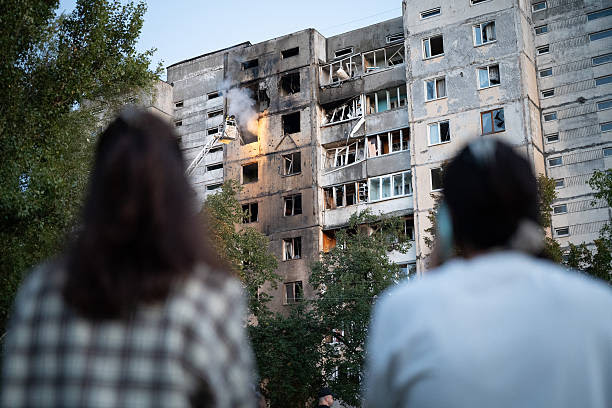
Local residents look at a residential building damaged in a Russian airstrike in Kyiv. (Danylo Antoniuk/Anadolu via Getty Images)
PUTIN’S CONTRADICTIONS ON PEACE, AND THE COSTS HE WON’T ADMIT
Vladimir Putin told the Eastern Economic Forum today that he believes there’s a genuine chance for constructive peace talks between Russia and Ukraine, and that only the two countries themselves can ultimately resolve the war — with the US, China, and everyone else limited to a supporting role. It’s a notable shift in tone from his own comments just two days earlier, when he said Russia couldn’t negotiate directly with Ukraine at all because Moscow considers it a “terrorist entity.” Foreign Minister Sergei Lavrov undercut the softer framing the same day, reiterating demands that amount to full Ukrainian capitulation while presenting them as a reasonable basis for talks — a pattern analysts assess is deliberate: appear open to negotiation while keeping terms Kyiv could never accept.
Putin also downplayed the war’s mounting costs to ordinary Russians. He claimed annual inflation sits at 6.3 percent and is “gradually normalizing,” even though Russia’s own Ministry of Economic Development raised its estimate to 6.32 percent just three days earlier, up from 5.98 percent in July — inflation rising, not falling. He framed record-low unemployment as a sign of economic health while refusing to answer a direct question about the war’s effect on Russia’s population, sidestepping the reality that labor shortages stem partly from military recruitment and partly from declining birth rates, concentrated hardest in Russia’s poorer, rural regions the Kremlin has deliberately prioritized for recruitment specifically to shield wealthier cities from the war’s visible toll.
A UKRAINIAN DRONE BOAT REACHES SOCHI, 820 KILOMETERS FROM THE COAST
Ukraine’s navy confirmed a naval drone strike on the Russian support vessel Nefrit in the port of Sochi overnight, a strike notable less for the ship itself than for the distance involved: roughly 820 kilometers from Ukrainian-controlled coastline, demonstrating Ukraine’s ability to reach precisely targeted Russian assets far beyond the Black Sea’s contested northern waters. Footage published by monitoring channels also showed an apparent fire at an oil depot near Sochi’s port, though the specific facility remained unconfirmed, alongside reports of an explosion near a Russian Pantsir air-defense system at the same location.
Ukrainian naval spokesperson Dmytro Pletenchuk said Russian forces haven’t deployed missile-equipped vessels from Russian ports in three months, relying instead on land-based launches near naval bases — a direct consequence, he said, of the Russian navy’s inability to safely repair or maintain ships and submarines given the sustained Ukrainian drone threat. Ukraine’s interception rate against sea-launched Kalibr cruise missiles has reportedly climbed to nearly 100 percent, likely because Russian vessels are now firing from far greater distances than before. Sochi carries its own symbolic weight: the city hosts Putin’s official summer residence and functions as a playground for Russia’s elite, making it a target chosen as much for what it represents as for any single vessel docked there.
AN ASSASSINATION ATTEMPT ON THE GENERAL BEHIND A CHILDREN’S HOSPITAL STRIKE
An unknown attacker shot Major General Nikolai Varpakhovich twice near Engels in Russia’s Saratov Oblast this morning before fleeing on a motorbike, leaving the commander of Russia’s 22nd Guards Heavy Bomber Aviation Division in critical condition. Russian investigators opened a criminal case for attempted murder; no suspect has been apprehended.
The target matters. Ukraine’s SBU formally charged Varpakhovich in absentia just three days earlier for his alleged role ordering the July 2024 missile strike on Kyiv’s Okhmatdyt children’s hospital — an attack that killed two adults, injured at least 34 people including nine children, and scored a direct hit on the hospital’s oncology and surgery departments while more than 600 patients were inside. Investigators concluded a Tu-95MS strategic bomber under Varpakhovich’s command carried out the strike.
Today’s shooting marks the fourth assassination attempt against a Russian officer in a rear area since August 1 alone, part of a pattern that’s left Russian military and defense-linked figures increasingly uncertain whether distance from the front actually guarantees their safety anymore. Ukraine has neither confirmed nor denied any involvement, maintaining the same careful silence it’s kept around every similar incident this year, even as the pattern grows too consistent to easily dismiss as coincidence.
MOSCOW’S AIRPORTS GRIND TO A HALT FOR A SECOND NIGHT
Vnukovo and Sheremetyevo airports in Moscow Oblast suspended operations for the second consecutive night, according to flight-tracking data, days after President Zelensky warned that Ukrainian drone activity would make Russian airspace “de facto closed” to commercial aviation. Russia’s aviation regulator initially insisted air transport was operating normally and dismissed a Ukrainian-issued airspace notice as illegitimate, before confirming the suspensions itself.
FlightRadar24 tracking showed 21 flights canceled and 235 delayed at Sheremetyevo overnight, with 22 canceled and 94 delayed at Vnukovo — disruption severe enough that even Turkish carrier Pegasus Airlines, one of the few Western-linked airlines still flying to Russia, canceled a round of flights before resuming a scaled-back schedule. Ukraine has pursued this exact strategy for roughly a year and a half through a program security officials have called Operation Carpet, deliberately flying drones near Russian airports to disrupt operations without necessarily striking them directly. Andriy Kovalenko, head of Ukraine’s Center for Countering Disinformation, argued today that this kind of pressure — not just air defense at home — is the only real way to stop what he called “Russian drone terror”: “The only way to stop it is to create the same on their territory at points that are painful for them.”
THE SHOOTOUT’S AFTERMATH: KAPLUNOV SPEAKS, ZELENSKY DISMISSES TWO DEPUTIES
Russian Volunteer Corps deputy commander Stepan Kaplunov broke his silence today, denying SBU allegations that he’d contacted Russia’s FSB and plotted assassinations, and giving his own account of the days before yesterday’s shootout between SBU and HUR officers in Kyiv. Kaplunov said he was seized near his home on August 23 by men who identified themselves as police, then blindfolded, held at what he called a “secret prison,” and threatened over two days of interrogation. “They were saying that one could disappear forever. There was talk about ‘digging a hole,'” he said, claiming he only confessed to FSB contact under psychological pressure after nine days in custody, before being released and returned home — without warning that investigators were about to search his apartment.
The SBU maintains it uncovered genuine evidence of contact with Russian intelligence tied to a planned assassination of a Russian opposition figure, and that Kaplunov cooperated voluntarily. Ukraine’s Prosecutor General confirmed criminal charges against one SBU officer and one HUR officer over yesterday’s shooting, which left three HUR personnel wounded. President Zelensky announced that deputy heads of both agencies “responsible for this situation” will be dismissed, calling the episode something that “should never happen” from institutions meant to defend the country rather than turn on each other.
MEANWHILE, AT THE FRONT
Ukrainian forces advanced north of Kupyansk, clearing four additional square kilometers between Dvorichna and Zapadne and liberating 13.5 square kilometers in that stretch since August 30, while Ukrainian drone strikes on a gas pipeline north of the city continued constraining Russian logistics across the Oskil River. Near Kozacha Lopan, Russian forces are infiltrating the settlement’s northern edge and raising flags for propaganda footage, but a source tracking Russia’s own Northern Grouping acknowledged forces still don’t actually control it — matching Ukraine’s own assessment that Russian troops hold barely 13 percent of the village despite Putin’s public claims otherwise.
Near Slovyansk, Ukrainian counterattacks near Lyman and Drobysheve pushed back against continued Russian pressure, while near Kostyantynivka, Russian sources published flag-raising footage over Izhevka that researchers assess was likely AI-altered. Ukrainian military observer Kostyantyn Mashovets reported genuine Ukrainian advances near Oleksandrivka, reaching the Zaporizhzhia-Myrne line and pushing to within 800 meters of Pavlivka’s northeastern outskirts, even as Russian forces separately seized Novomykolaivka nearby and attempted further infiltration northwest of it. Near Hulyaipole, Ukrainian forces struck Russian infiltrators in Vozdvyzhivka and counterattacked near Lyubytske and Rizdvyanka, while Ukrainian intermediate-range strikes continued against Russian logistics and command infrastructure well behind both fronts, part of a sustained effort to make any renewed Russian offensive costlier to actually sustain.
RUSSIA’S OCCUPATION MACHINE
Russia’s deportation of Ukrainian political prisoners continued in apparent violation of international law: occupied Crimea’s authorities transferred pro-Ukrainian activist Ksenia Svetlishina to a women’s prison in Russia’s Vologda Oblast, while five Ukrainian POWs and one civilian were separately deported from a penal colony in occupied Makiivka to prisons inside Russia proper — all reportedly suffering deteriorating health in custody, a transfer the Fourth Geneva Convention explicitly prohibits.
Occupation courts kept issuing severe sentences for perceived pro-Ukrainian activity: seven separate cases reviewed over the past week resulted in sentences of 13 to 23 years, three of them against women, for allegedly sharing information on Russian military positions or sending money to Ukraine’s military — a King’s College London study recently found that in occupied Zaporizhzhia Oblast specifically, sending money to Ukraine draws harsher punishment than murder. Early voting for Russia’s September State Duma elections began in occupied Luhansk and Donetsk oblasts, part of what Ukrainian intelligence assesses is a deliberate effort to manufacture the appearance of grassroots legitimacy for the occupation. Separately, occupied Donetsk Oblast’s administration pitched itself as an investment destination at Russia’s Eastern Economic Forum, even as an independent Belarusian investigation found Russian oligarchs personally profiting hundreds of millions of dollars from Mariupol’s reconstruction, often at the direct expense of displaced local residents forced from their homes.
KYIV’S EIGHTH DAY: COCA-COLA BURNS AS A “SIGNAL TO AMERICA”
Russian drones struck a Coca-Cola production facility near Brovary, in Kyiv Oblast, on the capital’s eighth consecutive day under sustained attack, damaging warehouses without injuring any employees. “Coca-Cola is already such an enemy to them that they are burning it with their Shaheds,” Zelensky said in his evening address. “A clear Russian signal to America — the Russians cannot help but know that this is an American enterprise,” framing the strike, much like Sybiha’s comments about the Mondelez factory weeks earlier, as evidence Russia’s targeting increasingly touches American economic interests directly.
The broader barrage injured at least 13 people across Kyiv, including a 12-year-old girl, with six hospitalized, several of them medical personnel caught in the strikes while responding to earlier damage. Debris fell across multiple districts — a residential complex in Holosiivskyi, a store in Darnytskyi, a park and non-residential buildings in Solomianskyi — while a fire on a nine-story building’s upper floors initially raised fears of a fatality that officials later said they couldn’t confirm. Separately, a Tuesday strike on a 16-story building in Kyiv’s Podil district, only now fully detailed, injured three people and required rescuing seven residents through smoke covering roughly 1,000 square feet of the structure’s upper floors.
ODESA’S NIGHT: SEVENTEEN WOUNDED IN A HIGH-RISE
A Russian drone struck a 21-story residential building in Odesa overnight, damaging apartments from the 10th through 17th floors and injuring at least 17 people, including three children, according to regional governor Oleh Kiper. Twelve nearby cars were also damaged. Emergency crews remained at the scene into the morning as officials set up an operational headquarters to coordinate the response.
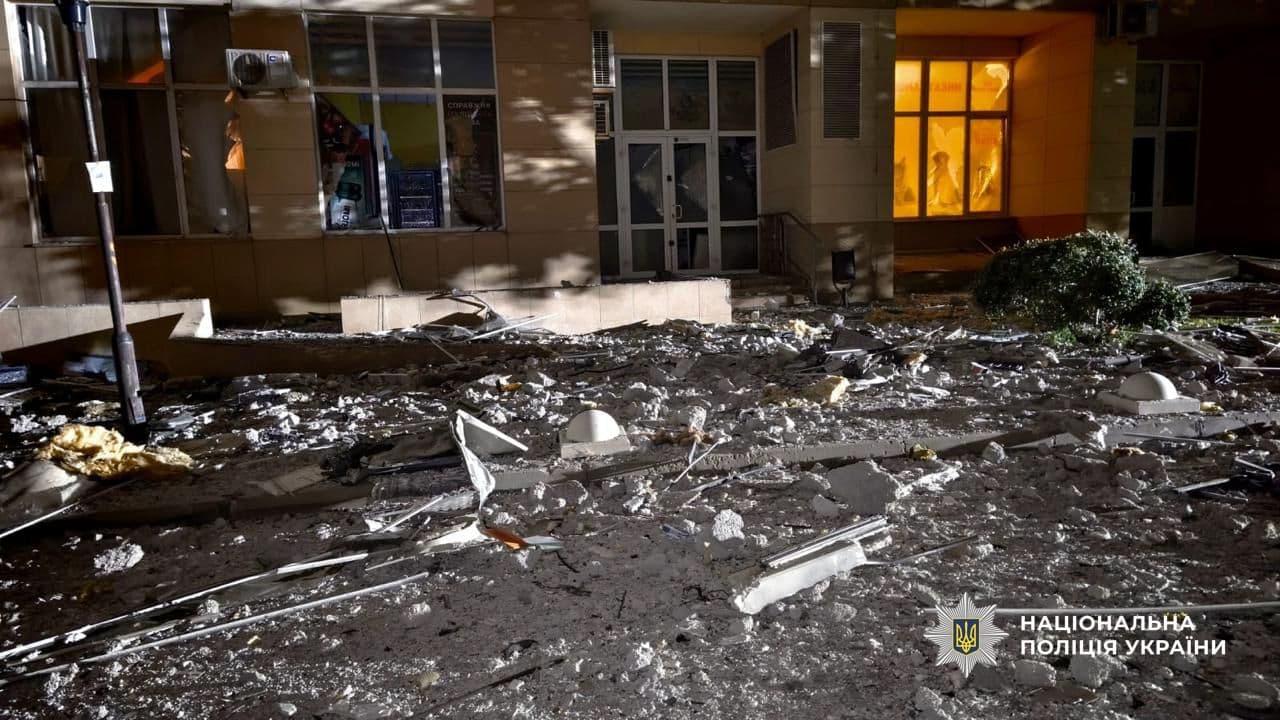
Russia attacked southern port city of Odesa overnight. (National Police)
The strike was part of a broader overnight barrage that damaged infrastructure across 13 Ukrainian oblasts, part of what Zelensky described as a deliberate new phase of escalation. “The enemy did not take a vacation — the Russians have found a new escalation and have no plans to slow it down,” he said, renewing calls for faster European production of both anti-missile and anti-drone systems. Nationwide, the overnight attacks killed at least five people and injured at least 66, with drones reaching as far as Khmelnytskyi and Vinnytsia oblasts in western Ukraine — regions historically considered farther from the war’s daily violence than they’ve proven to be this week. The deadliest single toll came in Dnipropetrovsk Oblast, where four people were killed and 13 injured as Russian drones, artillery, and a glide bomb struck six separate districts, damaging schools, apartment buildings, and a food warehouse in a single coordinated assault.
A COMBAT MEDIC’S LAST CALL
Mourners carrying flowers, Ukrainian flags, and soft toys filled Kyiv’s St. Michael’s Golden-Domed Cathedral today for the funeral of Eva Reuter, a 25-year-old combat medic killed in a Russian double-tap strike while rescuing victims of an earlier attack. Born in 2000, Reuter trained as an artist and art historian before joining Ukraine’s volunteer Hospitallers medical battalion in November 2022, where she went by the call signs “Alice” and “Planochka.” She later helped build the engineering branch of a drone unit within the 25th Airborne Brigade, mastering FPV systems and 3D printing while also handling international recruitment and communications.
After the service, mourners walked in procession to Maidan Nezalezhnosti, where Reuter’s fiancé — an American serviceman known by the call sign “Exile” — delivered a tribute in both Ukrainian and English. “She was the bravest person I ever knew,” he said. “She died to save others. She spent her life and gave the best years of her life to protect and save other people.” He described the moment of her death simply: people had been wounded, she knew they needed her, so she went — and Russian forces struck the same site again. “A part of me died in that car with her,” he said, before vowing to return to the fight she’d died supporting. The crowd answered his closing “Slava Ukraini!” with “Heroiam slava!”
WASHINGTON’S ENVOYS SET A DATE FOR KYIV AND MOSCOW
President Zelensky confirmed today that preliminary dates have been set for US envoys Steve Witkoff and Jared Kushner to visit both Kyiv and Moscow in the coming days — a trip that would mark the pair’s first visit to Ukraine itself since becoming Washington’s primary intermediaries in the war. “We have confirmation from them: there will be a meeting in Moscow, as well as one in Kyiv,” Zelensky said, adding that continued active American engagement remains essential. A Ukrainian official cautioned the visit could still fall through despite the pledge, given how many times it’s already been postponed since late July.
The confirmation lands days after Treasury Secretary Scott Bessent met Russian Finance Minister Anton Siluanov to discuss what’s widely believed to be a revised version of Washington’s 28-point peace framework — a plan Ukraine’s own officials say they still know nothing about directly. Foreign Minister Andrii Sybiha struck an optimistic note regardless, telling reporters he expects “new momentum” in diplomacy as political calendars resume around the world this autumn, while stressing that any real progress remains impossible without active American involvement: “It is unrealistic to achieve this without the involvement of the American side — these are the geopolitical realities.”
GERMANY DEEPENS ITS COMMITMENT
Germany advanced three separate fronts of support and confrontation with Russia today. A German-Ukrainian joint venture between Auterion and Airlogix officially began production on more than 5,000 medium- and long-range drones under a €300 million deal, with one model capable of striking targets up to 1,500 kilometers away — output expected to continue through mid-2027 and explicitly designed to help Ukraine sustain the kind of deep-strike campaign it’s run against Russia all year. “This partnership brings together what neither company could achieve alone,” Airlogix CEO Vitalii Kolesnichenko said.
Separately, Germany’s economics ministry pledged €250 million to Ukraine’s Energy Support Fund ahead of winter, bringing Berlin’s total contribution to the fund past €810 million since 2022 — the largest of any single donor, layered atop a €50 million humanitarian pledge announced just two weeks earlier. And in a retaliatory move following Germany’s closure of Russia’s Bonn consulate and Berlin cultural center, Foreign Minister Lavrov announced Russia will close all three Russian branches of Germany’s Goethe-Institut, the country’s flagship cultural and language organization, calling Berlin’s earlier move “the end of their cultural presence in Russia” while continuing to deny any Russian role in the Leipzig drone incident that triggered the whole exchange.
INDIA SAYS OIL PURCHASES WON’T END THE WAR
Indian Foreign Minister Subrahmanyam Jaishankar, on his first visit to Kyiv, pushed back directly against pressure for India to stop buying Russian oil, arguing the war “will not dissolve” based on who buys what from Moscow. “This conflict will be solved by dialogue, by diplomacy, by negotiations,” he said alongside Ukrainian counterpart Andrii Sybiha, adding that ensuring fuel access for India’s 1.4 billion people remains a genuine constraint he expects Ukraine to respect even as Kyiv respects India’s stated opposition to the war itself.
The comments come as the US House prepares to vote on legislation that could impose tariffs up to 100 percent on the world’s largest buyers of Russian energy, a list that includes both India and China. Trump previously imposed tariffs as high as 50 percent on Indian imports specifically over its Russian energy purchases before reducing them to 18 percent, while separately pushing New Delhi to substitute Venezuelan crude for Russian supply. India remains Russia’s second-largest oil buyer after China, and Jaishankar’s remarks make clear that pressure campaign hasn’t meaningfully shifted India’s underlying position, even as India maintains formal diplomatic distance from Russia’s invasion and voted, alongside 140 other nations, to condemn it at the UN back in 2022.
DENMARK WARNS OF RUSSIAN SABOTAGE RECRUITMENT
Denmark’s counter-intelligence agency warned today that Russia is actively trying to recruit Danish citizens to carry out sabotage against Danish defense companies, with the agency’s chief stating plainly that “Russia is both planning and carrying out acts of sabotage against defense companies and the defense industry in Europe.” Officials said Russian intelligence is specifically targeting firms involved in supporting Ukraine, and that the agency has already briefed vulnerable companies and urged precautions.
Denmark’s exposure is real: it’s one of Ukraine’s most significant defense-industrial partners, hosting Ukrainian production facilities on Danish soil and participating in the multinational Freya anti-ballistic missile project alongside ongoing drone-deal negotiations with Kyiv. The warning adds Denmark to a growing list of European countries — Germany, Poland, Slovakia among them — publicly confirming Russian sabotage or recruitment efforts against their own defense sectors this year, part of a hybrid campaign Western officials increasingly describe not as scattered incidents but as a coordinated continental strategy. Danish officials didn’t specify how many citizens had already been approached or which specific companies were targeted, citing the ongoing sensitivity of active counterintelligence work, but stressed the threat is real and current rather than merely theoretical, urging any company in the defense sector to treat unsolicited approaches with heightened caution going forward.
UKRAINE’S PUSH FOR INTERCEPTORS AND A SANCTIONS VOTE
President Zelensky said today that Ukrainian manufacturers are racing to bring high-speed interceptor drones to full effectiveness, chairing a meeting with military leadership to set concrete deadlines for scaling up production against Russia’s jet-powered Shaheds. “There are manufacturers in Ukraine capable of completing this task. It is important to complete it within the established deadlines,” he said, while confirming Ukraine has approved new “asymmetric” operations he declined to detail for security reasons, saying only that relevant intelligence agencies had already been directed toward countering Russia’s evolving drone threat.
In Washington, Ukraine’s sanctions commissioner Vladyslav Vlasiuk said he’s “optimistic” the House will eventually pass the long-stalled Russia sanctions bill, particularly if leadership fast-tracks it through a simplified procedure. “Everyone agreed that it was necessary to increase pressure on Russia,” he told reporters after a round of bipartisan meetings, adding that even Democrats wary of expanding Trump’s tariff powers haven’t ruled out supporting the measure outright. The bill would impose tariffs up to 100 percent on the largest buyers of Russian oil and gas and formally target Russia’s central bank, Sberbank, and Gazprombank, among other institutions, while also including sanctions on Iran over its military cooperation with Moscow — a provision Vlasiuk said Ukraine actively supports given how closely the two countries’ defense industries now work together.
TRUMP WANTS EUROPE TO REPAY WARTIME AID, AS AN ARMY DRONE UNIT IS SCALED BACK
President Trump said today he’ll ask European countries to reimburse Washington for ammunition and military aid the Biden administration gave Ukraine, framing the demand partly around his own frustration that European and NATO allies haven’t joined America’s ongoing conflict with Iran. “The Biden Administration gave far more Munitions away to Ukraine, at no cost to them, whatsoever, than we have used in Iran,” Trump wrote on Truth Social, adding that “hundreds of Billions of Dollars was given to Ukraine and NATO, free of charge, that Europe would have paid for — If they were only asked.” It’s not clear where Trump’s figures originate; he’s previously cited wildly different totals, from $300 billion to $500 billion, while Zelensky has put the actual US contribution closer to $100 billion.
Separately, a bipartisan group of US senators and a House representative sent a formal letter to the Army questioning its decision to roll back a roughly 600-member experimental drone warfare unit within the 173rd Airborne Brigade less than a year after creating it — a unit that had been developing tactics and technology directly informed by Ukraine’s own battlefield experience. “We have deep concerns that eliminating this specialized drone unit will limit our ability to learn from allies, particularly the Ukrainian Armed Forces,” the lawmakers wrote, asking the Army to explain whether the decision came from Pentagon leadership or within the service itself. The move follows a broader pattern of reduced US military presence in Europe under Trump, including the withdrawal of 5,000 troops from Germany and the cancellation of a planned 4,000-troop deployment to Poland.
A DRONE BOAT, A GENERAL SHOT, A CITY IN MOURNING
By nightfall, the day’s furthest reaches were hard to hold in a single frame: a drone striking a port near Putin’s own summer home, a bomber commander fighting for his life in a Saratov hospital, two of Ukraine’s own security agencies still untangling what happened between them in Kyiv. None of it moved the war toward resolution. All of it measured how far both sides are still willing to reach.
A 25-year-old medic who mastered both paintbrushes and drone repair won’t answer another emergency call. A children’s hospital’s attacker may not survive the attempt on his own life. And in Brovary, a Coca-Cola plant burns for reasons that have nothing to do with soda and everything to do with sending a message nobody asked to receive. Nothing today ended. Everything today added its own weight to a war that keeps finding new ways to reach further than anyone expected.
A PRAYER FOR UKRAINE
1. For Eva Reuter and Every Rescuer Who Answers the Call
Lord, a 25-year-old medic is gone tonight, killed doing exactly what she’d trained years to do: running toward people who needed her. We grieve a life this full, cut short in an act of pure courage. Comfort her fiancé and everyone who loved her, and give every rescuer still answering calls tonight the protection their bravery deserves, even when we cannot guarantee it.
2. For the Wounded of Odesa and Kyiv
Father, seventeen people are recovering tonight in Odesa, thirteen more in Kyiv, including children caught in violence aimed at nothing they had any part in. Heal their bodies and whatever fear now lingers in the quiet after the sirens stop. Protect every family living beneath buildings that could be struck tomorrow, and give them, somehow, the strength to keep living ordinary lives inside an extraordinary danger they never chose.
3. For Truth Between Ukraine’s Own Institutions
Lord of unity, we pray for clarity in the conflict between Ukraine’s security services, still unresolved and still causing real harm to people who serve the same cause. Give investigators wisdom to find the actual truth, whatever it costs the reputations involved. And give both agencies humility to serve the country rather than each other’s authority, so nothing like this ever happens again.
4. For Every Diplomat Still Trying, Despite the Odds
God of peace, we pray for the negotiators and envoys still working toward some version of an ending, even when progress seems to slip further away each time it’s promised. Give them patience with contradictory signals and persistence when talks stall out again. Let the coming days bring something more than another delayed visit and another missed opportunity for the people waiting on real news.
5. For Every Country Weighing Its Own Interests Against This War’s Cost
God of justice, we pray for wisdom for nations still balancing their own needs against the cost this war keeps extracting from Ukraine. Soften hearts that treat this conflict as someone else’s problem. And give Ukraine’s allies, wherever they stand today, the resolve to choose solidarity over convenience a little more often than they have.
In Your mercy, in Your justice, in Your time — bring this war to its end, and let the ending be worthy of what Ukraine has endured.