
September 6, 2026
Prepared by Diana Bozhyk
US envoys Steve Witkoff and Jared Kushner made their first-ever visit to Kyiv, arriving by train after Russian strikes near the capital’s airports forced them off a planned flight, and held a full day of talks with Zelensky and European security advisers that Witkoff called “significant progress” — even as Kremlin aide Yuri Ushakov confirmed Putin had reiterated his maximalist demands and researchers calculated Russia won’t actually seize the rest of Donetsk Oblast until 2032 at its current pace. Zelensky told reporters afterward that he still expects “the war will continue” through winter, as Russian strikes killed at least nine people and injured 68 more nationwide despite an agreed pause on hitting Kyiv and Moscow directly. In Germany, the far-right Alternative for Germany party won a historic state election in Saxony-Anhalt, threatening cuts to Ukrainian refugee support, just as Foreign Minister Sergei Lavrov warned Berlin was moving toward “a real war.”
THE DAY’S RECKONING
Steve Witkoff and Jared Kushner finally made it to Kyiv today, after months of promises and a plane that never got the chance to land. Russian strikes near the capital’s airports overnight made sure of that, so the two American envoys arrived instead by train, the way ordinary people have crossed into wartime Ukraine for three and a half years. They called the day’s talks significant. Zelensky, more soberly, told reporters afterward that he still expects the war to continue through winter regardless.
Behind that honest assessment sat a harder truth researchers confirmed today: at Russia’s current pace, it would take until 2032 to finish seizing Donetsk Oblast, the exact goal Putin keeps telling his own delegation is nearly won. Nine people died elsewhere in Ukraine today while diplomats talked. In Germany, a far-right party just won its first state government since the Second World War, threatening the refugee support and military supply routes Ukraine depends on. Diplomacy inched forward in one room today. Everywhere else, the war’s actual arithmetic kept running exactly as it has for years.
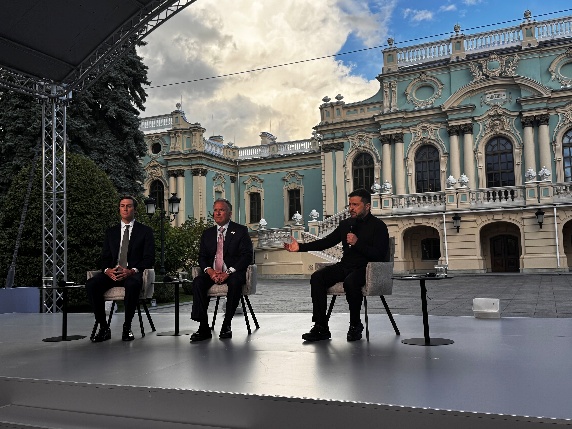
U.S. special envoys Jared Kushner (L) and Steve Witkoff (C) and the President Volodymyr Zelenskyy (R) are seen during the joint press conference in Kyiv. (Tim Zadorozhnyy / The Kyiv Independent)
PUTIN’S MAXIMALIST DEMANDS, AND WHY DONETSK WON’T FALL UNTIL 2032
Kremlin aide Yuri Ushakov confirmed today that Putin used his meeting with Witkoff and Kushner to reassert Russia’s full war aims rather than signal any real compromise, emphasizing what Moscow calls addressing the war’s “root causes” — diplomatic language for demands Putin first laid out in 2024: Ukrainian withdrawal from all of Luhansk, Donetsk, Zaporizhzhia, and Kherson oblasts, including areas Russia doesn’t even occupy; the replacement of Ukraine’s government with one Moscow approves of; and permanent Ukrainian neutrality barring NATO membership. Ushakov said Putin gave the envoys a “comprehensive assessment” of Russian battlefield advances — an assessment researchers say simply doesn’t match reality.
Independent battlefield tracking puts Russia’s overall rate of advance in August at just 2.91 square kilometers a day, and only 2.36 square kilometers a day in Donetsk Oblast specifically, Putin’s stated priority. At that pace, seizing the remaining 19 percent of the region would take until October 2032 — six years past Putin’s own December 2026 deadline, and well past the point where even his own commanders’ habitually inflated “beautiful reports” can paper over the gap. Putin has now set 15 separate deadlines for capturing Donetsk Oblast since 2022 and missed every one, including Kostyantynivka, which Russian forces have besieged without success for 11 months. Researchers assess Putin’s confidence stems largely from systematically dishonest reporting up his own chain of command, not from anything actually happening on the ground.
WITKOFF AND KUSHNER ARRIVE IN KYIV BY “PEACE EXPRESS” TRAIN
Steve Witkoff and Jared Kushner made their first-ever visit to Kyiv today, greeted by President Zelensky at Sofiiska Square before the two walked together to St. Sophia Cathedral ahead of formal talks. Ukraine had prepared airfields for their arrival, but overnight Russian strikes near Kyiv’s airports forced the delegation to fly instead into Rzeszow, Poland, and complete the journey by rail aboard a train marked “Peace Express.” “The trip was great,” Witkoff said. “I loved the train.”
The day unfolded in three stages: bilateral talks between Zelensky’s team and the American envoys focused on Ukraine’s winter needs, followed by a multilateral session joined by national security advisers from the UK, France, and Germany, and finally a joint press briefing. Zelensky’s negotiating team included presidential chief of staff Kyrylo Budanov, his deputy Serhii Kyslytsia, parliamentary faction leader Davyd Arakhamia, and intelligence chief Rustem Umerov. Witkoff called the discussions “substantive” and “meaningful,” while Kushner relayed “personal regards” from Trump and said the goal remained a “durable peace” that lets Ukraine “build themselves into the great nation they have the fullest potential to achieve.” Zelensky, in a lighter moment, reportedly gifted the envoys T-shirts reading “Kyiv Regime” — a wry nod to how Ushakov had referred to Ukraine’s government the day before.
“EVERYONE WAS SPEAKING RUSSIAN”: THE ENVOYS FACE UKRAINIAN PUSHBACK
Jared Kushner described his and Witkoff’s preference for returning to trilateral US-Russia-Ukraine talks, recalling a previous round conducted entirely in Russian: “Everyone was speaking Russian to each other. We were discussing these issues in a very extra-friendly manner, all in Russian.” The comment, paired with Witkoff’s description of Putin’s team as consistently “respectful,” drew visible discomfort from the assembled Ukrainian press.
One Ukrainian journalist asked Witkoff directly whether he felt “ashamed to sit at the same table with an international war criminal.” Witkoff didn’t back down: “We’ve always been treated respectfully by President Putin and his team. Relationships are critical in terms of solving conflicts like this. My job and Jared’s job, together, is to bring the parties together.” It’s a moment that captured a tension running underneath the entire visit — American negotiators speaking the diplomatic language of relationship-building with a government Ukraine considers responsible for war crimes, in a country that’s spent three and a half years absorbing the consequences of exactly the war those relationships haven’t yet stopped.
Kushner separately confirmed that the American team maintains near-daily contact with Ukraine’s top officials even during long stretches without an in-person visit, naming Budanov, Umerov, Arakhamia, and Kyslytsia specifically as regular contacts. He relayed that Trump understands the negotiations as “a very complex problem” that must be solved “not only to stop the fighting, but to create the conditions for a lasting and sustainable peace” — language that, whatever its sincerity, still stopped well short of any concrete timeline or specific concession from either side.
ZELENSKY: “WE EXPECT THE WAR WILL CONTINUE”
Despite a full day of talks, Zelensky offered reporters an unvarnished assessment: “If the war continues — and we expect the war will continue — we are counting heavily on the winter aid package… support for both air defense and the energy sector.” He said the sessions covered security and economic guarantees, territorial questions he said must ultimately be resolved leader-to-leader, and a “prosperity plan” combining military deterrence with postwar economic recovery. Ukraine, the US, and European partners agreed to meet again soon, though no venue has been set.
Zelensky noted Ukraine now has 67 companies working on shooting down jet-powered drones at scale, with three to five already showing real results, framing domestic defense production as “Plan B” while diplomacy remains “Plan A.” He also delivered a pointed, if gently sarcastic, observation: the envoys’ presence in Kyiv had shielded the city from strikes “even better than the Patriot systems” — a comment that landed just after a 10-day assault on the capital that only stopped because Putin agreed to a narrow pause during the visit itself. On US Patriot supplies specifically, he was less optimistic, saying only that American production “will increase… next year,” offering little relief for the winter directly ahead.
STRIKES CONTINUE NEAR KYIV DESPITE THE TRUCE
Even as diplomats met under an agreed pause on strikes against Kyiv and Moscow, Russian forces hit targets in Bucha Raion and Fastiv overnight — towns roughly 24 and 37 miles from central Kyiv, respectively, close enough to register as a pointed test of how narrowly Moscow intended to interpret its own promise. Russian sources acknowledged the strikes continued despite the truce, treating the geographic technicality as sufficient compliance. No hits were confirmed inside Kyiv city itself, though air-raid sirens sounded throughout the region as the envoys’ talks continued.
The pattern fits a broader dynamic that’s defined this entire diplomatic push: narrow, literal compliance with the specific terms of a pause, paired with continued violence everywhere the agreement doesn’t explicitly name. A truce that protects two capital cities by address, rather than protecting Ukrainian civilians by principle, leaves enormous room for exactly this kind of technically-compliant continued war — proof, if any were needed, that the diplomatic breakthrough Witkoff and Kushner described still has a very long way to go before it touches the war’s actual daily toll.
Ukraine, for its part, held to the letter of its own commitment, refraining from strikes on Moscow through the agreed deadline even as Russian forces tested the boundaries of their own promise. The asymmetry wasn’t lost on Ukrainian officials, who noted privately that a ceasefire genuinely meant to build trust would need to cover more than the two specific cities hosting foreign diplomats that particular weekend.
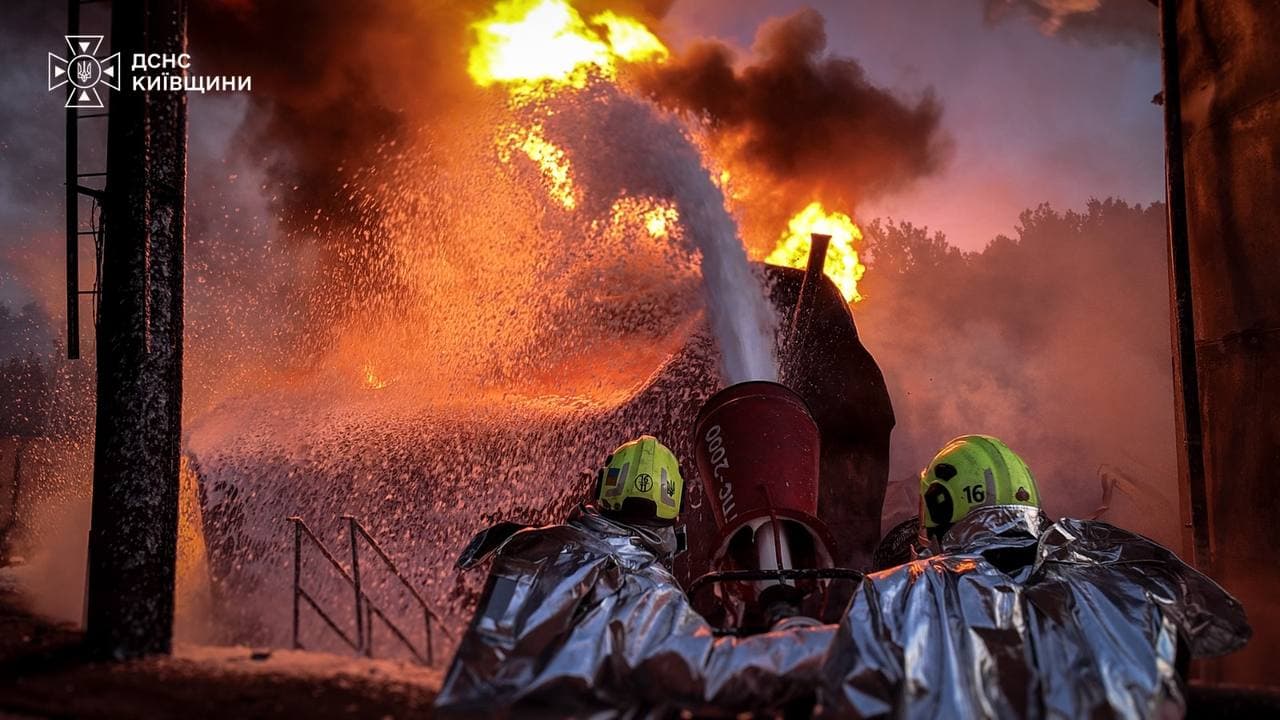
Firefighters tackling a large-scale blaze in Kyiv Oblast early on the morning. (State Emergency Service / Telegram)
NINE DEAD, 68 WOUNDED NATIONWIDE
Russia launched 108 drones at Ukraine overnight, including jet-powered Shahed variants, Gerbera decoys, and Banderol loitering munitions; Ukrainian forces intercepted 82 drones and six Banderols, with the rest striking 11 locations and debris falling at seven more. Kharkiv Oblast reported the heaviest toll: four killed and eight injured, including two more confirmed deaths from Saturday’s strike on a single Chuhuiv family. Kherson Oblast lost three people with 19 injured, including two children; Zaporizhzhia Oblast lost one person with 25 injured across multiple attacks; Mykolaiv Oblast lost a driver killed in a Shahed strike on transport infrastructure in Halytsynove.
Donetsk Oblast reported two injured, alongside a far larger consequence of the region’s sustained bombardment: 915 people, including 136 children, had to be evacuated from frontline areas. Khmelnytskyi Oblast reported seven injured, including a child, from falling drone debris, and Odesa Oblast reported three injured. Cherkasy, Poltava, and Sumy oblasts were also struck without significant reported damage.
Separately, a daytime strike on Dnipro hit logistics-company warehouses, injuring two people and sparking a large fire that took emergency crews hours to fully extinguish. By any measure, it was an entirely ordinary day of Russian violence — occurring, unremarkably, on the same day American envoys called their diplomatic progress significant, and while national security advisers from three European countries sat in the same city discussing how to eventually stop exactly this kind of daily toll.
GERMANY’S FAR-RIGHT AFD WINS A HISTORIC STATE ELECTION
Germany’s far-right Alternative for Germany party won a plurality in Saxony-Anhalt’s state election today, securing 44 percent of the vote and falling just three seats short of an outright majority in the 83-seat regional parliament — enough to make local AfD leader Ulrich Siegmund the state’s minister-president and give the party its first-ever seat in the Bundesrat, Germany’s upper house. It’s the first time a far-right party has led a German state government since World War II.
The result carries direct consequences for Ukraine. Siegmund has pledged to cut support for Ukrainian refugees — 31,000 of whom live in the state — and strip them of war-refugee status entirely, while AfD co-chair Alice Weidel predicted the result signals coming losses for Chancellor Friedrich Merz’s party nationally. Merz is reportedly already drawing up alternative eastward military supply routes in case AfD influence disrupts existing logistics through the region. Trump posted the projected results without comment; Elon Musk, a repeated AfD endorser, congratulated the party outright, while Polish Foreign Minister Radoslaw Sikorski called the result “a very worrying sign.” Germany remains Ukraine’s most important European ally, hosting more Ukrainian refugees than any other EU country — making even a single state election result a genuine signal of how fragile that support base may be becoming.
LAVROV SAYS GERMANY IS MOVING TOWARD “REAL WAR”
Russian Foreign Minister Sergei Lavrov told Kremlin propagandist Pavel Zarubin today that Germany is heading toward “the beginning of a real war,” responding to Berlin’s formal accusation five days earlier that Russian intelligence orchestrated last month’s drone attack at Leipzig Airport. Lavrov dismissed the investigation dismissively — “they found some kind of drone there… no one bothered to investigate” — while comparing Germany’s diplomatic countermeasures, including closing Russia’s Bonn consulate and Berlin cultural center, to actions taken “before the outbreak of World War II.”
German officials have firmly rejected the framing. “We are not at war. But we are the target of hybrid warfare,” Interior Minister Alexander Dobrindt said. Some domestic critics, meanwhile, have mocked Germany’s response as toothless — a popular German comedy program suggested Foreign Minister Wadephul’s promised pressure on Russia’s shadow fleet amounted to an empty threat, since sanctions and intelligence-sharing take weeks to show any visible effect, unlike Russia’s immediate rhetorical escalation. Lavrov’s comparison to the run-up to World War II drew particular criticism given the irony involved: Russia itself bans referring to its own full-scale invasion of Ukraine as a “war,” insisting instead on the state-mandated euphemism “special military operation,” even as its foreign minister freely uses war-adjacent language to describe how a democracy has responded to being sabotaged.
MEANWHILE, AT THE FRONT
Ukrainian military observer Kostyantyn Mashovets reported that Russian forces have made their most tactically significant gains of the war in the Hulyaipole direction, advancing seven to 11 kilometers north and west of the town since spring — though Ukrainian forces still hold key positions west of the Vozdvyzhivka-Verkhnya Tersa line, and the Russian advance’s rate is likely to slow further as diverging efforts toward Orikhiv dilute available forces. Near Kupyansk, Russian troops crossed the Oskil River and continue infiltrating Kupyansk and Kupyansk-Vuzlovyi, though Ukrainian forces retain control of both settlements.
Near Kostyantynivka, a Kremlin-affiliated commentator directly refuted his own government’s claim of seizing Kurtivka, stating there’s no evidence of any Russian presence there at all. Near Dobropillya, Russian infiltration continued with mixed and disputed claims of progress, and near Pokrovsk, a Ukrainian brigade reported Russian forces experimenting with a deliberately costly new tactic: sending small “opening” assault groups forward specifically to draw fire and expose Ukrainian positions for follow-up strikes, with commanders showing little regard for the resulting casualties. Kramatorsk’s city administration confirmed a nearby bridge was struck, while Ukrainian forces struck a Russian electronic-warfare system near Severodonetsk from 34 miles away, part of continued intermediate-range pressure on occupied Luhansk Oblast.
UKRAINE STRIKES A MAJOR REFINERY IN RYAZAN
Ukrainian forces struck the Ryazan oil refinery overnight, one of Russia’s largest with an annual processing capacity of roughly 17 million tons, damaging two crude-processing units despite Russian forces scrambling an attack helicopter in an unsuccessful attempt to stop the strike. Regional governor Pavel Malkov confirmed the resulting fire. The same overnight window brought continued Ukrainian suppression strikes against Rostov Oblast’s air defenses, hitting the Rostov-on-Don Airfield, a radar station, and two Pantsir-S1 systems — part of a sustained campaign to blind Russian defenses ahead of further strikes deeper into the region.
Updated damage assessments released today painted an even clearer picture of the campaign’s cumulative toll: Ukraine’s August 30 strike on the Millerovo Airfield destroyed two radars and an ammunition depot, while a September 3 strike on Sochi’s airport destroyed Russian Mi-28 and Ka-52 attack helicopters and damaged a third, and a separate September 4 strike on a Sochi oil depot destroyed nine storage tanks. Together, the strikes underscore how methodically Ukraine has been working through Russia’s rear-area military and economic infrastructure, well beyond the handful of headline refinery strikes that make international news. Ukrainian officials describe the campaign as deliberately sequenced — first blinding air defenses in a given region, then striking the higher-value economic or military targets those defenses were meant to protect, a pattern the Ryazan and Rostov strikes both followed within the same 24-hour window.
A CORRUPTION CASE KRAVCHENKO DENIES, BUT CAN’T FULLY ESCAPE
Prosecutor General Ruslan Kravchenko denied any connection today to the corruption scheme investigators revealed this week, insisting on Telegram that he issued no instructions protecting illegal call centers and used no official authority to shield the scheme. “I have no involvement whatsoever,” he wrote, confirming the implicated deputy, Serhii Kropyva, had been formally suspended and announcing that all staff handling call-center cases would now undergo polygraph testing. “No position will protect anyone,” he said.
But the case is difficult for Kravchenko to fully distance himself from: recordings released by NABU reference an unnamed “boss” identified only by the patronymic “Andriiovych” — Kravchenko’s own patronymic — and who previously led Russia’s State Tax Service, a role Kravchenko himself held from December 2024 to June 2025. A Prosecutor General’s Office statement has since confirmed investigators understand “boss” to mean Kravchenko specifically. “During the investigative proceedings, full access was granted to my office and to everything that needed to be inspected. No obstacles were put in the way. I have nothing to hide,” Kravchenko said, framing his own cooperation as evidence of innocence rather than exposure.
Ukraine’s High Anti-Corruption Court remanded Kropyva into custody with $2.7 million bail, on suspicion of laundering roughly $2 million in illicit assets. The case lands awkwardly for a position the EU has explicitly demanded Ukraine depoliticize as a condition of membership — a reform bill parliament’s own law enforcement committee blocked just weeks earlier, leaving the exact office now at the center of a bribery scandal without the independence-strengthening reform international partners had specifically requested.
UKRAINE REFUSES TO ERASE CRIMEA FROM A NEW UN MAP
Ukraine abstained from a UN vote adopting a new, more geographically accurate world map, one of only seven countries to withhold support, specifically because the map’s coloring depicts occupied Crimea as visually distinct from the rest of Ukraine. “In 2026, the U.N. should not need a reminder: Crimea is Ukraine. Shame,” lawmaker Kira Rudik wrote. The “Correct the Map” resolution, proposed by Togo and backed by the African Union, replaces the traditional Mercator projection — which exaggerates the size of northern countries — with one preserving countries’ true proportional size, and passed with 164 votes in favor.
Ukraine’s formal objection called the map’s depiction of the country “wholly unacceptable.” The EU, which supported the resolution, issued its own clarifying statement insisting the map “does not imply recognition of, support for, or acquiescence in any claim concerning disputed territories” — an attempt to separate a cartographic technicality from any actual legal position on Crimea’s status. The United States was the lone country to vote against the resolution outright, though for entirely unrelated reasons, with its UN representative describing the map as part of a “radical ideological project” tied to reparations debates. Five other countries — Estonia, Georgia, Lithuania, Moldova, and Serbia — joined Ukraine in abstaining, each for its own reasons tied to unresolved territorial disputes of their own.
KELLOGG’S OWN DAUGHTER BREAKS WITH HIM OVER MOBILIZING WOMEN
Meaghan Mobbs, president of a foundation supporting soldiers in Ukraine and daughter of former US special envoy Keith Kellogg, publicly disagreed today with her father’s August comments supporting the mobilization of Ukrainian women into military service. “People sometimes think that my dad and I are always exactly in the same mind. Not in this case,” she said, arguing women should be encouraged and supported in serving — including in combat-adjacent roles like intelligence and medical support — but never conscripted.
“I don’t think that right now, in the interests of Ukraine, we have to forcefully mobilize women,” Mobbs said, distinguishing her position from her father’s by emphasizing voluntary service over compulsion. Mobbs, who served military tours in Afghanistan herself, also used the interview to advocate for easier Ukrainian citizenship pathways for foreign volunteers, particularly those who’ve married Ukrainian citizens, describing the resulting families as a net benefit to Ukraine’s demographics and economy alike.
Her comments landed hours before Witkoff and Kushner’s own long-awaited arrival in Kyiv, adding an unexpected note of intra-American disagreement to an already crowded day of US-Ukraine relations. Mobbs said she hoped the envoys’ visit would shift their own understanding of the war firsthand: “My hope, my wish, and desire is that Witkoff and Kushner come here and realize how wrong they were, that they didn’t understand and couldn’t appreciate the resilience of the Ukrainian people. From my experience, when Americans come to Ukraine, they can change their views.”
A DEFECTOR’S SABOTAGE OPENS THE DOOR TO A REFINERY STRIKE
The pro-Ukrainian partisan network Atesh claimed today that a Russian servicemember who defected over “disagreement with the country’s leadership and the lawlessness he witnessed in the army” sabotaged a communications tower near Perm, roughly 930 miles inside Russia, in August — disrupting military coordination in the area shortly before Ukrainian drones struck the nearby Lukoil-Permnefteorgsintez refinery on August 21, temporarily suspending its operations. The Kyiv Independent couldn’t independently verify Atesh’s account.
The refinery, among Russia’s largest, processes more than 13 million metric tons of crude annually and had already been struck once before, in July. Atesh has claimed responsibility for a string of similar sabotage operations against Russian military infrastructure this year, including an electric substation powering a military plant in southern Russia in June and a locomotive fire in Lipetsk Oblast in May, while separately reporting a rising number of people willing to join or pass along intelligence from inside occupied Crimea — a quiet but persistent second front operating entirely behind Russian lines.
If accurate, the account offers a rare, human-scale window into how Ukraine’s deep-strike campaign sometimes depends on cooperation Kyiv can’t fully claim credit for: not just drones and missiles built and launched from Ukrainian territory, but individual Russian soldiers deciding, for reasons of their own conscience, to actively work against the army they once served.
BORDER CROSSING TO ROMANIA HIT AGAIN
Russian Shahed-type drones struck the Orlivka border crossing connecting Odesa Oblast to Romania overnight, forcing a temporary suspension of crossings just days after the facility had reopened from an earlier attack. No casualties were reported, and normal operations resumed by morning — a notably faster recovery than after the September 1 strike, which had taken two full days to repair.
Border Guard Service spokesperson Andrii Demchenko said Russia is actively targeting crossing infrastructure in both Romania and Moldova, part of a broader campaign against the Danube corridor that’s become Ukraine’s primary grain export route since Russia abandoned the Black Sea Grain Initiative in 2023. Some of the strikes in this stretch have landed within hundreds of meters of Romanian territory, a NATO and EU member state — a proximity that keeps testing, strike by strike, just how much risk Russia is willing to accept along the edge of allied territory in pursuit of choking off Ukraine’s remaining export routes.
The crossing’s faster recovery this time offers a small, practical measure of how Ukraine’s logistics resilience has improved even under repeated attack: infrastructure that once took days to restore now comes back online within hours, a hard-won efficiency built entirely out of necessity rather than choice, after months of absorbing exactly this kind of repeated targeting along the same stretch of river.
RAMSTEIN PREPARATIONS AND A PUSH FOR PAC-3 FUNDING
Defense Minister Yevhen Khmara spoke by phone with NATO Secretary General Mark Rutte to prepare for the coming Ukraine Defense Contact Group meeting in the Ramstein format, focusing on securing additional air-defense systems and expanded financial contributions ahead of the multilateral summit. The call followed a separate conversation with German Defense Minister Boris Pistorius the previous day, continuing a diplomatic push that began with Khmara’s direct appeal to EU defense ministers on September 1.
That appeal is already showing modest results: European Commission President Ursula von der Leyen confirmed EU member states are actively reviewing Ukraine’s request to allocate several billion euros from the bloc’s €90 billion support loan specifically toward PAC-3 Patriot interceptors — Ukraine’s primary defense against Russian ballistic missiles. The EU’s loan has already disbursed €8.5 billion since June toward drone and missile production, and the bloc continues advancing the Freyja project, a joint effort to build an independent European anti-ballistic missile system less dependent on American supply lines that have repeatedly proven unreliable this year.
EU foreign policy chief Kaja Kallas separately acknowledged the alliance-wide interceptor shortage directly, urging member states to review their own stockpiles and consider transferring or selling Patriot missiles nearing the end of their operational service life rather than let them expire unused while Ukraine’s own supply runs critically short heading into another winter of expected escalation.
A TRAIN TO KYIV, A STATE LOST IN GERMANY, A WAR STILL RUNNING
By nightfall, the day’s furthest edges pulled in opposite directions at once. Two American envoys finally reached Kyiv, calling their talks significant, even as the country’s own president warned the war would likely outlast the winter regardless. A far-right party won a German state for the first time since the Nazis, threatening the very refugee support and supply lines Ukraine depends on most.
Nine people are dead tonight who woke up this morning expecting an ordinary day. A prosecutor denies being anyone’s boss while recordings suggest otherwise. And somewhere in Perm, a Russian soldier who defected his own army is still out there, having helped burn down part of the machine he used to serve. Nothing today ended. Everything today measured how far this war still has to travel before any of today’s diplomacy actually touches it.
A PRAYER FOR UKRAINE
1. For the Nine Lost Today Across the Country
Lord, nine people are gone tonight — in Kherson, Zaporizhzhia, Mykolaiv, Kharkiv — killed on a day when the world’s attention was fixed on diplomacy happening far from where they lived. We grieve lives that mattered as much as any headline. Receive each of them, comfort the 68 injured and their families, and let their deaths be counted as fully as the day’s news of talks and trains and treaties.
2. For the 915 People Fleeing Donetsk Oblast
Father, we lift up the hundreds forced to leave their homes today, including more than a hundred children, driven out by violence that shows no sign of easing. Give them safety in wherever they land next, and give them strength for however long this displacement lasts. Let their uprooting be seen and remembered, not lost in the scale of everything else this war keeps demanding.
3. For Wisdom in Every Room Where Ukraine’s Future Is Discussed
Lord of nations, we pray for the negotiators working today toward something real, even amid contradictions and unresolved tensions on every side. Give them clarity to see past diplomatic courtesy toward the actual urgency Ukrainian lives require right now, not in some eventual future. And give Ukraine’s own leaders continued resolve to hold firm on what genuinely protects their people, regardless of how any single day’s talks unfold.
4. For Refugee Families Watching Germany’s Election Anxiously
God of the displaced, we pray for Ukrainian families in Saxony-Anhalt and across Germany, uncertain tonight what a changing political landscape might mean for their safety and welcome in a country they’ve come to depend on. Give them stability they cannot currently control, and give Germany’s leaders the resolve to protect vulnerable people regardless of which party gains ground in any single election.
5. For an End That Diplomacy Alone Hasn’t Yet Reached
God of patience, we pray for a peace process that’s finally moving, however slowly, after months of stalled effort. Give it real substance, not just symbolic visits and careful language. And give Ukraine’s people, who’ve heard hopeful diplomatic news before without seeing the war actually end, the strength to keep hoping anyway, without letting today’s talk substitute for tomorrow’s actual peace.
In Your mercy, in Your justice, in Your time — bring this war to its end, and let the ending be worthy of what Ukraine has endured.