
September 8, 2026
Prepared by Diana Bozhyk
Russia’s brief pause on striking Kyiv collapsed hours before its own stated deadline, with a massive overnight barrage of ballistic missiles, cruise missiles, and drones killing five people and injuring 70 more nationwide, including a strike on a Ukrainian television station’s building while journalists broadcast live. Hungary expelled ten Russian diplomats for activities incompatible with their status, a striking reversal for a government that spent years as one of Moscow’s friendliest voices in the EU, while Vladimir Putin and Donald Trump spoke by phone for an hour with the Kremlin claiming Putin gave Trump an “objective” battlefield assessment that independent researchers say bears little resemblance to reality. The EU cleared €3.2 billion for Ukraine to buy Patriot interceptors, Germany and Britain rushed additional missiles from their own stockpiles, and a Ukrainian opposition lawmaker said US envoys had returned from Moscow with harsher Russian demands, not a breakthrough.
THE DAY’S RECKONING
The truce didn’t even make it to its own deadline. Russia had promised to spare Kyiv until midnight Monday. By 8:45 p.m., drones were already inbound. By 3:30 a.m., the explosions started for real, and by morning, a television crew was pulling themselves out of rubble mid-broadcast, five people were dead, and seventy more were hurt in cities across the country.
Everything else about today moved in that same uneasy rhythm — genuine steps forward paired with reminders of exactly how far this war still has to run. Hungary, of all governments, expelled ten Russian diplomats, a reversal nobody would have predicted from Budapest two years ago. Putin spent an hour on the phone with Trump, reportedly repeating claims about the battlefield that simply aren’t true. Europe rushed missiles toward Ukraine fast enough to matter before winter, even as a Ukrainian lawmaker said the weekend’s diplomacy actually left Kyiv facing harsher terms than before. Nobody today closed the gap between the war Russia keeps describing and the one actually being fought. Everybody today kept adding to the record of exactly how wide that gap remains.
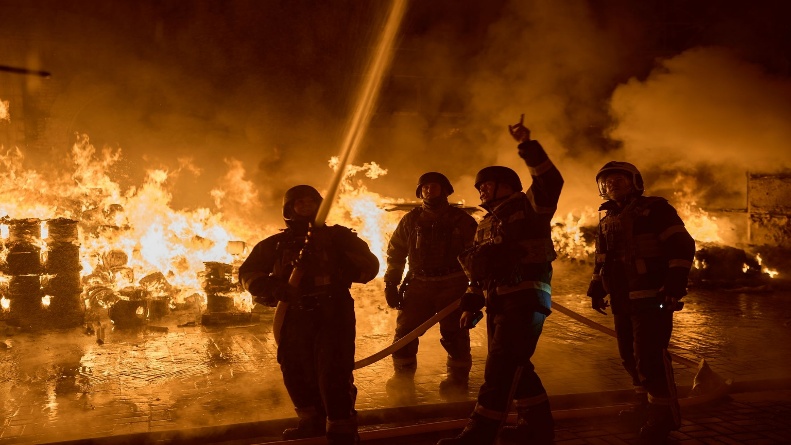
Firefighters deal with the aftermath of a massive Russian missile and drone attack in Kyiv, Ukraine. (Kostiantyn Liberov / Libkos / Getty Images)
RUSSIA ENDS ITS TRUCE WITH A MASSIVE ATTACK ON KYIV
Russia’s three-day pause on striking Kyiv unraveled hours before its own stated deadline, with Ukraine’s Air Force warning of jet-powered drones over the capital at 8:45 p.m. Monday — more than three hours before Moscow’s declared 11:59 p.m. cutoff. Explosions rang out across the city by 3:30 a.m., and the barrage continued in waves through the following day: 32 Kh-101 cruise missiles, an unspecified number of Onyx anti-ship and Iskander-M, S-400, and North Korean KN-23 ballistic missiles, and 166 Shahed-type drones, more than half of them jet-powered. Ukrainian forces intercepted two ballistic missiles, 31 cruise missiles, and 142 drones; strikes still hit 29 locations, with debris falling at nine more.
By evening, Kyiv’s death toll reached five, with 35 injured citywide and 70 injured nationwide when combined with strikes on six other regions. A drone struck the building of the “We Are Ukraine” TV channel during its live “United News” telethon broadcast, partially destroying the facility and injuring at least five people. “Shaheds against the media is a new page of Russian degradation, and there must definitely be a reaction from Europe and the world to this,” Zelensky said. Residents described a night defined by sudden violence: “It’s like The Hunger Games, it’s just about survival,” Solomianskyi district resident Dariia Kolisnyk told the Kyiv Independent. “You just go to bed, wondering whether you’ll wake up or not.” Rescuers pulled 10 people from a damaged five-story building and evacuated two more from a 16-story apartment block.
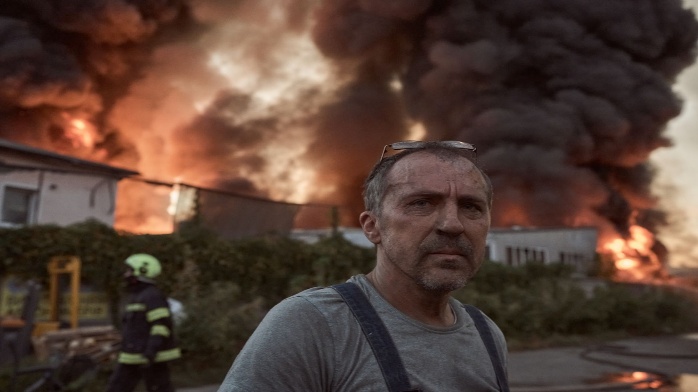
A man looks on as members of emergency services work to contain a fire in the aftermath of a Russian missile and drone attack in Kyiv, Ukraine. (Kostiantyn Liberov / Libkos / Getty Images)
PUTIN AND TRUMP TALK FOR AN HOUR AS THE KREMLIN PUSHES ITS VERSION OF THE WAR
Vladimir Putin and Donald Trump spoke by phone for roughly an hour today in what Kremlin aide Yuri Ushakov called an “extremely frank” and “constructive” conversation focused on prospects for ending the war. Ushakov said Putin gave Trump an “objective and thorough” overview of the battlefield and explained how the US could quickly resolve the conflict — while also insisting Russia harbors “no aggressive plans” toward Europe. Neither the White House nor Trump had issued a public readout by day’s end.
Independent researchers say Putin’s “objective” assessment is anything but. Putin’s understanding of the war is shaped by Russia’s own systematic culture of dishonest battlefield reporting — what Russian military bloggers themselves call “beautiful reports” — which emboldens him to keep insisting on maximalist demands unsupported by actual conditions on the ground. Kremlin spokesperson Dmitry Peskov reinforced the message today, claiming Ukraine’s situation “worsens each day” and that Russian terms will only harden the longer the war continues, while Foreign Minister Sergei Lavrov insisted any negotiation must address the war’s “root causes” — Kremlin shorthand for Russia’s original 2021-2022 war aims. None of it reflects a genuine shift: Russian forces have net-lost more territory than they’ve gained since March, a sharp reversal from the gains that underpinned the 28-point peace framework Washington floated back in November 2025.
HUNGARY EXPELS TEN RUSSIAN DIPLOMATS
Hungary ordered ten members of Russia’s diplomatic mission to leave the country today over activities Budapest called “unacceptable for diplomats under the Vienna Convention,” Foreign Minister Anita Orban announced, without disclosing further detail. “This decision protects Hungary’s security and sovereignty,” she said, adding that Hungary isn’t severing relations with Moscow and intends to continue dialogue “with respect and adherence to the rules.” Russia’s Foreign Ministry spokesperson Maria Zakharova promised Moscow’s response would be “harsh and painful.”
The expulsion marks the latest and most concrete step in Hungary’s dramatic foreign-policy reversal since Peter Magyar’s government replaced Viktor Orban’s Russia-friendly administration earlier this year. Budapest recently described Russia as a “threat to Europe and the global order” in its own UN General Assembly briefing materials and has taken several conciliatory steps toward Kyiv, including closing a controversial money-laundering investigation into a Ukrainian bank convoy.
Ukraine’s Foreign Minister Andrii Sybiha called the expulsions “very timely and sensible,” saying they would “strengthen the security of Hungary” — a notable statement given how frequently Hungary’s previous government clashed with Kyiv over EU aid and sanctions votes throughout the war’s first four years. For a country that spent years blocking or delaying EU assistance packages under Orban, today’s move signals just how completely Budapest’s relationship with both Moscow and Kyiv has been reshaped by a single change in government.
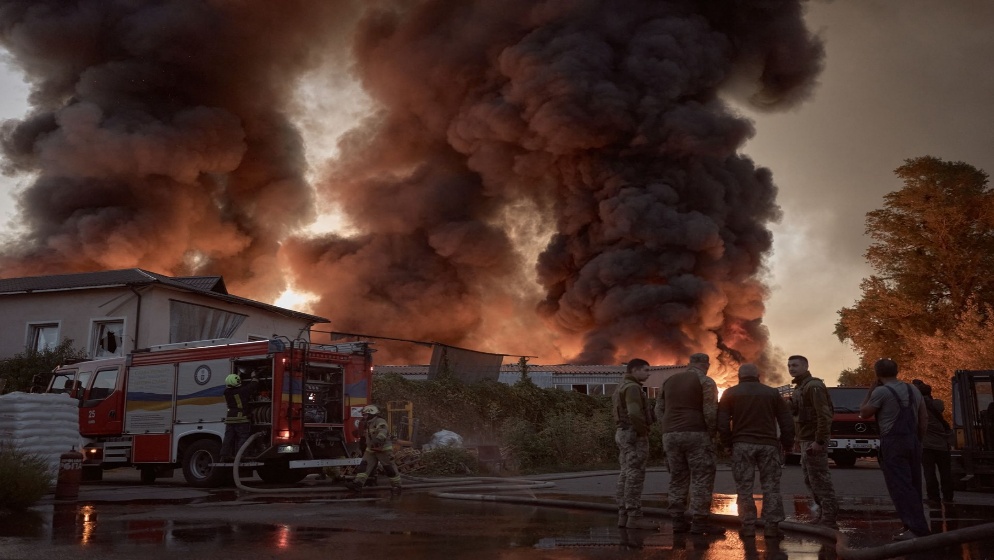
Members of emergency services work to contain a fire in the aftermath of a Russian missile and drone attack in Kyiv, Ukraine. (Kostiantyn Liberov / Libkos / Getty Images)
EUROPE AND BRITAIN RUSH PATRIOT MISSILES TO UKRAINE BEFORE WINTER
EU member states agreed today to release €3.2 billion for Ukraine to purchase PAC-3 Patriot interceptors, exempting the purchase from the bloc’s usual rule limiting non-European sourcing to 35 percent of any contract’s value. “The next disbursement of 3.2 billion euros will enable Ukraine to better protect its skies from Russia’s indiscriminate attacks,” European Commission President Ursula von der Leyen said, with formal approval expected September 11 alongside a broader 28.3 billion euro tranche of this year’s defense loans.
At the same time, the 36th Ramstein-format Ukraine Defense Contact Group meeting produced immediate commitments from individual allies. Germany’s Defense Minister Boris Pistorius announced Berlin would urgently transfer PAC-2 missiles from its own Bundeswehr stockpiles, along with additional AIM-9 air-to-air missiles and IRIS-T systems. “If you doubt, decide for the benefit of Ukraine,” Pistorius told fellow ministers. Britain separately announced a £100 million air-defense package funded through NATO’s Prioritised Ukraine Requirements List, building on a pledge of over 120,000 drones this year and its millionth delivered round of large-caliber artillery ammunition. Ukraine’s Defense Minister Yevhen Khmara, attending Ramstein for the first time alongside Commander-in-Chief Mykhailo Drapatyi, confirmed Ukraine is separately signing contracts for roughly 1,000 Patriot missiles through the EU loan, though he cautioned those wouldn’t arrive for years and urged partners to draw from existing stockpiles now instead.
ZELENSKY: RUSSIA STRUCK THE RUNWAYS ON PURPOSE
President Zelensky revealed today that Russia deliberately struck the runways at both of Kyiv’s airports — Zhulyany and Boryspil — ahead of Witkoff and Kushner’s visit, forcing the American delegation to travel by train instead of flying directly into the capital as originally planned. “Russia clearly wanted to emphasize that there was no security in Ukraine,” Zelensky said, calling the strikes a deliberate message rather than incidental damage. Ukraine had also explored routing the envoys through Gomel, Belarus, with a three-hour road transfer to Kyiv, but the American security team ultimately chose rail travel instead, which Zelensky said the envoys enjoyed.
Looking ahead, Zelensky said Ukraine’s own presidential aircraft could ferry the envoys directly to Kyiv on their next visit if they’d rather not fly aboard an American plane through contested airspace. “If they do not want to fly on an American aircraft, they can leave it in Poland or another country, and my plane can bring them,” he said, adding that he and the envoys had already agreed a second Kyiv visit should follow without a lengthy delay. “They have been to Moscow many times, and this was their first time in Kyiv.”
Zelensky said both airports remained technically capable of receiving the delegation despite the strikes, with the real obstacle being whether Russia would agree to a secure air corridor for the flight — an assurance Moscow never actually provided, leaving rail travel as the only option both sides could ultimately agree served the visit’s security needs.
RUSSIA HANDED KYIV HARSHER TERMS, OPPOSITION LAWMAKER SAYS
Ukrainian opposition parliament member Anna Skorokhod said today that the weekend’s US-brokered diplomacy delivered Kyiv worse conditions than before, not a breakthrough. “It was not only not a diplomatic breakthrough, they arrived with even worse conditions than we had before,” she said, describing Witkoff and Kushner’s trip as failing to produce any genuine movement toward direct talks between the warring parties themselves. She said the Kremlin used the American envoys specifically to relay a harder line, including new demands for changes to Ukraine’s constitution regarding territory that Russia hadn’t previously pushed.
Russia’s most recent formal peace terms, issued in June 2025, already amounted to a 31-point capitulation demand: Ukraine would surrender roughly 20 percent of its territory, cut its military by 80 percent, declare permanent neutrality, make Russian an official state language, and remove any official Russia deems a “Nazi” — among other conditions Ukrainian officials have called unanimously unacceptable. Skorokhod said she was aware of additional, harsher terms conveyed through the envoys but declined to disclose them, citing the informal way she’d learned of them. Her account contrasted sharply with Witkoff’s own public framing just a day earlier, when he told reporters the talks had produced “significant progress” and “new ideas” from Moscow.
EUROPE INSISTS IT WON’T BE SIDELINED FROM PEACE TALKS
European Commission spokespeople pushed back today against any suggestion that Europe’s role in ending the war could be limited to funding it. “Nothing about Ukraine can be decided without Ukraine and nothing about Europe and Europe’s security without Europe,” Commission spokesperson Christian Wigand said, citing formal European Council conclusions from June affirming the bloc’s right to decide matters affecting its own security. The comments came after Kremlin spokesperson Dmitry Peskov objected specifically to the involvement of French, German, and British national security advisers in the Kyiv round of talks, calling their presence more likely to “complicate the negotiation process” than help it.
The dispute highlights an awkward structural reality: the E3 — France, Germany, and the UK — participated in the Kyiv talks but cannot formally represent the EU as a bloc, and Britain hasn’t been an EU member since 2020. Zelensky insisted Europe’s inclusion remains essential regardless of the formal mechanics, telling reporters that negotiations concern “the security of the whole of Europe” and that Ukraine’s own EU future makes European participation unavoidable. Commission spokesperson Paula Pinho added a blunter assessment of where the obstacle actually lies: “We need Russian willingness to reach a just and lasting peace, which we are clearly not seeing.”
MEANWHILE, AT THE FRONT
Russian forces recently advanced in the Pokrovsk direction, seizing the settlements of Myrne and Vasylivka northwest of the city, according to geolocated footage. Near Kostyantynivka, Russian forces continued both advancing and infiltrating around the city, with milbloggers claiming the seizure of Chervone and a smaller Raiske settlement — though one Russian blogger admitted the Defense Ministry specifically asked bloggers to delay posting footage until the ministry could stage its own flag-raising video, a rare direct acknowledgment of Moscow’s deliberate information-management effort. Russian forces also struck a bridge over the Kazennyi Torets River near Kramatorsk with a glide bomb, the third river crossing hit in and around the city since August, part of a sustained campaign to sever Ukrainian logistics into the Fortress Belt.
Near Orikhiv, a Ukrainian brigade spokesperson said Russian command has formed roughly 120 assault groups totaling 150,000 personnel to sustain pressure in the sector, though the spokesperson said Russia still can’t mass enough force to meaningfully threaten Ukrainian logistics there. Separately, Deputy Presidential Office head Pavlo Palisa disclosed that Russia’s own military leadership is now privately pushing to extend Putin’s public deadline for capturing all of Donetsk Oblast from December 31, 2026 to March 31, 2027 — the 15th such deadline revision since 2022. “Russians have failed to achieve any operational success in Donetsk Oblast,” Palisa said, noting Ukraine still holds 21 to 22 percent of the region.
A DRONE’S HOUR-LONG FLIGHT OVER MOLDOVA AND ROMANIA
A Russian Shahed-type drone spent nearly an hour flying through Moldovan and Romanian airspace today, crossing from Moldova into Romania and back before crashing near Mihaileni Vechi, Moldova, in the afternoon. Both countries’ defense ministries confirmed the incursion; a Ukrainian monitoring channel identified the drone as a jet-powered Geran-4 capable of 450 kilometers per hour, fast enough to reach the Moldovan border from Odesa in six minutes and the Romanian border in 20 — speeds that sharply compress how much time NATO and Moldovan air defenses have to react.
It’s the latest in a string of similar incidents: NATO forces responded to a group of air targets near Romania’s border with Ukraine on September 6, and Romanian forces found drones off the country’s coast on September 3 and 4. Whether these incursions are deliberate remains unconfirmed, but analysts note Russia benefits either way — the incidents force NATO to divert attention toward its own airspace defense, implicitly test Article 5’s mutual-defense guarantee, and pressure member states to think twice about how much further support for Ukraine is worth the risk of drawing Russian drones closer to their own territory.
NATO’s own accounting underscores how routine these encounters have become: alliance jets have scrambled nearly 700 times over the past two years specifically to intercept Russian aircraft approaching or behaving erratically near NATO airspace, according to NATO Military Committee Chairman Admiral Giuseppe Cavo Dragone, who called the pace “almost one a day” and said the threats facing the alliance, from Russia to hybrid attacks and disinformation, are “real, and there are many.”
RUSSIA’S SECRET WAR GAMES AGAINST NATO
An investigation published today by the Russian outlet Dossier Center revealed that Russian military leadership has spent years running secret computer simulations of hypothetical wars against NATO, dating back to at least 2017. The exercises take place at an underground War Games Center outside Moscow, where roughly 50 to over 900 officers at a time role-play commanders across aviation, naval, submarine, intelligence, and air-defense branches, using computers to calculate casualties and troop movements on a wall-sized digital map.
One 2017 simulation focused specifically on Sweden’s Gotland island under the heading “Strategic Deterrence”; a 2018 exercise involving over 900 officers modeled conflict with US and Japanese forces, complete with a 3D rendering of a NATO-marked American reconnaissance aircraft and a target list including roads and industrial sites in Japan and South Korea. Notably, despite Southern Military District commanders running monthly war games throughout 2021 as Russia massed troops on Ukraine’s border, investigators found no evidence the simulations accurately modeled the invasion that followed — analysts say authoritarian command structures often discourage realistic worst-case planning, since subordinates learn leaders expect only positive assessments.
After Russia’s initial attempt to seize Kyiv failed in 2022, the General Staff ran two major follow-up exercises that spring, adjusting scenarios to reflect the actual conditions Russian troops had encountered — the absence of a continuous front line, sustained resistance from cities Moscow failed to capture, and active special-operations threats behind Russian lines. The underground facility reportedly runs roughly 250 training systems capable of simulating real Russian military formations, with the highest-level scenarios developed under what internal documents describe as direct “plans of the president of Russia.”
UKRAINE STRIKES TWO MORE RUSSIAN OIL FACILITIES
Ukrainian drones struck the Saratov Oil Refinery overnight, roughly 460 kilometers from the Ukrainian border, sparking a fire that Saratov Oblast Governor Roman Busargin confirmed injured 10 people, including three children, with six hospitalized in stable condition. The Rosneft-owned facility processes 4.8 million tons of crude annually and directly supplies Russia’s military, according to Ukraine’s General Staff, which confirmed an earlier successful strike on the same refinery on August 2 following a July 8 attack that had already forced it offline once this year.
Separately, monitoring channels reported Ukrainian drones struck an oil terminal at Novorossiysk overnight into September 9, setting it ablaze and damaging a nearby residential building, according to independent Russian outlet Astra; the city’s mayor confirmed a drone attack occurred without specifying which sites were hit. Russia’s Defense Ministry claimed it intercepted 384 drones nationwide overnight, a figure that couldn’t be independently verified but underscores the scale of the deep-strike campaign now running in parallel with Russia’s own barrage against Ukrainian cities on the very same nights.
Together, the two strikes reflect the same pattern that’s defined Ukraine’s economic pressure campaign for months: refineries and export terminals hit repeatedly enough that Russia can never fully complete repairs before the next strike arrives, compounding fuel shortages that have already forced Moscow into gasoline import deals and nationwide export bans.
REGIONAL CASUALTIES ACROSS THE COUNTRY
Beyond Kyiv, Russian attacks killed at least two more people and injured dozens across six additional regions. Donetsk Oblast lost two people in Kramatorsk, with six more wounded there and additional injuries in Sloviansk and Raihorodok, as the city’s security situation continues deteriorating under Russia’s gradual advance. Kherson Oblast lost one person with 13 injured; Zaporizhzhia Oblast reported 12 injured; Kharkiv Oblast reported three injured, including a 17-year-old boy, with a drone strike hitting central Kharkiv the following morning.
Odesa Oblast reported three men injured, aged 48 to 58, when a market in the city’s suburbs was struck. Sumy Oblast reported one injury from a drone strike, while a Kyiv-Sumy passenger train was struck twice by Shahed drones the same morning — though Ukrzaliznytsia’s monitoring team had already stopped the train and evacuated all 90 passengers and crew before impact. Chernihiv Oblast reported one injury in Pryluky, where a Russian drone also struck a shopping center, requiring roughly 50 rescuers to fight the resulting fire while repeatedly retreating against the threat of a follow-up “double-tap” strike.
Dnipropetrovsk Oblast reported one additional injury from separate strikes across the region. Taken together with the overnight barrage on Kyiv, the nationwide toll for the day reached at least five killed and 70 injured — a single day’s arithmetic spread across eight regions, absorbed by communities that rarely make international headlines individually but collectively bear the same weight as any single dramatic strike.
A NEW DEPUTY DEFENSE MINISTER FOR WEAPONS PRODUCTION
Ukraine’s Cabinet of Ministers appointed Hanna Hvozdiar as deputy defense minister today, tasking her with scaling up domestic weapons production and expanding defense exports. “Our task is a strong Ukrainian defense industry that gives the front what it needs now and creates a long-term advantage for Ukraine,” Defense Minister Yevhen Khmara said in announcing the appointment. Hvozdiar previously served as deputy defense minister from July 2025 to January 2026 and, before that, as deputy minister for strategic industries, where she helped launch Zbroya, Ukraine’s online platform connecting weapons manufacturers with buyers.
The ministry named front-line supply as her immediate priority, stressing that Ukrainian soldiers need enough domestically produced weapons delivered on time and in sufficient volume to counter Russian threats — a goal that will require manufacturers to significantly scale up both output and capacity. Her second focus will be expanding exports of Ukrainian defense products that exceed front-line needs, an area the ministry says could help build reciprocal partnerships with allies while attracting additional financing for Ukraine’s own defense-industrial base.
Before entering government, Hvozdiar worked at the Serhiy Prytula Charity Foundation, one of Ukraine’s largest military charity funds, serving as deputy director before leading the organization outright between 2022 and 2023 — a background the defense ministry framed as directly relevant experience in mobilizing resources quickly under wartime pressure, the same skill set her new role will demand at a national scale.
RUSSIA QUIETLY RESTRICTS A RESERVIST FROM LEAVING THE COUNTRY
Russia recorded its first documented case of a military reservist being blocked from leaving the country under a restriction imposed directly by a local enlistment office, according to a report citing the Russian anti-mobilization project Idite Lesom. A 24-year-old man from Rostov Oblast, placed in Russia’s reserves after completing compulsory service in 2024, was stopped at the Krasnodar airport on September 2 and handed formal notice of a travel ban — despite the restriction not appearing in Russia’s electronic system when he checked before his trip.
The case adds a concrete data point to broader concern about Russia quietly tightening exit controls ahead of a possible mobilization wave following September’s parliamentary elections. Between August 18 and 31 alone, Idite Lesom fielded requests from 73 conscripts attempting to cross the Russian border, successfully assisting 50 while 23 were turned back; a separate group of 11 conscripts attempting to leave via Belarus saw only four succeed. Western intelligence officials and independent analysts have said a renewed mobilization can’t be ruled out as Moscow works to replace mounting battlefield losses.
The group behind the report cautioned that a single documented case isn’t enough to conclude Russia has introduced a blanket exit ban for all reservists, but the timing — restrictions surfacing just weeks before elections widely expected to precede a fresh mobilization push — has done little to ease growing anxiety among Russians who fall within reservist age brackets and increasingly report double-checking their own registration status before any attempt to travel abroad.
ZELENSKY IN OSLO, AND A FEW CLOSING THREADS
President Zelensky met Norwegian Prime Minister Jonas Gahr Store in Oslo today to discuss strengthening Ukraine’s air defenses and advancing the Freyja anti-ballistic missile program, a joint European initiative aiming for a working prototype by mid-2027. Zelensky and First Lady Olena Zelenska arrived ahead of tomorrow’s funeral for King Harald V, Europe’s oldest reigning monarch at the time of his death on August 28, thanking Norway’s royal family and people for their continued support of Ukraine.
Separately, Prime Minister Serhii Koretskyi confirmed the government extended, for another academic year, a program fully covering contract-based tuition for children of Ukrainian veterans, with the Ministry of Veterans Affairs paying institutions directly rather than reimbursing families. And an IMF report released today grouped Moldova’s EU accession track with the Western Balkans rather than with Ukraine’s, citing Ukraine’s “much larger size and ongoing military conflict” as the reason for treating the two candidacies separately — a technical distinction that nonetheless underscores just how much the war itself continues shaping even Ukraine’s most hopeful long-term ambitions.
IMF Managing Director Kristalina Georgieva presented data showing EU membership typically boosts a new member’s GDP per capita by roughly 35 percent within a decade, driven mainly by productivity gains and capital investment — a figure the EU’s enlargement commissioner said Ukraine could realistically match “if it delivers on EU accession reforms,” calling the potential outcome “another economic miracle in Europe.”
A TRUCE BROKEN, A CALL MADE, DIPLOMATS SENT HOME
By nightfall, today’s threads pulled toward the same uneasy truth: nothing about this war is moving in a straight line. A ceasefire collapsed before its own deadline. A president spent an hour on the phone reportedly repeating claims that aren’t true. A government that once counted as Moscow’s friendliest EU voice sent ten of its diplomats packing.
Five people in Kyiv won’t see tomorrow. A television crew is rebuilding a newsroom mid-broadcast recovery. And somewhere in Brussels, officials keep insisting that whatever gets decided about this war’s ending, Europe intends to have a seat at that table regardless of who else is sitting there. Nothing today resolved. Everything today measured how much further apart the war’s stated diplomacy and its actual daily violence remain.
A PRAYER FOR UKRAINE
1. For the Five Lost in Kyiv
Lord, five people are gone tonight in Kyiv, killed in a barrage that arrived hours before a promised pause was even set to expire. We grieve a trust broken before it was ever fully extended. Receive each of them by name, comfort the 70 injured across the country tonight, and hold this exhausted capital as it counts, once again, what a single night’s violence actually cost.
2. For Journalists Struck While Simply Doing Their Jobs
Father, we lift up the journalists and staff of a television station hit while broadcasting live, doing nothing more than telling their country the truth of what’s happening to it. Heal the wounded, and give every reporter still working under this kind of threat the courage to keep going. Let the world take seriously what it means when even truth-telling itself becomes a target.
3. For Wisdom in Every Room Negotiating This War’s End
Lord of nations, we pray for clarity among everyone claiming to seek peace, especially when their public statements and private demands tell two different stories. Give negotiators discernment to separate genuine progress from performance, and give Ukraine’s own representatives strength to keep insisting on terms that actually protect their people, regardless of what pressure comes from any direction at all.
4. For Every Soldier Facing a Battlefield Their Leaders Refuse to See Honestly
God of truth, we pray for the soldiers on every side sent into battle based on distorted reports rather than actual conditions. Protect them from the consequences of leadership more interested in comfortable fictions than in accurate assessments. And give every commander, on any side, the courage to tell hard truths upward rather than the reports their superiors most want to hear.
5. For a Continent Still Deciding How Much It Will Risk
God of courage, we pray for nations weighing exactly how far to go in confronting the threat this war represents — expelling diplomats, sending missiles, absorbing drones that stray too close to their own borders. Give their leaders resolve that matches the actual danger, and give ordinary citizens reassurance that their safety is taken as seriously as the diplomacy surrounding it.
In Your mercy, in Your justice, in Your time — bring this war to its end, and let the ending be worthy of what Ukraine has endured.