
September 10, 2026
Prepared by Diana Bozhyk
Ukrainian forces struck a Russian gas complex nearly 2,840 kilometers from the border, the deepest strike of the war so far, while Russia killed five people and injured 67 more in a daytime strike on a Pavlohrad shopping center and hit Sumy’s Manufactura mall a second time in 24 hours, killing two more. NATO allies disrupted a covert Russian naval operation near Norway’s Svalbard archipelago involving technology designed to sabotage undersea cables, and the Kremlin formally rejected a US-backed proposal for a mutual pause in aerial strikes, with spokesperson Dmitry Peskov saying Russia would keep striking Ukraine’s energy grid. United Russia chairman Dmitry Medvedev used a lengthy interview to commit the country to a permanent war footing, even as Ukraine and Canada signed a 100-year partnership agreement worth more than $2 billion.
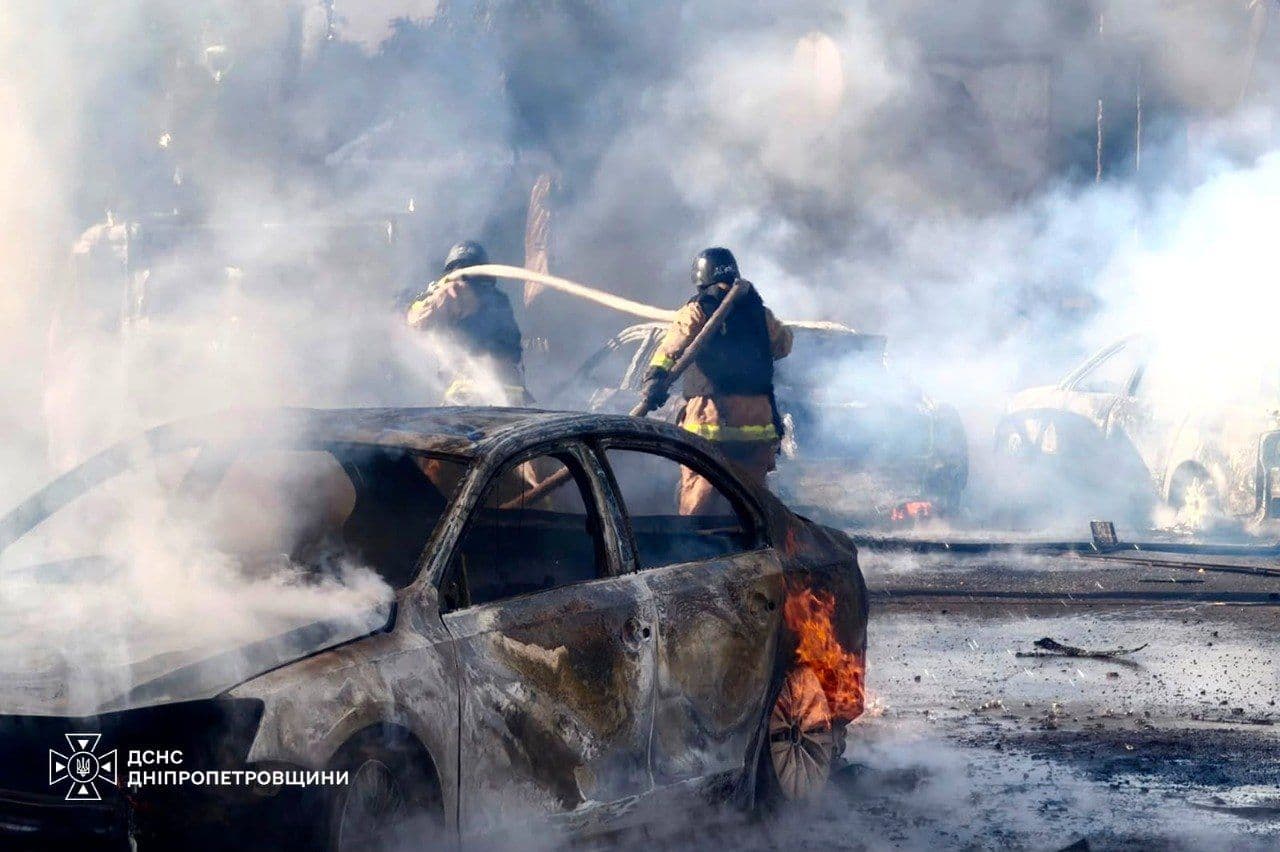
The scene of a Russian drone strike on a shopping center in Pavlohrad, Dnipropetrovsk Oblast. (DSNS/Telegram)
THE DAY’S RECKONING
A Ukrainian drone flew nearly 2,840 kilometers today, farther than any strike of this war, and found a gas complex in the Arctic that Russia never imagined needed defending. On the same day, a Russian strike found a shopping center in Pavlohrad, a city that used to be far enough from the front to feel safe. Five people died there. Sumy’s mall, already struck once yesterday, got hit again today.
Everything else moved with the same restless energy. NATO caught Russian submarines rehearsing how to sabotage the cables that carry the world’s internet traffic. Dmitry Medvedev told his own country to prepare for permanent war, no matter how or when the fighting in Ukraine actually ends. The Kremlin flatly rejected the latest American peace proposal, admitting outright it intends to keep bombing Ukraine’s power grid all winter. Canada signed on for a hundred years of partnership with Ukraine. Nothing today offered anyone a clean resolution. Everything today measured how far this war now reaches, and how little either side shows any sign of pulling back.
UKRAINE’S DEEPEST STRIKE YET HITS SIBERIA’S GAS COMPLEX
Ukrainian Special Operations Forces struck the Novy Urengoy Gas Condensate Treatment Plant and the Purovsky Gas Processing Plant in Russia’s Yamalo-Nenets Autonomous Okrug overnight, roughly 2,840 and 2,780 kilometers from the Ukrainian border respectively — the farthest strikes of the war so far. The Novy Urengoy facility processes 19.5 million tons annually; Purovsky handles 13.4 million tons. Both sit deep in the Arctic region Russia has spent years developing as an alternative shipping and export corridor specifically to reduce its dependence on Black Sea and Baltic ports increasingly exposed to Ukrainian strikes.
The strike demonstrates something Russian officials have spent months trying to downplay: Ukraine can now reach essentially anywhere across Russia’s vast territory, from the Norwegian border to well beyond the Urals, exploiting the simple reality that no country can fully defend a landmass this large with the air-defense resources Russia currently has available. The same region saw airport closures and drone warnings just a day earlier, in a district that had never previously faced any Ukrainian strike threat at all. Together, the incidents mark a genuine expansion of the war’s reach into parts of Russia that had functioned, until now, as if the conflict were happening somewhere else entirely.
FIVE DEAD IN PAVLOHRAD AS SUMY’S MALL IS STRUCK AGAIN
A Russian strike hit a shopping center in central Pavlohrad, Dnipropetrovsk Oblast, at midday today, killing five people and injuring at least 67 more, including three teenage boys aged 13, 14, and 15. “About an hour ago, the Russians struck a shopping centre in central Pavlohrad. In the middle of the day, when there were many people on the streets,” Interior Minister Ivan Vyhivskyi said. Two emergency workers were among the injured. Video evidence suggests at least one drone struck after an initial explosion — a pattern consistent with the double-tap tactic Russia has used repeatedly against rescue workers this year.
Hours later, Russian forces struck Sumy’s Manufactura shopping center for a second time in 24 hours, killing two more people and injuring 20, including three children — barely a day after the mall’s first strike killed two 21-year-olds and injured 23. Foreign Minister Andrii Sybiha said Moscow is deliberately targeting places where civilians gather “to inflict maximum casualties, spread fear, and coerce Ukraine into concessions,” calling for tighter sanctions on Russia’s weapons supply chains. “The world sees what Russia is doing. There will be support for Ukraine,” Zelensky wrote, promising new partner decisions on air defense “to protect Ukrainians from such Russian terror.”
NATO FOILS A RUSSIAN SUBSEA CABLE SABOTAGE PLOT
NATO allies disrupted a covert Russian naval exercise near Norway’s Svalbard archipelago that involved technology designed to disable undersea cables without leaving a trace, Reuters reported, citing Western officials. Russia’s Main Directorate for Deep Sea Research used deep-sea submersibles to rehearse deploying the technology, while Britain, Norway, and the United States tracked and confronted the Russian vessels at sea until they left the area without completing the exercise or damaging any cables.
The operation targeted a stretch near two roughly 1,400-kilometer fiber-optic cables connecting Svalbard to mainland Norway, cables that carry satellite data from a ground station tied to NASA’s Near Space Network. “Through our joint operation, we sent a clear message to Russia that they cannot operate covertly,” Norwegian Defense Minister Tore Sandvik said, adding that Russian authorities have been told plainly that any attempt to target critical infrastructure “will be detected and met with consequences.”
More than 20 subsea cables in the Baltic and Arctic regions have been damaged since 2024, though many incidents remain formally unattributed — part of a broader pattern of undersea sabotage that’s climbed steadily up Europe’s political agenda since Russia’s full-scale invasion began, prompting NATO to expand patrols across both the Baltic and the High North. A similar Russian submarine incursion was intercepted in British waters back in April, part of what Western officials increasingly describe as a sustained, deliberate campaign to probe the infrastructure holding much of Europe’s communications and data traffic together.
MEDVEDEV: RUSSIA MUST STAY ON A PERMANENT WAR FOOTING
United Russia chairman Dmitry Medvedev used an interview with Russian newspaper Vedomosti today to formally commit the ruling party to indefinite militarization, arguing Russian society must remain prepared for conflict even after the war in Ukraine eventually ends. He said Russia’s post-war defense industry should pivot toward stockpiling weapons against what he called an existential threat from NATO and US allies in the Pacific, while defending increased tax burdens and quiet moves toward nationalizing private enterprises as necessary responses to current pressure.
Medvedev also denied Russia has any mobilization plans, despite mounting evidence the Kremlin is quietly preparing exactly that once September’s elections conclude. The interview reinforces Putin’s own framing of United Russia as Russia’s “war party,” a role echoing how the Communist Party once positioned itself in the Soviet Union as sole defender against hostile encirclement.
Analysts see the messaging as part of a deliberate effort to centralize power, discourage dissent, and lay groundwork for demanding greater sacrifice from ordinary Russians — sacrifice that, if Medvedev’s framing holds, won’t end even if the shooting in Ukraine eventually does. The Kremlin has continuously worked to militarize Russian society through youth programs, militarized education, and its “Time of Heroes” initiative, which places combat veterans into government positions throughout both Russia and occupied Ukraine, giving today’s interview added weight as a preview of how permanent that militarization is meant to become.
THE KREMLIN REJECTS A MUTUAL AERIAL TRUCE
Kremlin spokesperson Dmitry Peskov formally rejected the latest US-backed proposal for a mutual pause in aerial strikes today, telling reporters that Kyiv isn’t offering a “permanent settlement” aligned with Russian interests and is merely seeking a truce covering what he called Ukraine’s “Achilles’ heel.” The rejection directly answers the aerial-truce proposal Witkoff and Kushner carried to Moscow and Kyiv last weekend, confirming Russia intends to keep striking Ukraine’s energy grid through the winter regardless.
Peskov repeated Russia’s now-familiar claim that Ukraine “opened Pandora’s box” by striking Russian economic targets, insisting Russian strikes on Ukraine remain “large-scale, systematic, and planned” in response. He reiterated Moscow’s unchanged demands: Ukraine’s full withdrawal from Donbas and abandonment of any NATO ambitions.
Kyiv has repeatedly proposed a full ceasefire along the current front line as a genuine first step toward peace talks — an offer Russia keeps rejecting even as it insists, publicly, that it remains open to negotiation. The rejection lands as a direct answer to the aerial-truce proposal Witkoff and Kushner personally carried between Moscow and Kyiv just days earlier, making clear that even the narrowest possible confidence-building measure Washington could broker has already failed to move Russia’s underlying position an inch.
A DRONE NEARLY HIT ZELENSKY’S PLANE — OR DID IT?
A day after Norwegian Prime Minister Jonas Gahr Store said a Russian drone “nearly struck” President Zelensky’s plane as it prepared to depart Chisinau, a source within Zelensky’s own administration told AFP that Store had “exaggerated” the actual risk. Moldovan authorities confirmed they closed the country’s airspace and delayed Zelensky’s takeoff after detecting a drone threat, only clearing the flight once the drone — later identified as a Russian Shahed-type — crashed roughly 160 kilometers from the airport.
The walk-back doesn’t fully resolve the ambiguity that made yesterday’s incident so alarming in the first place: a drone entered Moldovan airspace at almost exactly the moment Zelensky’s plane was preparing to leave, regardless of how close the two aircraft ultimately came to intersecting. Whether the incident reflected a genuine near-miss or simply the routine chaos of Russian drones drifting through contested airspace, the episode underscores how normalized this kind of ambiguous danger has become around even the most secure elements of Ukraine’s own government travel.
The competing accounts also reveal something about how carefully both Ukrainian and Norwegian officials are now navigating public statements about the president’s safety — eager enough to flag a genuine threat when one appears, but wary of amplifying fear that could shape public perception disproportionately to the actual risk, especially given how much scrutiny any claim involving Zelensky’s personal security now draws internationally.
POLAND FOILS A THREAT AT THE UKRAINIAN BORDER
Polish Prime Minister Donald Tusk said today that Polish and Ukrainian security services jointly prevented an unspecified direct threat against a Polish-Ukrainian border crossing overnight, without disclosing further detail about the nature of the plot or who was involved. Tusk said Poland expects further Russian provocations targeting its border crossings with Ukraine and that Poland and the rest of Europe need to prepare for “various scenarios” along the continent’s eastern flank.
The vague but pointed warning adds to a mounting pattern of hybrid incidents along NATO’s eastern border this year — sabotage plots, drone incursions, and now an apparently disrupted threat at one of the most heavily used crossing points between Poland and Ukraine, a route that carries much of the humanitarian and military aid flowing into the country.
Tusk’s decision to publicize the incident at all, even without specifics, suggests Polish officials increasingly see value in demonstrating vigilance publicly rather than managing these threats entirely behind closed doors. It follows a summer that’s already included a Russian cruise missile crash-landing on Polish soil in July and a foiled assassination plot on Polish territory targeting a dual US-Ukrainian national — a pattern that’s made Poland, more than almost any other NATO member outside Ukraine itself, a frequent target of exactly this kind of ambiguous, deniable pressure.
UKRAINE AND CANADA SIGN A 100-YEAR PARTNERSHIP
Ukraine and Canada signed a declaration establishing a 100-year partnership today, agreeing to deepen cooperation across defense, energy, technology, trade, and reconstruction following talks between Zelensky and Canadian Prime Minister Mark Carney in Calgary. “This relationship has flourished for over a hundred years and it will flourish in the century ahead, long after this war ends. Ukrainians helped build Canada, and Canadians will help rebuild Ukraine,” Carney said. The visit produced agreements and investment commitments worth more than $2 billion.
Carney announced a $253 million package of air-defense interceptors delivered through a joint US-Ukraine rapid-procurement program, plus $311 million in loan guarantees to help Ukraine secure natural gas for winter and $144 million more for hydropower infrastructure through Export Development Canada. Ukraine’s state nuclear company Energoatom and Canada’s Cameco also agreed to deepen their long-term uranium supply partnership through 2035.
The two countries additionally agreed to pursue joint drone and munitions production, with Canada offering to contribute technology to Europe’s Freyja anti-ballistic missile program, while Ottawa confirmed it’s preparing a new fall sanctions package specifically targeting Russia’s ballistic missile production. “There is a major global shortage of such systems and the missiles for them,” Zelensky said, framing the visit’s air-defense outcomes as especially urgent given how thinly stretched Ukraine’s interceptor supply has become heading into another winter of expected escalation.
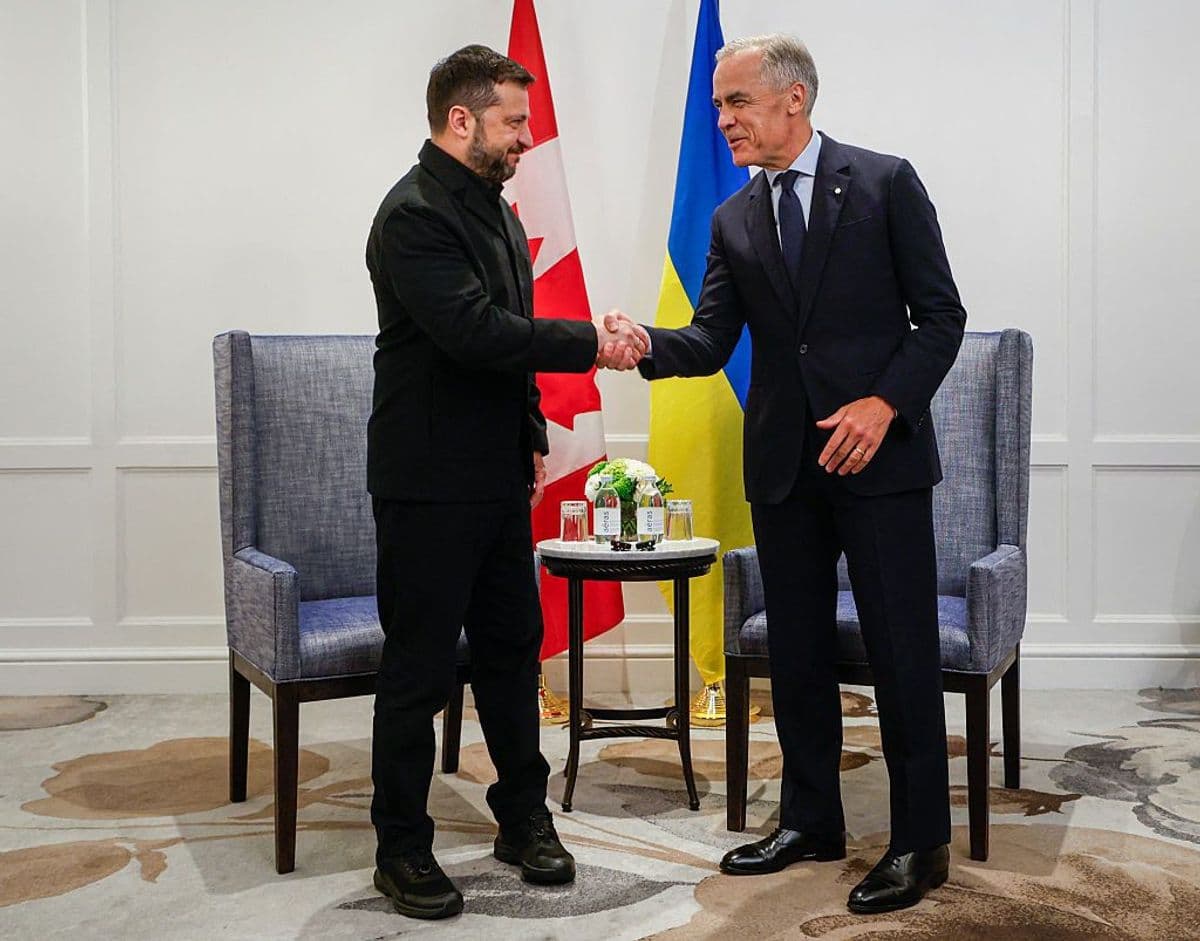
President Volodymyr Zelensky (L) and Canadian Prime Minister Mark Carney shake hands as they meet in Calgary, Alberta. Canada is providing Ukraine additional support in air defense, Ukrainian President Volodymyr Zelensky said during a visit for talks with Prime Minister Mark Carney. (Jeff McIntosh / POOL / AFP via Getty Images)
AMNESTY INTERNATIONAL: RUSSIA’S FOREIGN RECRUITMENT IS HUMAN TRAFFICKING
Amnesty International published a report today accusing Russia of systematically deceiving and coercing foreign nationals, mostly from the Global South, into fighting in Ukraine — practices the organization says amount to human trafficking under the UN’s Palermo Protocol. “Once victims sign the paperwork, often in a language they do not understand, military commanders restrict their movements, deploy them to the front lines with minimal preparation, and threaten those who seek a way out,” the report said. Recruiters reportedly weaponize overstayed work visas and alleged criminal charges, offering military service as an alternative to detention or deportation.
Two Sri Lankan nationals interviewed said they’d been promised cooking jobs before being sent to the front and captured by Ukrainian forces within weeks. A Brazilian IT professional recruited under what he thought was a legitimate tech contract said his commander threatened him directly when he asked to leave: “If you try to escape, you will either go to jail or we will kill you.” Ukraine’s prisoner coordination headquarters says it has identified 27,407 foreign nationals fighting for Russia as of March, recruited from at least 135 countries — a figure that’s grown steadily as more foreign fighters are captured and identified through Ukraine’s “I Want to Live” surrender program.
CONFIRMED: NOVOROSSIYSK STRIKE HIT THREE MORE WARSHIPS
Ukraine’s General Staff confirmed today that its September 9 strike on Novorossiysk’s naval base damaged the Petr Morgunov landing ship and the Zheleznyakov minesweeper alongside the previously reported Admiral Essen frigate, while new satellite imagery revealed additional damage to the Admiral Makarov frigate and a Buyan-M corvette that had reportedly just launched a cruise missile strike on Kyiv. Separately, imagery confirmed Ukraine’s August 30 strike on the Kirishi Oil Refinery destroyed roughly 60 percent of the facility’s total processing capacity — nearly 12 million tons annually — by disabling its primary oil-processing, diesel hydrotreating, and catalytic reforming units.
Ukraine’s Defense Ministry also disclosed today that its forces struck 17 pieces of Russian air-defense equipment, six bridges, more than 20 logistics warehouses, and over 30 drone launch sites across Russia and occupied Ukraine during August alone. Separately, Russian business outlet Kommersant reported that Wildberries and Ozon retailers have overwhelmingly abandoned marketplace-run warehouses for independent storage since July, with Wildberries sellers using their own facilities nearly doubling to 97.4 percent — direct evidence that Ukraine’s sustained strikes on retail logistics are reshaping how Russian e-commerce actually operates.
The cumulative picture from a single day’s disclosures is striking: warships damaged, a major refinery’s capacity gutted by more than half, and an entire retail sector forced to restructure its supply chains around the assumption that Ukrainian strikes will keep finding whatever facilities remain concentrated and vulnerable, regardless of how far from the front line those targets happen to sit.
MEANWHILE, AT THE FRONT
Ukrainian forces reportedly cleared all Russian infiltrators from Mykolaivka, east of Slovyansk, according to the city’s military administration head, who noted Russian soldiers had disguised themselves in civilian clothing to attempt infiltration — an act of perfidy and a war crime under the Geneva Conventions. Russian forces continue prioritizing an approach to Slovyansk from the east rather than the northeast, a Ukrainian task force spokesperson said, since sustained Ukrainian counterattacks near Lyman keep blocking the more direct route.
Near Dobropillya, a Russian milblogger acknowledged that Ukrainian drone operations are significantly slowing Russian advances, even as infiltration continued from multiple directions. Near Pokrovsk, high drone density on both sides is forcing Russian forces to avoid deploying high-value equipment entirely, while both armies’ artillery must constantly relocate to avoid counter-battery fire.
In Kherson City, Russian forces continued their “human safari” campaign, with footage showing a grenade dropped directly on a civilian — part of what researchers describe as an institutionalized pattern of deliberately targeting civilians in the war’s near rear. Near Kostyantynivka-Druzhkivka, Russian forces claimed to have gained fire control over the town’s outskirts without making any confirmed ground advance, while in western Zaporizhzhia Oblast, Ukrainian forces maintained positions in areas Russian sources had previously claimed to have infiltrated, continuing a pattern of Russian claims consistently outrunning what’s actually happening on contested ground.
A DRONE HITS A KYIV GAS STATION AS THE CAPITAL IS STRUCK TWICE
Russian jet-powered drones struck Kyiv early today, injuring four people and damaging a gas station in the Holosiivskyi district near the Respublika Park shopping mall, Mayor Vitali Klitschko said. The impact sparked a fire and set one vehicle ablaze before emergency crews extinguished the flames; three of the four injured were hospitalized. A non-residential building was also damaged in the district. Separate morning attacks hit the surrounding Kyiv Oblast, killing one person in the Obukhiv district and injuring two more there and in Fastiv district, where drone debris damaged a veterinary clinic and a private house; a warehouse in Obukhiv also caught fire, and private homes were damaged in Bucha district.
Russian drones returned to Kyiv again that evening. Klitschko said one drone fell on a two-story office building in the Obolonskyi district, another struck the roof of a four-story business center in Solomianskyi, and a third hit a warehouse in Obolonskyi, sparking another fire. The renewed strikes fit an established pattern this year of drones targeting gas stations specifically to disrupt fuel supplies and road logistics, a tactic Russia first concentrated in Kharkiv, Sumy, and Zaporizhzhia oblasts before expanding it into central Ukraine, with dozens of gas stations struck nationwide over the summer alone.
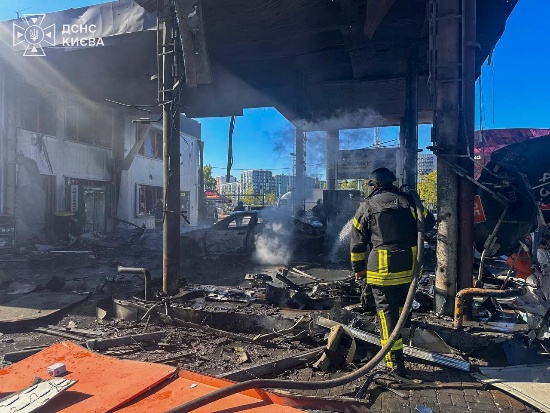
The aftermath of a Russian drone strike on a gas station in Kyiv’s Holosiivskyi district. (State Emergency Service of Ukraine in Kyiv/ Telegram).
UKRAINIAN PILOTS RESORT TO CANNONS AS MISSILES RUN SHORT
Ukrainian fighter pilots are increasingly forced to use aircraft cannons rather than missiles to shoot down Russian jet-powered drones, Air Force spokesperson Yurii Ihnat told the Kyiv Independent, citing a severe shortage of air-to-air missiles. “Due to a shortage of missiles, Ukrainian pilots are forced to take risks and use aircraft cannons. This requires precise maneuvering, as they must find the right firing point when the target is moving at speeds exceeding 400 km/h,” Ihnat said. Russia launched roughly 1,500 jet-powered drones in July and 2,800 in August, nearly doubling the pace in a single month.
Ukraine is deploying its full available fighter fleet against the threat — Soviet-era MiG-29s alongside US-made F-16s and French Mirage 2000s — but the faster jet-powered drones, flying at roughly twice the speed of older propeller models, represent a genuinely different tactical problem than the interceptor drones Ukraine has successfully used against slower Shaheds.
The missile shortage adds one more entry to a growing list of scarce resources — Patriot interceptors, artillery shells, and now air-to-air missiles — that Ukraine’s own pilots and air-defense crews must increasingly ration even as Russia’s nightly strike packages keep growing larger and faster. “Intense air battles are currently underway, as the enemy launches round-the-clock attacks with missiles and drones, leading to an increase in the consumption of air-to-air missiles and surface-to-air missiles,” Ihnat said, describing a defense system straining against demand that shows no sign of easing before winter arrives in full.
A DEADLY ATTACK NEAR ODESA, AND A FEW CLOSING THREADS
An unidentified drone attack struck the foreign cargo vessel Tedy yesterday, killing two Azerbaijani citizens and injuring two more, according to Azerbaijan’s Foreign Ministry, which didn’t specify who operated the drones or exactly where the attack occurred; the injured were taken to a hospital in Chornomorsk, Odesa Oblast. Separately, Ukraine’s sanctions commissioner confirmed that three of five Iranian oil tankers the US military destroyed on September 8 had direct ties to Russia’s shadow fleet, having previously called at Russian ports including Ust-Luga and Novorossiysk while repeatedly disabling their tracking systems to obscure their movements.
Former Prime Minister Yulia Svyrydenko was appointed president of the Kyiv School of Economics’ Business School today, taking on the role a year after her dismissal as premier and following reports she’d turned down an offer to become Ukraine’s ambassador to Washington. “KSE Business School should prepare leaders who will create the next generation of technologies, build competitive companies, and help Ukraine move from being a country that generates innovation to one that exports knowledge,” Svyrydenko said.
And Irish government records revealed that Aughinish Alumina, an Irish refinery owned by sanctioned oligarch Oleg Deripaska’s Rusal, privately told officials that its Russian ties had created a “challenging environment” for its operations — even as its alumina shipments to Russia have risen sharply since the invasion began, now representing roughly half the plant’s business, prompting renewed calls from Ukraine and Baltic states for the EU to ban the trade outright in its next sanctions package.
A GAS PLANT, A SHOPPING MALL, A CABLE THAT WASN’T CUT
By nightfall, today’s furthest reaches were hard to hold in a single frame: a drone striking a gas complex nearly 2,840 kilometers from Ukraine, a submarine rehearsing how to sever the cables that carry the world’s data, a shopping mall in Pavlohrad turned into a crime scene for the second time in two days across two cities. None of it resolved into anything simple. All of it measured exactly how far this war now reaches, on every front it touches.
Five people in Pavlohrad won’t see tomorrow. A Sumy mall has now buried victims from two separate strikes within a single day. And somewhere near Svalbard tonight, a Russian vessel turned back without cutting a cable it clearly meant to test cutting. Nothing today ended. Everything today confirmed how much further this war is still willing to reach before anyone involved shows real signs of pulling back.
A PRAYER FOR UKRAINE
1. For the Five Lost in Pavlohrad
Lord, five people are gone tonight in Pavlohrad, killed in a shopping center on an ordinary afternoon in a city that used to feel far enough from danger. We grieve a safety that keeps proving temporary. Receive each of them, comfort the 67 injured and their families, including three teenage boys now facing recovery instead of an ordinary school year, and hold this city as it learns what so many others already know too well.
2. For Sumy, Struck Twice in a Single Day
Father, Sumy’s shopping mall has now buried victims from two separate strikes within 24 hours. We grieve a pattern too deliberate to call coincidence. Comfort a community absorbing loss twice over, and give its rescue workers strength for a task that never seems to end. Let this repeated targeting be recognized for exactly what it is, not softened into just another entry in a long list.
3. For Every Foreign National Deceived Into This War
Lord of the exploited, we pray for the foreign nationals tricked and coerced into fighting a war that was never theirs, promised jobs that became death sentences. Give them a way home, and give the nations sending them a conscience to stop. Protect those still trying to escape, and let the truth about how they were recruited reach every family considering the same false promise.
4. For Ukraine’s Pilots Flying Without Enough
God of provision, we pray for the pilots forced to fly dangerously close to intercept drones because the missiles meant to protect them haven’t arrived in enough supply. Give them precision in every risky maneuver, and give Ukraine’s allies urgency in closing this gap before it costs a life it didn’t have to. Let scarcity never become the reason a skilled defender falls from the sky.
5. For a World Still Weighing How Far Russia Will Go
God of vigilance, we pray for nations tracking threats that keep testing the edges of what’s tolerable — cables nearly cut, borders nearly crossed, planes nearly struck. Give their leaders clarity to respond decisively rather than merely reactively. And give Ukraine, watching this war reach further into the world every week, assurance that the world is finally paying attention in ways that matter.
In Your mercy, in Your justice, in Your time — bring this war to its end, and let the ending be worthy of what Ukraine has endured.