
October 4, 2026
Prepared by Diana Bozhyk
German Chancellor Friedrich Merz made a surprise visit to Kyiv with a large business delegation, pledging €1.3 billion in military and energy aid and 1,000 interceptor drones despite Russian threats against foreign diplomats, as Russia’s Defense Ministry publicly announced it is intensifying strikes on Kyiv and Ukrainian infrastructure. A Russian drone struck Kyiv’s Northern Bridge for the second time in two days, bringing the total to seven hits on the capital’s two main Dnipro crossings in four days, while Zelensky said Russia used more than 1,900 drones, 1,700 guided bombs, and 25 missiles against Ukraine in a single week. Ukraine’s Operation Vivaldi has reclaimed up to 140 square kilometers near Lyman, and Moscow police detained at least 65 people at a Communist Party rally protesting Russia’s rigged parliamentary elections.
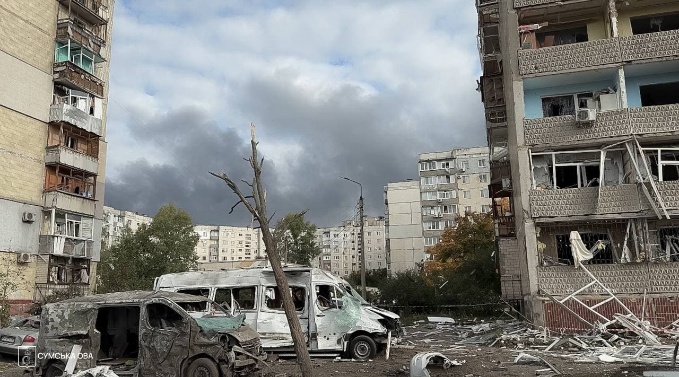
The aftermath of a Russian attack on Sumy, which damaged residential buildings and vehicles. (Sumy Oblast Military Administration/Telegram)
THE DAY’S RECKONING
The chancellor of Germany walked into Kyiv today without announcement and said what the day demanded: “Despite the threats that reached us from Moscow in recent days, I came today.” Russia’s foreign ministry had told foreign diplomats to flee the capital. Merz brought a business delegation instead, along with €1.3 billion and a promise of a thousand drone interceptors. Drones were hitting the city while he spoke.
Moscow answered in its own way: by announcing out loud that it’s intensifying attacks on Ukraine’s infrastructure, and framing the escalation as retaliation for things that independent analysts say never happened. A bridge in Kyiv took its seventh hit in four days. Zelensky counted the week’s cost in numbers no one should have to keep: nineteen hundred drones, seventeen hundred bombs, twenty-five missiles. And in Moscow itself, police were dragging protesters out of a rally for shouting “down with the Tsar.” Nothing today resolved cleanly. Everything today measured how openly Russia now says what its war is actually for.
MERZ ARRIVES IN KYIV WITH €1.3 BILLION AND 1,000 INTERCEPTORS
German Chancellor Friedrich Merz arrived in Kyiv unannounced today with Economic Affairs Minister Katharina Reiche and a large business delegation, his second visit as chancellor and fourth overall, pledging €1 billion in military assistance and €350 million for energy repairs alongside 1,000 interceptor systems to counter jet-powered Shahed drones. “Despite the threats that reached us from Moscow in recent days, I came today,” Merz said, referring to Russia’s Foreign Ministry warning that foreign diplomats face “mortal danger” in Kyiv. “This shows: we will not allow ourselves to be intimidated.” Russian drone attacks continued on the capital during the visit.
Berlin and Kyiv also concluded a bilateral agreement deepening counter-drone cooperation, letting German defense manufacturers integrate Ukrainian combat lessons directly into joint production ventures, with Merz stressing the partnership is reciprocal: German executives accompanying him are studying Ukrainian battlefield adaptations while helping establish joint high-tech facilities. Merz cited the thwarted Russian-directed sabotage plot at Leipzig/Halle Airport on August 4 as proof counter-drone technology matters for Germany’s own security. Berlin also announced plans for a trilateral summit with London and Paris, while Ukraine and Germany are jointly developing the Bars jet-drone interceptor, which Zelensky said has the highest interception rate of any currently available system.
RUSSIA ANNOUNCES A HARSHER STRIKE CAMPAIGN AND CALLS IT “RETALIATION”
The Russian Ministry of Defense announced today that it is intensifying strikes on infrastructure in Kyiv City, Kyiv Oblast, and across Ukraine, framing the escalation as a response to alleged Ukrainian strikes on Russian civilian targets since June. The ministry cited Ukraine’s strike series on Leningrad Oblast during June’s St. Petersburg economic forum and alleged strikes on Moscow’s election infrastructure during the September 18 to 20 Duma vote — claims ISW said Russia has repeatedly made without evidence, noting Ukraine’s September 19 and 20 strikes on Moscow targeted oil refineries and warehouses.
ISW assesses the framing is a pretext: Russia began its winter energy campaign in late September and is starting earlier than usual, before Ukraine can develop effective countermeasures to ballistic missiles and jet-powered drones, because Ukraine’s 2026 battlefield successes appear to be forcing Putin to abandon his original theory of victory in favor of making civilian life unbearable. Even the prominent Kremlin-affiliated blogger Rybar criticized the “reactive” framing, noting Russia has bombarded Kyiv continuously since 2022, though it praised the ministry’s increasingly candid rhetoric. The announcement follows the New York Times’ report of a Russian plan to cut electricity and heat by 90 percent in Kyiv, Kharkiv, and Odesa.
KYIV’S NORTHERN BRIDGE HIT AGAIN, SEVENTH STRIKE IN FOUR DAYS
A Russian drone struck Kyiv’s Northern Bridge on Sunday morning, damaging the roadway and injuring two people, Mayor Vitali Klitschko said. One was hospitalized and the other treated at the scene. Video footage showed a detonation crater blasted into the road surface. Klitschko later said a heating main was also damaged, temporarily cutting hot water to parts of the Desnianskyi district. The strike marked the fourth consecutive day Russian forces have targeted Dnipro bridges, and the second hit on the Northern Bridge in 24 hours after Saturday’s jet-powered drone strike severed its trolleybus power lines.
ISW counts seven strikes on the Northern and Southern bridges between October 1 and 4, part of what it describes as an effort to disrupt Ukraine’s economy and daily civilian life. Zelensky confirmed the strike in his own words: “This morning, the Russians once again struck Kyiv’s Northern Bridge with a drone.” Ukraine’s Infrastructure Minister has said pontoon crossings will be built within about three months and underground tunnels considered, as roughly 600,000 cars cross between the capital’s two banks every day and authorities have imposed new restrictions on bridge movement during air-raid alerts. Kyiv Mayor Klitschko warned a day earlier that keeping basic city functions running under constant attack has become a matter of “safety and survival,” and said restoring Green Line metro service across the Southern Bridge depends on a structural assessment by research institutes.
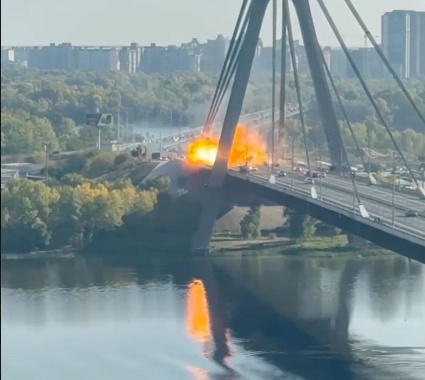
A screenshot from video shows the moment a Russian drone struck Kyiv’s Northern Bridge. (AMK Mapping/Telegram)
ZELENSKY: 1,900 DRONES, 1,700 BOMBS, 25 MISSILES IN ONE WEEK
President Zelensky said Russia used more than 1,900 attack drones, 1,700 aerial bombs, and 25 missiles against Ukraine over the past week, with more than 800 of the drones jet-powered. Overnight into Sunday, the Ukrainian Air Force reported Russia launched 135 Shahed-type drones, 52 of them jet-powered, plus Gerbera types, Banderol or Dan-T loitering munitions, and Parodiya decoys; Ukrainian forces downed 123 drones and two Banderol or Dan-T munitions, with strikes landing at five locations. Russian forces hit civilian, medical, communication, and residential infrastructure across Kyiv, Sumy, Dnipropetrovsk, Kharkiv, Donetsk, Zaporizhzhia, and Odesa oblasts.
The weekly total comes just days after the UN’s human rights chief reported at least 15,280 civilian deaths and injuries in the first eight months of 2026, a 55 percent increase over the same period last year. “Just this week, Russia has used more than 1,900 attack drones,” Zelensky wrote, tying the figures to his call for stronger international response. Ukrainian officials have warned the sheer volume of strike packages is designed to exhaust Ukraine’s air defenses and its civilian population simultaneously, a strategy the Institute for the Study of War assesses will only intensify as winter approaches and Russia stockpiles further.
ANTI-DRONE TURRETS, BARS INTERCEPTORS, AND A 700-MISSILE RUSSIAN STOCKPILE
Zelensky said Ukraine intercepts about 85 to 92 percent of conventional Shahed-type drones but only 50 to 60 percent of jet-powered ones, and announced it will install at least 12 automated anti-drone turrets firing .50-caliber machine guns in Kyiv City and eight more in Kyiv Oblast, while leaning on F-16 fighter jets as a cost-effective way to intercept jet-powered drones in large strike packages. The Ukrainian-German Bars interceptor reportedly has the best interception rate of any available system at around 30 percent, though other systems are “catching up,” he said.
On Russia’s side, Zelensky said Russia has stockpiled up to 700 ballistic missiles and produces 130 to 140 per month amid an ongoing Patriot interceptor shortage. “The Russians will now focus precisely on jet-powered drones and ballistics,” he said, predicting Moscow will move “toward quality rather than quantity.” ISW assesses Russia is stockpiling ballistic and quasi-ballistic missiles to conduct intense future strikes once jet-powered drones lose their current advantage, a pattern that underscores the continued importance of Western help for Ukraine’s air defense, including US-made Patriot systems able to counter ballistic missiles and a broader, diversified air-defense umbrella. Zelensky also said Ukraine has responded to the strikes on bridges and warned Moscow that mobile communications used in Kyiv are used in Moscow as well, hinting at reciprocal strikes on Russian telecom infrastructure.
RUSSIA’S CHEAP BANDEROL MISSILES JOIN ITS STRIKE PACKAGES
An ISW special report released today found Russia began integrating inexpensive, highly maneuverable quasi-cruise missiles into its strike packages in mid-2026 after scaling Banderol production, likely to further exploit Ukraine’s interceptor shortages. Banderols, designated S8000, use Chinese-made jet engines to fly at speeds up to 650 kilometers per hour with ranges up to 500 kilometers and warheads up to 150 kilograms, costing an estimated $50,000 to $150,000 each compared with roughly $2 million for a Kh-101 cruise missile. More than 40 of Russia’s daily strike packages between May 14 and September 30 included Banderols, and Ukraine’s Vladyslav Vlasiuk estimated 80 percent of strikes on Odesa’s port included them by late July.
Russia also unveiled the Dan-T, a similar jet-powered munition with a claimed 450-kilometer range and 270-kilogram weight, in Egypt on September 8; Rostec claimed “hundreds of successful strikes.” ISW assessed Russia plans to expand production, improve speed and maneuverability, and diversify launch platforms to deploy them in greater numbers in 2027 before Ukraine can field countermeasures at scale, leaving what it called a limited window for Ukraine and its partners to expand production of low-cost interceptors, electronic warfare, and layered air defenses capable of handling cruise-missile-like threats. Ukrainian Air Force spokesperson Yuriy Ihnat said Russia has launched over 7,700 jet-powered Geran-type drones so far.
SUMY: FIVE GUIDED BOMBS WOUND 13, A MEDICAL WAREHOUSE KILLS ONE
Russian forces struck Sumy on Sunday morning with five guided aerial bombs that hit residential high-rises and vehicles in the Zarichnyi district, wounding 13 people, including a child, according to regional authorities. All the injured were in stable condition, with injuries ranging from minor to moderate, though two victims were initially described as severely wounded. Separately, a Russian drone attack on a warehouse storing medical supplies in Sumy killed a 52-year-old employee and injured three others, local authorities said, bringing the oblast’s toll for the past day to at least three killed and 16 injured.
The attacks followed a series of Russian strikes on civilian logistics and infrastructure in Ukrainian cities over the weekend, and came days after glide bombs struck a Sumy school. Ukrainian officials have repeatedly cautioned that Moscow has accelerated its deployment of heavy guided bombs and high-speed unmanned munitions against municipal logistics and residential districts, renewing appeals to allies for enhanced air-defense coverage and standoff strike assets capable of suppressing Russian launch aircraft at border airbases, since the bombs are released far from their targets and are extremely difficult to intercept once launched. Ukraine’s Sumy Oblast authorities said damage from the strikes included apartment buildings, private homes, and vehicles across the affected neighborhoods.
KHERSON AND CHERNIHIV STRIKES WOUND SIX
Russian drone attacks injured six people in Kherson and Chernihiv oblasts on Sunday morning, regional officials reported. In Kherson, tactical drones struck pedestrians directly in what Ukrainian officials describe as an ongoing pattern of Russian operators deliberately targeting civilians in the city’s near rear. In Chernihiv Oblast’s Nizhyn district, Russian drones ignited residential fires, damaging homes in a region that has repeatedly absorbed strikes launched from across the nearby Belarusian and Russian borders.
Ukrainian forces also continued their own strike campaign against Russian military communications, repair facilities, and logistics, hitting signal installations near Hirnyk, Yasynuvata, and occupied Donetsk, and equipment repair sites near Vesela Tarasivka and Lysychansk in occupied Luhansk Oblast. Strikes also destroyed a Russian command post near Novaya Tavolzhanka in Belgorod Oblast and hit an equipment warehouse in Voznesenovka. Unmanned Systems Forces commander Robert Brovdi reported Ukrainian forces have struck 14 electrical substations in occupied Donetsk Oblast since September 24, 20 to 70 kilometers from the front line, including repeat strikes on at least one, and five more substations in occupied Luhansk Oblast, between 17 and 145 kilometers from the front. In late September Ukrainian forces also struck two Russian mobile radar complexes in occupied Zaporizhzhia Oblast, damaging a 35N6 Kasta low-altitude detection radar near Chekhohrad and a Soviet-designed P-18 early-warning radar near Akymivka, part of a sustained effort to degrade Russian air surveillance.
NO EU EMBASSY IS LEAVING KYIV
EU Ambassador to Ukraine Katarína Mathernová said no member state embassy is preparing to evacuate Kyiv despite Russian threats and infrastructure strikes, directly contradicting a Guardian report citing anonymous Western diplomats. “I am not aware of any embassy that is leaving — and certainly not embassies of EU countries,” she told Ukrinform. “I do not know what sources The Guardian used… quite the contrary.” She said she coordinates regularly with diplomatic missions of 25 EU member states in the capital and that both the EU Delegation and the EU Advisory Mission remain fully operational. “I think Putin’s rhetoric is a consequence of the lack of success on the battlefield,” she added.
European Commission spokesperson Christian Wigand said the same: “This is not the first time Russia has issued such threats. It shows that the Kremlin is losing the war and losing self-control. The European Union will continue to support Ukraine, expose Russia’s irresponsible and dangerous actions, and steadily increase pressure on Moscow.” European capitals meanwhile approved €6.6 billion through the European Peace Facility to reimburse member states’ bilateral military aid, approved €28.3 billion in defense procurement plans, and are finalizing what officials call the most extensive Russia sanctions package yet, while evaluating transferring interceptors directly from national stockpiles to Ukraine.
OPERATION VIVALDI RECLAIMS UP TO 140 SQUARE KILOMETERS
Zelensky told Reuters Ukrainian forces have liberated between 125 and 140 square kilometers near Lyman under Operation Vivaldi, which he said is not finished. “Our military wanted to start this operation a year ago, but at the time it was not sufficiently prepared,” he said. “Fortunately, we decided to postpone it briefly, and now we have good results and fewer casualties.” Zelensky said Russian casualty rates have risen over the past two to three months from an average of 30,000 to 32,000 monthly to roughly 42,000, a figure he said includes about 21,000 to 22,000 killed.
The operation relied heavily on unmanned ground vehicles operating ahead of infantry; Zelensky said fielding robotic systems in high-threat sectors proved instrumental in breaching defensive belts and preserving personnel. Ukraine’s parliament eliminated value-added tax on ground robotic equipment to speed deliveries, and Ukrainian units have conducted tens of thousands of supply runs and casualty evacuations using tracked and wheeled platforms. Joint clearance in the Lyman area involved the 3rd Separate Assault Brigade alongside border guard units, including the 3rd Border Guard Detachment named after Yevheniy Pikus and the 10th “Dozor” Mobile Border Detachment. Footage released by corps leadership showed units clearing contested settlements and evacuating captured personnel under continuous enemy observation. Military analyst Kostyantyn Mashovets said Ukrainian forces have cleared most Russian infiltrators from Lyman itself, though at least one very limited Russian group remains in the city’s east.
MOSCOW DETAINS 65 AT A PROTEST AGAINST DUMA ELECTION FRAUD
Russian authorities detained at least 65 people at an authorized Communist Party rally in Moscow on Sunday commemorating victims of the 1993 Black October constitutional crisis, the party said, after hundreds attended and began chanting “down with the Tsar.” The party had announced on September 23 it would hold the rally specifically to protest fraud in the September 18 to 20 State Duma election, in which United Russia won 355 of 450 seats amid documented ballot stuffing, detention of several hundred opposition observers, and the barring of the antiwar Yabloko party entirely.
The protest marks a rare, if limited, public expression of dissent in Russia’s tightly controlled political environment, and one aimed at the Kremlin’s own electoral machinery rather than at the war directly. The Russian Interior Ministry’s forces began detaining participants only after the “down with the Tsar” chant began, according to the Communist Party’s account. The Communist Party, formally a Kremlin-tolerated opposition within the Duma, has increasingly voiced complaints about vote manipulation, though it remains unlikely to mount any sustained challenge to Putin’s rule. The rally was authorized in advance, and the party said hundreds attended before detentions began, making the arrests a notable reaction by Russian security forces to what had been a sanctioned gathering rather than an unsanctioned street demonstration.
RUSSIAN BILLIONAIRES FUND 1% OF THE WAR BUDGET IN A “VOLUNTARY” LEVY
Russian billionaires donated an estimated $5.6 billion to fund roughly one percent of state spending in what Kyiv Post described as a “voluntary” war levy, as Moscow looks for revenue to cover a widening deficit. Russia plans to spend a record 17.1 trillion rubles on defense next year, about 35 percent of the federal budget, while the Finance Ministry has cut its 2026 oil-and-gas revenue forecast and plans to raise net borrowing by 43 percent in 2027. The 2026 budget deficit is now projected at 3.2 percent of GDP, double the 1.6 percent estimated earlier this year.
The levy fits a wider pattern of Moscow reaching for new sources of money. Putin recently signed decrees placing the Russian assets of Western companies, including Nestlé, Auchan, and Metro, under indefinite state-linked “temporary management,” and the government is preparing a windfall tax on mining, metals, and gold companies expected to raise 600 billion rubles over three years. Economist Janis Kluge estimates Russia has already spent roughly $676 billion on the war since 2022, a total on pace to approach $876 billion by 2027 — more than the country’s entire gold and foreign-currency reserves. The Kremlin has meanwhile published no detailed breakdown of how the billionaire contributions are collected or allocated, leaving the “voluntary” label impossible to independently verify from outside Russia.
LATVIA’S PRO-UKRAINE PARTY WINS A PARLIAMENTARY ELECTION
Latvia’s ruling centrist, pro-Ukrainian United List, led by Prime Minister Andris Kulbergs, won the country’s parliamentary election on October 3, taking 35.3 percent of the vote and 41 of the Saeima’s 100 seats, according to the Central Election Commission, on a turnout of 51.8 percent among nearly 800,000 voters. Kyiv Post reported a slightly higher preliminary figure of 36.6 percent, and said the party ruled out a coalition with the populist Latvia First. Zelensky congratulated Kulbergs on X: “This strong result reflects the Latvian people’s confidence in your leadership and your vision for the country’s future. Ukraine deeply appreciates Latvia’s unwavering friendship and support.”
The vote was a test for Kulbergs, who has been prime minister since May, following a political crisis in Riga earlier this year. Affordability and security concerns were the top issues in a Baltic country that shares a border with Russia and is home to a large Russian-speaking minority. Germany had deployed four Eurofighter jets to Latvia’s Lielvarde Air Base to reinforce its airspace around the election amid concerns about Russian drone incursions. The result suggests that, at least in the Baltic states closest to Russia, voters continue rewarding governments that take a hard line on Moscow, even as Russia-friendly parties have made gains in other European contests this year.
UKRAINE’S SCIENCE UNDER FIRE
Russian strikes are systematically destroying Ukraine’s scientific capacity, Kyiv Post reported, citing the September 28 strike on the Presidium of the National Academy of Sciences in central Kyiv that killed scientist Valerii Kotenko and Natalia Bukalo, assistant to academician Volodymyr Horbulin, who was himself injured. As of October 1, at least 180 Ukrainian scientists killed during the war had been recorded in the “My Science” project’s public database, including researchers, lecturers, engineers, and graduate students who died either at the front or in Russian attacks.
The same day, a strike damaged the Dobrobut medical center’s academy building, where upper floors caught fire; rector Nana Voitenko wrote: “It’s frightening, but not fatal. We will rebuild. Education will not stop.” A September 30 drone strike also hit the grounds of Kyiv’s Institute for Nuclear Research, where a shut-down research reactor sits, and a July 2 attack heavily damaged the Palladin Institute of Biochemistry, destroying a laboratory roof, equipment, reagents, and biological collections. Science communicator Anton Senenko argued modern defense depends on research: “There is a peaceful atom, but there is no peaceful Russian science.” Even so, researchers keep working: biophysicist Valeriia Trusova, whose Kharkiv laboratory burned down in the first weeks of the full-scale invasion, continues her research and teaching at Karazin Kharkiv National University, one of hundreds of scientists who have chosen to keep working in Ukraine despite the destruction.
A BANDEROL DOUBLE-TAP HITS KHARKIV; FIVE KILLED, 30 INJURED NATIONWIDE
Russian attacks killed at least five people and injured 30 others across Ukraine over the past day, local authorities said. In Kharkiv, Russian forces carried out a double-tap strike using Banderol missiles in the city’s industrial district, killing one person and injuring six, Mayor Ihor Terekhov said; an administrative building and vehicles burned, at least 10 multi-story residential buildings were damaged, and search-and-rescue operations continued. Kharkiv Oblast overall lost two people with five injured as Russian forces struck the city and nine other settlements with FPV, Molniya, and Lancet drones and a multiple-launch rocket system.
Dnipropetrovsk Oblast reported three injured in more than 50 attacks using drones, artillery, and a glide bomb, including two people hurt when a strike on food warehouses in Pavlohrad sparked a fire. Zaporizhzhia Oblast reported two injured amid 745 attacks on 47 settlements. Kherson Oblast reported two injured, and Donetsk Oblast two injured in Sloviansk. Ukraine’s Air Force said its defenses shot down 125 of 135 targets overnight, including 123 Shahed-type and other drones and two Banderol munitions, with strikes recorded at five locations. A September 24 Banderol strike on a farm in Kharkiv Oblast killed six people and injured 14, and a July 8 Banderol strike on Kharkiv carried an estimated 300 to 400 kilograms of explosives, according to local prosecutors.
THE US PUSHES FOR TRILATERAL TALKS BY THE END OF OCTOBER
The United States is pushing for Ukraine and Russia to hold negotiations at the technical level in a trilateral format before the end of October, Zelensky said at a press conference alongside Merz. “The American side is currently in contact with Ukraine and Russia and is proposing to hold some kind of meeting at the technical level in a trilateral format by the end of October,” Zelensky told reporters, saying he spoke directly with the US negotiating team on October 3 but could not disclose all the details. “We’re open to the UAE or any other country proposed by the U.S. side,” he said. “We’ll wait for a response” from Moscow.
The energy-strike truce Trump has been promoting and a possible reopening of the Black Sea grain corridor are expected on the agenda, though Ukraine has said it will agree to an energy ceasefire only if Russia also suspends attacks, and Moscow has shown no sign of pausing its assault on Ukraine’s grid. Sources told the Kyiv Independent that Trump privately doubts Putin will agree to an energy truce before winter. The push follows the early-September visits to Kyiv and Moscow by US envoys Steve Witkoff and Jared Kushner and comes as Russia continues days-long attacks on Kyiv and other cities, with Zelensky saying Putin issued a “new doctrine” permitting attacks on schools, hospitals, and roads.
UKRAINE STRIKES TWO RUSSIAN WARPLANES 500 KILOMETERS AWAY
Drones operated by the SBU’s Alpha special operations unit struck a Su-35 multirole fighter and a Su-34 fighter-bomber at the Khanskaya military airfield in Russia’s Republic of Adygea, about 500 kilometers from Ukrainian territory, along with an ammunition depot, the SBU said. “Both aircraft are carriers of guided aerial bombs, which the enemy massively uses along the front line and against Ukrainian cities,” the agency said, estimating the export value of a Su-35 at around $100 million and a Su-34 at around $50 million. The extent of the damage could not be independently verified.
Russia’s Defense Ministry separately claimed its air defenses destroyed 559 Ukrainian drones between 8 p.m. Saturday and 8 a.m. Sunday across multiple Russian regions, including Adygea, as well as occupied Crimea and the Black and Azov seas — a figure that could not be independently verified. The strike follows a September 16 Ukrainian attack on a Russian Su-24 bomber at the Saky air base in Crimea. Ukraine routinely targets Russian airfields, ammunition depots, and other defense infrastructure with long-range drones to reduce Moscow’s ability to launch attacks against Ukraine, and the SBU promised that enemy strikes on civilian infrastructure “will not go unanswered.”
MEANWHILE, AT THE FRONT
Russian forces likely reorganized their 4th Separate Motorized Rifle Brigade into the 84th Motorized Rifle Division, the first division-level formation under the 3rd Combined Arms Army, according to ISW, after the brigade’s Telegram channel rebranded itself in late September or early October. The new division is one of the primary fighting forces at Kostyantynivka, Russia’s priority effort, and brings to 12 the number of Russian brigades reorganized into maneuver divisions since 2022 under reforms Sergei Shoigu announced that year. The Russian MoD has not officially commented, and it’s unclear how Russia will staff these formations to doctrinal strength.
Neither side made confirmed advances elsewhere along the front on Sunday. Ukrainian forces advanced into Zarichne east of Lyman as counteroffensive operations continued, Russian commentators acknowledged, while Russian forces maintained positions roughly one kilometer from one contested settlement, according to the military analyst Mashovets. Russian forces continued offensive operations in the Hulyaipole direction and western Zaporizhzhia Oblast without advancing, and Ukrainian forces hit a Russian Su-34 fighter, an electronic-warfare station, and other Russian military assets, Brovdi reported, continuing the sustained intermediate-range campaign against the logistics and air-defense networks behind Russia’s strike campaign. Mashovets assessed that Russia is likely holding three to four motorized rifle or rifle battalions and up to four to five regiments of Territorial Defense Forces and mobilization reserves in the Borova and Lyman directions, and that Ukrainian pressure near Lyman has already slowed the Russian 3rd Combined Arms Army’s push toward Slovyansk through Mykolaivka, forcing it to divert forces to defend its northern flank.
A CHANCELLOR WHO CAME ANYWAY, A CAMPAIGN ANNOUNCED OUT LOUD
By nightfall, today’s threads pulled toward the same uneasy pattern this war keeps sustaining: Russia declaring its escalation openly while a growing circle of allies refuses to be frightened out of Kyiv. Merz came with a billion euros and a thousand interceptors. Moscow’s own ministry confirmed that the strikes on civilian infrastructure are policy, not accident.
A bridge took its seventh hit in four days. Thirteen people in Sumy were wounded by bombs dropped from a safe distance, and a man at a medical warehouse died. In Kharkiv, a double-tap Banderol strike left a city block burning. Two Russian warplanes burned on an airfield 500 kilometers from Ukraine. In Moscow, police detained sixty-five people for shouting at a government that says it has won an election. And in Riga, voters chose a government that wants to keep helping Ukraine. Nothing today ended. Everything today measured how openly Russia now says what its war is for, and how many allies are choosing, anyway, to show up.
A PRAYER FOR UKRAINE
1. For the Thirteen Wounded in Sumy and the Six in Kherson and Chernihiv
Lord, nineteen people were wounded today by bombs and drones aimed at nothing but ordinary lives, among them a child in Sumy, and five more died across the country, among them a man at a medical warehouse. We grieve harm that arrives without warning from a safe distance. Heal the wounded fully, comfort their families, and protect every community still living within reach of weapons it cannot intercept.
2. For a Capital Whose Bridges Keep Breaking
Father, we pray for Kyiv’s millions, whose bridges have now been struck seven times in four days, whose commutes and heating and hot water keep breaking under constant attack from the air. Protect the repair crews and engineers who work through every alert, hold this city together, and give its leaders wisdom to keep ordinary life possible even as every single day demands more of them.
3. For Every Leader Who Chooses to Come Anyway
Lord of courage, we give thanks for the chancellor who walked into a city Russia had threatened and said plainly he would not be intimidated. Bless every ally still choosing presence over distance, and give them the follow-through to match their words with delivered support before winter arrives and the cost of any further delay grows far heavier for everyone involved, here and abroad.
4. For Russians Shouting Into a Silence Built for Them
God of justice, we pray for the sixty-five detained today in Moscow for chanting what their government would rather no one say aloud at all. Protect them from whatever follows, and let truth reach a country whose leaders announce escalation openly yet punish ordinary citizens for questioning the very elections that claimed to speak for their consent, however quietly and carefully they ask.
5. For Scientists, Students, and the Future This War Targets
God of wisdom, we grieve the scientists killed in a struck academy and the hundreds of researchers lost to this war so far. Protect the laboratories that remain, the students still learning, and the quiet work of building something better for the future. Let knowledge outlast every attempt to burn it, and let Ukraine’s own minds rebuild everything that has been destroyed.
In Your mercy, in Your justice, in Your time — bring this war to its end, and let the ending be worthy of what Ukraine has endured.