
Ukraine Daily Briefing | April 21, 2026 | Day 1,518 of the Full-Scale Invasion
Russia’s chief of the general staff claimed his forces had seized 1,700 square kilometers and all of Luhansk Oblast — Day 1,518, when the gap between the war Russia describes and the war Ukraine fights became impossible to ignore. Overnight, Ukrainian drones set five oil tanks ablaze in Samara Oblast, 1,000 kilometers inside Russia, as Reuters confirmed that Ukrainian strikes have cut Russian oil output by up to 600,000 barrels a day. Zelensky announced the Druzhba pipeline was repaired, clearing Hungary’s months-long veto on €90 billion in EU aid, with Brussels promising a decision within 24 hours.
The Day’s Reckoning
Picture a general at a podium, pointing to a map that shows Russia winning. He says his forces hold 1,700 square kilometers seized this year. He says they are within seven kilometers of Kramatorsk. He has said all of this before — four times since October 2022 — and each time, the evidence has contradicted him completely.
While he was speaking, five oil tanks in Samara Oblast were burning. A Ukrainian drone had found the facility where Russia blends crude oil into Urals, its flagship export grade, 1,000 kilometers behind the front line. Other Ukrainian drones had already delayed fifteen trains in Rostov Oblast and struck a weapons depot in Bryansk. Reuters would report that day that the cumulative impact of Ukraine’s oil campaign has cut Russian production by up to 600,000 barrels a day — the steepest decline since 2020.
In Sumy, ten drones struck a hospital roof and residential streets overnight, injuring fifteen people, three of them children. In Slovyansk, Russian glide bombs destroyed a school. In a field near Mariupol, construction equipment was converting a mass grave from the 2022 siege into a road repair facility.
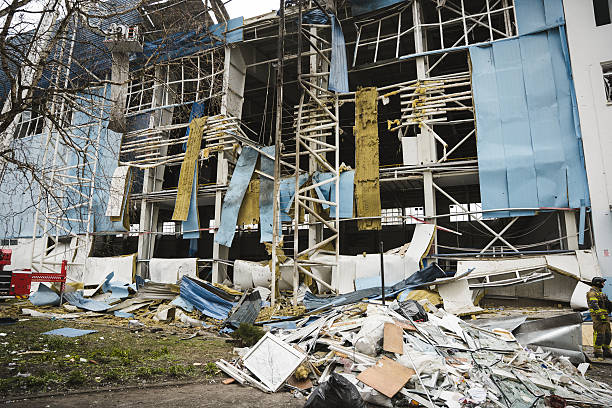
A sports complex remains destroyed after a Russian drone attack in Sumy. Fifteen people were injured in the attack on the city. (Sofiia Stasyuk/cukr.city/Global Images Ukraine via Getty Images)
Day 1,518: the general’s map, the burning tanks, the children in hospital, and the bodies disappearing under asphalt — the war Russia performs and the war Ukraine actually endures, running side by side without ever meeting.
The General Who Cried Wolf — for the Fourth Time
There is a moment in every Gerasimov briefing when the numbers become surreal. On April 21, standing before the Southern Grouping of Forces command, Russia’s chief of the general staff announced that Russian forces had seized 1,700 square kilometers since the start of 2026, captured 80 settlements, and now hold the entirety of Luhansk Oblast. He placed his troops within seven kilometers of Kramatorsk. He claimed 70 percent of Lyman and 75 percent of Novopavlivka.
The Institute for the Study of War assessed actual Russian gains at 381.5 square kilometers since January 1 — 22 percent of Gerasimov’s figure. Since March 1, when the Spring-Summer 2026 offensive launched, Russian forces have lost 59.79 square kilometers net. ISW found no evidence of Russian forces in Lyman whatsoever, and assessed only 20.51 percent of Novopavlivka under Russian control. Even the maximalist reading of pro-Russian milblogger maps reached only 715 square kilometers. The settlements Gerasimov named as recently seized — Borova, Studenok, Zaporozhets — sit 10 to 12 kilometers beyond the furthest extent of any Russian claim. Rybar’s own Zaporizhzhia map, published the day before the speech, showed Zaporozhets firmly under Ukrainian control.
This was the fourth time Russian officials have declared full seizure of Luhansk Oblast since October 2022. Two of those declarations came after Ukraine’s counteroffensive had already liberated large portions of the region. Gerasimov widened the timeframe of his April briefing to two to four months — broader than the single months of previous speeches — to accumulate enough numbers to disguise the near-zero progress of the current offensive. Russia’s own ultranationalist milbloggers have condemned the practice of seizing settlements “on credit” and sending “beautiful reports” upstream. The real audience is not the Russian military. It is Western governments whom the Kremlin wants to convince that resistance is futile and Ukrainian frontlines are collapsing. They are not.
Samara Burns: Ukraine Strikes the Heart of Russia’s Oil Export System
Imagine working the overnight shift at a pumping station. The facility handles the blending of crude oil from multiple fields into Urals — Russia’s flagship export grade, the benchmark price for roughly 80 percent of Russian oil revenues. It is 1,000 kilometers from the front. It has never been struck before. Then the drones arrive.
Ukrainian Security Service elements hit the Transneft-Privolga station in Prosvet, Samara Oblast, overnight, starting a massive fire. Five storage tanks, each holding 20,000 cubic meters of crude, were damaged — roughly 629,000 barrels of storage capacity destroyed in a single night. The Saratov Oblast governor acknowledged a strike on an industrial enterprise in his region the same night. The Ukrainian General Staff confirmed a separate strike on a Russian equipment depot near Persianovsky, Rostov Oblast, roughly 210 kilometers from the front; the North Caucasus Railway acknowledged a Ukrainian drone damaged an overhead line at Persianovka station, delaying fifteen trains. Ukrainian forces also struck a weapons and equipment concentration area near Klimovo, Bryansk Oblast, ten kilometers from the international border.
Battle damage assessments from the April 17 Syzran Oil Refinery strike confirmed the destruction of a storage tank, two pipeline sections, and a crude distillation unit. Satellite imagery showed the Tuapse refinery smoke plume — struck twice the previous week — stretching more than 300 kilometers across the Black Sea. Reuters reported that the cumulative impact of all these strikes has cut Russian oil output by 300,000 to 400,000 barrels per day compared to January-March, and by up to 600,000 barrels compared to late 2025 — potentially Russia’s worst oil production decline since 2020. Ukraine has now damaged all three of Russia’s major western export ports since mid-March. The pattern is deliberate, and it is working.
The €90 Billion Door Opens: Druzhba Flows, Orban’s Veto Falls
For three months, a pipeline has held €90 billion hostage. Russia struck the Druzhba pipeline in January, cutting oil flows to Hungary and Slovakia. Viktor Orban immediately blamed Ukraine and used his EU veto power to freeze a loan package already approved by the European Council — the largest financial lifeline in Ukraine’s wartime history, designed to cover two years of government budgets. Budapest and Bratislava escalated in February by halting diesel exports to Ukraine. Orban called it “energy blackmail.” Kyiv called it a Russian-aligned veto dressed in economic language. The loan sat frozen.
On April 21, Zelensky announced that Ukrainian specialists had completed repairs to the damaged section. “The pipeline can resume operation,” he said, “although no one can guarantee that Russian attacks will not happen again.” A Hungarian oil company filed the first transit request within hours; flows were expected to resume April 22, split evenly between Hungary and Slovakia. Orban — who lost his parliamentary majority in the April 12 elections — wrote to European Council President Costa promising to lift his veto “without delay” once transit resumed. EU foreign policy chief Kallas said a positive decision on the loan could come “within 24 hours.”
Economy Commissioner Dombrovskis confirmed the loan structure: Ukraine only repays if Russia pays reparations; if reparations never materialize, EU regulations allow frozen Russian central bank assets — €185 billion held at Euroclear in Belgium — to cover the gap. “Of course, we are not putting this obligation on Ukraine,” he said. Hungary’s new administration also reversed Orban’s withdrawal from the International Criminal Court, meaning Netanyahu could now be arrested if he enters Hungary. The Druzhba dispute is resolved. The money is hours away. And what Orban spent months weaponizing has become, in the end, a Ukrainian diplomatic win.
Hit Lists and Summoned Ambassadors: Moscow Names European Targets
Russia published a list. Not a diplomatic note, not a trade complaint — a list of 21 European companies it described as suppliers of drone technology to Ukraine. Kremlin mouthpiece Dmitry Medvedev called it “a roster of potential targets.” Three German firms appeared by name: Davinci Avia, 3W Professional, and Airlogistics Germany. The message was unmistakable: keep supplying Ukraine, and you will be treated as combatants.
Germany summoned the Russian ambassador immediately, calling the statements “direct threats” aimed at undermining support for Ukraine and testing European unity. “Our response is clear: we will not be intimidated.” The Czech Foreign Ministry summoned Ambassador Zmeyevsky separately; Foreign Minister Macinka demanded an explanation and stressed that all Czech assistance to Ukraine is grounded in international law. Russia has not publicly responded. The list is almost certainly psychological rather than operational — Moscow cannot strike private companies in Berlin or Prague without triggering NATO’s collective defense. But the intent is to raise insurance costs, chill future contracting, and make European defense firms weigh the personal risk of supplying Ukraine.
The broader European security environment darkened further. Sweden announced it had intercepted two Russian bombers, following Norway’s recent interception of Russian spy aircraft — a frequency of provocations that analysts are beginning to read as deliberate signaling rather than routine patrols. Germany reported considering raising its military reserve age limit to 70. Denmark dismissed an F-16 maintenance technician over his Russian wife. The EU separately sanctioned Euromore, a Kremlin-amplifying media outlet, and Pravfond, a Russian state-funded propaganda foundation that produces content claiming Ukraine has been “Nazified.” Brussels has now sanctioned 69 individuals and 19 entities linked to Russian hybrid influence operations.
Zelensky’s Warning: Iran’s War, Russia’s Mobilization Trap, and the $30 Billion Industry No One Expected
In an interview with Ukraine’s United News telethon, Zelensky laid out the war’s strategic landscape with unusual directness. The conflict in Iran, he argued, is doing Russia’s work for it — driving up oil prices, diverting American and European resources, and limiting Ukraine’s future access to air defense systems. “It strengthens the Russians, depletes the Americans and Europe’s energy reserves,” he said. Trump extended the US ceasefire with Iran on April 21 and directed the US military to continue blockading Iranian ports; the US sanctions waiver on Russian oil purchases was separately extended to May 16, earning Russia an estimated $150 million per day. A CSIS analysis reported that US forces had consumed at least 45 percent of their Precision Strike Missiles in just seven weeks of the Iran war.
On Russia’s mobilization ceiling: Zelensky argued that Moscow’s social media restrictions are not about suppressing criticism of Putin but about preventing unrest over a potential mass call-up. Adding the one to one-and-a-half million troops that Ukraine’s UN envoy said Russia would need to achieve its territorial objectives requires mobilizing from Moscow and St. Petersburg at a scale that would produce civil unrest the Kremlin cannot manage. Contract recruitment is reaching its limits. Zelensky said directly that “the easing of sanctions and political pressure on the aggressor has led to a partial resurgence of Russian military ambitions” — framing Ukraine’s drone campaign against Russian oil infrastructure as the substitute for the Western economic pressure that is being quietly withdrawn.
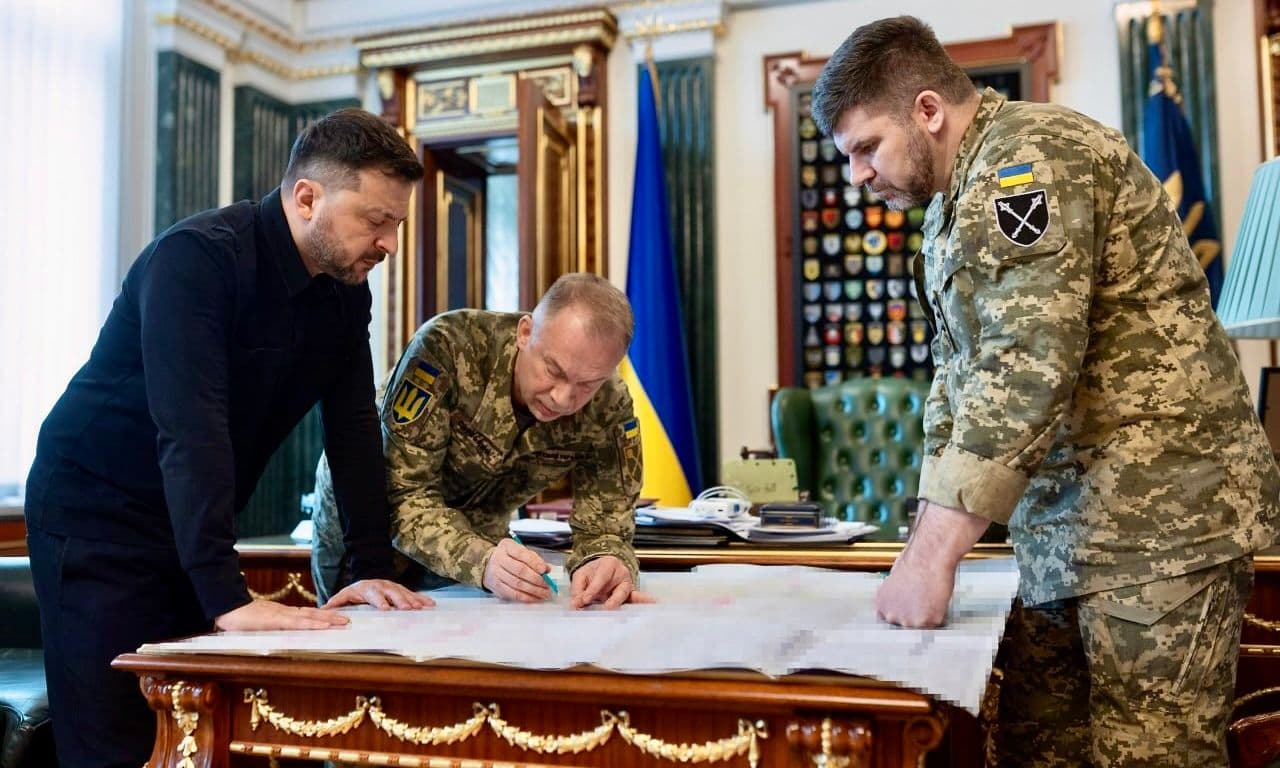
President Volodymyr Zelensky holds a meeting with Ukraine’s Armed Forces command in Kyiv, Ukraine. (Volodymyr Zelensky / Telegram)
On Ukraine’s own industry: 200 Ukrainian defense companies, 30 of them among the world’s top firms, now backed by $30 billion in investment. The naval drone program built with technology from Britain, Norway, and the Netherlands. “Made in Ukraine is an expensive brand today,” Zelensky said — expensive because the price of each product includes the lives of the people who used the equipment it was tested against. He also outlined a security vision: Norway, Ukraine, Britain, and Turkey together, he argued, possess armies stronger than Russia’s and could make the EU the world’s strongest security union.
Putin’s Army of Officials: Militarizing Russia From City Hall to the State Duma
On the same day his general was inventing victories at a podium, Vladimir Putin was at a municipal government ceremony praising veterans returning from Ukraine as natural-born administrators. They understand citizens’ needs, he said. They know how to make decisions. They are, he said, the “face” of the Russian state. He connected their placement in government directly to the September 2026 State Duma elections.
The vehicle is the Time of Heroes program — a systematic effort to install war veterans at every level of Russian government, from city halls to federal ministries. ISW assessed the Kremlin is intensifying the campaign now because Putin’s approval ratings are falling and Russian society is feeling the war’s costs more acutely. The objective is structural: build a governing class whose identity and career advancement are tied to the war continuing, so that any future path to peace runs through displacing the people who profit from it. Political scientist Sergei Medvedev noted that Ukraine’s FPV drones have built an effective wall on the front line halting Russian infantry, while “middlestrike” drones operating 300 kilometers behind the front hunt Russian reserves before they arrive. “Ukrainian housewives armed with 3D printers,” he wrote, are beating the vast Russian military-industrial complex. Russian blogger Karl Woloch added that Peskov’s references to ending the war if Ukraine withdraws from Donbas — “he no longer talks about the aims of the special operation” — suggest the Kremlin is recognizing its negotiating position is weakening.
Veterynarne Falls, Zybyne Holds: How Russia’s War Actually Works
North of Kharkiv City, Russian forces infiltrated the village of Veterynarne on April 21. Geolocated footage confirmed troops striking Ukrainian positions and raising a flag. The Russian MoD credited the 245th Motorized Rifle Regiment, 47th Tank Division, 1st Guards Tank Army, with support from the Chechen Akhmat Spetsnaz Vakha Battalion and the Rubikon Center for Advanced Unmanned Technologies. This is a genuine tactical development — contested, unstable, and immediately subject to Ukrainian counterattack. This is what Russian territorial gain actually looks like: small, violent, immediately disputed.
Three days earlier, the Russian MoD had announced the seizure of Zybyne, northeast of Kharkiv City. On April 20, Ukraine’s 16th Army Corps stated flatly that Russian forces do not control the settlement. Russian forces intensified offensive operations north of Kharkiv City and continued near Vovchansk as Ukrainian forces counterattacked; milbloggers claimed an advance north of Okhrimivka. Russian Aerospace Forces reportedly struck a Ukrainian brigade command post near Mala Rybytsia, northeast of Sumy City, with a guided glide bomb. In Sumy Oblast, Russian forces continued offensive operations as Ukrainian forces counterattacked southeast of the city. A Ukrainian brigade officer reported repelling a platoon-sized Russian mechanized assault on the Kursk-Sumy border — three armored vehicles including a self-propelled howitzer and three motorcycles, advancing 300 meters before being destroyed. The Russian command likely ordered the assault after infiltration tactics had failed. These are the real units, real distances, and real casualty rates that Gerasimov’s map does not show.
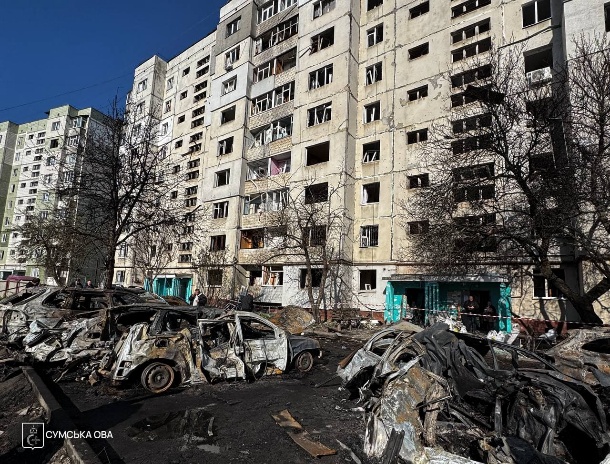
A residential building is damaged following Russian strikes on the city of Sumy. (Oleh Hryhorov / Telegram)
The Fortress Belt Holds: Six Directions, Six Stalled Offensives
Walk the Donetsk front line in April 2026 and you find the same story at every axis: Russian forces pushing, Ukrainian forces holding, and the daily cost measured in lives for distances measured in hundreds of meters. In the Chasiv Yar direction, the 70th Motorized Rifle Division and reinforcements from the 3rd Combined Arms Army conducted multiple armored assaults over the past week and seized three windbreaks northwest of the Novopivnichnyi Microraion. Three windbreaks — strips of trees planted to break wind on farmland. That is the measurable progress of Russia’s priority offensive. Ukrainian forces advanced in southeastern Kostyantynivka and continue periodic counterattacks that complicate Russian consolidation.
Near Dobropillya, the 2nd Combined Arms Army is grinding via Hryshyne and Novooleksandrivka. Military observer Mashovets called it “meat grinding”: advances of several hundred meters per day at catastrophic cost. Ukrainian drones near Stupochky are striking Russian mechanized columns before they reach their objectives, creating a broad contested gray zone northeast of Kostyantynivka. North of Pokrovsk, Russian drones are so severely constricting Ukrainian logistics that Ukrainian forces rely on drone drops and unmanned ground vehicles for resupply.
In the Oleksandrivka direction, Russian infiltration groups have shrunk from seven or eight soldiers to two or four, squeezed by fortifications and barbed wire. After the Starlink shutdown, Russian forces are building Wi-Fi bridges to compensate — more visible, more exposed, more targetable. Geolocated footage confirmed Ukrainian forces striking Russian positions in southwestern Sichneve after an infiltration mission. Ukrainian Special Operations Forces struck three ammunition depots and three supply depots near Mykilske, Makedonivka, and Markyne — the furthest roughly 147 kilometers from the front — plus two logistics hubs and additional ammunition depots near Mariyanivka and Lisne, during the week of April 13-20. In the Lyman direction, fresh Russian drone crews have been brought up specifically to hunt Ukrainian logistics. In the Slovyansk direction, small Russian infantry groups are using the warmer weather and improving foliage cover to increase infiltration attempts. Russian forces continued limited operations in the Novopavlivka and Borova directions without confirmed advances; Ukrainian forces struck a Russian ammunition and fuel depot near occupied Aidar, roughly 90 kilometers from the front.
Southern Front: 725 Attacks on Zaporizhzhia, Kherson’s Daily Attrition
Seven hundred and twenty-five. That is the number of separate Russian attacks on 39 settlements in Zaporizhzhia Oblast on April 21 alone — artillery, drones, guided bombs, and direct fire, distributed across the region from morning until night. Two people were killed in the city of Zaporizhzhia and surrounding settlements, ten injured. Russian forces continued offensive operations in the Hulyaipole direction and western Zaporizhzhia Oblast without confirmed advances; Ukrainian forces reportedly counterattacked in the western sector. Ukrainian forces struck a Russian command post near Novopavlivka, roughly 94 kilometers from the front, and a Russian repair base and command post in occupied Hamivka, about 92 kilometers from the front, during the previous week.
In the Kherson direction, no ground activity was reported — but the daily arithmetic of attrition continued without interruption. Geolocated footage showed Ukrainian forces striking a Russian drone operator command post in Hola Prystan, seven kilometers from the front southwest of Kherson City. Ukrainian forces also struck Russian materiel and technical depots near occupied Novomykolaivka, 42 kilometers from the front. One person was killed and five injured in Kherson Oblast through artillery, drones, and glide bombs targeting coastal settlements along the Dnipro River. These numbers accumulate day after day, week after week, in a direction of the front that rarely makes headlines.
143 Drones, Two Missiles, 54,000 Without Power: The Night Ukraine Did Not Sleep
Imagine living in Sumy. You have lived there for years, through the first months of the full-scale invasion, through every overnight alarm, every impact. You know the sound. On the night of April 20 to 21, ten drones came. One struck the roof of the local healthcare facility. Another hit the Zarichnyi residential district. Fifteen people were injured — three of them children. A seventeen-year-old girl was hospitalized. Hundreds of windows shattered. About ten cars burned in the streets.
Across Ukraine that night, Russian forces launched 143 Shahed, Gerbera, Italmas, and other long-range drones, plus two Iskander-M ballistic missiles fired from Kursk Oblast. Ukrainian air defenses downed 116 drones and one missile. Twenty-two drones broke through to 17 locations. In Chernihiv Oblast, a strike on an energy facility in Nizhyn Raion left 54,000 subscribers without power; a drone attack on Pryluky damaged the district police station, a library, businesses, houses, and about fifty cars. In Donetsk Oblast, FAB-1500 and FAB-250 glide bombs hit the center of Slovyansk, destroying a school, fifteen high-rise residential buildings, two houses, three shops, a beauty salon, a pharmacy, and a notary’s office, injuring three civilians. “The strike on the city center was no mistake,” said Governor Filashkin. “It was a deliberate decision to strike where people live.”
In Kharkiv Oblast, twelve people were injured in attacks on thirteen settlements, including the logistics hub of Izium; Russian forces additionally struck residential infrastructure in Bohodukhiv during the afternoon hours. In Dnipropetrovsk Oblast, three people were killed and at least eight injured in nearly 70 Russian attacks. In Zaporizhzhia, two killed and ten injured. In Kherson, one killed, five injured. Railway infrastructure was damaged in Kryvyi Rih and Kharkiv City. Ukrenergo reported simultaneous power outages across Chernihiv, Donetsk, Kharkiv, Sumy, and Zaporizhzhia oblasts. Six dead. Fifty-nine injured. One night.
Moscow Without Kyiv: The Protocol That Tells the Story
Zelensky was asked about reports that Trump envoys Steve Witkoff and Jared Kushner were expected to meet Russian officials in Moscow, with no confirmed plans for a Kyiv visit. His response was measured and pointed: “It is disrespectful to come to Moscow and not Kyiv.” He was not complaining about etiquette. He was naming a pattern: the Trump administration has treated Russia as a principal in these negotiations and Ukraine as a party to be managed, signaling to both sides who has more leverage before a single concession is formally discussed.
The US envoys met Putin in Moscow in January 2026. There are no confirmed plans for a Kyiv visit. Zelensky offered alternatives — third countries, if Kyiv was not possible — and added that such a visit would be “more important for them than for us,” distancing himself from appearing too eager for American attention. Per Kyiv Independent reporting, the Trump administration has not opposed Russia’s demand for control over the entire Donbas. After the Alaska meeting in August 2025, Washington signaled openness to a deal requiring Ukrainian withdrawal from Donetsk Oblast. “The easing of sanctions and political pressure on the aggressor has led to a partial resurgence of Russian military ambitions,” Zelensky said directly. The US sanctions waiver on Russian oil purchases, extended to May 16, earned Russia an estimated $4 billion during its first period. A leaked call reported separately revealed that 90 percent of the chips used in Russian drone production come from China.
‘Donnyland’: Ukraine’s Darkly Comic Bid to Capture Trump’s Imagination
Somewhere in the margins of a peace negotiation, a Ukrainian official floated the idea of renaming a portion of occupied Donetsk Oblast “Donnyland” — a name that combines Donetsk, Donald, and Disneyland. The New York Times reported the proposal, which covers approximately 2,000 square miles of northwestern Donetsk Oblast, has continued to surface in talks since it was first introduced, half-jokingly. Trump’s Board of Peace, which includes neither Ukraine nor Russia, could help administer it, negotiators reportedly suggested. No official documents reflect the plan.
The humor is a vehicle for something serious. The Trump administration has not opposed Russia’s demand for the entire Donbas. “Donnyland” is an attempt to give Trump a personal stake in a settlement that preserves Ukrainian-held territory — to convert a concession into a legacy project. Zelensky has been explicit about his position: “I will never abandon Donbas and the 200,000 Ukrainians who live there. Our best defensive strongholds are located here. If we withdraw our troops, the Russians will have complete freedom of action toward the center of the country.” The joke is Ukraine’s way of saying: if this is the language that works, we will speak it.
Kyiv Shooting Fallout, Kidnapping Draft Officers, and the Teenager with Two Bombs
Three separate cases of internal disorder surfaced on April 21, each revealing a different dimension of the pressure wartime Ukraine is under. In Kyiv, the fallout from a weekend shooting continued: police chiefs were dismissed for an inadequate response, officers ordered to retraining, and the patrol police chief resigned — only to be appointed as an adviser, a move that drew immediate criticism. A separate incident in Odesa saw SBU officers confront corrupt military and police personnel in a gunfight and chase, after reports of a protection scheme.
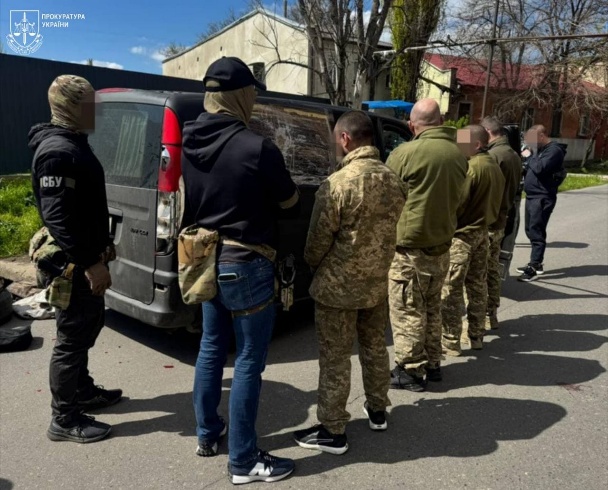
Four draft officers detained by the Security Service of Ukraine (SBU) in Odesa. (Prosecutor General’s Office / Telegram)
In Odesa, five draft officers from the Peresyp district recruitment office were detained after abducting a man from the street, forcing him into a van, driving him around the city, beating him, and demanding $30,000 under threat of expedited frontline deployment as a “stormtrooper.” An inside informant had scouted victims by financial situation and daily movements. Commander-in-Chief Syrskyi personally suspended the heads of both the Odesa Regional and Peresyp District Territorial Centers for Recruitment. Ukraine’s Ground Forces stated that “any violations of the law, abuse of authority, or unlawful actions are unacceptable.” The accountability matters: Ukraine’s mobilization legitimacy depends on it.
In Kremenchuk, Poltava Oblast, the SBU neutralized a double-tap terrorist attack on a police station before it could detonate. A teenager, recruited through Telegram by a Russian intelligence handler who provided both money and technical instructions, had assembled two IEDs in a rented garage and arrived at night to plant them. The design was identical to a Lviv attack earlier this year that killed two and injured 27: a first explosion to draw first responders, a second to kill them when they arrived. SBU officers detained the suspect mid-act. Communication devices confirmed contact with his handler in Russia. He faces up to ten years in prison. Russia is systematically recruiting Ukrainian teenagers through social media — one chat message at a time, one bomb at a time.
Crimea’s Beaches Become Minefields; Mariupol’s Graves Become Roads
Russia is mining Crimea’s beaches. All 760 kilometers of coastline. Variable-depth minefields, individual minefields, high-explosive barriers, hundreds of different mine types — scattered across what were, before 2014, some of the Black Sea’s most popular tourist destinations. Ukraine’s Southern Defense Forces spokesperson Voloshyn confirmed the operation on April 21: “The beaches will now become minefields.” The reason is the August 2023 Ukrainian special forces landing, when troops raised a Ukrainian flag on Crimean sand. Russia once treated the peninsula as untouchable rear area. Naval drone attacks, the destruction of the Kerch Bridge, and repeated strikes on military targets across Crimea have changed that calculus permanently.
In a field near Mariupol, the calculus of a different kind is playing out. Mariupol’s city council in exile published satellite imagery on April 21 showing that a mass burial site near Mangush — one of the first locations where Russian forces interred victims of the 86-day siege — has been converted into a road repair facility. At least 22,000 civilians are estimated to have died during the siege. Their graves are disappearing under construction equipment and asphalt. “Russian occupiers are concealing the true scale of the losses,” the city council said. Identification of remains will only be possible after de-occupation. Evidence is being erased on an industrial scale, and the window for justice narrows with every truckload of asphalt.
Manganese, Monaco, and What Russia Is Actually Doing in Occupied Ukraine
Russian business newspaper Kommersant reported that a company partially owned by Rostec — Russia’s state defense conglomerate — has secured a license to extract minerals from the Bolshoye Tokmak manganese deposit in occupied Zaporizhzhia Oblast and has already begun geological exploration. The deposit holds an estimated 1.7 billion tons of ore with purity exceeding 25 percent — among the top five deposits globally. Russia currently imports more than 90 percent of its manganese, which is essential for steel production. The deposit could supply Russia’s entire domestic demand of 1.3 million tons annually with a significant surplus. A mining and processing plant is reportedly already under construction near the site, with investment requirements estimated at $1.3 billion. For years, Moscow framed its invasion in terms of NATO expansion and the protection of Russian speakers. The corporate registration documents offer a different explanation.
Bloomberg reported separately that Ukrainian billionaire Rinat Akhmetov purchased a 471 million euro Monaco apartment in 2024 — one of the most expensive residential property transactions in recorded history. The waterfront property spans 2,500 square meters and includes 21 rooms, a private pool, and eight parking spaces. Akhmetov’s business empire, built on steel, energy, and mining, included Azovstal — destroyed in the 2022 Mariupol siege. He has suffered billions in war-related losses. He bought the Monaco apartment as the invasion was beginning. Defense adviser Serhii “Flash” Beskrestnov shared images of his destroyed home after Russian drones sent multiple jet-powered Shaheds at his residence. “Everything I built over 20 years is gone in an instant,” he wrote. He survived with minor injuries.
North Korea’s Bridge, Bulgakov’s Label, Solovyov’s Insults, and a Singer’s Pickup Truck
Russia and North Korea held an online ceremony celebrating the completion of span structures for the first road bridge linking the two countries by land — a five-kilometer, two-lane crossing that Russia’s transport minister called “strategically significant.” Around 12,000 North Korean soldiers fought in Russia’s Kursk Oblast; approximately 11,000 remain there. A leaked call reported separately revealed that 90 percent of the chips used in Russian drone production come from China. Russia’s censorship machine expanded: a biography of Mikhail Bulgakov — born in Ukraine, claimed by Russia — was labeled “drug propaganda” under a law in force since March 1. A Yekaterinburg library director warned that up to 30 percent of library collections may be removed because they were purchased with Open Society funds, a category apparently encompassing works by Pushkin and Tolstoy.
EU Defense Commissioner Kubilius told the Kyiv Independent that Europe’s defense spending surge — over €200 billion in 2026 alone — is creating a problem: money is arriving faster than the industry can absorb it. “We are more concerned that money is increasing more rapidly than production. It creates inflationary pressure.” Russia produced roughly 1,200 cruise missiles last year; Europe produced 300. Italian Prime Minister Meloni was called a “disgrace to the human race” and a “fascist creature” by Russian propagandist Solovyov on state television; Italy summoned the Russian ambassador. Meloni responded: “A diligent regime propagandist cannot give lessons in either consistency or freedom.” And British singer Dua Lipa helped fund a pickup truck for Ukraine’s First Medical Battalion through a London charity event; the vehicle has been delivered to the front.
Gerasimov’s map exists in a building in Moscow. The fires in Samara exist in satellite photographs that anyone can view. Both are real — but only one of them is changing anything. Ukraine’s drones are burning Russia’s revenue streams, crippling the logistics that feed a stalled offensive, turning refineries and pipelines into liabilities. The €90 billion is hours away. The graves in Mariupol are being paved over, but the cameras keep watching. Day 1,518 ends the way most days in this war end: with the dead uncounted, the wounded in hospital, and everything still at stake.
A Prayer for Ukraine
1. For the Fifteen in Sumy, Including Three Children
Lord, ten drones came to Sumy in the night and found a hospital roof and a residential street. Fifteen people were injured, three of them children. A seventeen-year-old girl is in a hospital bed this morning through no fault of her own. Hold her there. Steady the hands working around her. Let what was broken in those streets be rebuilt, and let the people of Sumy who have lived through hundreds of these nights find, somewhere, the rest they have not been allowed to have.
2. For the Boy Who Built Bombs in a Garage
Father, a teenager assembled two explosive devices in a rented garage because someone on Telegram promised him money for simple tasks. He was recruited, funded, and aimed at a police station by a handler he never met. He is in custody now. Guard Ukraine’s young people from those who hunt them through phone screens with promises of easy money. And for this boy — in Your mercy, let him understand, before his years in prison are finished, what he was made to become, and let him become something else.
3. For Zelensky and the Weight He Carries
God, the man responsible for Ukraine’s survival spent this day repairing a pipeline, protesting a diplomatic snub, overseeing a front line holding against six simultaneous offensives, and watching his people shelter from 143 drones. Give him clarity when the pressures are contradictory. Give the people around him the courage to tell him what is true. And let the decisions made in these exhausting days be worthy of the country that depends on them.
4. For the Soldiers Holding the Line Gerasimov Says Has Already Fallen
Lord, they are holding Kostyantynivka and the riverbank at Kupyansk and the windbreaks west of Chasiv Yar while a general in Moscow declares their positions lost. They know what the maps actually show. Sustain them through a fourth year. Protect them from the glide bombs and the infiltrating groups and the drone crews hunting their supply lines. Let the fortifications hold. Let the line that so many lives have been spent building not be traded away at a negotiating table for the sake of someone else’s political needs.
5. For the 22,000 Beneath the Road at Mangush
God of justice, they are paving over the dead in Mariupol. Twenty-two thousand people killed in eighty-six days of siege, now buried under construction equipment and fresh asphalt. Their names are largely unknown. Their graves are disappearing. We ask that You remember them when the concrete hardens and the last visible trace is gone. We ask that de-occupation comes, that excavation follows, and that the record survives long enough for justice to reach it. In Your mercy, in Your justice, in Your time — bring this war to its end, and let the ending be worthy of what Ukraine has endured.