
Ukraine Daily Briefing | April 22, 2026 | Day 1,519 of the Full-Scale Invasion
Vladimir Putin renamed Russia’s premier security academy after Felix Dzerzhinsky — the founder of the Bolshevik secret police and architect of the Red Terror — on the same day his foreign minister told Orthodox clergy that protecting Ukrainian Russian-speakers is a Russian war aim. Overnight, 215 drones struck Ukraine from six directions, killing four people and destroying a train at a Zaporizhzhia railway yard, as Ukrainian forces hit the Black Sea Fleet’s command hub in Sevastopol and watched Tuapse’s refinery ignite for the second time in a week — Day 1,519, when the Kremlin celebrated its repressive heritage and the cost of that heritage fell, once again, on Ukraine.
The Day’s Reckoning
Picture the ceremonies running side by side. In one room, Sergei Lavrov stands before Russian Orthodox priests at an Easter reception, glass raised, explaining that defending the right of Ukrainians to speak Russian and worship in Moscow-aligned churches is one of Russia’s war aims. In another building, Vladimir Putin signs a decree. The decree restores the name of Felix Dzerzhinsky to the FSB Academy — the institution that trains Russia’s next generation of security officers, the heirs to the KGB that Putin himself served. Dzerzhinsky organized the Cheka, the Bolshevik secret police. He systematized mass arrest and execution as instruments of state policy. The Red Terror bore his signature. Putin’s decree calls this an “outstanding contribution to national security.”
Outside both rooms, 215 drones are already in the air.
By morning: a railway engineer is dead in Zaporizhzhia, struck by a drone at a train yard. Thirty civilians have been wounded in Sumy Oblast alone. Power is out across Dnipropetrovsk, Zaporizhzhia, Kharkiv, and Sumy oblasts. In Tuapse, on Russia’s Black Sea coast, an oil refinery burns for the second time in six days — oil raining from ruptured storage tanks, more than 150 emergency workers still recovering from the last blaze. Ukrainian forces have meanwhile struck the Black Sea Fleet’s command hub in Sevastopol, an armored vehicle depot of the Russian 150th Motorized Rifle Division in Rostov Oblast, and drone control nodes from Kursk to occupied Donetsk.
In Brussels, a €90 billion loan to Ukraine moves within hours of final approval — unlocked by the resumption of Russian oil flowing through a Ukrainian pipeline that Kyiv repaired specifically to free the money. In Sumy Oblast, Russian soldiers are crawling through underground pipelines for days at a time to avoid Ukrainian drone surveillance. In Donetsk, Russian assault groups have switched from walking across kill zones to riding motorcycles. And on a podium somewhere in Moscow, Russia’s chief of the general staff is claiming his forces hold territory that Ukraine’s own defenders say they are standing in.
Day 1,519. The Kremlin names an academy after a mass executioner. A train engineer dies in Zaporizhzhia. The loan clears. The drones are already loading for tomorrow.
The Name on the Door: Putin Restores Dzerzhinsky to Russia’s Security Academy
There is a building in Moscow where Russia trains the officers who will run its filtration camps in occupied Ukraine, monitor its citizens, and knock on doors in the night. On April 22, Vladimir Putin gave that building back its Soviet name.
Felix Dzerzhinsky founded the Cheka after the 1917 revolution and organized the Red Terror — the campaign of mass arrest, systematic torture, and execution that shaped early Soviet power. Historians estimate the Cheka killed tens of thousands in its first years, often by quota. Putin’s decree restoring Dzerzhinsky’s name to the FSB Academy — which served as the KGB’s higher education institute during Soviet times — cited the institution’s personnel for their “merits” and honored Dzerzhinsky’s “outstanding contribution to ensuring national security.” The decree was issued without apparent irony.
The move is consistent with a broader pattern. Over three years of full-scale war, the Kremlin has systematically rehabilitated Soviet coercion as a governing philosophy: Stalin’s portraits appearing in government buildings, “enemy of the state” language applied to war critics, NKVD symbolism adopted by state-adjacent media. Putin’s personal endorsement of Dzerzhinsky’s methods of “ensuring national security” is the latest step. The message to Russian society — and to the millions of Ukrainians living under Russian occupation — is precise: the machinery of repression is not a historical artifact. It is a living institution. It is proud of its lineage. It knows your address.
Easter Glass, War Aims: Lavrov’s Liturgical Justification for the Invasion
At an Easter reception for Russian Orthodox clergy on April 22, Foreign Minister Lavrov offered the most explicit liturgical framing of the invasion that senior Russian officials have delivered in months. One of Russia’s war goals in Ukraine, he said, is to protect the “honor and dignity” of Russian citizens there — including their right to use the Russian language and practice the Orthodox faith. Ukraine, he claimed, has spent more than a decade persecuting the Ukrainian Orthodox Church Moscow Patriarchate, seizing its churches and attacking clergy and parishioners.
The claims are false, and their falseness is not subtle. The Ukrainian Orthodox Church Moscow Patriarchate is not an independent religious institution. It is the operational arm of the Kremlin-controlled Russian Orthodox Church inside Ukraine — an organization that Ukraine’s security services have documented as a vehicle for Russian intelligence activity, Kremlin narrative distribution, and ideological preparation for the invasion. The ROC’s senior leadership has publicly endorsed the position that Ukraine should not exist as a separate nation. It has advocated for the codification of a Russian state ideology premised on that position.
What is actually happening to religious communities in Russian-occupied Ukraine inverts Lavrov’s claims entirely. Orthodox believers unaffiliated with Moscow face systematic persecution. Ukrainian clergy have been detained, tortured, and assassinated. Churches have been looted and destroyed. Russian occupation authorities conduct “arbitrary detention and assassinations of Ukrainian clergy” and deliberately desecrate and demolish places of worship — the precise behavior Lavrov attributes to Kyiv. The Easter speech was not addressed to Ukrainian Russian-speakers. It was addressed to Western governments and domestic Russian audiences, offering a moral frame for a war that has none.
215 Drones, Four Dead, and a Train Engineer Who Did Not Come Home
Russia launched the drones from six directions simultaneously — Kursk, Oryol, and Bryansk from the north; Millerovo in Rostov Oblast and Primorsko-Akhtarsk in Krasnodar Krai from the south; Shatalovo in Smolensk Oblast from the northwest; and occupied Cape Chauda in Crimea from the southwest. Covering the entire country at once forces Ukrainian air defenses to split attention and ammunition across every direction simultaneously. Of 215 Shahed, Gerbera, Italmas, and other long-range drones, Ukrainian forces downed 189. Twenty-four struck 13 locations.
In Zaporizhzhia City, one hit a train at a railway yard and killed an engineer. Rail is not simply a transportation convenience in Ukraine — it is a military and humanitarian lifeline, moving ammunition, soldiers, medicine, displaced civilians, and the goods that keep cities under pressure functioning. Deputy Prime Minister Kuleba confirmed the strike. The engineer’s death was reported alongside a broader toll: one killed and eight injured in Zaporizhzhia Oblast overall; one 59-year-old man killed in Sumy Oblast’s Yampil; a 17-year-old girl injured in neighboring Putyvl; thirty people wounded by drone strikes across Sumy Oblast; one killed in Kharkiv Oblast near Cherkaski Tyshky; nine injured in Donetsk Oblast; three passengers wounded when a drone struck a civilian microbus in Dnipropetrovsk Oblast; one killed and six injured across 38 municipalities in Kherson Oblast. Four dead. Seventy-nine injured. One night.
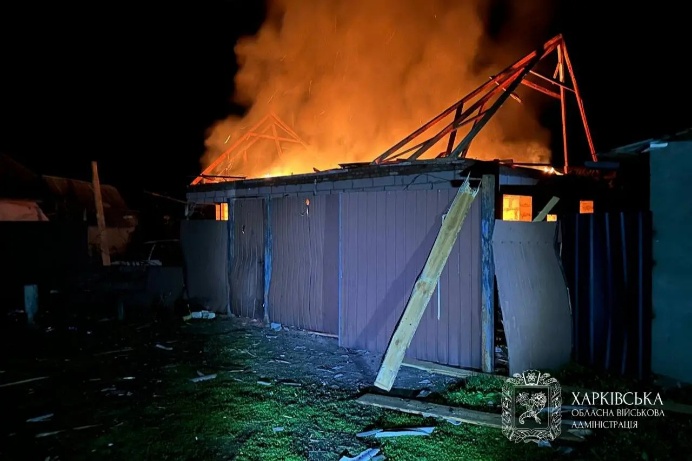
A fire that resulted from a strike on Kharkiv Oblast. (Kharkiv Oblast Administration / Telegram)
The state energy operator Ukrenergo reported power outages across Dnipropetrovsk, Zaporizhzhia, Kharkiv, and Sumy oblasts following the strikes. Russian forces struck agricultural facilities, port infrastructure, residential buildings, and railway infrastructure in Chernihiv, Dnipropetrovsk, Kharkiv, and Odesa oblasts. Between April 18 and 22, Russian forces launched 110 drones against Bohodukhiv — a logistics hub northwest of Kharkiv at the intersection of the P-46 Sumy-Kharkiv and P-45 Kharkiv-Okhtyrka highways — inflicting the most concentrated campaign against the city since February 2022. Military analysts assess this as battlefield air interdiction: targeting Ukrainian logistics in preparation for potential future offensive operations along the Kharkiv-Sumy corridor.
Sevastopol, Persianovsky, and a Day of Deep Strikes: Ukraine Hits Russia Across Every Layer
While Russian drones crossed into Ukraine, Ukrainian forces were already conducting a coordinated strike campaign across multiple layers of Russian military infrastructure. The Ukrainian General Staff confirmed strikes on April 21 and overnight into April 22 spanning from the Black Sea Fleet’s command center in occupied Crimea to armored vehicle storage depots deep inside Rostov Oblast.
The most strategically significant target was the Striletskyi naval traffic control center in occupied Sevastopol — the command hub that coordinates Russian Black Sea Fleet movements in the western theater. Hitting the coordination infrastructure, not just individual vessels, degrades the Fleet’s capacity to manage complex operations and adds to a sustained Ukrainian campaign that has already forced significant relocation of Fleet assets from Sevastopol.
In Rostov Oblast, strikes on an equipment depot near Persianovsky hit the armored vehicle storage park of the Russian 150th Motorized Rifle Division, part of the 8th Combined Arms Army of the Southern Military District. Destroying vehicles in depot storage removes them before they ever reach a front line. Command posts near Vyazovoye and Vysokoye in Belgorod Oblast were also struck, along with drone control points near Korovyakovka in Kursk Oblast and near Tetkino on the Kursk-Ukraine border. In occupied Donetsk, Ukrainian forces hit a command and observation post near Zatyshne and a troop concentration near Hrafske, both roughly 70 kilometers from the front line. Ukrainian forces additionally struck a Molniya fixed-wing FPV drone control point near Dobrolyubivka in occupied Kharkiv Oblast, approximately 19 kilometers from the frontline, degrading the infrastructure behind the drone strikes hitting Ukrainian civilians.
Tuapse Burns Twice, Gosplan Returns: Ukraine’s Oil Campaign Forces Soviet-Style Fuel Rationing
The Tuapse oil refinery — one of Russia’s key Black Sea export hubs, integrated with a shipping terminal — caught fire again following Ukrainian strikes. Witnesses described oil raining from the sky as storage tanks ruptured. More than 150 emergency personnel had spent days extinguishing the previous blaze, struck less than a week earlier. The repair crews had barely finished.
The cumulative pressure of Ukraine’s refinery campaign is now showing in Russia’s domestic economy. Ukrainian drones struck Russian refineries dozens of times in 2025, causing record downtime and regional fuel shortages. In 2026, multiple large facilities have again halted operations after further attacks. Gasoline prices have surged, prompting the Russian government to draft agreements with oil companies allowing the state to set recommended production volumes, dictate domestic supply levels, and cap retail fuel price increases — with government monitoring of compliance through the end of 2026. The Soviet logic of centralized fuel allocation is not formally back. The mechanism is.
Germany separately learned on April 22 that Russia plans to halt the flow of Kazakh oil through the Druzhba pipeline to the PCK refinery in eastern Germany starting May 1. Rosneft Germany — the Russian state-owned subsidiary under German trusteeship since 2022 — told German regulators the Russian Energy Ministry had ordered the halt, without providing any direct explanation to Berlin. Germany’s Energy Ministry said the PCK refinery near the Polish border could operate at reduced capacity without jeopardizing fuel security for the Berlin region. The unilateral halt of non-Russian oil through a Russian-controlled pipeline, announced while Moscow simultaneously demands pipeline restoration as a condition for peace talks, illustrates energy infrastructure’s continued role as a pressure instrument.
The €90 Billion Door Opens: Druzhba Flows, Orban’s Veto Falls, the Loan Moves
For three months, a pipeline repair held €90 billion hostage. Russia struck the Druzhba pipeline’s Ukrainian section in January, cutting oil flows to Hungary and Slovakia. Viktor Orban immediately used his EU veto power to freeze the Ukraine Support Loan — already approved by the European Council, designed to cover two years of Ukraine’s government budget and two-thirds allocated to defense — until transit resumed. He lost his parliamentary majority in Hungary’s April 12 elections to a pro-European challenger. His leverage evaporated with his majority.
On April 22, EU ambassadors approved both the 90-billion-euro loan and the long-blocked 20th package of Russia sanctions in the same session. Hungary’s energy company Mol confirmed that crude oil had begun flowing through the Ukrainian section of the pipeline at noon, with first deliveries to Slovakia expected by April 23. The Cyprus Presidency of the EU Council confirmed a written procedure for final Council adoption, expected to conclude April 23 afternoon. Zelensky said Ukraine was “fulfilling its obligations in relations with the European Union — even on such sensitive issues as the operation of the Druzhba oil pipeline” and expected the European side to deliver in return.
The irony of the arrangement is structural: to receive a loan to fund its defense against Russia, Ukraine repaired a pipeline carrying Russian oil to EU member states. The loan itself, while large, does not close the funding gap. A European Commission analysis shows Ukraine still faces a defense shortfall of 19.6 billion euros in 2026 even after all committed funds including the loan — and only 13.3 billion euros is projected from the EU for 2027, far below the $38 billion the IMF had assumed. The disbursement begins between late May and early June. It is a lifeline. It is not enough.
Five Drones for One Man: Russia Targets Ukraine’s Electronic Warfare Advisor at Home
Five Shahed-type drones were launched at a single private residence outside Kyiv on the night of April 20 to 21. The target was Serhii “Flash” Beskrestnov, Ukraine’s defense ministry advisor on electronic warfare — the technical field that directly determines Russia’s ability to navigate drones to Ukrainian cities. Several drones were intercepted before reaching the house. One struck the building. One fell nearby. Three vehicles were destroyed. All personal radio and communications equipment was lost.
Investigators recovered wreckage at the site including a remote-control modem, a jet engine, and serial numbers confirming Russian military origin. One of the five drones carried only a camera — almost certainly used to confirm Beskrestnov’s presence before the strike drones arrived. “Five rocket ‘Shaheds’ flew for one target — to me,” he said from the hospital. He noted that there were no military facilities at the site and that he lived there with his family. He intends to return to work.
The targeted strike on Beskrestnov — a known technical specialist whose expertise directly affects the effectiveness of Russian drone operations — signals that Russia is conducting targeted elimination operations against Ukrainian technical experts, not only battlefield commanders. The expertise Ukraine has accumulated over three years of drone warfare is itself a strategic asset, and Russia appears to have concluded that removing the people who built that expertise is worth the operational cost of a precision strike deep behind the front line.
Crawling Through Pipes and Riding Motorcycles: How Russia Adapts to the Drone Battlefield
Ukraine’s drone operators have made open-ground movement near the front lines exceptionally lethal. Russian commanders have responded with adaptations at opposite ends of the speed spectrum: slower than walking, and faster.
In Sumy Oblast, a Ukrainian unmanned systems battalion spokesperson reported that Russian forces are crawling through underground pipelines for multiple days before emerging to attack — using buried infrastructure to move invisibly beneath the drone surveillance that has otherwise made open-ground infiltration suicidal. Simultaneously, Russian forces in the Kostyantynivka-Druzhkivka tactical area in Donetsk are transitioning from small foot-mobile infantry groups to light motorized assaults: motorcycles, civilian cars, and military buggies. The logic is speed. A motorcycle crosses the drone kill zone — the exposed strip where FPV operators acquire and intercept infantry — in a fraction of the time a walking soldier does. Russian forces also conducted two roughly platoon-sized mechanized assaults east of Chasiv Yar on April 18 and 19, suggesting the shift is not limited to light vehicles.
Elite VDV airborne units of the Russian 106th VDV Division are being rotated out of Sumy Oblast and replaced by motorized rifle elements from the Leningrad Military District — specifically elements of the 9th Motorized Rifle Regiment of the 18th Motorized Rifle Division, 11th Army Corps. The rotation signals that the VDV units need to rest and reconstitute after heavy losses in Sumy Oblast. The replacement with lower-grade forces from a distant military district is a measure of the cost Ukraine has extracted from Russia’s best assault formations.
Vovchansk, Kupyansk, and the Human Safari: The Kharkiv Front in April
North of Kharkiv City, geolocated footage published April 22 confirmed Russian advances in both northern and southern Vovchansk — a town northeast of Kharkiv that has been the scene of intense urban combat since Russia’s May 2024 border crossing — with a Russian milblogger additionally claiming movement southwest of Veterynarne in the same direction.
In the Kupyansk direction, Russian forces conducted an infiltration mission in northern Kupyansk on April 22 as Ukrainian forces counterattacked. A Ukrainian brigade officer operating in the direction reported that Russian forces are gradually intensifying pressure on Kupyansk itself, pushing from both banks of the Oskil River simultaneously — a tactic that forces Ukrainian defenders to cover two approaches at once. Fighting continued in the Borova direction. Ukrainian forces struck back at the drone infrastructure enabling Russian operations, hitting a Molniya fixed-wing FPV control point near Dobrolyubivka, roughly 19 kilometers from the frontline.
Near Cherkaski Tyshky, north of Kharkiv City, a Russian drone struck a civilian vehicle, killing one person and injuring another — 17 kilometers from the international border. Ukrainian prosecutors describe this pattern as “human safari”: the deliberate targeting of civilian movement with drones as policy rather than byproduct. The Kharkiv Oblast Prosecutor’s Office documented the incident. In 38 separate locations across Kherson Oblast, Russian drones, artillery, and airstrikes killed one civilian and injured six others throughout the day — the background hum of a front line that runs through populated territory.
688 Assaults in 22 Days: The Donetsk Front’s Grinding Mathematics
Ukrainian Commander-in-Chief Syrskyi reported that Russian forces launched 688 separate assaults in the Pokrovsk direction between April 1 and 22 — roughly 31 per day, sustaining the highest operational tempo on the entire front. Individual assaults regularly fail to produce territorial gains, but the cumulative pressure forces constant Ukrainian tactical adjustments and extracts a steady cost in personnel and equipment.
In the Slovyansk-Lyman direction, Russian forces conducted offensive operations with Ukrainian forces counterattacking; a Russian milblogger claimed advances to the eastern outskirts of Rai-Oleksandrivka, southeast of Slovyansk. In the Novopavlivka and Oleksandrivka directions, Russian forces launched ground assaults on April 22 but did not advance. A milblogger separately claimed Russian forces advanced south of Minkivka, northeast of Kostyantynivka, on April 21. Ukrainian mid-range strikes continued in the same operational cycle: forces hit a command and observation post near Zatyshne and a troop concentration near Hrafske in occupied Donetsk, both roughly 70 kilometers from the front.
On the southern axis near Hulyaipole in Zaporizhzhia Oblast, Russian forces conducted infiltration missions northwest and southwest of the city while deploying thermobaric artillery to the southeast — weapons using fuel-air explosive pressure waves that are particularly lethal in open terrain and against fortified positions. Russian milbloggers claimed the seizure of Hirke east of Hulyaipole, advances south of Hirke, east of Hulyaipilske, and entry into southeastern Verkhnya Tersa. In western Zaporizhzhia Oblast northwest of Orikhiv, Russian forces continued offensive operations without confirming advances. In the Kherson direction, limited Russian assaults toward Dnipro River delta islands came to nothing.
The Luhansk Fiction: Gerasimov Claims a Region Ukraine’s Defenders Say They Are Standing In
Russia’s Chief of the General Staff Valery Gerasimov announced on April 21 that Russian forces had “fully completed” the occupation of Luhansk Oblast. It was not the first such announcement. The Russian Defense Ministry made the identical claim on April 1. Both were false.
Oleksii Kharchenko, head of Ukraine’s Luhansk Oblast Military Administration, confirmed on April 22 that 14 settlements in the oblast remain outside Russian control — in active battle zones, in contested gray zones, or under Ukrainian administration. Ukrainian forces are specifically stationed in the Novoyehorivka and Hrekivka areas. Oleksandr Borodin of Ukraine’s 3rd Separate Assault Brigade additionally confirmed that the village of Nadiia remains under Ukrainian control despite constant Russian pressure. Battlefield monitoring group DeepState showed the same settlements unoccupied as of April 20.
Kharchenko named the motive directly: “Russia needs significant victories on the battlefield by May 9.” Victory Day — Putin’s annual parade, the Kremlin’s most important domestic performance of military power. “But there are none. That is why the invaders are trying to pass off wishful thinking as reality.” The false claim will circulate through Russian state media regardless. The correction, as always, will travel more slowly than the lie.
Moscow Without Kyiv: The Diplomatic Impasse and the Envoys Who Never Arrived
On April 22, Zelensky called publicly for the resumption of trilateral peace talks among Ukraine, Russia, and the United States. The last such meeting was February 16. A follow-up planned for late February was cancelled when US-Israeli strikes on Iran began. Since then, US envoys Steve Witkoff and Jared Kushner have been consumed by the Iran negotiations. They have not visited Kyiv. Former US Ambassador to Ukraine Steven Pifer said this asymmetry is “exactly why the negotiations are not working out.”
Kremlin spokesman Peskov said Putin was ready to meet Zelensky — in Moscow, to finalize agreements already negotiated at lower levels. “The key is that there must be a reason to meet,” Peskov told the Russian outlet Vesti, “and the main thing is that the meeting should be productive; it can only serve the purpose of finalizing agreements.” The formulation is a closed loop: it defines the meeting’s purpose as ratifying Russian terms, names Moscow as the required venue, and makes Zelensky’s attendance a submission. Zelensky has ruled out Moscow. Putin has declined neutral third countries. Lavrov said earlier in April that resuming negotiations “is not our top priority.”
Major structural gaps remain: Ukraine proposes freezing the current front line as a ceasefire basis; Russia demands Ukrainian forces withdraw from parts of Donbas it does not yet control — a precondition Kyiv rejects entirely. “We’re ready for any format, at any time,” Zelensky said on April 22. “We are not afraid to meet at any time in any country, except for Russia and Belarus.” A US official told the Kyiv Independent on April 15 that a possible trip by the envoys to Ukraine was under discussion. No visit has been confirmed.
Germany’s First Military Strategy Since World War II: 460,000 Troops, Russian Threat Named
German Defense Minister Boris Pistorius unveiled Germany’s first national military strategy since World War II on April 22, titled “Responsibility for Europe,” with the explicit goal of building Europe’s strongest conventional army by 2039. The plan calls for expanding German forces from roughly 185,000 active-duty troops to 260,000 by the mid-2030s, while growing reserves from 60,000 to 200,000 — a total force of at least 460,000.
The document names Russia in terms that German governments avoided for decades. “Russia is creating the conditions for a war against NATO and is already conducting hybrid operations against the Alliance’s member states,” the strategy states. “Today’s Russia therefore poses the greatest immediate threat to peace and security in Germany and the Euro-Atlantic region for the foreseeable future.” Pistorius warned that Russia’s rearmament pace could lead to a confrontation with NATO within a year — a timeline that would have been considered alarmist in German political discourse as recently as 2021.
The strategy explicitly addresses the shift in American posture under Trump, who has repeatedly questioned NATO’s value and pushed Europe to shoulder more of its own defense. Germany’s document positions Berlin as willing and capable of leading European security without waiting for Washington to decide whether the alliance remains worth defending. Pistorius described the plan as transforming the Bundeswehr “in the short term” for enhanced defense capability, “in the medium term” for significant capacity buildup, and “in the long term” for technological superiority. Germany has also asked the rest of Europe to step up air defense support for Ukraine; production capacity and political will remain limiting factors.
Spain Delivers, Patriots Deplete: The Air Defense Arithmetic Behind the Weapons Announcements
Spanish Defense Minister Margarita Robles visited Kyiv on April 22 to announce 100 VAMTAC armored tactical vehicles and 155-millimeter artillery ammunition for Ukraine’s State Border Guard, with first shipments beginning in May. The VAMTAC is a high-mobility off-road vehicle capable of 135 kilometers per hour; Ukrainian forces mount the UK-developed Rapid Ranger air defense missile system on it — a laser-guided weapon effective against low-flying drones and helicopters. Spain has committed €1 billion in military aid for Ukraine in 2026 and previously contributed Patriot PAC-2 missiles through the PURL program.
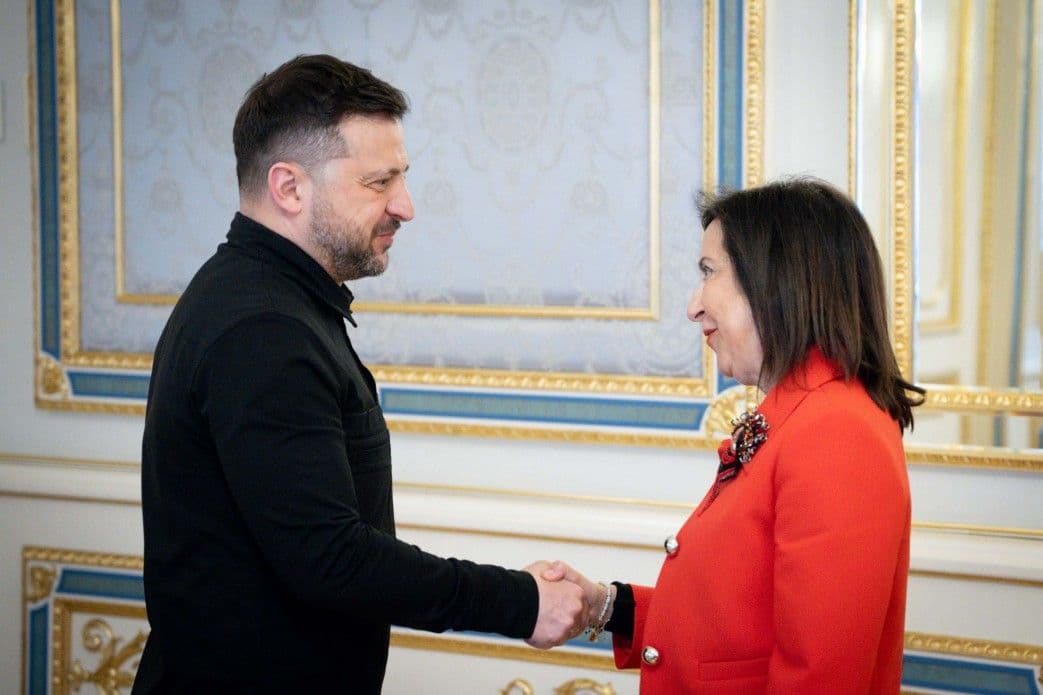
President Volodymyr Zelensky and Spanish Defense Minister Margarita Robles meet in Kyiv. (Presidential Office)
Behind these deliveries runs a harder calculation. A Center for Strategic and International Studies analysis published April 21 found that the US-Israeli war against Iran has consumed between 1,060 and 1,430 Patriot interceptor missiles — out of a pre-war American stockpile of 2,330. Zelensky noted that the US fired over 800 Patriot missiles in the Middle East within weeks, more than the roughly 620 Patriot missiles delivered globally across all of 2025, itself an all-time high. THAAD ammunition has been depleted to perhaps 70 remaining rounds. Ukraine’s PAC-3 MSE stockpiles — the missiles that intercept Russian ballistic threats like the Iskander-M and Kinzhal — are critically low and not being replaced at the rate they are consumed.
Raytheon is expanding Patriot production in Germany, but the new facilities are not yet operational. CSIS estimates PAC-3 MSE missiles take 29 months from contract signing to finished production. Production decisions made today will not yield usable interceptors until 2028. Ukraine is fighting a war measured in days. The production timeline is measured in years. The VAMTAC deliveries and the Patriot depletion exist in the same supply chain reality, and the gap between them is where Ukrainian cities live.
Sky Map in Saudi Arabia: Ukraine’s Drone Defense Expertise Crosses Borders
Three years of defending against Shahed drone swarms have made Ukraine’s military one of the world’s foremost authorities on counter-drone warfare. On April 22, Reuters reported that the United States has deployed Ukraine’s Sky Map technology platform at Prince Sultan Air Base in Saudi Arabia — a deployment not previously publicly disclosed. Sky Map integrates data from multiple radars and sensors into a unified dashboard displaying maps and live video feeds, allowing operators to identify and track incoming threats in real time. Ukrainian military personnel traveled to the base to train US forces on operating the system.
The deployment follows Ukraine’s signing of ten-year defense export agreements with Saudi Arabia, the UAE, and Qatar. The base has also tested Merops interceptor drones developed by Project Eagle, a company backed by former Google CEO Eric Schmidt, though early testing encountered difficulties. In March, an Iranian missile attack damaged several aircraft at the base and destroyed a US E-3 Sentry early warning aircraft. The Iranian Shahed drones that Russia uses against Ukrainian cities every night are the same threat the Sky Map system was designed to counter — and that system is now protecting American forces from their original manufacturer’s weapons.
2,100 Children Home, Thousands Still Gone: Ukraine Counts the Recovered
More than 2,100 Ukrainian children taken by Russia have been returned to Ukraine through the Bring Kids Back UA initiative, President Zelensky reported on April 22, following a meeting with the initiative’s representatives. Of those, 150 were returned since the beginning of 2026. The initiative has been tracing and recovering Ukrainian children from Russian-occupied territories and Russia itself since 2023. Zelensky announced a ministerial-level meeting of the International Coalition for the Return of Ukrainian Children in Brussels on May 11, calling for “broad representation, concrete decisions, and practical support from partners.”
The number 2,100 is significant and insufficient simultaneously. Ukraine’s official Children of War database documents at least 20,000 confirmed abductions, while official Ukrainian estimates range from 150,000 to 300,000 depending on methodology. A UN investigation published in March 2026 concluded that Russia’s forced deportation of Ukrainian children constitutes crimes against humanity. The International Criminal Court issued arrest warrants for Putin and Russia’s Children’s Rights Commissioner Maria Lvova-Belova in 2023 for their roles in the abductions. The Brussels meeting on May 11 runs alongside a separate EU session evaluating entry bans for Russian war veterans as an additional accountability measure.
Tribunal Momentum, Plahotniuc’s 19 Years, and a Ukrainian Bank Bought by a Polish Fintech
On the accountability front, a senior EU diplomatic official confirmed on April 22 that the European Union is likely to formally endorse the Special Tribunal for the Crime of Aggression against Ukraine — the court established by the Council of Europe in May 2025 to prosecute Russian leadership for the decision to launch the invasion. Frank Hoffmeister, director of the legal department in the European External Action Service, said he was “pretty optimistic” a positive decision was coming. Only a qualified majority vote is required — 55% of EU countries representing 65% of the population — and the Council of Europe’s Committee of Ministers meeting on May 15 has been identified as the target date for EU endorsement. The Netherlands has offered to host the tribunal; evidence collection is underway; 16 signatory countries have already been confirmed.
In Chisinau, a Moldovan court sentenced Vladimir Plahotniuc — who effectively controlled Moldova’s government, judiciary, and security services as the country’s top power broker from 2013 to 2019 — to 19 years in prison for his role in the theft of $1 billion from three Moldovan banks in 2014. Plahotniuc had fled Moldova in 2019 when his political project collapsed, was sanctioned by the United States in 2020 and 2022, and was extradited from Greece to Moldova in 2025. His sentencing is widely seen as a marker of Moldova’s alignment with European democratic accountability standards.
In Kyiv’s banking sector, a Polish fintech made its move: Zen.com, registered in Lithuania, acquired First Investment Bank (PINbank) from Ukraine’s Deposit Guarantee Fund for Hr 175 million ($3.9 million). PINbank was previously owned by sanctioned Russian oligarch Yevgeny Giner until his 88.9% stake was confiscated by Ukraine’s High Anti-Corruption Court in 2023. Former Polish President Andrzej Duda, serving on Zen.com’s supervisory board, called the deal “a strong signal of confidence in Ukraine’s financial system.” It is the second foreign acquisition of an insolvent Ukrainian bank in 2026, following Estonian fintech Iute Group’s entry in March. Ukraine’s banking sector generated nearly $3 billion in profit across 60 banks in 2025.
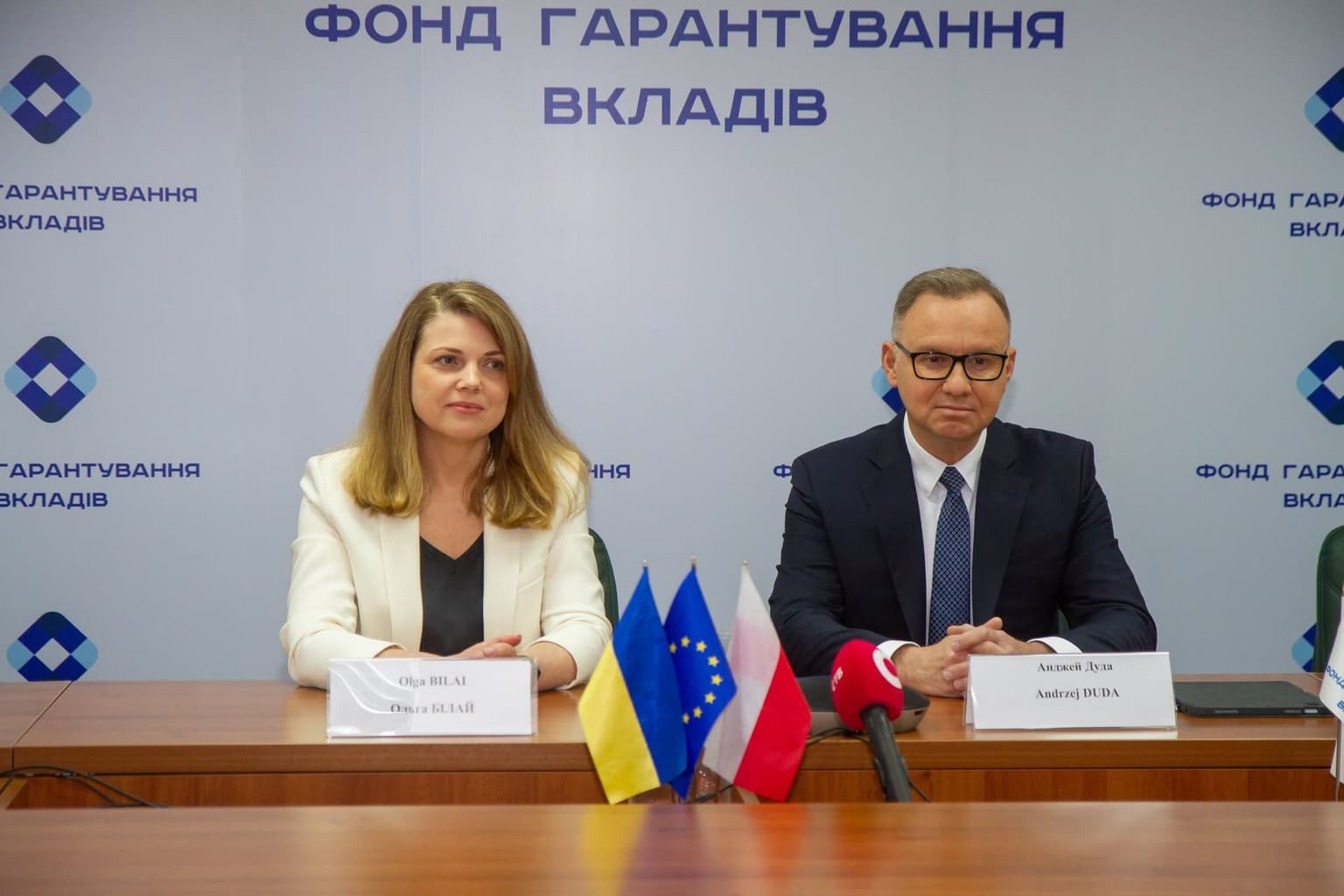
Olha Bilai, managing director of the Deposit Guarantee Fund and Andrzej Duda, a member of the supervisory board of Zen.com and president of Poland from 2015 to 2025 at a press conference in Kyiv. (Deposit Guarantee Fund of Ukraine/Facebook)
EU Accession Opens, Venice Biennale Contested: Ukraine’s Fight on the Cultural and Diplomatic Front
EU Enlargement Commissioner Marta Kos signaled on April 22 that she expects to formally open the first cluster of Ukraine’s EU membership negotiations once Hungary’s incoming pro-European government — replacing Orban after his April 12 electoral defeat — takes office in May. “Everything is ready,” Kos told the Kyiv Independent. “I hope we can start very soon, even under the Cyprus presidency for cluster one.” The first cluster, covering rule of law, public administration, democratic governance, and the bilateral minority rights agreement with Hungary, is always the first to open and the last to close in the EU accession process. Opening it formally marks Ukraine’s transition from candidate to active accession state.
On a different European stage, Ukraine is pushing for the EU to deny entry visas to participants in the Russian pavilion at the Venice Biennale. Foreign Minister Sybiha confirmed Ukraine has sanctioned five pavilion members, including commissioner Anastasia Karneeva — whose father is deputy CEO of Rostec, Russia’s largest state defense conglomerate — and whose business partner is Lavrov’s daughter Ekaterina Vinokurova. EU top diplomat Kaja Kallas called Russia’s participation “morally wrong” on April 21 and announced the EU intended to cut its funding for the Biennale if Russia was not excluded. Italy’s Culture Ministry expressed support for Ukraine’s position; the Biennale’s president has defended Russia’s involvement as a matter of artistic freedom. “While Russia bombs museums, destroys churches and seeks to erase Ukrainian culture, it should not be allowed to exhibit its own,” Kallas said.
The ceremony rooms and the drone strikes ran in parallel all day, and that is not a coincidence. Putin names an academy after a mass executioner. An engineer dies in a Zaporizhzhia railway yard. A refinery burns in Tuapse for the second time in six days. A drone expert is pulled from the rubble of his own home. Lavrov raises his Easter glass and tells priests this is a war of protection. Gerasimov points to a map that does not match the territory. And in Brussels, €90 billion moves toward Ukraine through a pipeline carrying Russian oil — the war’s central contradiction, made liquid and set flowing. Day 1,519 ends the way most days in this war end: with the dead uncounted, the wounded in hospital, and everything still at stake.
A Prayer for Ukraine
1. For the Engineer at the Zaporizhzhia Railway Yard
Lord, he went to work that night. He knew the war. He went anyway, because the trains have to run and someone has to be there — to move the ammunition, the medicine, the displaced families still crossing a country that has not stopped moving since February 2022. He was doing exactly that when the Shahed found the yard. We do not know his full name. We know he was an engineer. We know he died in the service of keeping his country moving. Receive him with the dignity he was not given in his final moment. And hold those going to work tonight in cities under the same sky.
2. For the 17-Year-Old Girl Injured in Putyvl
Father, she is seventeen. The source says she was injured in a drone strike near the border, in Putyvl, where the war arrives without announcement most mornings. Seventeen is old enough to have known most of her conscious life under the threat of this invasion, and young enough that she should never have had to. Be near her as she heals. Let the people around her have what they need to help her. And let her be ordinary, and safe, and bored in the way teenagers are supposed to be bored, someday soon.
3. For Serhii in the Hospital, Who Will Go Back to Work
God, five drones flew for one address. He survived because several were intercepted, and because the one that struck did not kill him — and he knows the gap between those two facts is not something he earned. He says he will return to work. We do not ask You to dissuade him. His work saves Ukrainian lives, and the men who sent those drones understood that clearly enough to send five. Heal what was broken. Guard what was not. Let the expertise built over three years of this war continue protecting the people it was built to protect.
4. For the Soldiers Holding Lines That Gerasimov Says Have Already Fallen
Lord, they are holding Kupyansk and Vovchansk and Pokrovsk under 688 assaults in 22 days while a general in Moscow declares their positions lost. They know what the ground actually shows. Sustain them through a fourth year of this. Protect them from the glide bombs, the infiltrating groups, the drone crews hunting their supply lines. Let the line hold. And let what so many lives have been spent defending not be traded away at a table for the sake of someone else’s political needs.
5. For the Children Who Have Not Come Home Yet
God of justice, 2,100 have returned. Every one of them is a small miracle of persistence. But the number is a fraction. There are tens of thousands — perhaps hundreds of thousands — who are not home, who are being raised in a country that insists they are not Ukrainian, who are being taught to forget. Be near them in whatever renamed city they are in. Let them carry something inside that survives the forgetting. Bring them home. In Your mercy, in Your justice, in Your time — bring this war to its end, and let the ending be worthy of what Ukraine has endured.