
The Ukraine Daily Briefing · Tuesday, October 27, 2026
Prepared by Diana Bozhyk
Minutes after a local ceasefire began around occupied Oleshky at 3 a.m., a second wave of Russian ballistic missiles hit Kyiv, punching a hole in the Southern Bridge and cutting the capital’s Green metro line in two. The truce held through the day and was widened to the whole Kherson region, while Putin, the Financial Times reported, used a 90-minute call with Finland’s and Norway’s leaders to lecture on medieval history, and invited Zelensky to Moscow. Zelensky said delays in Patriot deliveries “directly assist Russia,” and listed the year’s three Ukrainian offensives as proof that the front is the strongest it has been in a long time.
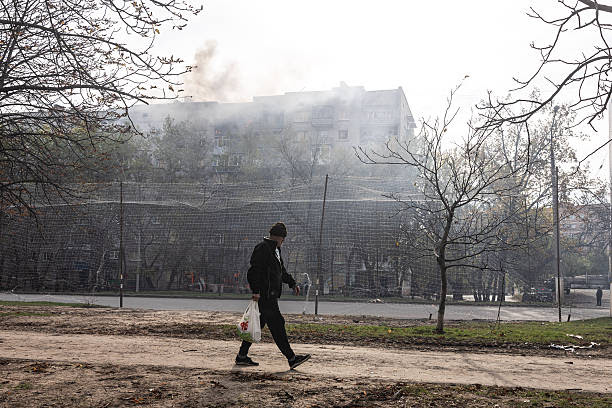
A person walks past a burning building which firefighters are trying to put out following an attack by a Russian drone in Sloviansk, Donetsk Oblast. (Diego Herrera Carcedo/Anadolu via Getty Images)
The Day’s Reckoning
At 3 a.m., the guns around Oleshky were supposed to fall silent, and they did. Within minutes, Russian ballistic missiles were flying at Kyiv. At about 3:30 a.m., at least seven explosions shook the capital in three minutes. One missile tore a large hole in the Southern Bridge, the crossing that carries cars and the Green metro line over the Dnipro. By morning, commuters from the left bank were walking across it, a half-hour trek.
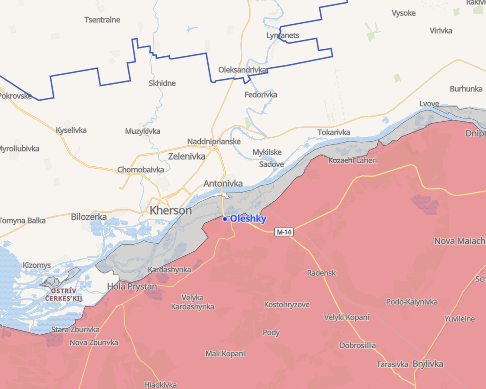
That is the plot of this Tuesday: a truce in one corner of the war and fury everywhere else. Around Oleshky, Ukrainian marines watched the Russian lines and reported quiet. In Helsinki, the leaders of Finland and Norway spent an hour and a half on the phone with Putin, who answered them with history. And in Kyiv, Zelensky said that in two weeks more than 100 ballistic missiles had been fired at the capital and its region.
“Every such delay results in another Russian strike hitting a target,” he said of the missing Patriot interceptors. “Sadly, these attacks happen every single day.”
The Southern Bridge
You live on Kyiv’s left bank and work on the right. On Tuesday morning, your metro train stops at Osokorky and goes no farther. The bridge ahead is closed.
The second wave of the night struck the Southern Bridge and its metro infrastructure, and Mayor Vitali Klitschko released the first photos of the damage. Traffic stopped in both directions, and Green Line trains ran in two separate sections, between Syrets and Vydubychi and between Osokorky and Chervonyi Khutir. The same wave hit an administrative building in the Podilskyi district and non-residential buildings elsewhere. Over the whole night, which began with Monday evening’s strike on a university campus, one person was killed and 15 injured, among them a paramedic, a medical technician and a 20-year-old student. Zelensky said five of the wounded were university students and staff. “While emergency services were assisting people and addressing the aftermath of the initial strike, the Russians launched ballistic missiles again,” he said.
The Air Force said Russia fired S-400 and Iskander ballistic missiles from the Bryansk region and 280 drones, 69 of them jet-powered. Two ballistic missiles and 255 drones were shot down or jammed. Zelensky put the night’s total at 16 ballistic missiles and more than 280 drones, and said strikes hit 11 regions, from Kyiv and Vinnytsia to Odesa, Kherson and Chernivtsi. “In almost every instance, the Russian targets were energy infrastructure, logistics, and civilian urban infrastructure,” he said.
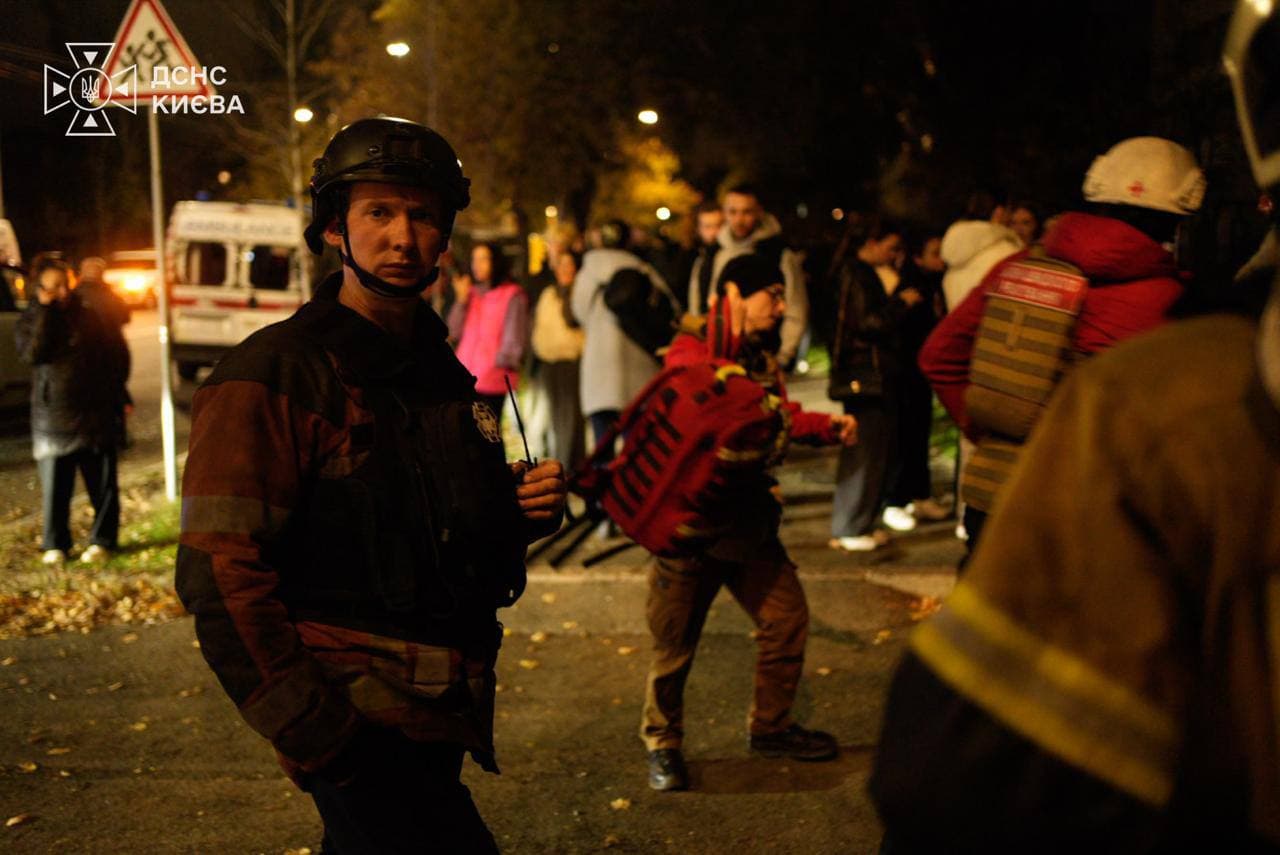
Emergency responders work at the site of a Russian ballistic missile attack in Kyiv overnight. (Ukraine’s State Emergency Service / Telegram)
Russia has struck Kyiv’s bridges repeatedly since October 1, and Kyiv has since ringed them with machine-gun turrets. On Tuesday, the city’s Defense Council agreed to spend 1 billion hryvnias, about $22 million, on temporary crossings over the Dnipro, at sites the military will choose. City specialists are also working on ways to protect the bridges’ structures, and the council discussed shelter maintenance and mobile shelters. Authorities announced new limits on crossing the bridges during air-raid alerts.
Across the rest of Ukraine, Russian attacks over the past day killed at least four people and wounded at least 55. In the Donetsk region, three were killed and 22 wounded. In the Chernihiv region, six were hurt, including a 12-year-old. In the Kherson region, a Russian Molniya drone hit a hospital, wounding a 62-year-old nurse. Five were wounded in the Zaporizhzhia region, including a 17-year-old boy, three in the Sumy region and two men in the Chernivtsi region. Late on Tuesday, a jet-powered drone set off a 2,500-square-meter fire in Kharkiv’s Osnovianskyi district, engulfing an apartment building, a house and an industrial building. Five people were wounded, among them a four-year-old boy.
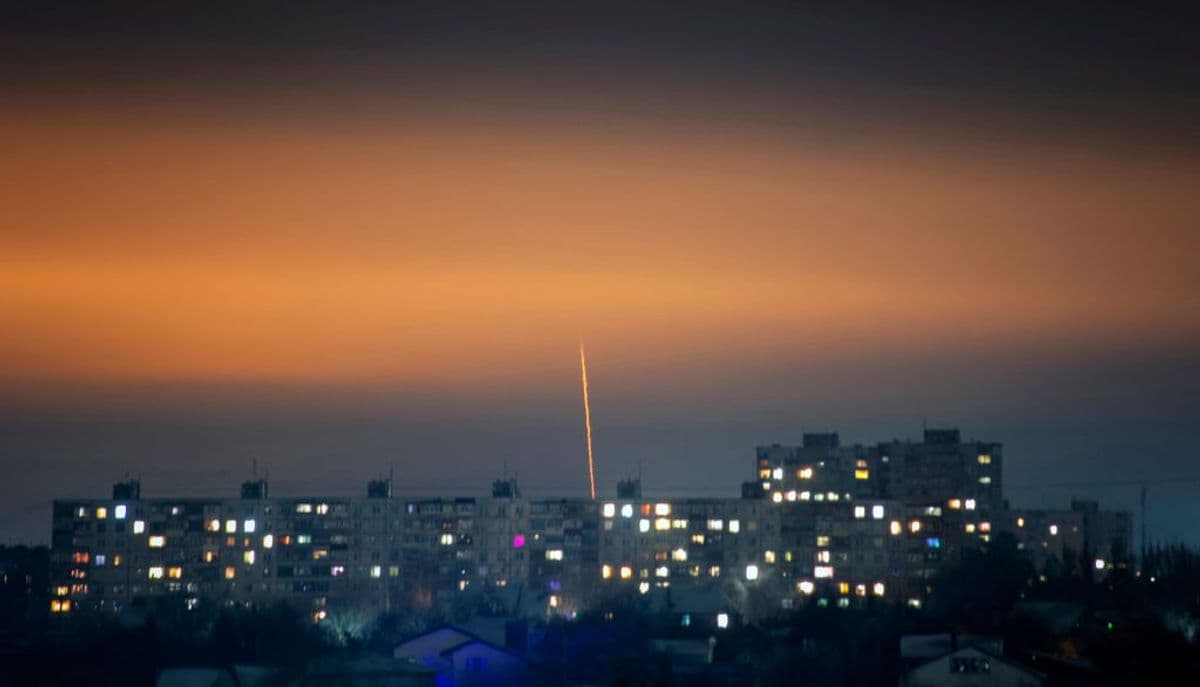
Illustrative image: A missile launched from Russia’s Belgorod Oblast flies toward Kharkiv, Ukraine, amid Russia’s full-scale invasion of Ukraine. (Vadym Bielikov/AFP via Getty Images)
Silence Over Oleshky
You are a Ukrainian marine on the right bank of the Dnipro, watching the Russian positions across the river from Kherson. At 3 a.m., they go quiet.
“As of 9 a.m., the enemy is observing the ceasefire introduced as part of the humanitarian mission,” Marine Corps spokesperson Pavlo Drohal said. At 11 a.m. Kyiv time, Kremlin spokesman Dmitry Peskov said there had been no reported violations. By 5:30 p.m., Ombudsman Dmytro Lubinets said the truce was being “fully honored” by both sides. “I hope that everything will continue in accordance with the agreed plan and that we will be able to help the civilians in Oleshky who are eagerly awaiting assistance,” said Lubinets, who negotiated the deal with his Russian counterpart, Yana Lantratova. Kyrylo Budanov, head of the Presidential Office, confirmed that a “bilateral ceasefire” had begun.
Then the truce grew. Melania Trump wrote that it had been “expanded… within Kherson,” and Lubinets’ spokesperson, Tetiana Shelest, said it now covers the entire Kherson region. She said the start had been moved up two days to protect civilians and speed up aid. Russia’s Defense Ministry also announced that its forces had stopped fighting in the area. The truce will last until 10:59 p.m. Kyiv time on November 1, Lubinets and lawmaker Davyd Arakhamia said.
The timing of the rest is still settling. Russia’s occupation chief for the region, Volodymyr Saldo, said the aid mission would begin on October 29, that the mined road to Oleshky was being cleared, and that housing for evacuees had been prepared in occupied Kherson, Crimea and other Russian regions. Residents could stay in Russia or travel to Ukrainian-held territory “to reunite with their families,” he said. Lubinets’ office told residents that demining had begun and evacuations would start on October 30, the Kyiv Independent learned.
About 24,000 people lived in Oleshky before the full-scale invasion. The White House estimates 1,700 to 2,000 remain, about 50 of them children. Zelensky warned over the weekend that Russia could use the demining to steer evacuees toward Russia. In Moscow, Peskov said the military would provide all details of the operation.
Ninety Minutes With Putin
Finland’s President Alexander Stubb and Norway’s Prime Minister Jonas Gahr Støre called Putin from Helsinki, in consultation with Ukraine, to urge an end to the war ahead of the Abu Dhabi talks. “The discussion was frank and substantive,” Stubb said. “Ending the war requires direct discussions.” Støre said the war’s suffering “will impact generations.” They said they spoke for their own countries, not for Europe.
The call was planned for 30 minutes. It ran about 90, and according to three sources cited by the Financial Times, Putin spent most of it on a lecture about medieval Slavic history. Ukraine’s call for an immediate ceasefire was barely discussed, the sources said, and the two leaders did not interrupt.
Kremlin aide Yuri Ushakov said Stubb and Støre passed on Zelensky’s wish to speak with Putin directly. “Our boss repeated that if Zelensky really wants to hold direct negotiations, let him come to Moscow, where he will be provided with all conditions, including in terms of security,” Ushakov said, adding that leaders should meet only to sign documents worked out by negotiators. The Kremlin’s readout said Putin insisted a lasting peace was possible only if Russia’s interests were taken into account and accused NATO and EU countries of prolonging the war. He also told them about the Oleshky operation. The leaders also discussed security in the Baltic Sea and Northern Europe and the freedom of navigation, and all three agreed to stay in contact by phone. Norway is the only non-EU country to have pledged support for Ukraine’s 2027 budget needs, and Finland has sent 35 aid packages.
Zelensky said he was briefed in detail and that Stubb and Støre “made it clear to the Russian leader that real de-escalatory steps are needed.” Not every European welcomed the call. “I actually don’t know what the two countries think can be achieved with this,” Danish Prime Minister Mette Frederiksen told TV2. “I think we should stand together and speak with one voice.” A European Commission spokesperson said the EU is committed to a peace “that will be just and sustainable.”
Interceptors, Wherever They Can Be Found
“The artificial and prolonged delays in the delivery of interceptor packages for Patriot and NASAMS systems – which have unfortunately been occurring recently – directly assist Russia in achieving the goals of its terrorist campaign,” Zelensky wrote. In his evening address, he was blunter. “Everyone hears, everyone sees that right now, it is difficult for us to defend against Russian ballistic missiles. And above all, we do not have enough missiles for Patriots,” he said, asking for “the necessary authorizations from the Pentagon.”
Kyiv is looking everywhere. Defense Minister Yevhen Khmara said Ukraine asked Britain, France, Germany, Italy and Poland for 10 percent of their Patriot and IRIS-T stocks, in exchange for ammunition already contracted for future delivery, along with more portable anti-aircraft missiles. After talks in Paris, German Defense Minister Boris Pistorius said European partners had prepared winter aid packages. Poland announced it won the right to host Europe’s service center for PAC-3 Patriot interceptors, the only one outside the United States, which would cut repair times from shipping missiles across the Atlantic. Deputy Defense Minister Magdalena Sobkowiak-Czarnecka called it “historic”; Germany, the Netherlands and Norway had also bid. It will cost about 1 billion zlotys, roughly $253 million, and take about a year, and the WZE electronics plant near Warsaw, which already services PAC-3 components, is seen as the likely site. Ukraine has repeatedly been reported to have run out of Patriot interceptors in mid-October.
Against jet-powered drones, Ukraine is doing better. The General Staff said air defenses have downed nearly 60 percent of Russian Geran-4s over the past three months, reaching 80 percent in some attacks, with F-16s, Mirages and MiG-29s doing much of the work alongside Gepards, Skynex and Skyranger guns, interceptor drones and mobile fire teams. Even Ukraine’s biggest courier company has joined in: Nova Poshta co-owner Vyacheslav Klymov said on Monday that its private air defense unit has shot down Shaheds aimed at its depots.
Washington, meanwhile, kept warming to Moscow. The New York Times reported that Trump is considering lifting sanctions on Russia’s sovereign investment fund, run by Kremlin envoy Kirill Dmitriev, which is involved in the diesel deal. At least five ships are now believed to be carrying Russian diesel to the United States; two of them, the Leruo and the Primorye, are sanctioned shadow-fleet tankers that European authorities must stop if they enter their waters.
Three Offensives
This year you fought with Ukraine’s Air Assault Forces. On Tuesday, the president counted what your campaign won.
In his evening address, Zelensky described three Ukrainian offensives this year. The Air Assault Forces liberated more than 800 square kilometers and 26 settlements across the Dnipropetrovsk, Donetsk and Zaporizhzhia regions between January 29 and August 12. Operation Vivaldi, led by the 3rd Army Corps near Lyman from July to mid-October, retook 277 square kilometers and more than 16 towns and villages, inflicting at least 8,000 Russian casualties and capturing about 270 soldiers, its commander, Brig. Gen. Andrii Biletskyi, has said; he says it derailed Russia’s plan to encircle Sloviansk and Kramatorsk from the north. And Operation Veles turned Russia’s pipeline tactic against it near Kupiansk, with troops moving more than 15 kilometers underground, capturing more than 30 Russians and inflicting more than 100 casualties. “This year, Ukraine’s positions on the front line remain the strongest they have been in a long time during this war,” Zelensky said.
The Institute for the Study of War reported that Russian forces did not attack in the Kupiansk direction at all on Monday, likely because Ukraine now controls the pipeline that fed their infiltrations. Ukrainian forces held at least one position in southern Kostiantynivka while Russians kept infiltrating the north of the city; a Kremlin-affiliated blogger claimed Russian troops had seized Rozkishne, west of the city, a claim ISW did not confirm. Neither side reported ground fighting in the Novopavlivka, Oleksandrivka or Kherson directions. Near Dobropillia, a Ukrainian drone officer said Russia is intensifying assaults and targeting supply routes into the town. Russia’s Defense Ministry claimed to have seized Obshche near Hulyaipole; ISW said Russian forces are at least 17 kilometers away. Russian attacks near Lyman, Malynivka east of Kramatorsk, Velykyi Burluk and in northern Sumy made no gains, and over the weekend Russia dropped a 3,000-kilogram FAB-3000 glide bomb on an Oskil River crossing near Borova. Near Lyman, drone operators of Russia’s 50th Varyag Brigade said they were now striking Ukrainian troops, a sign, ISW said, that Moscow is still searching for ways to stabilize the sector after Operation Vivaldi.
Drones now do most of the killing. Ukraine’s Defense Ministry said drones have killed or badly wounded 302,000 Russian soldiers since January, each strike recorded on video in the Delta system. Ukraine also struck a former Ukrtelecom building in occupied Melitopol that Russian forces reportedly used as a command and data center, and the General Staff confirmed that its strike on the Tolyattikauchuk plant in the Samara region damaged a process pipeline.
Also Today
Konotop in the dark. Konotop entered its fourth day without power after Saturday’s strikes, Mayor Artem Semenikhin said, with schools damaged, the hospital on generators and water supplied only from 6 to 9 a.m. and 6 to 9 p.m. “It was a treacherous strike on civilian infrastructure in the middle of the night,” he said.
Books lost on Language Day. Russian strikes hit a Kharkiv warehouse of publisher KSD holding about 300,000 books, delaying its November releases, on the Day of Ukrainian Writing and Language. No employees were hurt. Russian strikes destroyed more than 13 million Ukrainian books over the summer.
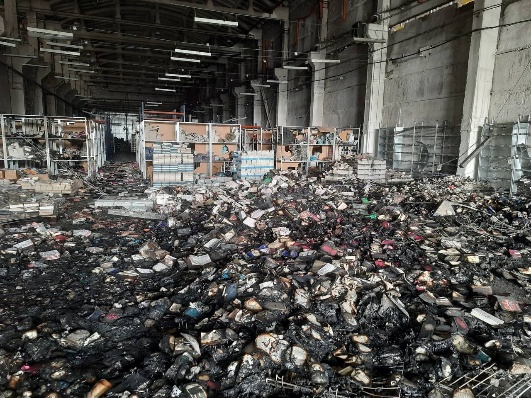
KSD’s warehouse after getting struck in a Russian attack on Kharkiv. (KSD / Telegram)
A Ukrainian satellite. Ukrainian company Himera said its test satellite, Obria nano, built with Denmark’s GomSpace, is operating in orbit as a first step toward a sovereign Ukrainian communications network. The company plans a constellation covering all of Ukraine and wants to move satellite and terminal production home. Former military intelligence deputy chief Ilya Pavlenko warned that Russia is moving its jet-drone factories underground.
Papers for foreign soldiers. Parliament gave foreign and stateless soldiers in Ukraine’s forces a year instead of six months to obtain residence permits, ahead of a November 10 deadline.
Seoul pulls eight. South Korea has withdrawn eight diplomats from Kyiv in the dispute over the disclosure of two North Korean prisoners’ transfer, Foreign Minister Cho Hyun said. Essential staff remain to help about 85 South Koreans in the country.
Voronezh and Yandex. ISW reported that Ukraine’s weekend strikes in Voronezh also hit the Voronezh aircraft plant, which builds Il-96 airliners, and reportedly the city’s two-level Severny road and rail bridge. Yandex said it moved its Lyapunov, Galushkin and Chervonenkis supercomputers, which train its language models, after Ukrainian strikes on its data centers.
New commanders in Belarus. Belarus named Col. Alexander Ilyukevich commander of its Western Operational Command, with Maj. Gen. Andrey Kravchenko as chief of staff.
Sport and isolation. Ukraine’s sports minister said Kyiv will boycott the 2030 world weightlifting championships in Moscow, and the European Commission said it “regrets” the choice, as well as a federation’s decision to strip Lithuania of a 2027 pentathlon event after Vilnius refused visas to Russian and Belarusian athletes.
The Closing
Tonight, Oleshky has had its first quiet day in months, and Kyiv has a hole in one of its bridges. Across the river from Kherson, marines are still watching. In Helsinki, two friends of Ukraine heard Putin’s answer, and it was history, not peace. Ukraine has proved again this year that it can push the Russians back. What it cannot do alone is stop the missiles that fall on its cities while the interceptors wait.
A Prayer for Ukraine
1. For Those Who Defend
Lord of hosts, cover the marines who keep watch across the Dnipro, and the soldiers of the Air Assault Forces, the 3rd Army Corps and the Khartiia Corps, who took back what was stolen. Guard the defenders of Kostiantynivka, Dobropillia and Hulyaipole, and the pilots and gunners who chase jet drones through the night. Give them strength, and bring them home.
2. For the Wounded and the Grieving
God of all comfort, receive the one found beneath a building in Kyiv and the dead of Donetsk region. Heal the students, the paramedic and the medical technician of Kyiv, the four-year-old boy in Kharkiv, the nurse wounded in a Kherson hospital, and the children hurt in Chernihiv and Zaporizhzhia regions. Comfort every family that woke to sirens again tonight.
3. For Those Who Lead
King of kings, give President Zelensky the patience to keep seeking peace and the courage to keep telling the truth. Bless President Stubb and Prime Minister Støre for speaking up for Ukraine, and open the ears of those who hear only themselves. Move the leaders who hold the interceptors to release them now, before another strike finds its target and another family grieves.
4. For Oleshky
Faithful God, let the silence over Oleshky hold until every person who wishes to leave has left in safety. Clear the mines from the road, carry the food and medicine to the hungry and the sick, and let every family choose freely where to go. Remember those who stay behind, the old and the sick who cannot travel, and let them never be forgotten by the world.
5. For a People Who Keep Standing
Father, on the day Ukraine honors its language and its writing, its books burned and its bridges broke, yet its people still crossed the river on foot to go to work. Sustain the commuters, the publishers, the energy crews of Konotop and every family living without light. In Your mercy, in Your justice, in Your time — bring this war to its end, and let the ending be worthy of what Ukraine has endured.