
The Ukraine Daily Briefing · Wednesday, October 28, 2026
Prepared by Diana Bozhyk
The ceasefire around occupied Oleshky passed its first 30 hours “without a single incident,” and Melania Trump’s adviser said Putin had asked for her to mediate it. In The Hague, the Netherlands pledged a €500 million military package and €1.2 billion in recovery aid, Britain promised more than £10 billion for 2027, and Zelensky said talks with Russia and the U.S. could come between November 6 and 10. Ukrainian intelligence said Russia is building a new launch site near Millerovo for up to 100 jet-powered drones a day.
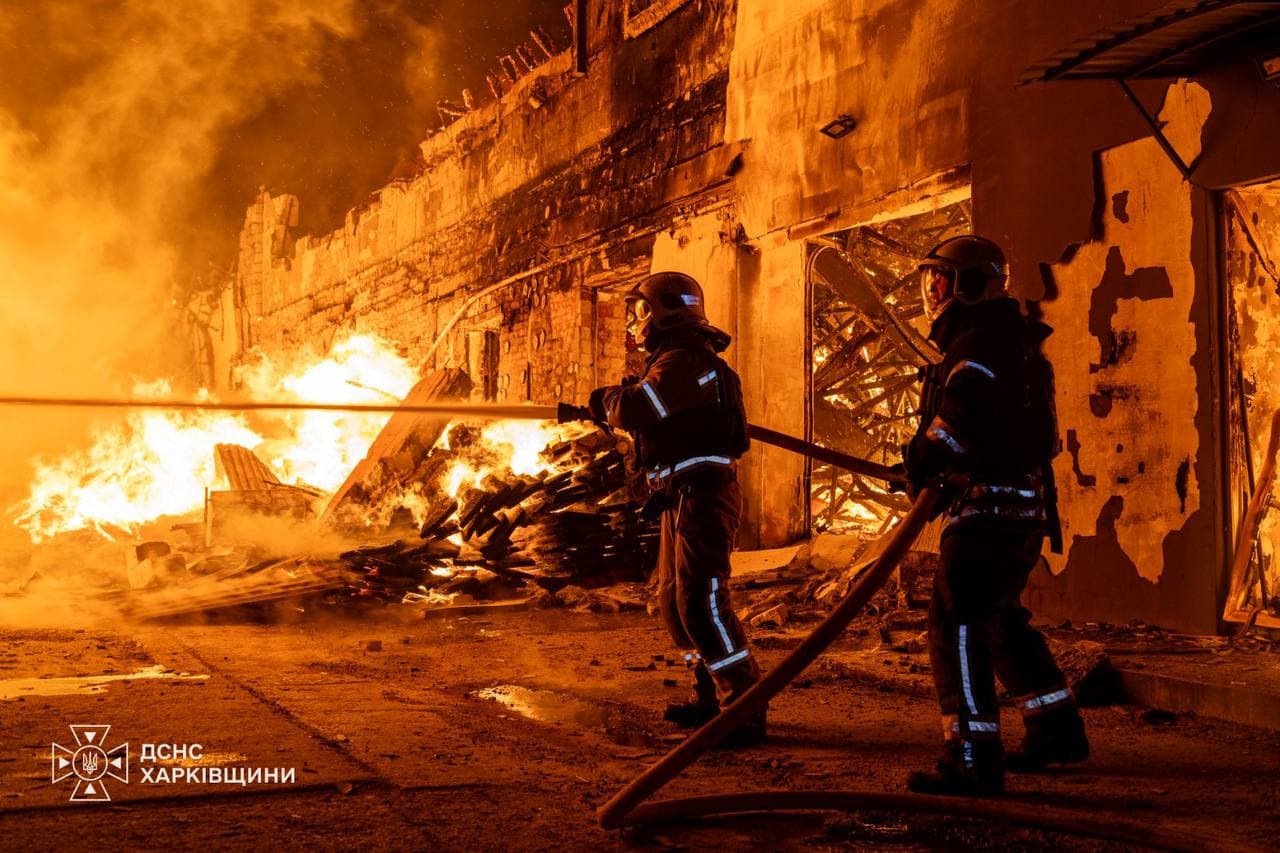
Rescuers extinguish a fire following a Russian drone attack on Kharkiv, Ukraine. (Ukraine’s State Emergency Service/Telegram)
The Day’s Reckoning
For 30 hours, nothing fell on Oleshky. The truce had passed “without a single incident,” Ombudsman Dmytro Lubinets said on Wednesday. Across the Kherson region, the governor reported no strikes on critical or civilian infrastructure at all. For a region that has lived under fire every day since 2022, that alone was news.
That is the plot of this Wednesday: a quiet corner and a busy capital. Zelensky flew to The Hague, where the Netherlands put new money on the table, and from London came the largest British pledge of the war. The date for talks with Moscow edged closer. And the Kremlin’s side of the ledger kept moving too: a new drone base rising near the border, a foreign minister bound for Atlanta, and Putin calling Elon Musk “a genius.”
Beyond the truce line, the war went on. A Russian ballistic missile and 88 drones flew at Ukraine overnight, and two people were killed.
Thirty Quiet Hours
You live in Oleshky. For months, drones have hunted anyone who tried to leave by road. On Wednesday morning, you hear nothing.
“Without a single incident,” Lubinets said of the first 30 hours of the truce. Marine Corps spokesperson Pavlo Drohal said both armies were still observing it at 8 a.m. Kherson Governor Oleksandr Prokudin said no strikes on critical or civilian infrastructure were reported anywhere in the region over the past day; four people hurt in earlier attacks came forward for care. The truce runs until November 1.
Marc Beckman, Melania Trump’s senior adviser, told the Kyiv Independent that the idea of her mediation came from Moscow. “President Putin wanted very much for her to participate and also wrote a formal letter explaining that she… would be recognized as the exclusive intermediary from Russia,” he said. The Russian military, he said, proposed starting two days early and widening the truce across the Kherson region, and Ukraine agreed. Russian and Ukrainian representatives met in person in Belarus to sign it, and neither the Vatican, the UN nor the Red Cross could be brought in as mediators. “What we’ve seen so far is tremendous cooperation from both sides,” Beckman said, adding that both sides had asked him to keep some terms confidential. He said Lubinets is expected to arrive in Oleshky within 36 hours to lead the effort on the ground.
Ukraine remains wary. Zelensky has warned that Russia will try to steer evacuees toward Russian territory, and Foreign Minister Andrii Sybiha has warned that Moscow is preparing to stage “dozens” of propaganda videos about “rescuing” the town’s residents.
Elsewhere, Russia launched an Iskander-M or S-400 ballistic missile, 88 drones, 38 of them jet-powered, and a Banderol missile overnight; Ukraine downed 71 drones, and strikes landed at eight locations. Over the past day, Russian attacks killed two people and wounded 17. In the Dnipropetrovsk region, one person was killed and one wounded in the Synelnykove district, and three were hurt in Dnipro. In the Donetsk region, one person was killed and three wounded. Four people were hurt in Kharkiv and two elsewhere in the region, two in the Zaporizhzhia district, and two men aged 51 and 43 in the Sumy region.
The Hague
Zelensky arrived in the Netherlands and went to Catshuis, the Dutch prime minister’s residence, to meet Rob Jetten. Afterward, he announced a new Dutch military package worth €500 million, “being prepared right now – this fall.” “This is truly significant, especially when it comes to repelling Russian air attacks,” he said. They also discussed Bliksem, a pan-European project to build an interceptor that can destroy medium- and intermediate-range ballistic missiles above the atmosphere. Ukrainian officials also met Dutch Foreign Minister Tom Berendsen and Defense Minister Dilan Yesilgoz-Zegerius, business leaders held talks, and Zelensky was to meet King Willem-Alexander.
At the same time, Dutch Foreign Trade Minister Sjoerd Sjoerdsma was in Kyiv laying out €1.2 billion in non-military aid for 2027 to 2029, most of it for energy and water. It includes €40 million for the Ukraine Energy Support Fund by year’s end and €55 million for Dutch energy equipment. “Support for recovery and reconstruction can’t wait for a ceasefire,” he said. “However successful you are on the battlefield, it’s also essential that energy systems, hospitals and food production keep ticking over.” He also signed €10 million for Ukraine’s Ramstein industrial initiative with Economy Minister Oleksandr Kravchenko. “We will be with Ukraine however long and whatever it takes,” Sjoerdsma told the Kyiv Independent. The Netherlands has given about $10 billion in military aid, including F-16s and Patriot launchers.
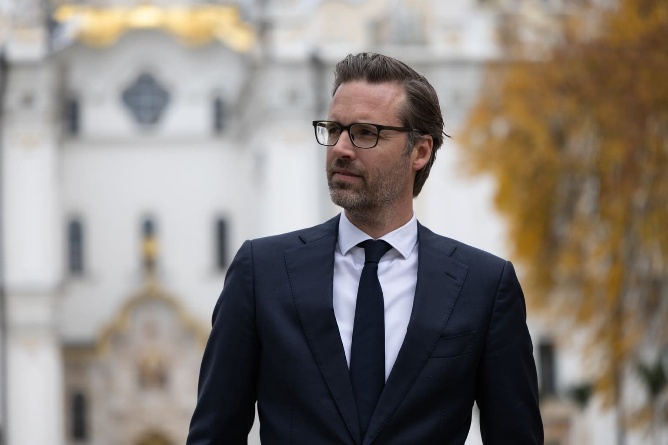
Dutch Foreign Trade Minister Sjoerd Sjoerdsma during his visit to Kyiv, Ukraine. (Tetiana Bulhakova)
In The Hague, Zelensky gave the clearest timetable yet for talks. “We need to have this meeting till the end of (next) month, I hope… between Nov. 6 and 10,” he said, adding that the venue could change because of the war in the Middle East and that he expects Washington to confirm a date around November 4, after the U.S. midterm elections. He said one or two technical rounds on an energy and maritime ceasefire, prisoner exchanges and the return of abducted children could lead to a leaders’ summit, and that territory can be decided only by leaders. Kremlin aide Yuri Ushakov has said Europe will not be invited to Abu Dhabi.
From London came the biggest number of the day. Britain will provide more than £10 billion for Ukraine in 2027, John Healey announced as he presented the U.K. budget: £5.5 billion in World Bank guarantees, £500 million for the World Bank’s crisis facility, £3 billion through UK Export Finance, mainly for military needs, and £500 million in military support for this winter. Prime Minister Andy Burnham called it the largest financial package Britain has ever committed to Ukraine. “A truly strong and very timely step,” Zelensky said. Ukraine faces a 2027 shortfall of about €70 billion even with planned EU support; until Wednesday, Norway, with $9 billion, was the only non-EU country to pledge toward it. EU officials hope Canada will contribute after this week’s EU-Canada summit in Montreal, and the EU is weighing another loan and new ways to use frozen Russian assets.
What Zelensky Told Reporters
At a closed-door briefing with journalists on Tuesday, Zelensky laid out, in detail, how this month looked from his desk.
On air defense, he said Ukraine has received an average of 12 Patriot interceptors a month from the United States in 2026, about 150 a year, while it needs to stop about 150 Russian ballistic missiles a month. Some European countries have agreed to send missiles from their own stocks, he said, but they need Washington’s approval. “Without Hegseth’s signature, it’s simply impossible,” he said. “Every week, we have to put together new packages, find new missiles, and secure new air defenses.” He said he had asked Trump in New York on September 22 for a special winter package of interceptors, and Trump promised to try but said the United States needs them too. American officials, he noted, have blamed past gaps in ballistic-missile warnings on “bad weather.” He said the war in the Middle East has reduced the military and financial support Ukraine receives.
On Trump’s October 11 energy truce, he said Ukraine held off striking Russian refineries for 72 hours. “I said, ‘Let’s respond calmly by striking other targets for at least 72 hours. We won’t touch the oil refineries.’ That didn’t help. There was all kinds of rhetoric, and no one thanked us for those three days.” He said Ukraine has not attacked the tankers carrying Russian diesel to the United States.
On Starlink, he answered Elon Musk directly. “When Elon Musk said that we use Starshield against the Russians — yes, against the Russians, but on our own territory. This is not offensive; it’s defensive,” he said. “Of course, civilians died while Starlink/Starshield were switched off.” Ukraine now downs about 90 percent of Shahed-type drones, he said, and was testing jet-powered Bars interceptors, 2,000 of them paid for by a European country, when the cap hit. “I only know that, technically, SpaceX turns these systems on and off.”
On the capital, he said he had asked Prime Minister Serhii Koretskyi to build a task force to help Kyiv get ready for winter, naming former security chief Vasyl Maliuk, former infrastructure minister Oleksandr Kubrakov and former Prime Minister Volodymyr Groysman. “As president, I can’t just sit back and watch the mayor try to handle this on his own,” he said. The head of the state infrastructure agency, Serhii Sukhomlyn, “declined as soon as he heard it was about Kyiv,” he said, while Kharkiv’s preparations were “a different level.” Mayor Vitali Klitschko, he said, “gets the impression that someone wants to replace him.”
And on NATO, he said Moscow wants a separate deal with the alliance or the United States that would change Europe’s security structure, and that “any retreat, any rollback in security terms, is a sign of weakness for the alliance.” He added that Ukraine has also heard American “signals” about possible reductions of U.S. troops in Europe. He defended the Finnish and Norwegian leaders’ call with Putin, saying they had coordinated it with Kyiv in advance, and said Ukrainian and European sources had called the Financial Times’ account of a history lecture “incorrect.” Other European governments, he noted, keep their own contacts with Moscow through intelligence services and national security advisers, and Trump’s 2025 Alaska summit with Putin had already “ended that isolation.”
Diesel, Sanctions and a Watchdog That Won’t Look
The U.S. Treasury is reviewing an application to lift sanctions on the Russian Direct Investment Fund, The New York Times reported, as part of an effort to improve relations with Moscow; a U.S. official called its chief, Kirill Dmitriev, a “helpful envoy.” Under President Biden, the Treasury called the fund “widely considered a slush fund for President Vladimir Putin.” Eric Green, who oversaw Russia policy at the National Security Council under Biden, told the Times that lifting the sanctions would signal Washington had abandoned keeping economic pressure on Moscow until a peace deal. Some of the diesel bound for the U.S. left Russia before any American buyer had paid, the Times reported. Le Monde reported that Witkoff had presented Ukrainian negotiators in Florida with a postwar “regional prosperity plan” that would restore Russian oil and gas flows to Europe through Ukraine.
In Washington, resistance grew. Senator Richard Blumenthal wrote to Athanasios Martinos, managing director of Eastern Mediterranean Maritime, which operates the tanker Agioi Fanendes carrying the first cargo, warning that unloading it would break the 2022 law banning Russian oil imports. “Reverse course while there’s still time,” he wrote. Representative Gregory Meeks introduced a bill to block Russian diesel imports. And the Pentagon’s inspector general declined a bipartisan request from nine senators to investigate the Starlink and Starshield disruptions, referring them to the Air Force, the Associated Press reported. Senator Jeanne Shaheen called the response “concerning.”
Russian Foreign Minister Sergey Lavrov, under U.S. sanctions since 2022, will lead Russia’s delegation to the G20 foreign ministers’ meeting in Atlanta on October 30 and 31, spokesperson Maria Zakharova said. At the Russia-Africa summit in Moscow, Putin praised Musk. “I want to point out that Elon Musk is a genius, a real genius,” he said, adding that Moscow keeps in contact with “U.S. partners, including Mr. Musk” on space.
Behind the Lines
You are a Ukrainian marine. Your new commander fired the first shots of this war.
Col. Vadym Sukharevskyi, former head of Ukraine’s Unmanned Systems Forces, has been chosen to lead the Marine Corps, replacing Maj. Gen. Dmytro Deliatytskyi, Ukrainska Pravda and Interfax-Ukraine reported. In April 2014, as a senior lieutenant in the 80th Airborne Brigade, he ordered his men to open fire on Russian proxy forces near Sloviansk, the first shots in Ukraine’s fight against Moscow’s “separatist” uprising. He later commanded the 59th Motorized Brigade, which helped liberate Kherson, and led the new drone branch in 2024 before being dismissed after less than a year. His return is part of a command reshuffle by Commander-in-Chief Mykhailo Drapatyi.
On the Russian side, the strain shows. The Security Service of Ukraine said it arrested two deserters from Russia’s 291st Motorized Rifle Regiment who left their positions in the Donetsk region, buried their uniforms and weapons, changed into civilian clothes from an abandoned house and hitched a ride toward Dnipro, hoping to “go underground” in Kyiv. They were caught at the Dnipropetrovsk regional line, one still wearing a Russian military tag around his neck. One, from occupied Luhansk, has fought for Moscow since 2016 and has two murder convictions; the other, a Russian freed from prison to fight, is being held as a prisoner of war.
Russia is also preparing for winter. Ukraine’s military intelligence said satellite images show a new launch site for jet-powered Geran-4 and Geran-5 drones near Millerovo airfield in the Rostov region, about 20 kilometers from the Luhansk region, able to handle up to 100 launches a day once complete. It sits 3.5 kilometers from the airfield and can share its air defenses, roads and utilities. As of late August, there were no significant signs of construction there. Russia already has at least 12 such sites, and the drones can reach 770 and 950 kilometers. Ukrainian intelligence also published a list of 49 Russian and Belarusian companies building Russia’s Rassvet satellite network, 23 of them, including Roscosmos, not sanctioned anywhere. The project is led by Bureau 1440, part of IKS Holding, with state bank VTB among its investors, and Russia plans to fit Rassvet terminals into command vehicles, including Iskander-M launch systems. And Russian grain ships are again leaving the Sea of Azov after a three-month halt caused by Ukraine’s summer drone campaign, Operation Molochka, which hit 218 shadow-fleet vessels by early August, Reuters and Bloomberg reported. Russia’s Krasnodar region had declared an emergency in September because it could not export grain.
The front line still takes volunteers. In Kramatorsk, Jesse Adams, a Canadian who founded the RainCoast Dog Rescue Society, was evacuating animals on his third trip to Ukraine when a Russian FPV drone hit his vehicle’s windshield on Sunday, Animal Rescue Kharkiv reported. Doctors could not save him. It was his first mission rescuing cows and pigs, for a family afraid to leave their home without them. “Thanks to Jessie, today hundreds of animals are alive,” the group wrote.
Also Today
A war budget. Parliament passed Ukraine’s 2027 budget in first reading with 239 votes. Defense takes about 4.89 trillion hryvnias, 43.8 percent of GDP, with revenue of 5.65 trillion, spending of 7.27 trillion and a deficit of nearly 1.7 trillion. It assumes 1.3 percent growth and 8 percent inflation; a final vote is expected in November.
The cost to Russia. Ukraine’s General Staff put Russian losses since February 2022 at 1,583,350 troops killed and wounded and more than $204 billion in equipment, and estimated that Russia has spent over $700 billion on the war, rising from $86 billion in 2022 to $190 billion in 2025, and pays more than $95 million a day in compensation for its dead and wounded.
A fugitive’s claims. Ukraine’s anti-corruption agencies denied claims by former Prosecutor General Ruslan Kravchenko, who fled to Austria, that they plotted against him, calling it an attempt to “secure protection for himself.” Kravchenko had claimed that two Ukrainian military intelligence officers detained in Austria were sent to harm him; the Presidential Office and intelligence agency did not comment.
Kyivstar buys GigaCloud. Ukraine’s largest mobile operator agreed to buy cloud provider GigaCloud for up to $50 million.
The Closing
Tonight, a town across the river from Kherson has gone a day and a half without hearing a drone. In The Hague and London, Ukraine’s friends wrote checks for next year. Near Millerovo, Russia is pouring concrete for the drones it plans to send this winter. Ukraine will take every quiet hour it is given. It is also getting ready for the ones it will not be.
A Prayer for Ukraine
1. For Those Who Defend
Lord of hosts, bless the marines who keep watch over a silent river, and their new commander, who has stood for Ukraine since the first shots in Sloviansk. Guard the air defenders who must stretch every interceptor, the pilots testing new ways to stop the drones, and every soldier holding the line while the talks are planned. Keep them safe through the cold nights ahead.
2. For the Wounded and the Grieving
God of all comfort, receive the dead of Synelnykove district and Donetsk region, and Jesse Adams, who crossed the world to carry frightened animals out of Kramatorsk. Comfort his family and his friends at Animal Rescue Kharkiv. Heal the wounded of Dnipro, Kharkiv, Zaporizhzhia and Sumy regions, and every family that woke to sirens. Bless all who risk their lives to save the helpless, people and animals alike.
3. For Those Who Lead
King of kings, give President Zelensky wisdom in The Hague and in every hall where Ukraine’s future is weighed. Bless Prime Minister Jetten, Prime Minister Burnham and the peoples of the Netherlands and Britain for their faithful help. Let the coming talks be honest, and let no peace be signed that rewards the one who struck first. Grant the negotiators patience and clear sight.
4. For Oleshky
Faithful God, keep the silence over Oleshky until every family has received bread and medicine and every person who wishes to leave has gone in peace. Guard the deminers on the road, the officials who will walk into the town, and the old and the sick who cannot travel. Let no camera be used to twist their suffering, and let the truth of what they endured be told.
5. For a People Who Keep Standing
Father, Ukraine plans its budget for war and still prays for peace. Sustain the families of Kyiv preparing for a hard winter, the workers who keep the lights on, and the volunteers who never stop coming. In Your mercy, in Your justice, in Your time — bring this war to its end, and let the ending be worthy of what Ukraine has endured.