
Ukraine Daily Briefing — April 5, 2026
In Kstovo, Ukraine’s drones lit the Lukoil refinery sky orange — 1,000 kilometers inside Russia — despite allied pleas to stop.
In Nikopol, a Russian FPV drone turned a Saturday market into a massacre, killing five civilians including a 14-year-old girl.
In Sumy, nineteen children — the youngest two years old — were wounded in a single overnight attack as Russia answered Zelensky’s Easter ceasefire proposal with nearly 380 drones in 48 hours.
The 1,502nd day of war: the day Ukraine chose defiance, and Russia chose children.
The Day’s Reckoning
The world was preparing for Easter. Russia was preparing its drones.
While Catholic and Protestant families across Europe set tables and lit candles, Moscow’s targeting computers were selecting Ukrainian cities. Ninety-three Shaheds, Gerberas, and Italmas — launched from six directions, crossing hundreds of kilometers of night sky — descended on Odesa, Sumy, Chernihiv, Kharkiv, and beyond. Zelensky had formally proposed an Easter ceasefire. The Kremlin didn’t reply with words. It replied with this.
At the same moment, 1,000 kilometers inside Russia, flames erupted above the Lukoil refinery in Kstovo. Ukraine’s drone commanders had read their allies’ urgent messages asking Kyiv to stop hitting Russian oil infrastructure — global energy markets reeling from the U.S.-Israeli war against Iran, the Strait of Hormuz closed, prices spiking. Ukraine read the messages, acknowledged them, and struck anyway.
On the southern front, something quieter but potentially more consequential was unfolding: Ukrainian counterattacks in the Oleksandrivka direction had liberated 480 square kilometers and forced Russia to pull elite naval infantry from its main offensive axis. The spring-summer offensive Russia had been assembling was already being disrupted — not by headlines, but by grinding, methodical pressure.
Nine civilians confirmed dead. Ninety-five wounded. Nineteen of them children. A Russian soldier charged with deporting 15 kids at gunpoint. Thirteen thousand chemical weapons violations documented since 2022. This is what the 1,502nd day looked like.
The Night Kyiv Told Its Allies No
The requests had come through diplomatic channels — polite, urgent, firm. The U.S.-Israeli war against Iran was in its sixth week. Iranian missiles had closed the Strait of Hormuz, cutting off roughly one-fifth of the world’s oil supply. Prices were spiking. Western allies delivered the message to Kyiv: please stop hitting Russian refineries. The world can’t take much more.
Ukraine’s answer lit up the night sky over Nizhny Novgorod Oblast.
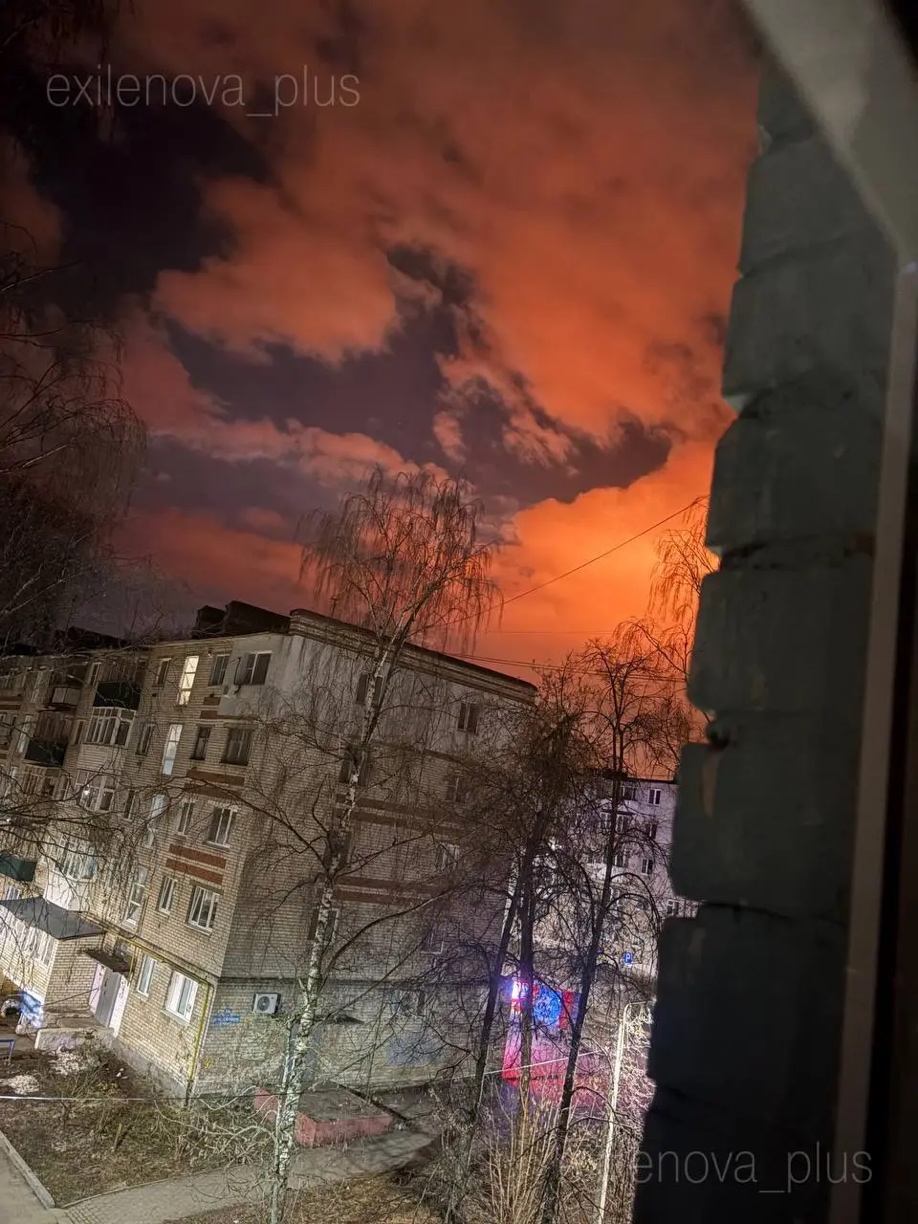
Robert “Madyar” Brovdi — commander of Ukraine’s Unmanned Systems Forces — personally confirmed the strikes on April 5. His drones hit the Lukoil-Nizhegorodnefteorgsintez refinery in Kstovo, roughly 1,000 kilometers from the Ukrainian border. Fires blazed. Russian air defense launched into the dark. Debris still fell across two refinery facilities and the nearby Novogorkovskaya power plant. NASA satellite data caught heat anomalies at 2 AM local time.
Simultaneously, a drone struck an oil pipeline near Primorsk port in Leningrad Oblast — the third hit there in two weeks. This night was part of a 13-day blitz against eight facilities spanning 1,700 kilometers of Russian territory: oil terminals at Ust-Luga and Primorsk, refineries in Kstovo, Kirishi, Yaroslavl, and Ufa, defense plants in Tolyatti and Chapayevsk.
Kremlin milbloggers, increasingly muzzled by new Telegram censorship, offered only quiet acknowledgment: the damage was real, costly, slow to repair. One speculated Ukraine was burning Russian air defense munitions with daytime border strikes before sending deep-penetration drones at night. Translation: Russia’s defenses are being systematically gamed — and Russia can’t stop it.
Saturday at the Market: How Russia Answered the Ceasefire Offer
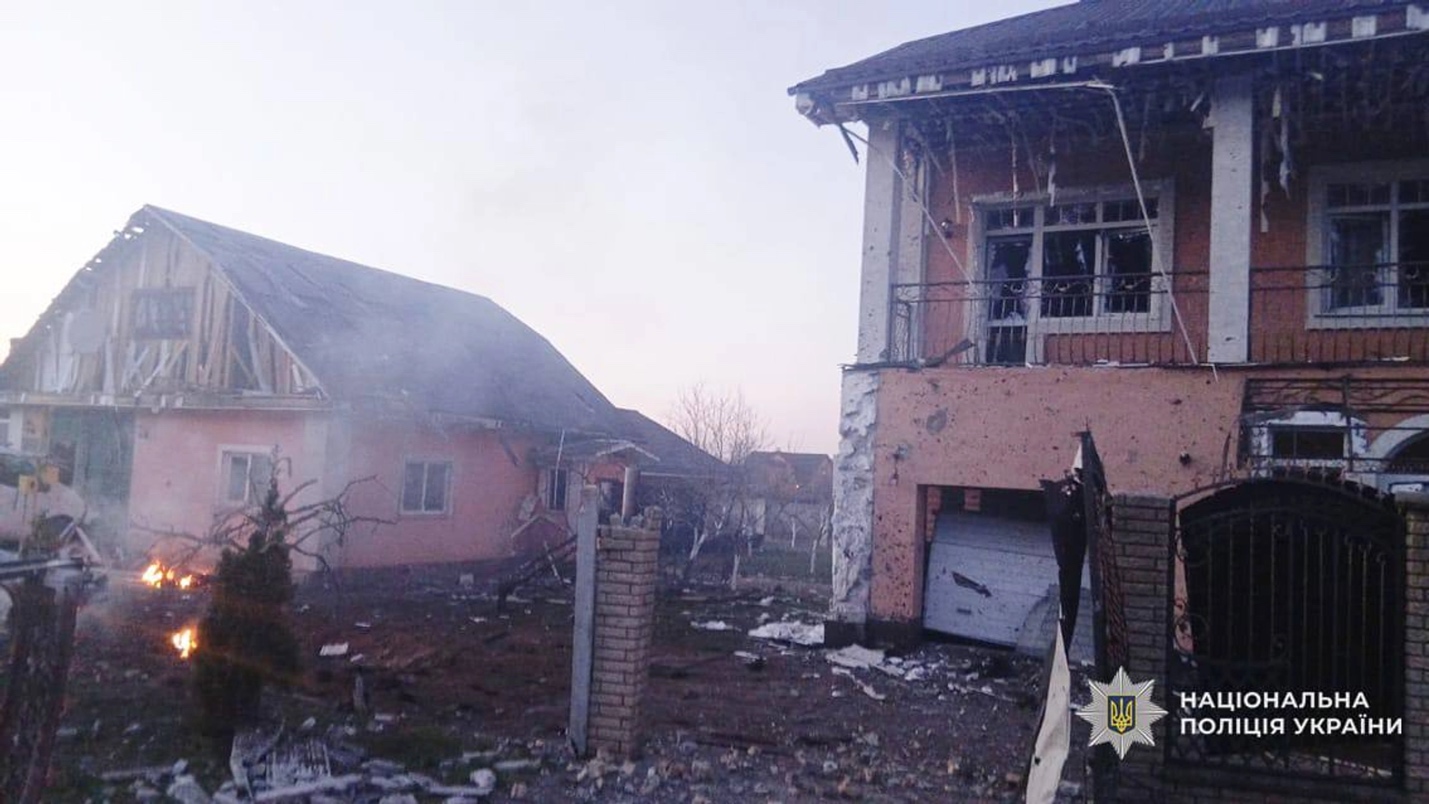
It was a Saturday morning at a market in Nikopol. People were shopping. A normal morning in a city that had learned to live with war.
Then the FPV drone arrived.
Five people died. Twenty-seven wounded, including a 14-year-old girl in critical condition. The next morning, a second drone hit Nikopol again — one more dead, a 60-year-old woman in “extremely grave” condition. Same city. Two mornings. Six dead.
That was just Nikopol.
In Sumy city that night, a drone tore through an apartment building. Twenty-nine people were hurt across the oblast, 19 of them children aged two to fifteen. In Kramatorsk: six killed, ten wounded, homes and businesses gutted. In Kharkiv, eleven people including an 11-year-old girl injured across 11 districts struck by glide bombs and drones. In Kherson: two dead, thirteen wounded, an ambulance destroyed. In Chernihiv, a Geran found an agricultural shed and a bread delivery van, killed one man, set five hectares of grass on fire — 52 shellings, 80 explosions, one day. In Odesa before dawn, 93 drones approached from six directions. Air defense got 76. Seventeen hit ten locations — 250 windows shattered, four balconies destroyed, three injured, a hundred emergency workers in the streets with gas cut off.
Nearly 380 drones in 48 hours. Six thousand five hundred in March alone, plus a record 7,987 glide bombs — over 1,500 more than the previous monthly record. Ukraine’s Defense Ministry stated it plainly: “Having failed to achieve the desired successes at the front, the Russian army is trying to apply pressure by increasing the number of airstrikes.” Zelensky had proposed an Easter ceasefire. Moscow sent this instead.
The Offensive Nobody Was Watching — and Why Russia Is Losing It
While cameras fixed on drone strikes, something strategically significant was happening in the south. Russia was losing ground it couldn’t afford to lose.
Since late January, Ukrainian forces had been grinding forward in the Oleksandrivka direction. Not in dramatic surges — settlement by settlement, meter by meter. By April 5, General Syrskyi confirmed the total: 480 square kilometers liberated, twelve settlements, and a deepening crisis in Russian planning.
Military observer Kostyantyn Mashovets reported the consequence: Russia had been forced to pull significant portions of the 120th Naval Infantry Division (Baltic Fleet) and the 40th Naval Infantry Brigade (Pacific Fleet) away from the Dobropillya tactical area. These are elite assault troops — the exact forces Russia needs for its spring-summer offensive. They were now stuck plugging a hole Ukraine had deliberately carved.
Near Pokrovsk, the arithmetic was equally brutal. A Ukrainian drone brigade reported eliminating over 500 Russian soldiers in March — 21 percent more than February — even as attack intensity grew. More assaults. More dead. Less ground. Russian forces were hitting with FPV swarms ahead of infantry, attacking in groups of 10-20 near Hryshyne, operating tanks from concealed positions to avoid Ukrainian drones. They were paying more for less.
The Russian 83rd Separate VDV Brigade was reportedly withdrawing to Moscow Oblast for reconstitution. Elite airborne forces, pulled back before the main offensive even launched.
Burning Trains, a Sunken Ship, and Four Drones Worth $20 Million
While refineries burned deep inside Russia, Ukrainian forces were cutting supply lines closer to the front.
On April 3 and the night of April 4, Ukrainian strikes hit fuel train convoys near Stanytsia Luhanska and Shchotove in occupied Luhansk Oblast. The General Staff was precise: the damage “complicates the provision of fuel and lubricants to the occupying army.” Slower tanks. Grounded aircraft. Less mobile guns. Every train matters.
The confirmed damage from the April 2 strike on Kirovske airfield in occupied Crimea was stark: one Orion strike drone destroyed, three damaged. The Orion — Russia’s Reaper equivalent, with a 250-kilometer range, 24-hour endurance, and 200-kilogram weapons payload — costs roughly $5 million each. Four Orions. One strike.
At sea, occupation head Vladimir Saldo confirmed a Ukrainian drone sank the dry cargo vessel Volgo-Balt in the Sea of Azov on April 3. Ukrainian military analysts noted the ship had been hauling stolen Ukrainian wheat throughout the war. The surviving crew spent two days reaching shore. A Kremlin-linked milblogger admitted Russia’s shipbuilding industry would struggle to replace the loss — an acknowledgment that the naval war, too, is bleeding Russia.
Ukrainian drones also struck an aviation storage depot in occupied Saky, Crimea. About 181 kilometers from the front line. Methodical. Every night, something Russian burns.
A Thousand Kilometers of Front: Russia Pushed Everywhere, Advanced Almost Nowhere
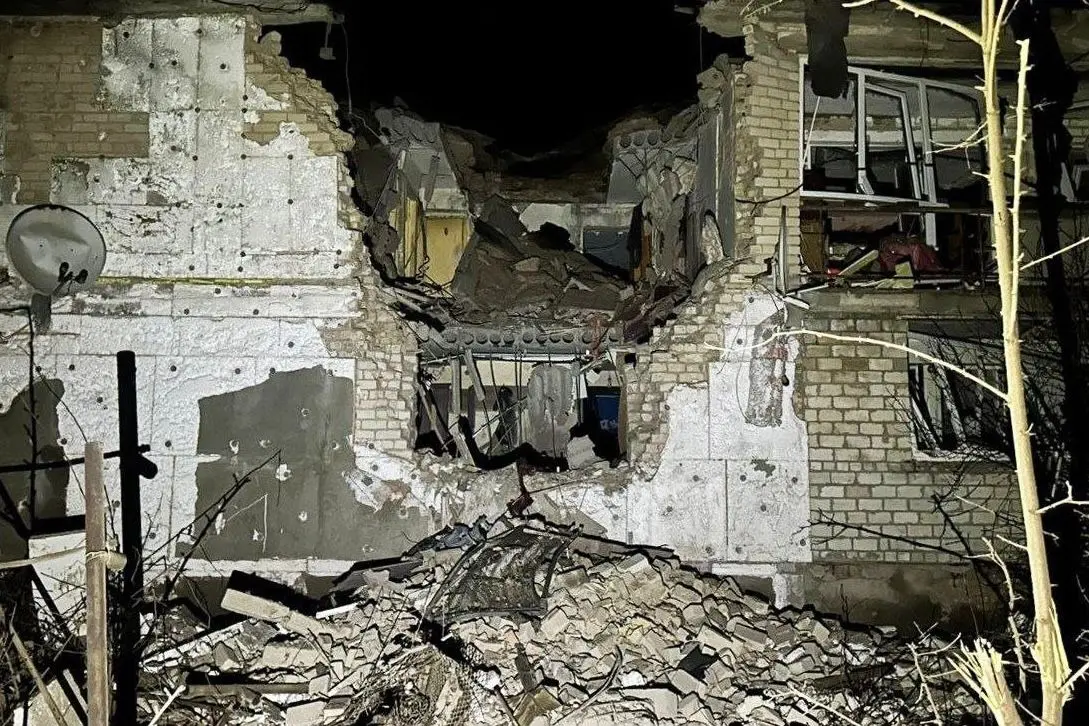
The aftermath of a Russian attack in Zaporizhzhia Oblast. (Zaporizhzhia Oblast Military Administration/Telegram)
Across the full length of the contact line, Russian forces attacked on April 5. Across nearly all of it, they went nowhere.
In northern Kharkiv Oblast, assaults near Hrafske, Vilcha, Vovchansk, and Starytsya produced nothing. Ukraine counterattacked near Vilcha and Vovchanski Khutory. The line held. Near Kupyansk, a single exception: geolocated footage confirmed a marginal Russian advance west of Holubivka — among the few confirmed Russian territorial gains of the day. Near Borova, attacks near Novoplatonivka and Borivska Andriivka: no change.
In Donetsk Oblast, the same story repeated across the Slovyansk, Kostyantynivka-Druzhkivka, and Lyman directions. A spokesperson for Ukraine’s 11th Army Corps offered a telling detail: Russian forces had reduced ground attacks over the prior week while nearly doubling their use of tactical aviation. Fewer infantry assaults, more airstrikes. They were trading soldiers for bombs — a sign that foot-soldier losses were becoming too costly even as the tempo rose.
In the south, a single Russian soldier appeared on geolocated footage north of Myrne in the Hulyaipole direction — a probe, not an assault. Near Orikhiv and the Antonivskyi Bridge in Kherson, limited attacks produced nothing. Zaporizhzhia Oblast absorbed 887 Russian strikes in 24 hours — drones, rockets, artillery — causing property damage, no reported deaths.
Russia was conserving its assault capacity, waiting for its spring offensive to crystallize. Ukraine was making the wait expensive.
13,000 Times: The Chemical War the World Has Decided to Tolerate
The number sat in a Ukrainian General Staff report, released April 4, waiting for someone to react: 13,000 documented instances of Russian chemical weapons use since February 2022. Four hundred in March 2026 alone.
The weapons aren’t nerve agents. Drone-dropped K-51 and RG-Vo aerosol gas grenades. Makeshift containers dispensing CS and CN — riot control compounds explicitly banned from battlefield use under the Chemical Weapons Convention Russia signed. The tactic is simple: flood a Ukrainian trench with gas, wait for soldiers to break cover and gasp for air, kill them in the open with drones or artillery.
The confirmation is overwhelming. The OPCW reported it in June 2025. Dutch and German intelligence confirmed it in July 2025. The U.S. State Department determined it in May 2024. Russia’s own 810th Naval Infantry Brigade posted acknowledgment of deliberate K-51 use on its Telegram channel in December 2023 — not as a confession, as a boast.
Russia isn’t hiding this. It’s simply calculated that 13,000 confirmed violations will produce the same international response as 12,000 did. So far, that calculation is correct.
Twenty Soldiers, Fifteen Children, and a Song They Were Forced to Sing
They came to the school in Novopetrivka, Kherson Oblast, in 2022. About twenty of them. Armed. They had already threatened the director and her husband at gunpoint. Interrogated her. Then they took the children.
Fifteen of them. Three orphans. Ten without parental care. Two from difficult circumstances. Not one of them a military threat under any reading of any law. All marched out under armed escort.
The group was held first in Stepanivka, deeper in occupied Kherson, for three months. As Ukrainian forces closed in that October, they were moved — first to Russian-occupied Crimea, then to Krasnodar Krai. Court documents describe what followed: mandatory Russian national anthem. Mandatory propaganda events. Ukrainian language: forbidden. “Constant psychological pressure,” the documents state.
Ukraine’s Prosecutor General has now charged the organizing soldier by name. Maksym Maksymov of Bring Kids Back Ukraine told Euronews: “What happened was a deliberate operation — surveillance, control, forced transfer, deportation, and efforts to erase their identity.” Deputy Prosecutor General Viktor Lohachov confirmed that data on more than 19,000 Ukrainian children is under active verification. The figure is not final.
Fifteen children from one village. Nearly 20,000 from a country.
Knives at the Draft Office: The War Ukraine Is Fighting at Home
In Vinnytsia on April 4, two enlistment officers stopped a man to check his military papers. Standard procedure, National Police present. The man pulled a knife and stabbed both of them. One went to intensive care. The other was listed as stable. The attacker fled. No arrest.
Two days earlier in Lviv, a customs inspector had fatally stabbed a draft officer in the neck. The suspect claimed the officers attacked him and his brother first, used pepper spray. Not tested in court. But the claim resonates — because the anger behind it is real.
The Ombudsman’s complaint figures tell the arc of a fracturing system: 18 complaints against enlistment officers in 2022. Then 514. Then 3,312. Then 6,127 in 2025 — nearly double in a single year. Reports of forced street detentions, amplified by Russian disinformation but rooted in real incidents, have become routine conversation.
Ukraine needs men at the front. The front is brutal and volunteerism is exhausted. So conscription intensifies. And as it intensifies, abuses accumulate, trust collapses, and men pull knives. Russia didn’t cause this fracture. But it is widening it every day.
Cuba, Belarus, and the Supply Chain Sanctions Can’t Kill
On April 5 in Minsk, Belarusian and Cuban officials held the 12th meeting of their bilateral Military-Technical Cooperation Commission. No headlines. No cameras. Reviewing agreements, identifying areas for deeper defense cooperation. Routine business.
That same day, a Belarusian delegation from the Brest Free Economic Zone signed industrial cooperation agreements with Russia’s Leningrad Oblast and toured the Emperium LLC shipbuilding facility. A November 2025 investigation by Belarusian opposition group BELPOL had already documented what Belarus provides: upgraded chassis for Russia’s Pantsir-S1 air defense launchers. Belarus isn’t just territory Russia uses. It’s a manufacturing node.
Pull back and the full architecture becomes visible: Cuban military agreements. Belarusian weapons components. Iranian drone designs reproduced by the thousands. Chinese parts in factories where Japanese engineering used to run. North Korean ammunition. Each thread looks modest alone. Together they form a durable supply chain that three years of Western sanctions have not severed.
Russia built a parallel economy because it had to. The economy works. And it grows.
What the 1,502nd Day Revealed
Two acts of defiance played out in the dark of April 5. In Kstovo, Ukrainian drones set a Russian refinery on fire despite every ally asking them to stop. In Nikopol, Russian drones killed people at a market despite every norm of war forbidding it. Each side decided the rules didn’t apply today.
Ukraine’s defiance was calculated. Kyiv is fighting an energy war and an attrition war simultaneously, and has decided that damaging Russia’s oil revenues outweighs allied discomfort. The 13-day campaign across 1,700 kilometers of Russian territory has proved one thing clearly: Ukrainian drones can strike almost anywhere, Russian air defenses cannot protect everything, and the economic damage is real and compounding.
Russia’s escalation was something else. Nearly 380 drones against civilians on Easter weekend isn’t a military strategy. It’s a message — to Ukrainians, to Western publics, to anyone who thought a ceasefire proposal might produce restraint: there is no restraint coming.
The ground war’s most consequential story — Ukrainian counterattacks in the south quietly draining Russia’s assault reserves before the spring offensive launches — received almost no public attention. It may matter more than everything else. If Russia’s offensive begins with depleted naval infantry and exhausted armor, the campaign that was supposed to break Ukraine’s Fortress Belt may culminate before it achieves its objectives.
Day 1,502. The fires will be repaired or they won’t. The children will come home or they won’t. Nobody knows yet. The war doesn’t offer answers. Only more days.
A Prayer for Ukraine
1. For the Five Who Went to the Market on Saturday
Lord, they went to a market on a Saturday morning in Nikopol — the kind of thing people do in peacetime and do in wartime because life has to continue. Five of them did not come home. A 14-year-old girl is in critical condition in a hospital somewhere, her name not yet in any headline. Be with her. Be with the families who are learning, this Easter weekend, what it means to lose someone to a drone at a market stall. Hold them where no human hand can reach.
2. For the Nineteen Children in Sumy
Father, nineteen children were wounded in Sumy Oblast in a single night — the youngest two years old, the oldest fifteen. They were asleep, or nearly so. They had done nothing. They were simply Ukrainian, and in this war that is enough to make them targets. Heal their bodies. But also heal what cannot be seen on any scan — the fear that does not leave, the sound they will hear in the dark for years. Let them grow up. Let them grow up without this defining them.
3. For Zelensky, and the Weight of a Proposal No One Accepted
God of mercy, Zelensky asked for a ceasefire for Easter. He knew the answer before he asked it. Russia answered with 380 drones. Be with those who must lead when every offer is rejected, every gesture met with escalation, every day requiring decisions that will cost lives no matter what is chosen. Give him clarity when the options are all terrible. Give him the wisdom to know which terrible option is the least so. And when he carries home the cost of those decisions in the small hours of the morning, let him not carry it entirely alone.
4. For the Soldiers Holding Ground in the Chemical Smoke
Lord, Russian forces used chemical agents in Ukraine 400 times last month. The tactic is to gas a trench and force soldiers into the open to be killed. The soldiers who hold those trenches know this. They hold them anyway. We do not have their names. We do not know what they are breathing, or what they are thinking in the moments before the grenades drop. But you do. Strengthen them. Protect them where their equipment cannot. And let the world that confirmed these crimes 13,000 times over find, finally, the will to make them stop.
5. For the Fifteen Children Still in Krasnodar, and the 20,000
God of justice, fifteen children were marched out of a school in Novopetrivka at gunpoint in 2022. They were taken to Crimea. Then to Krasnodar. They were forbidden from speaking their own language. They were made to sing another country’s anthem. Ukraine has now charged one man by name for what was done to them. One man, for fifteen children, out of nearly twenty thousand. Let this charge be the first thread pulled. Let the naming of names continue. Let the chain of command be followed to its end, whoever stands there. Let the children — all of them, the verified and the unverified and the still uncounted — come home.
In Your mercy, in Your justice, in Your time — bring this war to its end, and let the ending be worthy of what Ukraine has endured.
Ukraine Daily Briefing — April 5, 2026 — Sources: Kyiv Independent, Kyiv Post, ISW, Ukrainian General Staff, Regional Military Administrations