
In Nikopol, a Russian drone found a Saturday market and killed five shoppers before 9 a.m. In Tolyatti — 750 kilometers inside Russia — Ukrainian drones set chemical plants ablaze as the regional governor scrambled to acknowledge what the smoke already confirmed. In Istanbul, Zelensky sat down with Erdogan, one day after the Turkish president had spoken with Putin, to build the architecture of a peace process the battlefield showed no sign of honoring. The 1,500th day of war — when Russia answered a ceasefire proposal with 286 drones, and Ukraine answered back with fires burning deep in Samara Oblast.
The Day’s Reckoning
Before dawn on Easter eve, 286 Russian drones lifted off from Bryansk, Kursk, and the southern steppe. Zelensky had asked for a ceasefire. This was Moscow’s reply.
By morning, five people lay dead in a Nikopol market. A 16-year-old boy died in a Kramatorsk hospital from cluster munition wounds. A drone punched through the 13th floor of a Sumy apartment building while families slept. Before the day was over: 16 dead, 94 wounded.
While Russian munitions fell on Ukrainian cities, Ukrainian drones flew the other direction — 750 kilometers into Russia, where chemical plants in Tolyatti burned hot enough that the regional governor had no choice but to acknowledge the fires. Ukraine’s campaign against Russian industrial infrastructure has already cut Moscow’s oil export capacity by 40 percent. Now Ukraine’s own allies were quietly asking Kyiv to ease up — global oil prices were spiking, driven by the Iran war, and Western capitals were feeling the pressure at the pump.
Zelensky, meanwhile, was in Istanbul with Erdogan, who had spoken with Putin the day before. The diplomatic triangle that may eventually end this war was taking shape — slowly, carefully, with no guarantees.
At home, Putin’s grip was quietly slipping. His trust rating hit its lowest point since 2019 — not from battlefield losses, but from a Telegram crackdown so clumsily executed it crashed Russian bank payment systems and turned pro-war milbloggers against the Kremlin.
On the front lines, Russian forces pushed hard across a dozen sectors. They advanced in none.
Easter eve. Drones falling. Fires burning 750 kilometers inside Russia. A president in Istanbul trying to negotiate a peace the battlefield refused to honor.
286 Drones: How Moscow Answered Zelensky’s Easter Prayer
Zelensky offered a ceasefire. Catholics mark Easter on April 5. Orthodox Easter falls on April 12. A rare convergence of Christian calendars — the kind of moment that, in another world, might have given both sides a reason to pause. Zelensky offered that reason.
Moscow launched 286 drones.
Shahed-type, Gerbera-type, Italmas — lifted from six directions inside Russian territory, fanning out across Ukrainian airspace through the night. Ukrainian air defenses fought them down one by one, killing 260 of them. Twenty-six broke through. Ten locations struck. Debris scattered across six more. At 7 a.m., the Air Force reported roughly 20 still circling overhead.
The night fit a pattern that no longer surprises anyone in Ukraine. March alone brought 6,500 drones and 7,987 glide bombs — a wartime record, surpassing February’s record by more than 1,500. In the first three months of 2026, Russia deployed over 15,800 drones. That’s nearly 50 percent more than the same period last year. On March 23-24, Moscow launched 1,000 in a single 24-hour window — including a rare mass daytime attack that killed seven and wounded around 50 while people were still at work.
Ukraine’s Defense Ministry offered the clearest explanation for the escalation: “Having failed to achieve the desired successes at the front, the Russian army is trying to apply pressure by increasing the number of airstrikes.”
Translation: the ground war isn’t working. So Russia is trying the sky.
The skies over Ukraine are no longer a place of occasional terror. They are a front line — active, contested, and open every night.
Zelensky asked for a pause. The drones were still coming at dawn.
Five People Went to Market. They Didn’t Come Home.
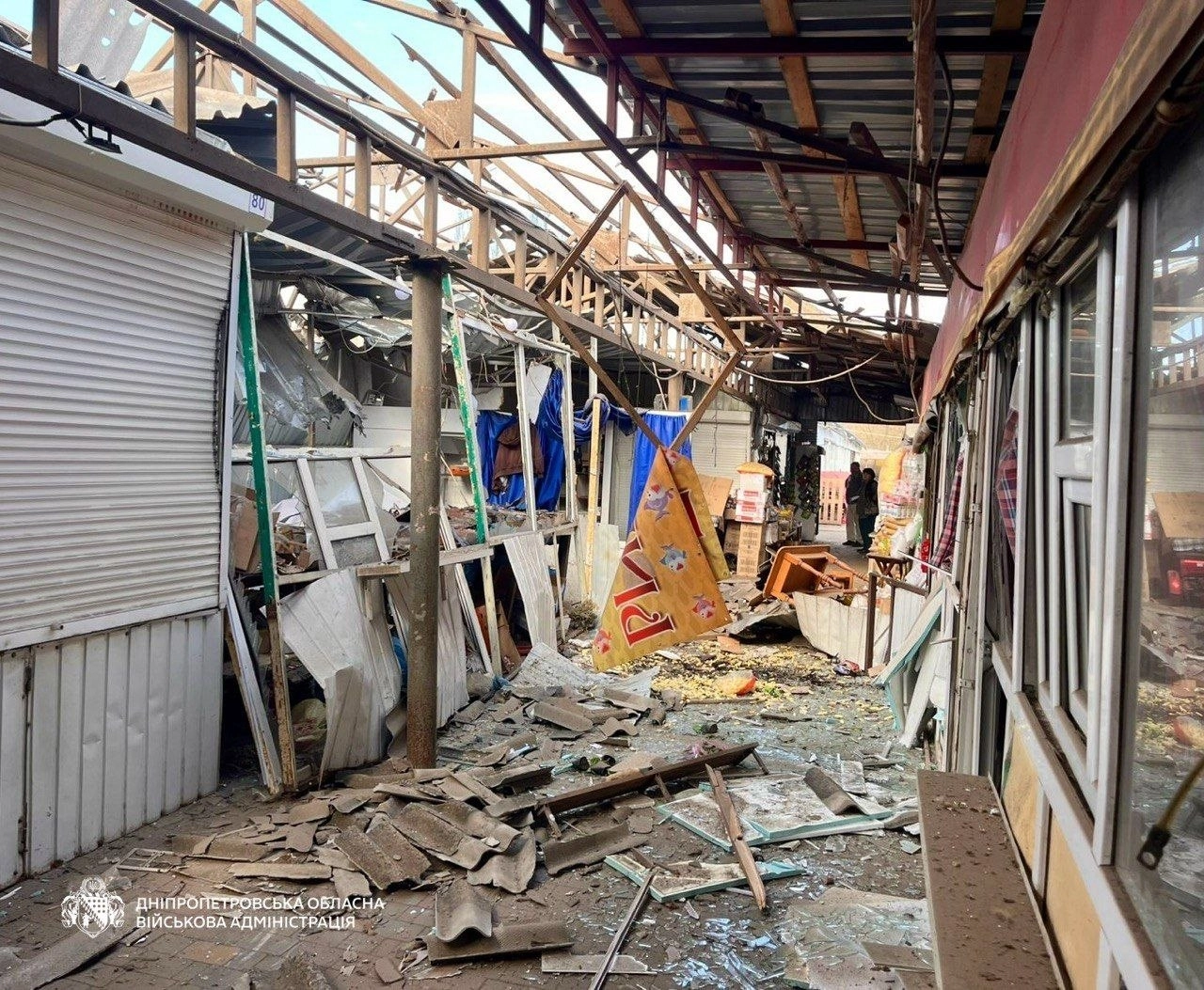
It was a Saturday morning. Vendors were setting up stalls. Early shoppers moved through the aisles. In Nikopol — a city on the Dnipro that has absorbed Russian fire for three years — this was just another morning.
Then a Russian FPV drone found the crowd.
Three women. Two men. Dead where they stood. Twenty-five more wounded, including a 14-year-old girl in critical condition, transferred to a regional hospital for specialized care. Eight victims hospitalized with shrapnel wounds, blast injuries, and burns. Fire gutting the pavilions, spreading to a nearby shop.
“The Russians took the lives of five people,” Dnipropetrovsk governor Oleksandr Hanzha wrote on Telegram.
That was just one city. One hour. One drone.
In Kharkiv, ballistic missiles had hit the Kyivsky district the day before, wounding two — including an 18-year-old girl. Over April 3-4, Russian forces attacked 11 Kharkiv Oblast districts with glide bombs and drones, killing four more, wounding eleven.
In Kramatorsk, the killing had been methodical. Between 6:17 and 6:25 p.m. on April 3 — eight minutes — Russian forces dropped four FAB-250 cluster bombs on a residential neighborhood. A 71-year-old man. His 68-year-old wife. A 45-year-old woman. A 16-year-old boy who made it to hospital but not out of it. A prosecutor is now investigating for war crimes.
In Kherson Oblast: one killed, 25 wounded. In Shostka: four glide bombs on residential streets, a 59-year-old woman dead, three injured.
Add it up. One day’s accounting: 16 dead, 94 wounded.
Russia called it war. The prosecutors are calling it something else.
The Drone That Found the 13th Floor
Sometime after midnight, a Russian loitering munition climbed toward a 16-story apartment building in central Sumy and found the 13th floor.
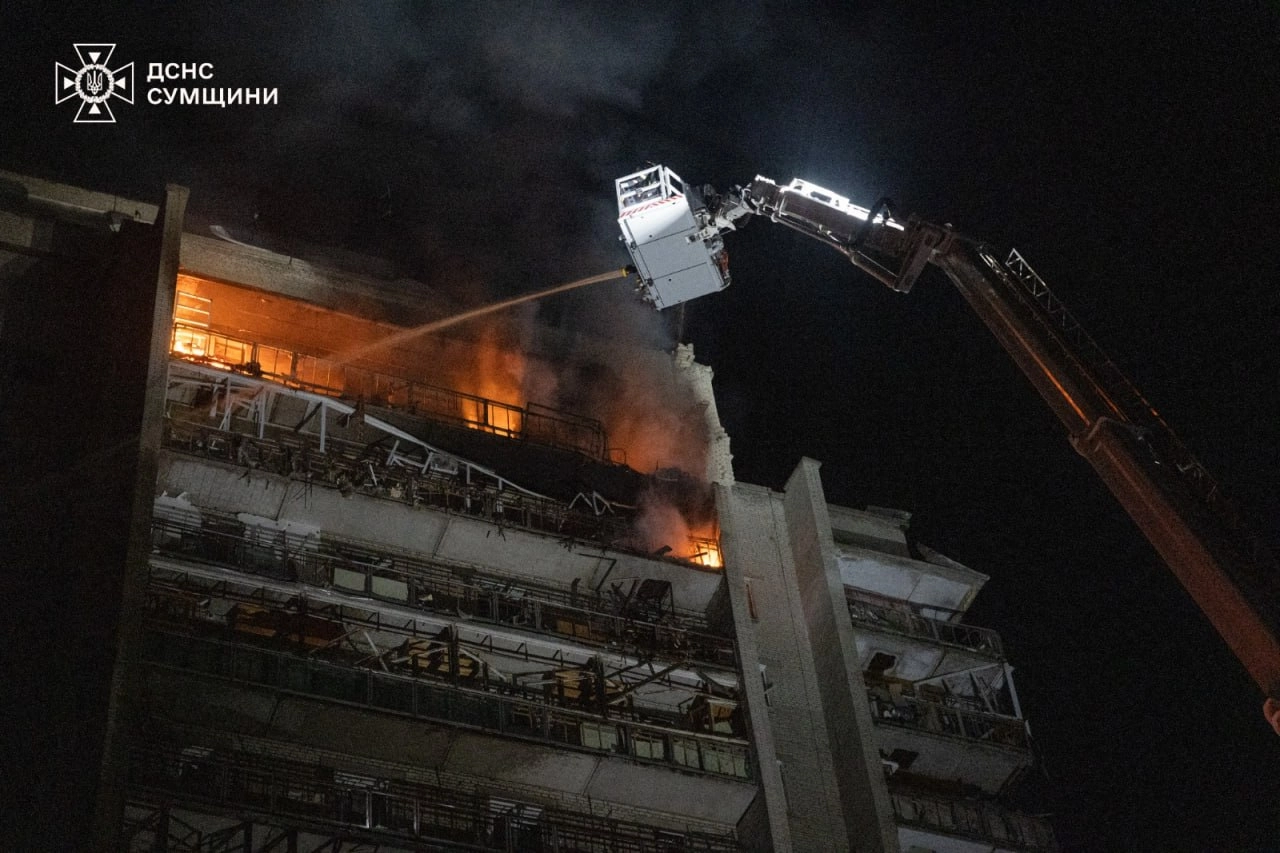
The blast punched through the upper stories. Fire spread across multiple floors. Residents — woken from sleep, disoriented, some without power — were evacuated by emergency crews using high-altitude equipment. By morning: 13 injured, including a child. More than 300 windows shattered across four residential blocks. Gas lines ruptured. Power cut to parts of the city. Four separate addresses hit across the Zarichnyi district. Temporary housing opened for families with nowhere to go.
Sumy sits close to the Russian border. It is struck often. Russia has made a calculation about cities like this — that sustained civilian terror eventually breaks something. So far, it hasn’t.
In Kyiv, the night brought a different kind of fear. An air-raid alert sounded at 6:30 a.m. as drones approached the capital. One was shot down — its debris punching into the roof of a four-story office building in the Darnytskyi district, igniting a fire on the top floor. Mayor Klitschko confirmed it. No casualties. The national railway operator Ukrzaliznytsia pulled suburban trains and evacuated passengers until the threat passed, then resumed service.
In the Dnipropetrovsk region — beyond the Nikopol market massacre already described — Russian forces struck more than 20 times overnight with drones, artillery, and guided bombs. Three of the wounded: a five-month-old baby. A six-year-old boy. A 41-year-old woman. Fires burned through the Pokrovske, Chervonohryhorivka, and Myrivka communities.
The night touched everyone. Almost no one was safe.
Fires in Tolyatti: Ukraine Reaches 750 Kilometers Into Russia
While Russian drones hunted apartment buildings in Sumy and market stalls in Nikopol, Ukrainian drones were flying the other direction — deep into Russia, past the front lines, past the occupied territories, all the way to Tolyatti in Samara Oblast.
Seven hundred and fifty kilometers from the Ukrainian border. Chemical plants burning.
The KuibyshevAzot facility — nitrogen fertilizers, polyamides, caprolactam — caught fire. So did the adjacent Tolyattikauchuk plant, which makes synthetic rubber. Geolocated footage confirmed both. Then Samara Oblast Governor Vyacheslav Fedorishchev did something Russian regional officials almost never do: he confirmed it publicly. Ukrainian drones had struck an industrial enterprise in his city.
The same night, Taganrog — Russia’s Azov Sea port, just 40 kilometers from Ukrainian territory — took hits of a different kind. Two defense enterprises reportedly struck: Atlant-Aero, which builds Russian drones, and the Beriev Aircraft Plant, where Tu-95 strategic bombers and A-50 surveillance aircraft are modernized. One civilian was killed, four wounded when a drone fell on a residential building.
The night before, Reuters had confirmed — through three industry sources — that Ukrainian strikes on the Bashneft-Novoil refinery in Ufa on April 1-2 forced the shutdown of a crude distillation unit handling over 28 percent of the facility’s total capacity.
Add it all up. Reuters calculations show Ukraine’s combined campaign — drone strikes, shadow fleet seizures, pipeline damage — has cut Russia’s oil export capacity by 40 percent. Reuters called it “the most severe oil supply disruption in the modern history of Russia.”
Russia is bleeding fuel. Ukraine is holding the needle.
Too Effective: Why Ukraine’s Allies Want It to Stop Winning the Oil War
Ukraine’s refinery campaign was working. That became the problem.
Since U.S.-Israeli strikes on Iran began February 28, oil prices have blown past $100 a barrel — the first time since the 2022 invasion. Iran shut the Strait of Hormuz. One-fifth of the world’s oil supply stopped moving. Energy markets went into crisis. And Russia — the country Ukraine was trying to bankrupt — earned an extra 6 billion euros in the first two weeks alone as prices spiked.
Now Ukraine’s allies were making calls. Quietly, carefully, without press conferences. Stop hitting the refineries. Global supply is already disrupted. Your strikes are making it worse.
Kyrylo Budanov, head of Ukraine’s Presidential Office, confirmed the pressure to Bloomberg with the studied vagueness of a man who knows exactly what he’s saying. “Let’s answer this diplomatically. We are receiving certain signals about this.” He wouldn’t name the countries asking.
He didn’t need to. In March, Washington had already issued a temporary license allowing countries to purchase Russian oil stranded at sea — a partial sanctions rollback dressed up as emergency energy policy. The move handed Moscow a windfall at the precise moment Ukrainian drones were torching Moscow’s refineries.
Reading between the lines: the West needed Russian oil to stabilize markets it had helped destabilize by going to war with Iran.
Budanov offered cautious optimism that the Iran war might end soon. He gave no indication Ukraine planned to stop striking. Kyiv considers refineries legitimate military targets — they fuel the tanks, fund the budget, sustain the war.
Ukraine’s allies want it to stop winning this particular battle. Kyiv hasn’t agreed.
No Steel, No Tanks: Ukraine Shuts Down Russia’s T-90 Supply Line
The workers at the Alchevsk Metallurgical Plant hadn’t been paid since December. Production was already faltering. The occupation, it turns out, is bad for business.
Then the SBU and Ukraine’s Unmanned Systems Forces arrived — for the second time in a month — and finished the job.
FP-2 drones from Ukrainian defense firm Fire Point hit the blast furnaces first. Then the production shops. Then the gas pipelines, distillation columns, and electrical substations. The SBU published video: flames rising from multiple sections of the facility simultaneously. By the time the smoke settled, Alchevsk had stopped producing steel entirely.
That matters beyond the footage.
The plant — under Russian control since 2015 — feeds steel directly to Uralvagonzavod, the Russian manufacturer that builds T-90 battle tanks and Msta-S howitzers. Hitting Alchevsk isn’t an industrial strike. It’s reaching inside Russia’s armor production pipeline and cutting a wire.
The wage context adds a darker layer. Russia has not been paying workers at industrial facilities across occupied Ukraine for months. At Alchevsk, employees were already earning below the regional average. Across Luhansk Oblast, the former Ukrainian state mining enterprises now run by Russia had accumulated roughly 169 million rubles in unpaid wages. Some miners reported nothing since December 2025.
Russia seized these factories, renamed them, and stopped paying the people running them.
Ukraine’s National Resistance Center documented the arrears. Ukraine’s drones documented the rest.
The plant that Russia couldn’t keep running, Ukraine stopped for good. No steel. No tanks.
Gone Blind: Ukraine Tears Out Russia’s Eyes Over Crimea
One moment it was tracking. The next, it wasn’t.
Somewhere in Feodosia, an S-400 Triumf radar station — capable of locking onto 100 objects simultaneously at 600 kilometers, guiding up to 72 missiles — went dark. Operators from the 414th Separate Brigade’s “Madyar’s Birds” unit had found it.
The Ukrainian military was unusually candid about how hard that is. “It is a complex target because it can be deployed in five minutes and usually changes position before it is detected.” Finding it, fixing it, striking it before it moved — that’s the achievement. The radar is gone. The missiles it would have guided are now flying without direction.
Feodosia was one of four air defense kills that day.
In Donetsk, the 1st Separate Unmanned Systems Center destroyed a Tor surface-to-air missile system. In Luhansk, Ukrainian drones disabled an SKPP radar — the system Russian drone interceptor teams depend on to detect UAVs at 20 kilometers range. Without it, they’re blind. A ZU-23-2 anti-aircraft gun on an MT-LB armored vehicle was destroyed in Luhansk the same day.
Two days earlier, Ukrainian forces had hit the Kirovske Air Base in occupied Crimea — destroying one Orion strike-reconnaissance drone, damaging three more, and taking out an An-72P patrol aircraft. The General Staff confirmed updated damage assessments on April 4.
The pattern is deliberate. Not a single dramatic blow — a sustained, methodical campaign to strip Crimea of the systems protecting it. Radar by radar. Missile battery by missile battery.
Russia’s most strategically important peninsula is getting harder to defend.
Hit the Source: Ukraine Strikes the Factories That Feed the Front
Major Robert “Magyar” Brovdi released his strike accounting for April 4. Read it as a map of everything Russia needs to keep fighting — and everything Ukraine is methodically destroying.
Start at the source. In Russia itself, Ukrainian forces hit two Shahed drone preparation hubs: Khalino Air Base near Kursk City, 100 kilometers from the front, and Navlya in Bryansk Oblast, 70 kilometers out. These are the assembly points — where the drones that hit Sumy and Kyiv overnight are built, armed, and launched. Destroying them before they fly is air defense of a different kind.
Then the supply lines. In occupied Luhansk, Ukrainian strikes hit fuel trains near Shchotove and Stanytsya Luhanska on two consecutive nights. A fuel tanker near Novosimeikine. A ZU-23-2 anti-aircraft gun near Lozivskyi. Command posts and troop concentrations of the Russian 3rd Combined Arms Army near Shulhynka and Bilovodsk. Geolocated footage confirmed strikes near Shchotove, Lozivskyi, and Novosimeikine.
Then the commanders. In occupied Donetsk, Ukrainian drones hit command posts and troop concentrations near Holubytske and Velyka Novosilka — and destroyed a Tor-M2 air defense system near Zachativka, confirmed by geolocated footage.
Then the logistics backbone. In occupied Zaporizhzhia, Ukrainian strikes hit supply hubs of both the 5th and 35th Combined Arms Armies, and a command post near Samiilivka.
Fuel. Command. Air defense. Manpower. Hit them all, simultaneously, across four oblasts.
An army that can’t move, can’t communicate, and can’t be resupplied doesn’t stay an army for long.
Pressure Without Progress: Russia Attacks Across a Dozen Sectors, Gains Nothing
They attacked in Vovchansk. They attacked near Kupyansk, Pokrovsk, Novopavlivka, Slovyansk, Lyman, and the Sumy buffer zone. Across at least a dozen sectors on April 4, Russian forces pushed forward.
They advanced in none of them.
In Vovchansk — the shattered city northeast of Kharkiv fought over street by street for nearly a year — Ukrainian forces had quietly moved forward in the southwestern districts. Geolocated footage confirmed it. Russian forces counterattacked near Vilcha, Starytsya, Tsehelne, Okhrimivka, Izbytske, Hrafske, and Liptsi. The line held.
Near Kupyansk, the evidence of Ukrainian advance came from an unlikely source: Russian drone operators of the 121st Motorized Rifle Regiment, caught on geolocated footage striking a Ukrainian position in northern Kupyansk — a position that hadn’t existed before. When Russian units start targeting new coordinates, it means Ukrainian forces have moved into them.
In the Oleksandrivka direction, Ukrainian forces pushed into northwestern Boikove. Russia counterattacked across a wide arc — Andriivka-Klevtsove, Sichneve, Novohryhorivka, Verbove, Stepove, Zlahoda, Krasnohirske. No territorial change. Ukrainian forces also advanced along the T-0504 Pokrovsk-Kostyantynivka highway north of Berestok, confirmed by geolocated footage.
Elsewhere, the pattern repeated without variation. Near Pokrovsk: attacks at Hryshyne, Bilytske, Rodynske, Myrnohrad, Udachne, Novopidhorodne. No advance. Near Novopavlivka: attacks toward Novomykolaivka and Muravka. No advance. Near Slovyansk and Lyman: attacks south toward Dibrova, east and southeast of the city. No advance.
In the Sumy buffer zone, Russian forces probed near Hrabovske, still trying to widen the corridor they’ve carved along the northern border.
Still trying. Still failing.
The Man Who Talked to Both: Zelensky Flies to Erdogan’s Istanbul
The sequencing was deliberate. On April 3, Erdogan called Putin. On April 4, Zelensky flew to Istanbul.
The man in the middle was sending a message to both.
The two leaders announced “new steps in security cooperation.” They discussed jointly developing gas fields, with details to follow. Ukraine offered Turkey its “expertise, technology, and experience” in defense — not diplomatic filler, but a genuine commodity. Ukraine has spent three years learning to shoot down Iranian-made drones. That knowledge is now worth something in a Middle East at war.
Erdogan’s Putin call the day before had been carefully constructed. He called for an end to attacks on civilian vessels in the Black Sea without naming Russia as the perpetrator. “Turkey urges all parties to refrain from steps that would result in an escalation,” his office stated. The Iran war, he added, “should not be allowed to create additional conflict zones in the Russia-Ukraine crisis.”
Reading between the lines: Ankara wants to be the indispensable broker when this war finally reaches a table. Not a Western proxy. Not a Russian partner. The essential neutral — the country both sides need to have onside.
Zelensky is playing the same board. The Istanbul visit follows 10-year defense deals signed last week with Saudi Arabia, Qatar, and the UAE — joint arms production, training, air defense systems capable of helping unblock the Strait of Hormuz. Ukraine is turning battlefield suffering into strategic currency across the Middle East.
Cities burning at home. Defense deals signed abroad. Zelensky is running two wars simultaneously — one on the ground, one in the world’s chancelleries.
Own Goal: The Kremlin’s Censorship Crackdown Crashes Russia’s Banks
On April 3, Russia’s federal censors tried to block Telegram. They blocked the banks instead.
The Kremlin has been throttling Telegram since February 9-10, tightening its grip on the app that Russian soldiers, civilians, and pro-war milbloggers all depend on. The logic was straightforward: control information, control the narrative.
What followed was not straightforward.
Payment systems at multiple Russian banks went dark. Transfer services failed. Several Russian sources connected the outages directly to the Kremlin’s IP-blocking efforts — before Roskomnadzor, the federal censor, reportedly pressured them to delete the reports. The evidence vanished. The empty ATM screens did not.
Pavel Durov, Telegram’s founder, twisted the knife. Despite the Kremlin’s months-long campaign, 65 million Russians were still accessing Telegram daily through VPNs. The censorship wasn’t working. It was just causing collateral damage.
The polling captured the erosion. Putin’s trust rating — tracked weekly by the Kremlin-linked Public Opinion Forum — fell five percentage points in a single week, from 76 to 71 percent. The largest single-week drop since 2019. The slide began February 8. The Telegram crackdown began February 9.
The sequence speaks for itself.
Now even the Kremlin’s most loyal online warriors are turning. Pro-war milbloggers — the propagandists who have spent three years cheerleading the invasion — are publicly complaining that the crackdown wastes money while prices rise, and has stripped front-line troops of their primary battlefield communication tool.
Russian officials have issued contradictory statements about Telegram policy. Translation: nobody planned this. Nobody controls it. And the backlash is bigger than anyone in Moscow expected.
29 Dead in the Mountains: A Russian General’s Unreported End
Not every Russian military loss comes from a Ukrainian drone. Some come from the mountains of occupied Crimea on a night when something went wrong with a flight.
On March 31, an An-26 military transport aircraft went down in Crimea’s mountains. All 29 military personnel on board were killed. The Russian Defense Ministry confirmed the crash and opened a criminal investigation — Article 351 of the Russian Criminal Code, violations of flight rules.
What Moscow didn’t confirm was who was on board.
BBC’s Russian Service found out anyway. Unnamed sources in the Russian Northern Fleet, corroborated by a relative of another victim: Lieutenant-General Aleksandr Otroshchenko was among the dead. Commander of the Northern Fleet’s air corps since 2013. Syria veteran. Gone in an unreported crash on an occupied peninsula.
Moscow has not officially confirmed his death.
The silence is telling. Russia does not publicize the deaths of generals — not from Ukrainian fire, not from crashed transport planes. But lieutentant-generals don’t disappear quietly. Sources talk. Relatives grieve. The BBC finds the story.
If confirmed, Otroshchenko becomes another data point in a pattern: senior Russian military personnel dying at a rate that would have been unthinkable before February 2022. Combat losses, accidents, the grinding attrition of a war that has now consumed officers at every level.
Crimea, specifically, has become dangerous in ways that extend beyond Ukrainian strikes. The peninsula Russia annexed in 2014 and turned into a military hub is now a target — systematic, patient, unrelenting.
Twenty-nine bodies in the mountains. One general, unconfirmed. Another entry in Russia’s growing ledger of loss.
You Will Fight for the Country That Occupies You
The bus stations closed first. Then the patrols appeared — at markets, street corners, public squares. Since the start of April, anyone moving through occupied Luhansk has been stopped and checked.
“Everyone — drivers, passengers, pedestrians — is being thoroughly checked,” said Oleksii Kharchenko, head of Ukraine’s Luhansk Oblast Military Administration. “Special attention is given to individuals under 30-years-old, whom the Russians plan to throw into meat assaults.”
At night, the knocking starts. Russian law enforcement moves door to door, questioning residents about their neighbors. It’s a technique lifted directly from the Soviet playbook — community surveillance weaponized for conscription. Accept a Russian passport. Register for military service. The paperwork is now in order. You can be drafted to fight against your own country.
Artem Kariakin knows this world. A Ukrainian soldier, he lived under Russian occupation in Kadiivka from 2014 to 2021. He describes what makes this mobilization uniquely brutal — beyond the legal coercion, beyond the checkpoints.
“In Donbas, unfortunately, many families have a family member who was a soldier mobilized into the Russian army and killed by Ukrainian troops.”
Russia isn’t just filling its ranks. It is engineering grief — forcing Ukrainian families into a war where their sons might die fighting their brothers. The trauma won’t end when the war does.
Under the Geneva Convention on the Protection of Civilian Persons in Time of War, this is a war crime. Under international humanitarian law, it is a war crime.
Russia is doing it anyway. The buses aren’t running. The patrols aren’t leaving.
Seven Children Home. Seventeen Thousand, Nine Hundred and Thirty Still Gone.
A 13-year-old boy from Kherson. Both parents dead. Placed in a Russian rehabilitation center by occupation authorities.
Two brothers — 13 and 16 — whose reunion with their sister in Ukrainian-controlled territory occupation officials tried to block.
A 14-year-old boy who hadn’t seen his mother in four years.
Seven children came home. Ukrainian Ombudsman Dmytro Lubinets announced their return as part of the “Bring Kids Back UA” initiative — the fourth such reunification effort facilitated by First Lady Melania Trump, who has maintained a back-channel to the Kremlin on humanitarian issues. The US State Department committed $25 million on March 27 to fund identification, return, and rehabilitation of abducted children.
The math behind the headlines is staggering. Since the 2022 invasion, Ukrainian officials estimate nearly 20,000 children have been illegally deported or forcibly transferred to Russia or occupied territories. Ukraine has brought home 2,070.
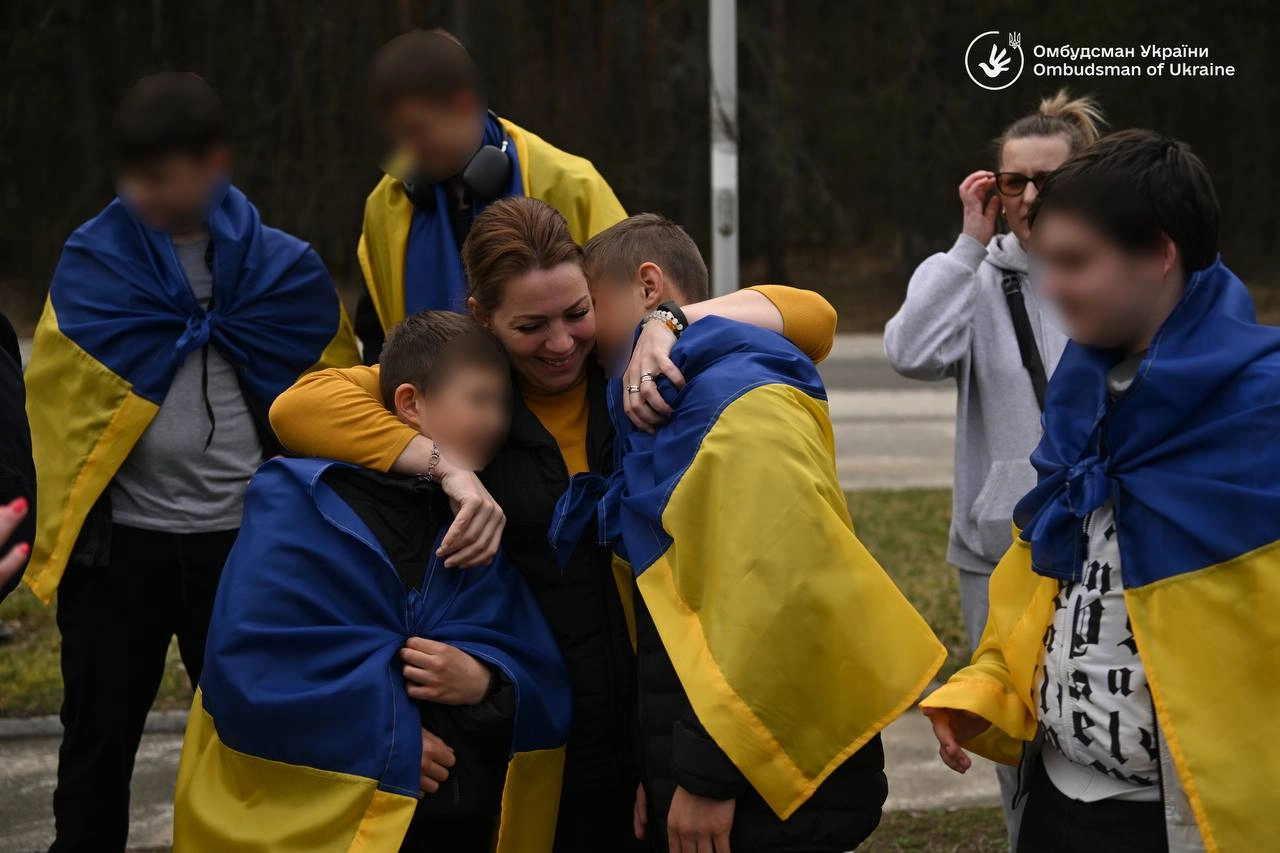
Seven this week.
The International Criminal Court issued arrest warrants in 2023 for Putin and Russia’s children’s rights commissioner Maria Lvova-Belova — the official whose job title is the protection of children, and whose actual job became their deportation. A UN-mandated inquiry classified the transfers as crimes against humanity.
Russia has a word for what it’s doing with these children. It calls it protection.
The ICC has a different word. So does every parent still waiting.
Seventeen thousand, nine hundred and thirty children. Still waiting to come home.
Half the Lights Back On: Ukraine’s Race to Rebuild Before Winter Returns
Russia destroyed 9 gigawatts of Ukraine’s power generation. Ukraine has rebuilt 4.
That number — announced by Energy Minister Denys Shmyhal on April 4 — contains both a triumph and a warning.
Ukraine’s peak winter demand is 18 GW. Russia’s campaign knocked out half of it. In January, the country was generating just 11 GW — running on imports from Hungary, Romania, and Slovakia, burning through 3.6 billion kilowatt-hours of borrowed electricity and 4.6 billion cubic meters of imported gas to keep homes from freezing.
Then 14,000 energy workers went to work. They restored 85 percent of thermal power generation. Sixty-six percent of hydroelectric capacity. Repaired transformers. Rebuilt grid infrastructure. Over 40 countries sent equipment through the Energy Ramstein format and raised 602.5 million euros for the Ukraine Energy Support Fund.
“Partners now clearly understand and better appreciate our main needs,” Shmyhal wrote.
But Russia hasn’t stopped. On April 4 — the same day Shmyhal announced the recovery — Russian drones struck Naftogaz facilities in Poltava. Ukraine’s largest state energy company has now been attacked over 40 times this year alone.
The clock is already running on next winter. Energy officials are urging the government to order critical equipment by May — because some components take a full year to manufacture, and Ukraine’s domestic production workforce has been hollowed out by the war.
Four gigawatts rebuilt. Five still gone. Winter returning in seven months.
The race isn’t over. It’s just started again.
Send the Snake: Ukraine’s Firefighting Robot Goes to War
The cluster bombs had already fallen. Now the rubble was burning — and somewhere inside it, gas canisters.
Soldiers of the 12th Special Purpose Brigade “Azov” stood at the edge of the fire in Kramatorsk and ran the calculation. Move closer: risk the canisters, the FPV drones circling overhead, the next artillery round. Or send the Snake.
They sent the Snake.
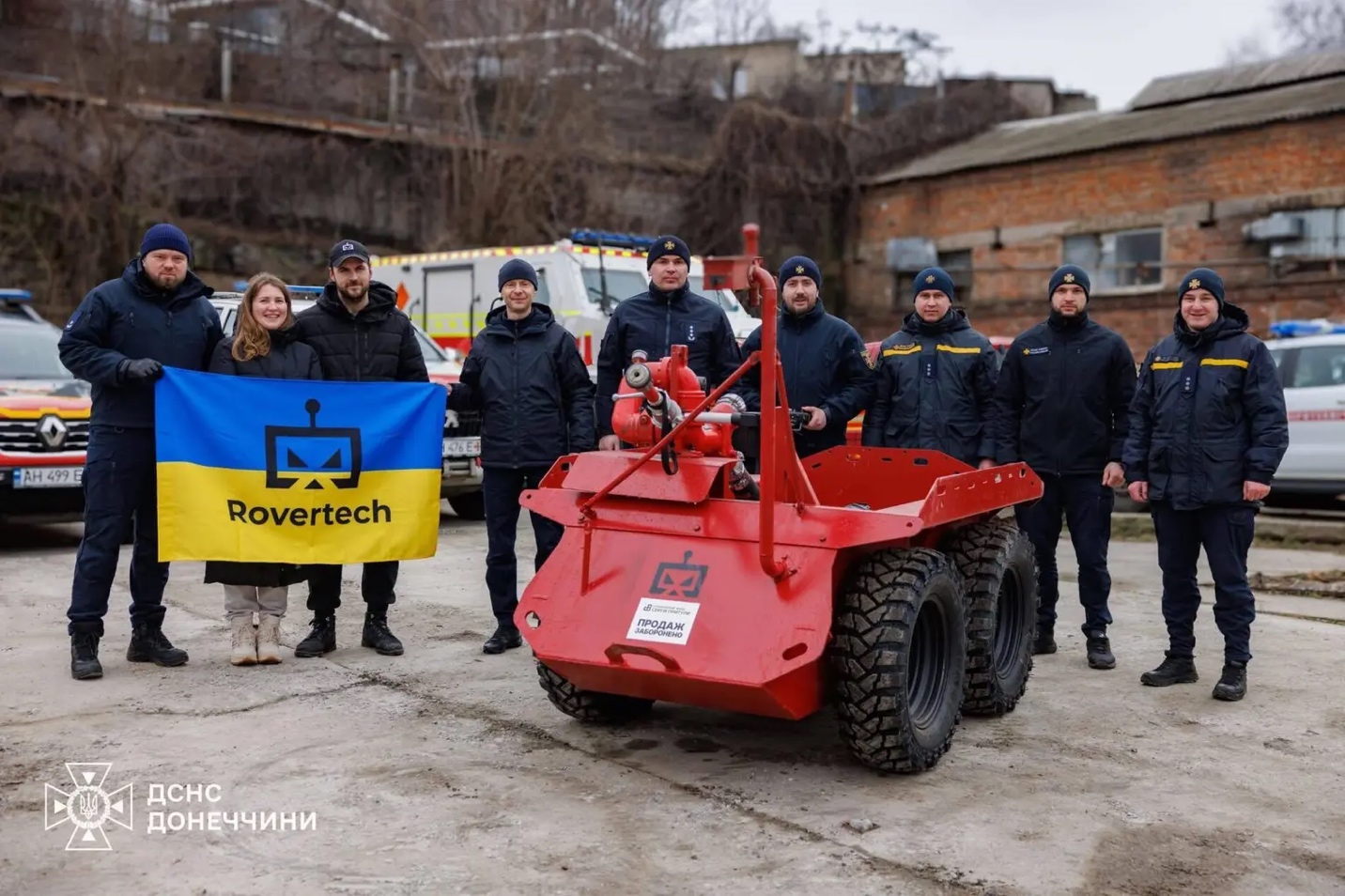
The Zmiy — Ukrainian for “Snake” — crawled toward the blaze on tracks, operated by remote control from 3,000 meters away. Seven hundred kilograms of towing capacity. A remote firefighting module. No pulse to stop. It doused the fire and held the line while soldiers sheltered.
“There was a threat of repeated shelling, then FPV drones — we would move to shelter at those times. When it was safe, we continued working,” said the fire platoon commander, call sign “Berdyansk.”
RoverTech, the Ukrainian defense company that builds the Zmiy, delivered firefighting versions to emergency services in Donetsk and Dnipropetrovsk oblasts in early March. The robot was designed for contested environments — places where humans can’t go without dying. Kramatorsk qualified.
The moment carries weight beyond one fire in one city. Ukraine’s defense tech sector — already attracting significant foreign investment — is finding that battlefield innovations translate directly into civilian survival tools. Robots built to outlast shelling are now saving the neighborhoods the shelling targets.
The war is inventing the tools to survive it.
“Completed.” Ukraine Disagrees. So Does the Map.
On April 1, Russia’s Defense Ministry declared victory in Luhansk Oblast. Occupation complete. Mission accomplished.
Ukraine’s Third Assault Brigade answered the same day. Their troops were “holding the last lines of defense in the region.” A contested strip of land along the western border remained — and remains — unoccupied.
Russia announced completion of a goal it hadn’t achieved. It’s a familiar move: declare administrative victory, feed the domestic audience, hope nobody checks the map. Kyiv checked the map.
In occupied Crimea, the information war runs darker. A 55-year-old man was arrested for allegedly expressing support for Ukrainian military strikes on Feodosia — strikes on Russian military infrastructure in his own occupied homeland. The charge: “public justification of terrorism.” The arresting officers: FSB Black Sea Fleet. The message to every other Crimean watching: keep your opinions to yourself. Or else.
Then there’s Belarus — nominally neutral, functionally complicit. In February, Belarusian opposition organization BELPOL published a list of 120 Belarusian organizations and defense enterprises feeding Russia’s war machine. Components for 152-millimeter artillery shells. Parts for Grad rocket systems. Logistics networks. Financial channels helping Moscow evade sanctions.
One hundred and twenty organizations. In a country that isn’t officially at war.
Three stories, one pattern: Russia declaring what isn’t true, arresting those who notice, and building a coalition of partners willing to help sustain the fiction.
The map still shows that strip of western Luhansk. Unoccupied. Contested. Still there.
What April 4 Revealed
Two wars ran simultaneously on Easter eve.
In Nikopol, a drone found a market. In Tolyatti, Ukrainian drones found a chemical plant. In Istanbul, Zelensky found Erdogan. In Moscow, the Telegram crackdown found the banks. Sixteen people found death. Seven children found their way home.
The day’s arithmetic was brutal and precise: Russia launched 286 drones and gained nothing on the ground. Ukraine struck 750 kilometers into Russian territory and held the line across a dozen contested sectors. The aggressor escalated. The defender reached deeper.
What April 4 revealed about the war’s direction is harder to read.
Russia is bombing harder because the front isn’t moving. That’s not strength — it’s frustration made explosive. But frustration with unlimited munitions still kills people in markets and on the 13th floor.
Ukraine is striking deeper and wider than at any point in the war. The refinery campaign, the industrial strikes, the systematic dismantling of Crimean air defenses — these are not desperation moves. They are the actions of a military that has found its range. The question is whether allied pressure to protect global oil markets will force Kyiv to pull back precisely when the campaign is working.
The Iran war has bent the diplomatic geometry around Ukraine in ways nobody fully understands yet. Western capitals need Russian oil. Russia is earning windfall profits. Ukraine is being asked to ease up. None of this was in anyone’s strategic plan eighteen months ago.
Putin’s trust rating is falling. His banks glitched. His milbloggers are angry. His forces advanced nowhere.
Easter morning came. The drones were still flying.
Day 1,500. The questions outlast the answers. They always do.
A Prayer for Ukraine
1. For the Five Who Went to Market
Lord, we bring before you a Saturday morning in Nikopol — vendors setting up stalls, early shoppers moving through the aisles, the ordinary rhythm of a city that has learned to live inside a war. Then a drone. Three women. Two men. Dead where they stood. A 14-year-old girl in critical condition, carried to a hospital that shouldn’t have needed her. We do not know their names. You do. Hold them. Hold the families who went looking for them and found only the aftermath. Let the weight of five ordinary lives not be lost in the arithmetic of this war.
2. For the Boy Who Was Sixteen
Father, we pray for a 16-year-old boy in Kramatorsk who survived the cluster bombs long enough to reach a hospital, and did not survive the night. He was born in 2009 — into a Ukraine that was already contested, already threatened, already being watched. He did not choose this war. It chose him. We ask for comfort for those who loved him, for the mother or father or friend who got the call. And we ask that his name — unknown to us, known to you — be written somewhere that outlasts the conflict that took him.
3. For the Leaders Carrying Impossible Choices
God of wisdom, we pray for Zelensky in Istanbul — negotiating a peace framework while his cities burned through the night behind him. We pray for the advisors and commanders weighing each strike, each alliance, each concession. The decisions made in these rooms will determine whether the war ends in justice or exhaustion. Grant clarity where there is pressure. Grant courage where there is calculation. And where the choices are genuinely impossible — grant mercy for the choosing.
4. For the Defenders in the Dark
Lord, we pray for the soldiers holding the line in Vovchansk, in Kupyansk, in the Zarichnyi district of Sumy where the drone came through the wall at midnight. For the air defense crews who worked through the night and killed 260 of 286. For the fire platoon commander called Berdyansk, who sent a robot into the rubble because the gas canisters made it too dangerous to go himself. For the 14,000 energy workers who have spent months rebuilding what Russia spent weeks destroying. They are holding something together that the world depends on. Do not let them hold it alone.
5. For the Arc That Bends Toward Justice
God of justice, we hold before you 20,000 children — deported, transferred, taken. We hold the seven who came home this week and the thousands still waiting. We hold the ICC warrants bearing Putin’s name. We hold the UN finding of crimes against humanity. We hold the 55-year-old man arrested in Crimea for the crime of hoping Ukraine would win. History is long, and justice is slow, and we do not know what shape the ending takes or when it comes.
But we ask.
In Your mercy, in Your justice, in Your time — bring this war to its end, and let the ending be worthy of what Ukraine has endured.