
Over Kharkiv, jet-powered drones struck for the first time as Russia unleashed 579 missiles and drones — its largest assault of the year. Over Ufa, 870 miles inside Russia, a Ukrainian strike set one of the country’s most important oil refineries ablaze. In Misrata, Libya, Ukrainian troops were operating a drone base that had already sunk a Russian tanker in the Mediterranean. Day 1,499 — the war that started in eastern Ukraine now burns across three continents.
The Day’s Reckoning
At 4:00 a.m., Ukrainian air raid monitors picked up the first signatures. Then more. Then hundreds.
Russian Tu-95 and Tu-160 strategic bombers were airborne, cruise missiles in their bays. Shahed drones — Iranian-designed, mass-produced, and cheap enough to overwhelm any defense — flooded Ukrainian airspace in waves. By the time the last one fell, Russia had fired 579 aerial weapons in a single assault. The largest barrage of 2026. At least four dead. More than thirty wounded. A nation that had barely exhaled from an identical attack two days earlier, hit again.
While Russian missiles were still falling on Kharkiv and Zhytomyr, Ukrainian drones were setting a refinery on fire in Ufa — a Russian city 870 miles from the front, deeper inside Russia than most people ever drive on a road trip.
And tucked inside an intelligence report published that same morning: Ukraine has been quietly basing troops in Libya. From there, Kyiv had already sunk a Russian tanker in the Mediterranean.
Three simultaneous realities, happening in parallel.
Russia launched its worst aerial assault of the year. Ukraine struck deeper into Russian territory than it ever has. And a covert front — one nobody officially acknowledges — opened on the North African coast.
This is what Day 1,499 looked like: a country absorbing a record attack while running a secret war on three fronts, 2,000 miles from home.
The war started in eastern Ukraine. It no longer stays there.
240 Drones. Then 400. Then the Missiles Came.
At 4:00 a.m., the air-raid apps started screaming. By 5:00 a.m., Ukrainian monitors had confirmed two Tu-160 strategic bombers airborne — each capable of carrying a dozen cruise missiles. The numbers on the tracking screens kept climbing.
By 7:00 a.m., 240 drones were in Ukrainian airspace simultaneously. By 9:00 a.m., that number had nearly doubled.
The assault had actually begun the evening before, at 6:00 p.m. on April 2, and it would not stop until mid-afternoon on April 3 — twenty hours of continuous attack. Russia fired 542 drones, around 330 of them Shahed-type, plus 25 Kh-101 cruise missiles, 10 Iskander-M ballistic missiles, and 2 Iskander-K cruise missiles. Ukrainian air defenses intercepted 515 drones and 26 missiles — an extraordinary performance under relentless pressure. But 11 missiles and 27 drones punched through, striking 20 locations. Debris from intercepted weapons rained down across 22 more sites.
At 10:20 a.m., Air Force spokesman Yurii Ihnat watched a MiG-31 take off on his tracking feed. He knew what that meant. Russian missiles were seconds from launch.
Ihnat had seen this pattern before — but this was the worst version of it. “If they could launch a thousand drones a day consistently, they would,” he said. “As it stands, they are just keeping us on edge constantly.”
Analyst Viktor Kevliuk was blunter about the design: exhaust the air defenses over hours, then send the precise strikes through the gaps. “Their goal is to create a sense of constant danger.”
Russia’s Foreign Minister Sybiha called it what it was — Moscow’s answer to Ukraine’s Easter ceasefire proposal, delivered not in words but in ordnance.
The winter attacks came at night. Spring attacks come in daylight. Russia is testing something new.
Thirty-Seven Hits. Eighteen Locations. Two Days in a Row.
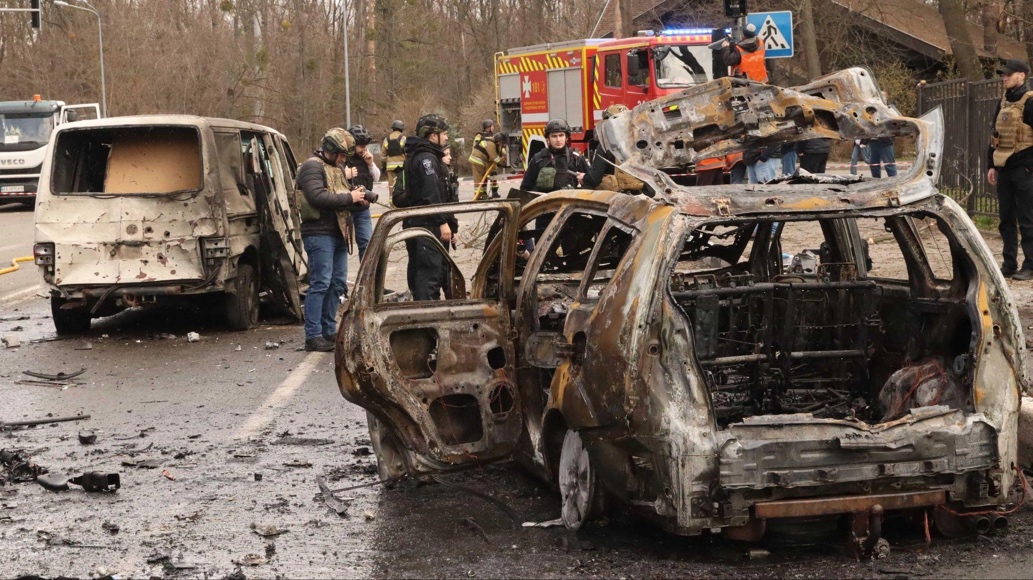
Ihor Terekhov has been mayor of Kharkiv since before the full-scale invasion. He has catalogued Russian strikes for three years — hundreds of them. On April 3, he ran out of measured language.
“Perhaps the most massive in the entire time of the great war,” he wrote. “Definitely the heaviest since the beginning of the year.”
Thirty-seven hits. Eighteen locations. Ballistic missiles and drones arriving in coordinated waves. And something that had never happened before over Kharkiv: jet-powered drones, flying faster than any UAV the city had faced.
“There is critically little time for air defense,” Terekhov warned. “And for residents to descend into shelters.”
In the Shevchenkivskyi district, drone fragments tore through a residential street. Cars burned. Five people were wounded, two critically. A 60-year-old man and a 30-year-old woman were taken to hospital. Neither survived. Twenty-five high-rise apartment buildings were damaged.
Forty miles away in Kyiv Oblast, a 51-year-old man died in the Bucha district when drones hit his neighborhood. A car dealership burned. A school was damaged. At a veterinary clinic in Chabany, roughly 20 animals were killed.
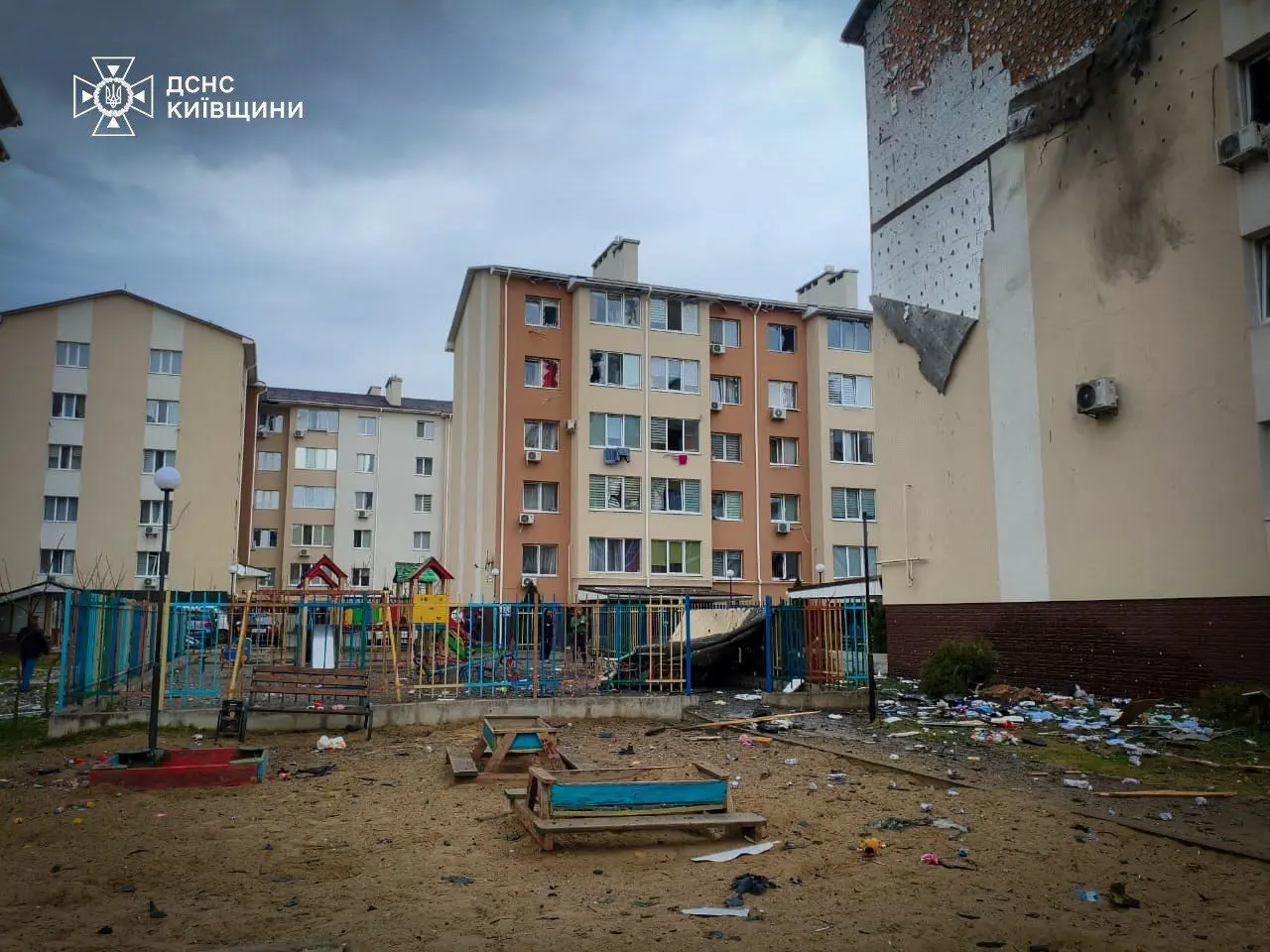
In Zhytomyr, between 10:00 and 11:00 a.m., a 70-year-old woman died in her home as missiles and drones struck the region. Ten others were wounded. Eighteen buildings destroyed — nine of them homes. More than 100 more damaged. In Sumy, a drone hit a shopping center mid-morning, injuring three people among the Friday crowds. In Poltava, drones fell on farms and private homes.
One of the day’s less-reported casualties: the Kyiv Cardboard and Paper Mill — hit by a Shahed, shut down, its tissue and packaging production halted. “An attack on the basic everyday needs of ordinary Ukrainians,” the company said.
It was.
870 Miles Inside Russia, Something Was Burning
The governor of Bashkortostan went on record to say Ukraine’s drones never reached the refinery. Only falling debris, he insisted. Caused some minor damage.
The satellite images told a different story. The Bashneft-Novoil refinery in Ufa was on fire.
Ukrainian drones had flown 870 miles from the border — farther than London is from Warsaw — and hit one of Russia’s most strategically vital fuel facilities overnight on April 1 to 2. The General Staff didn’t bury the significance: “This refinery is a key component of Russia’s fuel and energy complex and is used to meet the needs of the Russian military.” Processing roughly seven million tons of crude per year, it produces the marine, hydraulic, and motor lubricants that keep Russian military equipment running. A residential building nearby also caught fire. No casualties were reported.
The governor’s denial was standard. The fire was not.
Ufa wasn’t an isolated strike. US spatial intelligence firm Vantor had analyzed satellite imagery showing that Ukrainian drone strikes in March alone destroyed at least 40 percent of storage capacity at Russia’s Primorsk port on the Baltic — a terminal handling up to one million barrels of oil per day, through which roughly 40 percent of Russia’s oil exports flow. Eight reservoirs, each holding 50,000 cubic meters, severely damaged. Two of them had stored diesel.
Ukraine was dismantling Russia’s energy infrastructure piece by piece — refineries, ports, pipelines — treating each facility as the military target it functionally is.
Closer to the front, Ukrainian forces also destroyed a Buk-M1 air defense system in occupied Luhansk Oblast, hit fuel tanks near Shchotove, and struck equipment depots, ammunition stores, and a training ground across occupied Zaporizhzhia.
The governor of Bashkortostan could say what he liked. The refinery wasn’t processing anything.
35,000 Dead or Wounded. One Month. All on Video.
Zelensky didn’t ease into it.
“Russian losses this March have reached their highest level since the start of the war,” he said. Then he read the numbers aloud.
Drone strikes alone: 33,988 Russian servicemembers killed or seriously wounded. Artillery and other weapons: another 1,363. Total confirmed losses in a single month: more than 35,000.
“And these are clearly verified losses,” he added. “We have video evidence of each one.”
Let that land for a moment. Not estimated. Not projected. Verified — each casualty documented by the drone operators who caused it.
The numbers expose something profound about how this war has changed. Artillery used to be the killing machine. Now it’s a drone costing less than $1,000, operated by a 22-year-old watching a screen. Major Robert “Magyar” Brovdi — commander of Ukraine’s Unmanned Systems Forces — reported that Russia’s recruitment rate in March fell below its battlefield loss rate for the fourth consecutive month. Russia is losing soldiers faster than it can replace them.
Ukraine also destroyed 274 Russian air defense systems during the month — the shield Russia uses to protect its forces and its territory, being stripped away battery by battery.
British intelligence, Zelensky said, now assesses the battlefield situation as the most favorable for Ukraine in ten months — since June 2025.
He named the units making it happen: the SBU’s Special Operations Center “A.” The “Madyar’s Birds” drone unit. The “Phoenix” border guard unit. Lazar’s Group. The 95th Separate Airborne Assault Brigade.
Behind each name: thousands of strikes. Thousands of confirmed kills.
Thirty-five thousand in March alone.
450 Square Kilometers — and a Question Nobody Can Answer
Since late January, Ukrainian forces have been grinding forward in the Oleksandrivka sector — the raw, contested triangle where Dnipropetrovsk, Zaporizhzhia, and Donetsk oblasts converge. Commander-in-Chief Syrskyi’s number: more than 450 square kilometers retaken over two months.
It’s a significant figure. It’s also been the same figure for weeks.
Emil Kastehelmi, a military analyst with Finland’s Black Bird Group, said what the maps were suggesting. “It seems that the momentum is gone. It does not really seem that the Ukrainians have made much progress beyond what they achieved in February and early March.”
He added a caveat that matters: in the gray zones where fighting continues, “control” is a generous word. Russian forces may not actually hold the ground they’re nominally defending. Ukrainian forces may not fully hold what they’ve nominally taken. The front is a fog, not a line.
On the ground, geolocated footage confirmed a Ukrainian advance northwest of Stepnohirsk in western Zaporizhzhia. Counterattacks were reported near Hulyaipilske and Vozdvyzhivka. A Ukrainian battalion NCO in the Hulyaipole direction noted something telling: Russia was now committing elite naval infantry and VDV airborne troops to plug its losses — the kind of reserve you spend when you’re bleeding.
ISW assessed that Ukraine’s pressure may have already fractured Russian planning for the Spring-Summer 2026 offensive, forcing Moscow into reactive defense rather than coordinated attack.
Zelensky added one more variable. The fog that Russian forces had been using as cover — for infiltration, for movement, for surprise — was disappearing. Spring sunshine doesn’t forgive movement.
The counteroffensive may have stalled. It may also have already done its most important work.
Attack. Repel. Repeat. The Front That Never Breaks.
Same story. Different villages. Same result.
Across the entire eastern front on April 3, Russian forces attacked along every major axis — Kharkiv, Kupyansk, Lyman, Slovyansk, Kostyantynivka, Pokrovsk, Sumy. On every axis, they failed to advance. On every axis, they paid for the attempt.
In northern Kharkiv Oblast, Russian probes pushed toward Veterynarne and Lyptsi. Drone operators from the 71st Guards Motorized Rifle Division and Chechen Sheikh Mansur battalion were active northeast of the city. The line held.
At Kupyansk, Russian forces hit the city itself and six surrounding villages — Krasne Pershe, Petropavlivka, Kurylivka, Novoosynove, Pishchane, Kivsharivka. Repelled on all of them.
In the Donetsk heartland, Russian units threw fiber-optic FPV drones, howitzers, and motorized rifle regiments at Chasiv Yar, Ivanopillya, Kleban-Byk, and a dozen more villages in the Kostyantynivka-Druzhkivka corridor. Ukrainian forces counterattacked at Chasiv Yar. The line held.
Near Slovyansk and Lyman, Russian forces pushed toward Drobysheve and Svyatohirsk. Ukrainian counterattacks met them near Drobysheve. The line held.
Around Pokrovsk — the city Russia has been trying to encircle for months — attacks came from four directions simultaneously: northwest near Hryshyne, north near Bilytske and Rodynske, east near Myrnohrad, southwest near Udachne and Kotlyne. No confirmed advances. The line held.
In Sumy and Kursk oblasts, Russian forces probed toward Sopych, Mala Korchakivka, Andriivka, Kindrativka, and Myropillya. No advances there either.
Six directions. Dozens of villages. Hundreds of attacks.
The line held.
Moscow’s Answer Was 700 Drones
On Wednesday, Zelensky opened a video call with Steve Witkoff, Jared Kushner, Senator Lindsey Graham, and NATO Secretary General Mark Rutte. He had one ask: a ceasefire over Easter.
The Kremlin called it a “PR stunt.”
Then it launched more than 700 drones.
The barrage that tore through Ukrainian cities on April 3 wasn’t a coincidence or a scheduling overlap. Foreign Minister Sybiha said it plainly: “Ukraine made the proposal publicly. Russia is responding with Shaheds and continues its terrorist operations against our energy sector and infrastructure.”
Peace proposal. Drone swarm. The sequence was the message.
March 2026 had already written the context in numbers. Russia fired at least 6,462 long-range UAVs into Ukraine that month — 28 percent more than February, the highest single-month drone total of the entire war. On March 24 alone, more than 1,000 drones flew in a single 24-hour period. Missile strikes, by contrast, fell 52 percent. Russia has done the math: drones are cheaper, harder to intercept in mass, and inexhaustible enough to keep an entire country in a permanent state of alarm.
The heating season that just ended told its own story. Naftogaz counted 129 Russian attacks on Ukrainian gas and heating infrastructure across 151 days — pipelines, production facilities, underground storage, heating systems. Everything Ukrainians needed to survive winter, systematically targeted.
US-brokered peace talks have stalled. Washington’s attention has drifted toward Iran.
Zelensky’s Easter ceasefire offer remains technically on the table.
Russia’s answer is already in the rubble.
200 Ukrainian Soldiers. One Libyan Base. One Burning Russian Tanker.
The war moved to Africa, and nobody announced it.
Radio France Internationale published the investigation on April 3: approximately 200 Ukrainian officers and specialists are currently based in Misrata, Libya — at the Air Force Academy that also houses US Africa Command personnel and a UK intelligence center. Near the Mellitah Oil and Gas Complex, one of Libya’s largest energy facilities, Ukrainian forces have access to a drone launch site.
The arrangement traces back to a deal signed between Kyiv and Tripoli in October 2025. Ukraine gets basing rights. Libya gets drone training, oil sector investment, and future arms sales. Neither government has confirmed it publicly. Neither needed to.
On March 3, the Russian LNG tanker Arctic Metagaz caught fire in the Mediterranean near Libya. Russia accused Ukraine. RFI’s sources said a Ukrainian Magura V5 naval drone, launched from Mellitah, struck it.
The tanker was part of Russia’s shadow fleet — the armada of foreign-flagged, opacity-wrapped vessels Moscow uses to move energy under sanctions. It burned 2,000 miles from Ukraine.
Russia, meanwhile, runs its own Libya operation. The Africa Corps — a paramilitary force controlled directly by the Russian Defense Ministry — operates across southern and eastern Libya in coordination with warlord Khalifa Haftar. Moscow has been in Libya for years, backing the man who opposes the internationally recognized government now hosting Ukrainian troops.
Two armies. One country. Neither officially there.
What began as Russia’s war against Ukraine has become something stranger and wider — proxy conflicts within proxy conflicts, drones launched from North African coastlines, tankers burning in waters nobody expected this war to reach.
The Tanker That Went Dark in St. Petersburg
On March 15, the Flora 1 sailed into St. Petersburg. Then it turned off its transponder and disappeared.
It reappeared on April 1, slipping out of port under a Cameroonian flag. Two days later, Swedish Coast Guard and Police Authority vessels intercepted it east of Gotland, suspecting it of causing an oil spill in the area.
What they boarded was more than a tanker. The Flora 1 is on the EU sanctions list — part of Russia’s shadow fleet, the sprawling armada of foreign-flagged, opacity-wrapped vessels Moscow built specifically to move oil that Western sanctions were designed to stop. Turning off your transponder in St. Petersburg and reappearing under an African flag is not an accident of navigation. It is the system working as intended.
Swedish Civil Defense Minister Carl-Oskar Bohlin confirmed the boarding. He didn’t need to say much more.
European states have been tightening this noose for months — intercepting, boarding, and seizing shadow fleet vessels from the Baltic to the North Sea. Each seizure is a small act in a larger campaign with a simple logic: Russia’s war runs on oil revenue. Oil revenue requires moving oil. Moving oil requires ships. Remove the ships and the chain breaks.
From St. Petersburg to Gotland to the Mediterranean where the Arctic Metagaz burned last month — the same pressure, applied from different directions.
The Flora 1’s transponder is back on now. Its cargo isn’t going anywhere.
Russia Lost a Warplane Over Crimea. Ukraine Had Nothing to Say.
At 11:00 a.m. Moscow time, a Russian Su-30 went down over occupied Crimea.
Russia’s Defense Ministry was unusually forthcoming: training flight, no weapons aboard, crew ejected safely, search-and-rescue recovered them. Nothing to see here.
Ukraine said nothing.
In this war, silence is rarely nothing.
The Su-30 is not a training aircraft that happens to carry weapons. It is one of Russia’s primary strike platforms over Ukraine — used for air patrols, intercepting Ukrainian jets, and launching precision weapons against ground targets. Russia has been losing them at a pace it cannot sustain. In May 2025, Ukrainian Magura naval drones shot down two Su-30s near Novorossiysk with AIM-9M missiles — the first time in recorded history a naval drone destroyed a manned fighter jet. Last December, Ukrainian partisans infiltrated Lipetsk Oblast and set fire to two more on the ground.
Each loss matters. Russia isn’t building replacements.
Whether this crash was mechanical failure, pilot error, or something Ukraine prefers not to discuss publicly remains unanswered. The Ukrainian military reported no aerial intercepts over Crimea on April 3. It also issued no statement, answered no questions, and acknowledged no knowledge of the incident whatsoever.
The Defense Ministry in Moscow called it a training accident.
The crew survived.
The jet didn’t.
Ukraine kept quiet.
The Tank That Learned New Tricks
Somewhere behind Ukrainian lines, a 1960s-era tank is doing something its designers never imagined: being tested as a 21st-century weapon.
John Cockerill Defence, a Belgian arms manufacturer, handed a modified Leopard 1 to Ukraine’s armed forces in early March. Polish defense publication Defence24 reported this week that testing is proceeding well. If it passes, it goes to the front.
The modifications gut everything that made the original obsolete. The manned turret is gone, replaced by a remote-controlled Cockerill 3105 unit operated from inside the hull. Crew drops from four to three — a quiet but significant concession to Ukraine’s manpower reality. The autoloader carries 12 to 18 shells. Thermal sights reach 15 kilometers at night, 18 during the day. The cannon stabilizes for accurate fire on the move.
Then there’s the detail that reveals everything about how this war is actually fought: the gun elevates to 42 degrees. No modern production tank goes that high. That specification exists because Ukrainian tank commanders almost never fight other tanks. They use their vehicles as impromptu artillery — hull-down behind cover, lobbing shells at targets they can’t directly see. The Cockerill turret was built for the war that’s actually happening.
The redesign also sheds 3 to 5 tons through aluminum construction, trading heavy armor for mobility. STANAG Level IV protection stops machine guns and shell fragments. It won’t stop an anti-tank missile or an FPV drone.
Nothing reliably does anymore.
Estimated cost: $4 to 8 million — a fraction of a new Leopard 2. For an army that needs capable vehicles in quantity, that arithmetic matters.
Zelensky Wants THAAD, Ten-Year Deals — and His Drone Makers to Stop Going Rogue
The briefing was closed-door. The frustration was not.
Speaking to journalists on April 2 — Kyiv Post in the room — Zelensky laid out Ukraine’s defense future with equal parts ambition and barely contained anger.
The centerpiece: THAAD. Russia’s KABs have become its weapon of choice along the front — Soviet-era bombs retrofitted with GPS guidance and folding wings, dropped from aircraft flying safely beyond Ukrainian air defense range. Ukrainian forces can’t easily intercept the bombs. They can’t easily reach the planes launching them. THAAD’s radar detects threats at up to 2,000 kilometers. Deploy it, Zelensky argued, and Russian aircraft stop coming. “Russian planes simply would not approach.” Ukraine is formalizing the request to Washington and consulting Gulf states that already operate comparable systems.
The longer vision: at least ten government-to-government contracts, ten years each. Billions invested. Joint production lines in partner countries — the Danish model, already running in Denmark, Germany, the Netherlands, and the UK — expanded globally.
Then came the anger.
Zelensky had recently spoken with a Middle Eastern leader who mentioned a deal his country had struck to buy Ukrainian interceptors — from a Spanish-registered Ukrainian company, without Kyiv’s knowledge or money. “I said: We will not train you or anyone else if our state has not received the money.” He knows of roughly ten Ukrainian drone factories built abroad specifically to bypass state oversight. “Built behind the state’s back,” he said. “I think they’ll be losing out.”
He tried to buy faster from Raytheon. Every delivery date hit the same wall.
“Can it be 2027?” The White House. “2028?” The White House. “2029?” The White House.
Ukraine is fighting now. The paperwork moves at its own pace.
The Alliance That May Have to Stand Alone
Keith Kellogg — Trump’s former Ukraine envoy — called NATO “cowards” this week and proposed replacing it with something new, something that would include Ukraine.
In European capitals, nobody laughed.
Behind closed doors, European leaders are drafting a mutual defense clause modeled on Article 5 — the NATO commitment that treats an attack on one member as an attack on all. The difference: this version works whether Washington participates or not. Three years of watching Russia advance and American politics fracture have produced a continent that is no longer willing to assume the United States will answer the phone.
Europe is rearming. Its lawyers are writing new treaties. Its diplomats are running the numbers on what collective defense costs without American logistics, intelligence, and nuclear deterrence behind it.
The answer is: more than anyone budgeted.
Zelensky is building his own hedge against every scenario simultaneously. THAAD from Washington if possible. Ten-year production deals with Gulf states regardless. Danish-model joint factories across Europe either way. A base in Libya if that’s what it takes to reach Russian tankers in the Mediterranean. The Easter ceasefire proposal sits inside all of this not as a peace offering but as a signal — to Washington, to European partners, to a watching world — that Ukraine is the reasonable party.
Russia answered it with 579 aerial weapons.
Day 1,499. Europe is designing the architecture of an alliance it hopes it never needs. Ukraine is building the weapons it needs right now. And the gap between those two timelines — between Europe’s careful planning and Ukraine’s immediate war — is where the danger lives.
What April 3 Revealed
Two realities ran in parallel and neither cancelled the other out.
While Russian drones killed a 70-year-old woman in her Zhytomyr home, Ukrainian drones were setting a refinery on fire 870 miles inside Russia. While Moscow launched its largest aerial assault of the year, Kyiv was confirming 35,000 Russian soldiers killed or wounded in a single month. While Sweden boarded a shadow fleet tanker in the Baltic, Ukrainian troops in Libya were already operating the base that sank one.
The war has no edges anymore.
Russia innovates — jet-powered drones over Kharkiv, mass Shahed production outpacing interception capacity, daytime attacks designed to exhaust defenses that were built for night. Ukraine innovates back — 870-mile refinery strikes, naval drones hunting warplanes and tankers, Belgian turrets turning Cold War chassis into modern fire platforms.
Each side adapts. Neither breaks.
Zelensky offered Easter. Moscow sent 700 drones as its reply. The people who died in Kharkiv, Kyiv, Zhytomyr, and Sumy weren’t asked their opinion of either gesture.
The questions that matter now don’t have answers yet. Can Russia sustain 35,000 losses a month before its recruitment crisis becomes a collapse? Can Ukraine hold a front this long with an army this size against pressure from every direction? Can Europe build its replacement alliance before Washington decides whether to leave? Can any of this end before the cost becomes unbearable for someone?
Nobody knows.
Day 1,499. The swarm keeps coming. The refineries keep burning. The line holds — somewhere between exhaustion and collapse — and the war keeps expanding into spaces nobody expected it to reach.
A Prayer for Ukraine
1. For the Woman Who Died Between Ten and Eleven
Lord, somewhere in Zhytomyr Oblast, a 70-year-old woman was in her home when the missiles came. We do not know her name. We know she survived everything that came before this — occupation, fear, three years of war — and that she did not survive the morning of April 3. Receive her. Hold her name, even if we cannot. And let her death not be absorbed into a number without someone, somewhere, pausing long enough to grieve her specifically.
2. For the Child in the Obukhiv District
Father, a child was among the wounded when drones struck the Obukhiv district. We are not told their age, their name, or what they saw. We ask that they be held by people who love them, that their fear find somewhere to go, and that the adults around them find words — which do not exist — to explain what cannot be explained to a child. Protect the children of Ukraine. There are so many of them carrying things no child should carry.
3. For Zelensky in the Room
God of the impossible, on April 2 a man sat in a video call and offered an Easter ceasefire to people who were already launching the drones that would answer him. He is trying to hold a country together, fight a war, secure weapons, negotiate peace, and bear witness — all at once, all without rest. We do not ask that his decisions be easy. We ask that they be wise, and that he not be abandoned by the allies whose support he is running out of time to secure.
4. For the Soldiers Holding the Line
Lord, on April 3 Russian forces attacked along every major axis of the front — Kharkiv, Kupyansk, Lyman, Pokrovsk, Zaporizhzhia. On every axis, Ukrainian soldiers held. We do not know what it costs a person to hold a line under that pressure, day after day, month after month, into a third year. We ask that they be sustained beyond what their bodies should be able to sustain. That the ones beside them stay alive. That the line hold one more day — and then one more after that.
5. For the Long Arc
Justice is not fast, and this war has made that unbearable. Refineries burn 870 miles inside Russia. Tankers sink in the Mediterranean. A 70-year-old woman dies in Zhytomyr. And the war continues, and the accounting has not yet come.
We ask that it come.
In Your mercy, in Your justice, in Your time — bring this war to its end and let the ending be worthy of what Ukraine has endured.