
April 2, 2026 — In Ufa, a Ukrainian drone found an oil refinery 800 miles inside Russia and set it on fire before dawn. In occupied Crimea, a separate strike destroyed four Russian Orion drones, a patrol aircraft, and a radar station in a single night raid. In Lviv, a customs inspector stabbed a military enlistment officer to death on a public street in broad daylight. The 1,493rd day of war — when Ukraine’s reach extended deeper into Russia than ever while the cracks inside Ukraine itself grew harder to ignore.
The Day’s Reckoning
Before dawn, a Ukrainian drone crossed 800 miles of Russian airspace and found an oil refinery in Ufa. It didn’t matter that Ufa sits deeper inside Russia than most European capitals. The refinery burned.
By morning, a Kremlin aide had announced peace talks were “on pause.” Russia was demanding Ukraine surrender all of Donbas. And in Lviv, a customs inspector had allegedly stabbed a military enlistment officer in the neck on a public street. The man died in hospital.
Four wars ran simultaneously on April 2.
In the skies over Russia’s industrial heartland, Ukrainian drones proved again that no facility is beyond reach. In the diplomatic corridors of Washington and Moscow, the gap between negotiation and reality widened further. In occupied Ukraine, a systematic dismantling of Ukrainian identity — children taken, indoctrinated, and handed back as something else — continued without pause.
And inside Ukraine’s own military command, something uncomfortable surfaced. A botched armored assault near Pokrovsk — an M1 Abrams tank and two other vehicles burning on the E-50 highway — ignited a public confrontation between a frontline regiment and the defense minister’s own advisor. The question underneath it: is Ukraine’s commander-in-chief micromanaging his forces into unnecessary casualties?
Meanwhile, Russian Lt. Gen. Aleksandr Otroshchenko — commander of the Northern Fleet’s air corps — was confirmed dead in a Crimean plane crash. The 14th Russian general killed since the invasion began. That same night, Ukrainian drones destroyed four Orion strike drones, a patrol aircraft, and a radar station at a Crimean airfield.
Melania Trump announced seven more Ukrainian children had come home from Russia.
Twenty thousand five hundred identified. Two thousand returned. The math of this war doesn’t always move in Ukraine’s favor.
No Safe Distance: Ukraine Burns a Refinery in Russia’s Heartland
The engineers at the Bashneft-Novoil refinery in Ufa thought distance was their protection. They were wrong.
Before dawn, Ukrainian drones crossed 800 miles of Russian airspace — farther than London to Warsaw — and found the facility’s AVT-5 unit, the critical heart of the refining process. Geolocated footage confirmed fires burning at the site. A nearby residential building caught fire too, though workers had sheltered in time.
Regional Governor Radiy Khabirov rushed to contain the narrative. All drones shot down, he insisted. Just debris. Just “an unspecified enterprise.”
The footage said otherwise.
Rosneft’s Bashneft-Novoil refinery processes 7.3 million tons of oil per year. It doesn’t matter whether every drone hit its target. Debris at 800 miles still burns.
This wasn’t a one-off. Ukrainian forces had struck the Ust-Luga oil terminal twice in a single week. Hit a chemical plant in Samara Oblast days before that. Now Ufa — a city so deep inside Russia that attacking it once seemed unthinkable.
Ukraine’s position is explicit: oil facilities fund the war, which makes them legitimate targets. For the executives and engineers managing Russia’s energy infrastructure, that logic is no longer abstract. It arrives before dawn, in the dark, trailing fire.
No refinery is out of range. Not anymore.
One Pipeline Left: Ukraine Targets Russia’s Last Gas Artery to Europe
The Russkaya compression station in Krasnodar Krai sits on the Black Sea coast, anonymous and industrial. Natural gas flows into it from across Russia, gets compressed, and disappears beneath the waves toward Turkey and Europe. Without it, TurkStream stops.
Three Ukrainian drones went looking for it.
Gazprom claimed all three were shot down. The station was undamaged, they said. No disruption to supply.
Maybe. But the choice of target told the real story.
TurkStream is the last pipeline Russia has. NordStream — destroyed. Yamal-Europe to Poland — shut down in 2022. Transit through Ukraine — severed in 2025. What was once a continental gas empire stretching from Siberia to Western Europe has been reduced to two parallel pipes threading under the Black Sea: one feeding Turkey, one reaching into the Balkans and Central Europe.
The timing sharpened the stakes. Global oil and gas prices were already surging — the U.S.-Israeli war on Iran had closed the Strait of Hormuz, squeezing supply worldwide. Russia was positioned to profit enormously from that chaos.
Unless the infrastructure that moved those profits never made it to the export terminal.
Ukraine wasn’t just attacking a compressor station. It was reaching for the revenue stream keeping the war alive — at the precise moment that revenue stream was about to swell.
Gazprom says the drones missed. The Russkaya station keeps running. Gas keeps flowing.
For now.
“Courtesy Visit”: Ukraine Guts a Crimean Airbase and Buries a General
While drones burned Ufa’s refinery, a separate Ukrainian strike team was already over Crimea.
Robert “Magyar” Brovdi, commander of Ukraine’s Unmanned Systems Forces, described what happened next with deliberate understatement: his forces had paid “a courtesy visit” to Kirovske airfield. Ukrainian-made FP-2 strike weapons — each carrying a 60–100-kilogram warhead — did the talking.
When the smoke cleared: one An-72P patrol aircraft destroyed. Four Orion strike and reconnaissance drones obliterated at their pre-flight preparation facility. One Soviet-era P-37 “Sword” mobile radar system — gone.
The Orions matter. Heavy, expensive, dual-purpose machines capable of both reconnaissance and strike missions, they represent exactly the kind of high-value asset Russia cannot quickly replace. Shooting them down mid-mission is hard. Destroying them on the ground before they ever threaten a Ukrainian soldier is efficient. Cold, calculated, and effective.
Crimea has been Russia’s aviation hub throughout the war — the elevated platform from which Russian air power reaches down into southern Ukraine. Ukraine has been dismantling it, piece by piece.
The airfield strike landed against a backdrop already shadowed by death. Three days earlier, an An-26 transport aircraft had crashed into the mountains of occupied Crimea, killing all 29 personnel aboard. The BBC’s Russian Service confirmed what Moscow hadn’t: among the dead was Lt. Gen. Aleksandr Otroshchenko — commander of the Northern Fleet’s mixed aviation corps since 2013, Syria veteran, and now the 14th Russian general killed since the invasion began.
Russia blamed mechanical failure. No external damage found. Kyiv claimed nothing.
Fourteen generals. One peninsula. Two aircraft down in three days.
172 Drones, Two Women on Fire, and a New Weapon Over Kharkiv
One hundred seventy-two drones lifted off from Russian territory overnight — Shaheds, Gerberas, Italmas, and others — fanning out toward Ukraine from multiple directions simultaneously.
Ukrainian air defenses caught 147 of them.
Twenty-two got through. Twelve locations struck. Eight more hit by falling debris. By morning, seven oblasts were in the dark: Kharkiv, Sumy, Donetsk, Dnipropetrovsk, Zaporizhia, Cherkasy, and Odesa.
In Kharkiv’s Kyivskyi district, one drone found a residential building. The second and third floors caught fire. Two women — 61 and 52 years old — were pulled out injured.
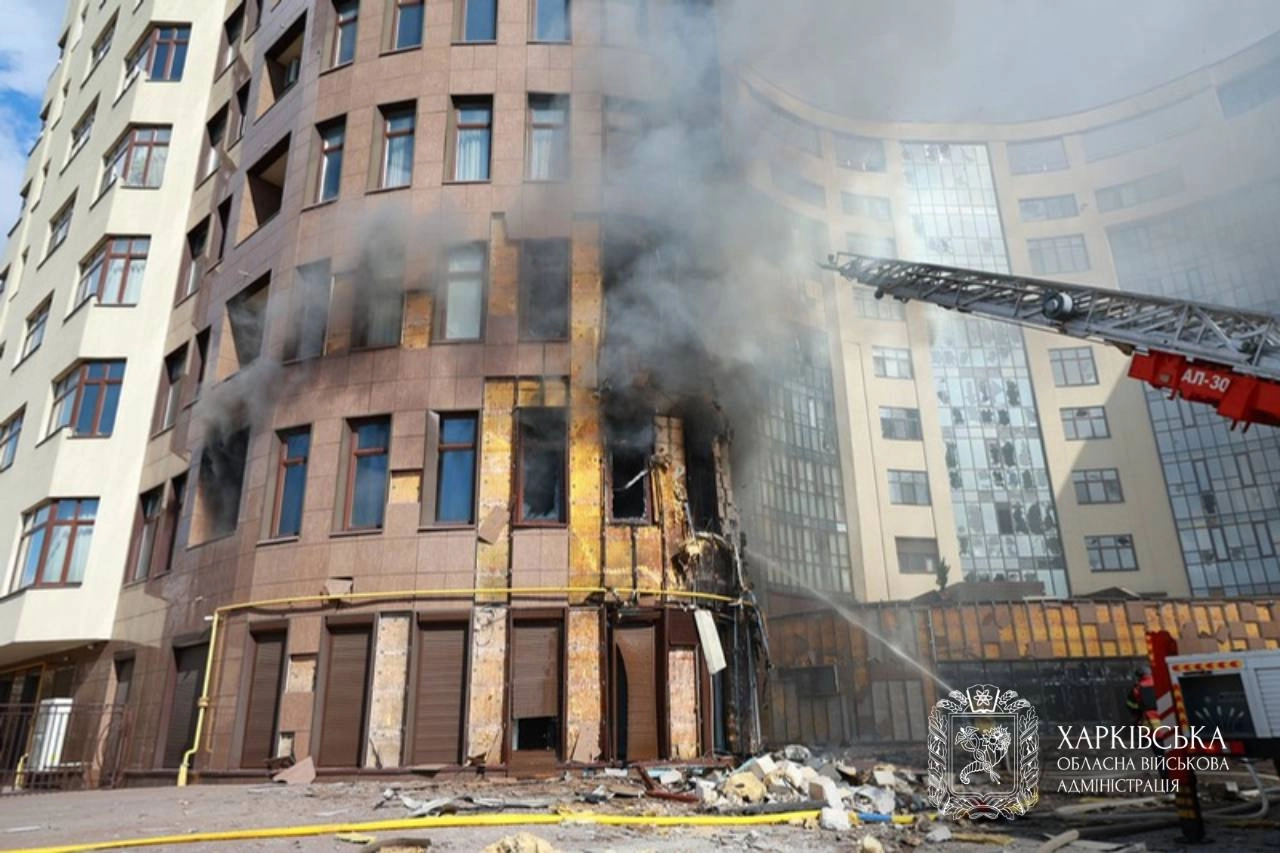
Mayor Ihor Terekhov had been counting. “Since the beginning of the day, the enemy has struck Kharkiv 11 times,” he said, “all hits in the Kyivskyi district.” Then he noted something that stopped people: most of the drones over Kharkiv that day were jet-powered. First time Russia had deployed that variant against the city.
A new weapon. Same neighborhood. Eleventh strike of the day.
Eight hundred kilometers to the west, in Lutsk, the previous night’s attack had found a different kind of target. A logistics warehouse serving Simi and Sim23 — Ukraine’s largest convenience store network, 400-plus shops — burned to the ground. More than 21,000 square meters consumed. Roof collapsed. Every frozen and fresh product destroyed, along with all refrigeration equipment.
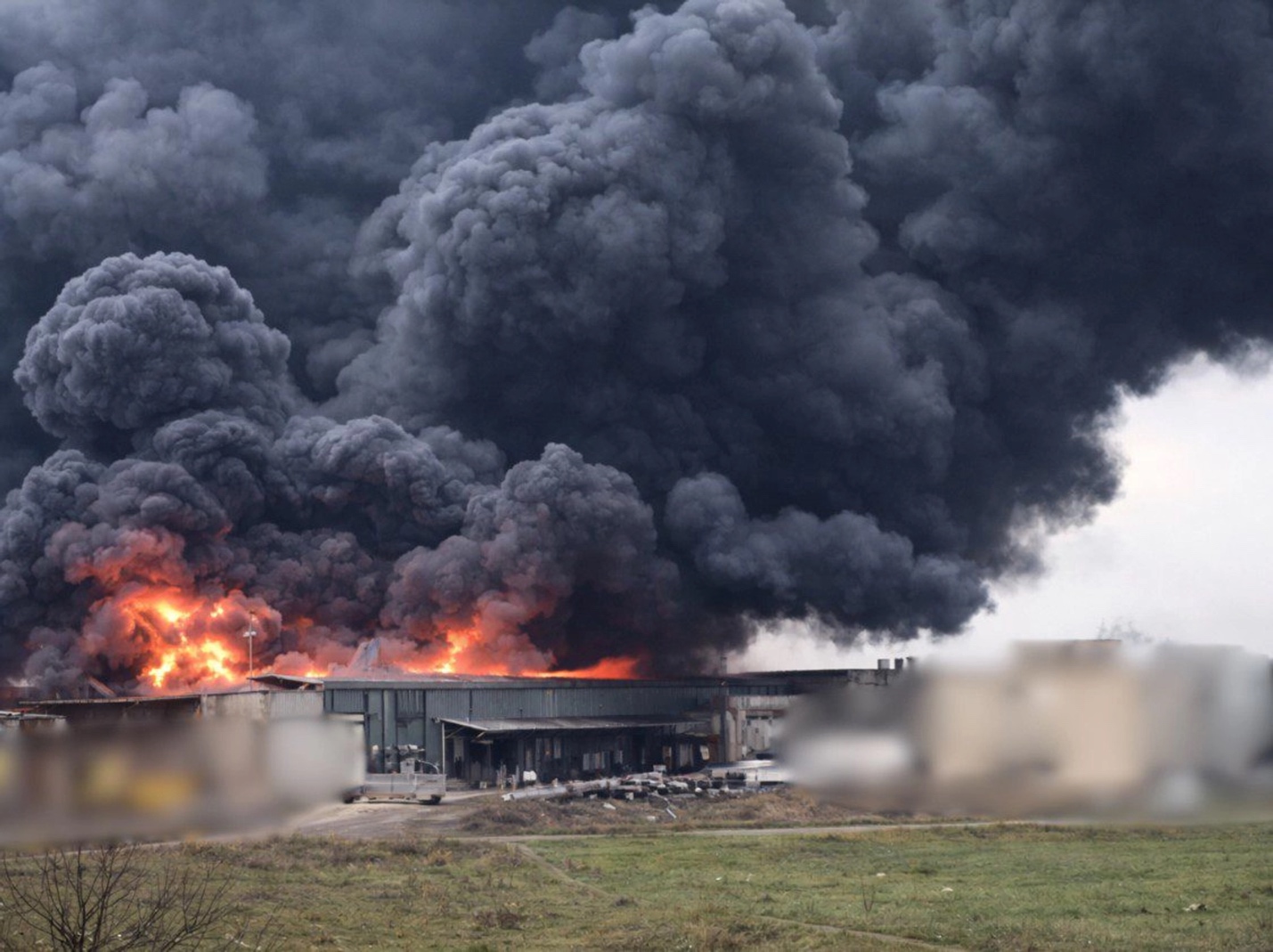
The employees were in shelters. No casualties.
The stores stayed open. Ukraine redistributed its logistics flows and kept moving — because stopping isn’t an option when the attacks don’t stop either.
Blood for Meters: A Thousand Miles of Front, and Nobody Breaking Through
Somewhere near Yunakivka, a Russian assault column pushed forward and stopped. Near Veterynarne, another. Near Kupyansk, inside the city itself, the fighting continued block by block. At Nadiya, geolocated footage captured both sides moving — a motorized Russian assault, a Ukrainian response.
This is what the front looks like on a typical day. Not a breakthrough. Not a collapse. Just pressure, everywhere, all at once.
Russian forces attacked across northern Sumy Oblast — Yunakivka, Mala Korchakivka, Novodmytrivka — without advancing. In Kharkiv Oblast, the 127th Motorized Rifle Regiment pushed northeast of the city near Veterynarne, Starytsya, Izbytske, and Dehtyarne. Also, without advancing.
Near Slovyansk, Ukrainian forces quietly gained ground — southeast of Stavky, north of Riznykivka — while counterattacking at Dibrova, Ozerne, and southern Yampil. In the Kostyantynivka-Druzhkivka area, Ukrainian troops pushed into Ivanopillya despite assault after assault from multiple directions.
Near Pokrovsk, Russian forces attacked from every angle. Didn’t advance.
In Zaporizhia, a Russian milblogger reported fresh reserves and Yolka interceptor drones being rushed to the 58th Combined Arms Army — apparently bracing for a Ukrainian counteroffensive that hasn’t come yet.
Then came Moscow’s announcement: Russia had “completed” the occupation of Luhansk Oblast.
Ukraine’s Third Assault Brigade replied the next day — April 1, timing intentional. They were still there. Still holding. In six months, they’d repelled 144 Russian assault attempts by more than 260 soldiers, inflicting equivalent losses. DeepState maps confirmed it.
Peskov demanded Zelensky surrender Donbas “today.”
Ukraine published a map of its defensive positions.
Burning Tanks on the E-50: Ukraine’s Military Turns on Itself
The video was damning. Russian drone footage from the elite Rubicon unit showed an M1 Abrams tank, a BMP-2 infantry fighting vehicle, and an M1117 armored vehicle burning on the E-50 highway west of Pokrovsk near Hryshyne. Two soldiers dead. The vehicles belonged to Skelia — Ukraine’s 425th Assault Regiment, one of the largest and most lavishly resourced units in the army, operating under the direct patronage of Commander-in-Chief Oleksandr Syrskyi.
Serhii Sternenko didn’t wait. A frontline volunteer turned official advisor to Defense Minister Mykhailo Fedorov, he posted immediately. “What they are doing to people in certain formations is no better than Russian practices,” he wrote. “This must end.”
Skelia fired back. The mission succeeded, they said — infantry dismounted and pushed forward on foot, the fifth vehicle survived and evacuated the crews. Then the invitation: if Sternenko knew a better way to storm Russian strongholds in Pokrovsk, they’d find him a uniform.
The Armed Forces of Ukraine’s official account reshared Skelia’s rebuttal.
That gesture revealed everything.
The 7th Rapid Reaction Corps — officially responsible for Pokrovsk’s defense — was asked whether it had approved or even known about the operation. It declined to comment. Former Azov Brigade Chief of Staff Bohdan Krotevych supplied the answer nobody official would give: “Syrskyi personally approves assault operations, personally distributes the majority of mobilized people to his favorite units, completely ignoring the order of the President.”
Three burning vehicles on a highway. A defense ministry advisor calling it a crime. The military high command publicly backing the regiment over its own minister.
The front wasn’t the only place Ukraine was losing ground.
“The New Indispensables”: Russia Offers Students $87,000 to Fight Its War
The job posting looked like a tech recruitment ad. Academic leave. Free housing. Tuition benefits. Salary up to 7 million rubles — $87,000 a year. Far Eastern Federal University and the Moscow State University of Civil Engineering were among those running it, targeting engineering and aeronautics students.
The position: drone operator. Location: Ukraine.
Dmitry Peskov stepped in front of cameras to frame it carefully. “A completely open offer,” he said, “for technically skilled young people to join a new type of unit.” The recruitment materials had already coined the branding: “the new indispensables.”
What the posters didn’t mention: the work is combat operations. The risk is personal and significant. The reason the salary is $87,000 is because Russia needs these people badly enough to pay that much — and can’t get them any other way without announcing another general mobilization.
Russia is burning through soldiers faster than it can replace them. A second mass call-up would crack the domestic fiction that the war is going well. So instead, the Kremlin recruits at universities — students who are cheaper to pressure, easier to incentivize, and politically safer to lose than another wave of drafted fathers and sons.
The branding calls them elite. The math calls them a workaround.
The Pause: Russia Stalls, Zelensky Dials, and Nobody Expects Peace by Easter
Yuri Ushakov chose his words with the precision of a man who has spent decades saying nothing diplomatically. Trilateral negotiations between Russia, Ukraine, and the United States were, he told reporters, “Currently on pause.” Russia remained in contact with Washington, he added, discussing what he called “Ukrainian-related issues.”
No confirmation from Washington. None from Kyiv.
While Ushakov was parsing language, Zelensky was burning through his contact list. Witkoff. Kushner. Lindsey Graham. NATO Secretary General Rutte. Then a separate call to British Prime Minister Starmer. The pitch was the same each time: a ceasefire for Orthodox Easter, April 12. Ten days away.
Russia has rejected every ceasefire proposal Ukraine has made. Everyone. Analysts gave this one the same odds.
The backdrop made everything harder. Washington’s diplomatic bandwidth was consumed by the war in Iran — the U.S.-Israeli conflict had closed the Strait of Hormuz and was demanding American attention that might otherwise have pressed Moscow toward a deal. Peace talks slow when the superpower mediating them is fighting its own war.
Into that vacuum, Russia issued an ultimatum: withdraw from all of Donbas within two months or face harsher peace terms.
Zelensky’s response was not diplomatic. “I am surprised how anyone can believe this,” he said. “After so many years, they continue pushing this narrative.” He noted the obvious contradiction: Russia had already declared ambitions extending far beyond Donbas.
The Easter ceasefire sits unanswered. The pause continues.
Ten days to April 12. Nobody is holding their breath.
$230 Million and a Factory in Romania: Europe Bets on Ukrainian Drone Expertise
Ukraine knows things about drone warfare that no one else does.
It has learned them the hard way — four years of offense-defense cycles compressed into months, innovations tested not in laboratories but against live Russian air defenses, with the cost of failure measured in soldiers’ lives. No NATO country has that knowledge. No defense contractor has that curriculum.
Romania is about to get it.
Ukraine’s Defense Ministry announced a joint drone production initiative funded by the EU’s Security Action for Europe program — 200 million euros, roughly $230 million. The facility goes up in Romania. Ukrainian battlefield experience meets European industrial capacity.
The Institute for the Study of War assessed it plainly: Europe’s defense industrial base benefits directly. The offense-defense technological cycle Ukraine has been running at war speed is producing innovations NATO members have been watching and want to replicate — but can’t, because they haven’t been in the fight.
The partnership works on two levels simultaneously. Practically: more drones for Ukraine, built faster, with a supply chain inside the EU. Strategically: Ukrainian expertise embedded in European defense manufacturing now, before any ceasefire changes the political dynamics and complicates the relationship.
Whatever happens at the negotiating table, Romanian factories will keep building.
2:15 p.m. in Lviv: A Knife, a Dead Soldier, and a System That Needs to Change
At 2:15 in the afternoon, on a street in Lviv, a Customs Service inspector pulled a knife during a routine document check and stabbed an enlistment officer in the neck.
The officer died in hospital.
Police detained a suspect within hours. His name is being withheld. He faces 10 to 15 years — or life.
The Defense Ministry’s response carried something unusual: honesty. “Anyone who kills a soldier — whether on the front lines or in the rear — is acting against Ukraine,” the statement read. “The killer will face inevitable punishment.”
Then came the admission nobody expected: “Ukraine’s mobilization system requires changes, which will be implemented in the near future.”
The ministry had just acknowledged, in the same breath as a murder, that the system driving men to this point was broken.
The enlistment officer was almost certainly a wounded combat veteran — the military routinely reassigns injured soldiers to recruitment duty. A man who had already given something to the war, now working a desk job that made him a target on a Lviv street.
The pressure behind that knife had been building for months. Ukraine’s draft reaches men aged 25 to 60. Stories of forced street detentions had spread — some Russian disinformation, some confirmed. Volunteers had dried up. The men who remained were the ones who hadn’t found a way out yet.
A government employee chose a knife instead of avoidance.
That is not an isolated incident. That is a system reaching its breaking point — and a ministry, for once, admitting it.
Seven Children Home: The War’s Most Heartbreaking Arithmetic
Seven children came home.
The White House announced it quietly — the fourth such announcement since Melania Trump wrote a personal letter to Vladimir Putin in August 2025, appealing directly to him about Ukraine’s abducted children. President Trump carried the same message in person during his Alaska meeting with Putin. The State Department followed in late March with $25 million for identification, repatriation, and rehabilitation.
Seven more home. The First Lady called it evidence that “both sides remain committed to ongoing cooperation, raising the safety and well-being of children above this abhorrent war.”
Then the numbers land.
Ukraine has identified more than 20,500 children taken by Russia since the full-scale invasion began. Roughly 2,000 have been returned. The International Criminal Court issued arrest warrants for Putin and Russia’s children’s rights commissioner Maria Lvova-Belova in March 2023 — war crimes charges, issued and outstanding.
The warrants exist. The children mostly don’t come back.
Seven is not nothing. Seven children returned to families who had given up counting the days. Seven lives pulled back from whatever Russia was making them into.
But 20,500 identified. 2,000 returned. The gap between those two numbers is not a diplomatic failure or a logistical challenge.
It is the war’s longest shadow — and it will outlast the fighting by decades.
“Nurturing Patriotism”: How Russia Turns Ukrainian Children Into Russian Soldiers
In a school in occupied Simferopol, children were told to weave camouflage nets for the Russian military. Refusal carried consequences: failing grades, FSB reports filed against their parents.
The occupation authorities had a name for this. “Nurturing patriotism.”
In occupied Kherson Oblast, 33 teenagers were sent to the Patriot Center in Krasnodar Krai for pre-conscription military training — the first group from occupied Ukraine to attend. One came back and told interviewers the experience had inspired him to pursue a career in the Russian airborne forces.
He is Ukrainian.
The Cultural Map 4+85 program shipped more than 4,500 children from occupied Luhansk Oblast to Moscow, Sochi, and St. Petersburg in 2025 alone — officially for “cultural enrichment.” The Republic of Kalmykia hosted children from occupied Antratsyt for “medical and social rehabilitation.” A Russian State Duma member announced her humanitarian organization had personally arranged the “evacuation” of 3,500 Ukrainian children to Russia since 2022. Some received surgical interventions during their stays.
She said this proudly, on state television.
The Institute for the Study of War assessed what the individual programs, taken together, represent: a coordinated, systematic effort to permanently erase Ukrainian identity in occupied children and cultivate a generation loyal to the Russian military.
Camouflage nets in classrooms. Pre-conscription camps. Cultural trips that don’t come back as cultural trips. Medical care that arrives with ideological conditions.
Seven children came home today. Russia is building a system designed to make the rest forget they ever had a home to return to.
No Food, No Water, No Way Out: The Slow Death of Occupied Oleshky
The occupation leadership left Oleshky in December. They relocated to Skadovsk and didn’t come back.
What they left behind: a town without food. Russian authorities had stopped delivering supplies in late December 2025. By January 7, residents had emptied the last two trucks by hand — dairy products, vegetables, whatever was left. After that, people started hunting for food. Multiple residents died. Starvation. Cold. No medical care. The hospital became the only place selling food — at prices most couldn’t afford. Road blockades, mines, and vehicle spikes made leaving impossible.
The occupation head for Kherson Oblast, Vladimir Saldo, went on Russian state media to explain that none of this was happening. Ukraine was disrupting civilian logistics, he said. Everything was fine.
Two hundred kilometers northeast, 200,000 people in occupied Luhansk Oblast lost water when a supply line between Kadiivka and Alchevsk failed. The pipeline hadn’t been repaired since 2014 — twelve years of deferred maintenance under occupation, now a crisis. In Melitopol and Mariupol, electricity failures from Ukrainian strikes knocked out water systems too.
To patch the healthcare system it had dismantled, Russia was flying in doctors — from Orenburg Oblast, Adygea, the Jewish Autonomous Oblast — for week-long visits. The “Zemsky Doctor” program promised longer postings, luring 50 medical workers from Moscow to occupied Luhansk with a specific incentive: free housing sourced from “abandoned” properties.
ISW assessed that “abandoned” was a category being deliberately inflated — homes seized from displaced Ukrainians, redistributed to Russian doctors.
The occupation didn’t just take land. It took houses, water, food, and doctors — then offered some of them back, on Russia’s terms.
April 15 or Else: The Kremlin Moves to Seal Russia’s Information Border
Maksut Shadayev called the meeting. More than 20 companies showed up — Yandex, Ozon, Gazprom Media, and others. The Russian Digital Development Minister delivered a deadline: block VPN access by April 15.
The penalties for non-compliance were not subtle. Corporate income tax jumping from 5 percent to 25 percent. Loss of IT accreditation. Military deferments revoked for staff. Telecommunications licenses cancelled — without a court order.
Dmitry Peskov told reporters he knew nothing about the meeting.
Multiple credible Russian outlets had just reported on it in detail.
The VPN crackdown itself wasn’t new — the Kremlin has been trying to seal Russia’s information borders for years. What was new was the architecture of consequences. This wasn’t a request. It was a corporate hostage situation: comply, or watch your tax rate quintuple and your operating licenses disappear.
Russians use VPNs to see what their government doesn’t want them to see. Ukraine. Casualties. The war’s actual trajectory. April 15 was the date Shadayev wanted that window closed.
The same day, a separate law quietly took effect. Since April 1, the FSB has had legal authority to access any Russian organization’s databases — corporate records, financial communications, telecommunications networks, scientists’ international contacts — without a court order. On demand. Instantly.
A member of the New People party noted there was no mechanism requiring the FSB to delete what it copied.
Translation: everything is now accessible. Nothing is private. And there is no oversight.
The Kremlin isn’t just fighting a war in Ukraine. It’s building a state where its own people can’t find out how that war is going.
$2.28 to Betray Your Neighbors: Russia’s Drone-Dropped Spy Network
They looked like money. Hr.100 notes — about $2.28 — falling from Russian drones over the border regions of Chernihiv and Sumy. Residents found them in fields and streets.
Then they read what was printed on them.
One side: “Share the coordinates and help start a fire. You will get real money.” The other: a QR code leading to what officials called “hostile resources.” The messages were written in Ukrainian, not Russian — designed to look like they belonged there.
Oleh Hrihorov, head of the Sumy Regional Military Administration, called it “an attempt at provocation” and told residents not to touch the codes. Chernihiv authorities issued identical warnings within hours.
The scheme was simple and cynical. Russia needs eyes inside Ukrainian territory — coordinates for artillery, locations of military movements, positions of air defense systems. Professional intelligence networks became harder to run after European countries expelled hundreds of Russian diplomats in 2022. So Russia adapted: disposable recruits, recruited cheap, at scale.
A drone can drop a thousand fake banknotes over a border village in minutes. If one person scans the code and sends coordinates, the investment paid off. The note costs nothing. The airstrike it enables costs lives.
The Security Service of Ukraine documents these cases regularly. The fake hryvnia were just the latest delivery mechanism — low cost, wide distribution, written in the target’s own language.
Two dollars and twenty-eight cents. That’s what Russia thinks Ukrainian loyalty is worth.
The Fake Minesweepers: How Two Men Turned Ukraine’s Deadliest Problem Into a Racket
The sappers walked the fields with their equipment, dug carefully into the soil, and “discovered” ammunition.
They had planted it themselves that morning.
Two suspects — a private demining company director and the head of a sapper group — allegedly won government tenders worth Hr. 6.3 million, about $144,000, to clear landmines from 122 hectares of Kherson farmland. The fields had already been demined. The work was already done. They did it anyway, on paper, collecting payment for danger that no longer existed — while creating danger that now did.
Certificates were falsified. Farmers were recruited as accomplices. Inspectors came, saw the “discovered” ordnance, signed off, and left.
Ukraine’s State Bureau of Investigation is now examining additional contracts — 600 hectares across Mykolaiv and Chernihiv regions, Hr. 53.2 million, $1.2 million. The two suspects face up to 12 years in prison and confiscation of property.
The financial crime is almost secondary to what was actually at stake.
Farmers were cultivating those Kherson fields believing them safe. Tractors running over ground that may still hold live ordnance. Children playing near field edges marked clear on official certificates signed by men who never swept them.
Ukraine has more landmine contamination than almost any country on earth. The system clearing it depends entirely on trust — that the certificates are real, that the work was done, that the fields are safe.
Two men just sold that trust for $144,000.
Until 2050: Russia Writes Occupied Ukraine Into Its Economic Future
The Russian State Duma wasn’t debating whether to keep occupied Ukraine. It was debating investment thresholds.
A bill passed in first reading would reduce the minimum capital required to enter the free economic zones of occupied Donetsk, Luhansk, Zaporizhia, and Kherson oblasts — dropping the barrier from 30 percent to 10 percent of total project value. More Russian entrepreneurs in. More Russian money anchored. The program runs until at least 2050.
While the Duma legislated, the construction crews were already working. Far Eastern regions committed funding for 107 social facilities in occupied Donetsk. Moscow and Kaluga sent builders to occupied Mariupol and Pervomaiske. Prime Minister Mishustin signed a decree releasing 8.5 billion rubles for gas supply to occupied Ukraine in 2026 alone.
In occupied Mariupol, planners were drawing up something larger. The port — the biggest on the Azov Sea — was being redesigned for vessels up to 25,000 tons, with dredging projects and customs infrastructure that would connect it to the Caspian Sea and global ocean routes. Target completion: 2040.
In occupied Sevastopol, the Kremlin-controlled MAX messaging app was quietly replacing the apps residents used to manage their apartment buildings. Twenty-four thousand people already using it. Building management chats migrated to a platform the FSB can read.
Every layer told the same story. Investment zones to 2050. Port modernization to 2040. Gas decrees for 2026. Construction crews on the ground today.
Russia wasn’t administering occupied Ukraine. It was absorbing it — methodically, expensively, and with no exit planned.
The Chairman’s Table: Russia Holds Court While Its Army Bleeds in Ukraine
Andrey Belousov took his seat at the head of the table.
Around him: defense ministers and delegations from Belarus, Azerbaijan, Kazakhstan, Kyrgyzstan, Tajikistan, and Uzbekistan — the Commonwealth of Independent States security secretariat, convened in Moscow, chaired by Russia.
The agenda was routine. The symbolism was not.
While Russian soldiers were dying by the thousands in eastern Ukraine, their defense minister was hosting a multilateral security forum — projecting the image of a great power still setting the agenda for its neighbors, still the gravitational center of the post-Soviet space.
Belarus sent Viktor Khrenin. The others sent their delegations. Nobody declined.
That is the point. Whatever Russia’s losses in Ukraine, whatever the cost in men and equipment and international standing, the former Soviet states continue to show up when Moscow calls a meeting. The chair at the head of the table remains Russian. The forum remains Russian-chaired. The orbit holds.
A war of attrition grinds on 1,500 kilometers to the southwest. Here, in a Moscow conference room, Russia still looks like an empire.
What April 2 Revealed
Two realities ran in parallel and neither blinked.
In Ufa, a refinery burned. In Crimea, four Orion drones never flew again. In Moscow, a Kremlin aide announced peace talks were paused while Russia demanded Zelensky surrender Donbas by sundown. Seven children came home. Twenty thousand five hundred were identified. Two thousand returned.
The math doesn’t close.
Ukraine’s drones reached deeper into Russia than ever before — and Ukraine’s own command structure cracked open on social media over burning tanks on the E-50 highway. A mobilization system under pressure produced a dead enlistment officer on a Lviv street. A defense ministry admitted reform was needed in the same statement condemning the murder.
Russia, meanwhile, was not improvising. Free economic zones structured to run until 2050. A port in Mariupol designed for 2040. Children in occupied Simferopol weaving camouflage nets and being told it was patriotism. The occupation isn’t an interim measure waiting for a peace deal. It is the peace deal Russia is building without negotiating.
The Easter ceasefire proposal sat unanswered. The pause in talks continued. The front held — everywhere, and nowhere — pressure without breakthrough, resistance without reversal, a thousand kilometers of contact line trading lives for meters.
What April 2 revealed wasn’t new. It was the war’s essential character made visible again: Ukraine’s reach extending while its internal tensions surface; Russia’s ambitions clarifying while its costs mount; diplomacy performing while the battlefield decides.
Nobody broke today. Nobody will break tomorrow.
The questions that have no answers yet remain the same ones from February 2022.
Day 1,493. The war ground forward.
A Prayer for Ukraine
1. For the Two Women in the Kyivskyi District
Lord, a drone found a residential building in Kharkiv before the day was done — the eleventh strike in that district since morning. Two women, 61 and 52, were carried out of the fire. We do not know their names. We know they were home when the world came through the wall. Hold them in their pain. Steady the hands of those treating them. And remind us that behind every number in every damage report, someone was living an ordinary life until they weren’t.
2. For the Teenager Who Wants to Join the Russian Airborne Forces
Father, somewhere in occupied Ukraine, a boy came home from a military training camp in Krasnodar Krai and told an interviewer it had changed him. He is Ukrainian. He does not know what he is becoming. We do not pray against him — we pray for him. For the identity being quietly dismantled inside him. For the day, whenever it comes, when he is given back the history that was taken. Protect what Russia is trying to erase. It is still there.
3. For Zelensky, Working the Phones
God of patience, he called Witkoff, Kushner, Graham, Rutte, and Starmer — the same proposal each time, an Easter ceasefire ten days away, offered to people who could not deliver and a Russia that would not accept. Give him the endurance to keep making calls that go unanswered. Give him wisdom to know when persistence becomes something else. And give those who hold power over this war the courage to use it for something other than delay.
4. For the Soldiers on the E-50 Highway
Lord, two men died near Hryshyne. Their unit acknowledged it in a social media post, between arguments about tactics and accountability. They did not choose to become a data point in a public dispute about military command. They went where they were sent. Receive them. Comfort those who loved them. And in the rooms where Ukraine’s generals and ministers are fighting each other over how those men died — let someone, finally, ask the right questions and act on the answers.
5. For the 18,500 Still Unaccounted For
God of justice, seven children came home today. The count of those identified stands at 20,500. The count of those returned stands near 2,000. The arithmetic of this crime does not close. The ICC warrants exist. The children mostly do not come back. We name this for what it is — not a diplomatic complication, not a negotiating variable, but a generation taken. Hold every child still in Russia’s system. Bring them home by whatever means mercy and justice allow.
In Your mercy, in Your justice, in Your time — bring this war to its end and let the ending be worthy of what Ukraine has endured.