
Ukraine Daily Briefing | July 2, 2026 | Day 1,590 of the Full-Scale Invasion
Prepared by Dayana Bozhyk
Russia launched 570 drones and missiles at Ukraine overnight on July 1 to 2, the large majority aimed at Kyiv, killing at least 30 people and injuring 91 in the capital alone in what officials called the deadliest single attack on the city this year; Kyiv has declared July 3 a Day of Mourning. President Volodymyr Zelensky visited the ruins of a leveled apartment building in the Darnytskyi district, promised Russia “will receive a response,” and renewed his push for Ukraine to produce its own Patriot interceptors as Defense Minister Mykhailo Fedorov appealed to 40 partner nations for missiles. Elsewhere, Ukrainian forces struck Russia’s fourth-largest oil refinery in Kstovo and blacked out twelve electrical substations across occupied Crimea, while a new report from the Center for Strategic and International Studies found the war has cost more than two million combined casualties, with Russian forces advancing toward Kostyantynivka at a pace comparable to the Battle of the Somme.
THE DAY’S RECKONING
By morning, the number was 30, and rescuers were still digging. A nine-story building in Kyiv’s Darnytskyi district had taken a direct hit sometime after midnight, and by the time anyone could count what was left, 64 apartments were gone — not damaged, gone, turned into the kind of gray rubble that used to be someone’s kitchen table. Seventeen people came out of that one building alive. At least four did not come out at all. Across the rest of the city, the count kept climbing through the day: 30 dead, 91 hurt, more than 130 places hit, a Red Cross warehouse full of medical supplies burned to nothing, a children’s hospital rebuilt once already after Mariupol burned in 2022, hit again.
Volodymyr Zelensky walked through the wreckage in Darnytskyi and said the thing everyone already knew: partners who deliver what they promised, on time, save lives that otherwise get lost to rubble. Not far away, in Kstovo, Russia’s fourth-largest oil refinery was also on fire — Ukraine’s answer, delivered the same night, seven hundred kilometers into Russia. And in a Washington research building nobody in Kyiv could see from a bomb shelter, a new report quietly did the math that mattered most: over two million people, dead or wounded or missing, on both sides of this war combined. Neither side needed the number to know it. Everyone in Kyiv could have told you, digging through a stranger’s kitchen table at four in the morning.
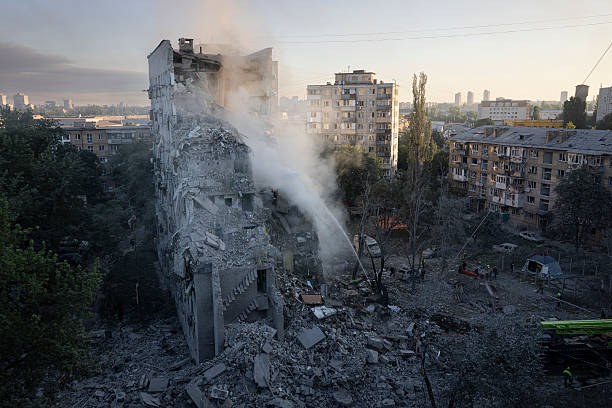
A view of a destroyed building in Kyiv after a large-scale Russian drone and missile attack. At least 30 people were killed and 91 injured in the attack, officials said. (Danylo Dubchak/Frontliner/Getty Images)
KYIV’S DEADLIEST NIGHT THIS YEAR
Russia launched 570 aerial weapons at Ukraine overnight — 496 Shahed-, Gerbera-, and Italmas-type drones, Banderol loitering munitions, and Parodiya decoys; 24 Iskander-M/S-400 ballistic missiles; 34 Kh-101 cruise missiles; eight Kalibr cruise missiles; and four each of Tsirkon hypersonic anti-ship missiles and Kh-59/69 guided missiles. Ukrainian air defense downed 476 drones and most of the missiles, but 25 ballistic missiles and 12 drones still struck 33 locations, with debris falling on 18 more. Twenty-eight of the missiles fired at Kyiv were ballistic — a record for a single attack on the capital, Air Force spokesperson Yurii Ihnat said. More than 20 residential buildings across the capital and a medical facility were hit directly; Prime Minister Yulia Svyrydenko said nearly 100 buildings sustained damage in total, and officials warned additional civilians likely remained trapped under rubble even as the confirmed toll reached 30 killed and 91 injured in Kyiv alone.
The list of what burned reads like a cross-section of ordinary city life. The Donetsk Oblast Intensive Care Hospital — itself a re-established institution after Russian forces occupied the original in Mariupol — was damaged. The Ukrainian Red Cross lost a humanitarian warehouse holding over 79 million hryvnia, about $1.76 million, in generators, heat pumps, defibrillators, and first-responder supplies. Electronics retailer Moyo lost its entire warehouse; IT distributor ERC took a direct missile hit that wounded staff; wine retailer OKWINE’s central warehouse was destroyed; logistics firm Denka Logistics lost roughly 800,000 books belonging to publisher BookChef, representing years of work by authors, translators, and illustrators; the historic CityHotel Residence caught fire on its roof. DTEK reported damaged energy infrastructure leaving parts of Kyiv without power, and internet provider Utels lost equipment serving roughly 500,000 homes and businesses. A record 52,500 people, including nearly 4,500 children, sheltered in Kyiv’s 46 metro stations overnight — the highest wartime shelter use ever recorded in the capital.
Kremlin spokesperson Dmitry Peskov claimed later on July 2 that Russian forces had struck only “military or quasi-military targets.” Zelensky, standing at the ruins in Darnytskyi, called the claim what it was by simply describing what he saw: “An ambulance station, a scientific institute, a hotel, and businesses have also been destroyed.” Kyiv Mayor Vitali Klitschko called it the war’s “most massive” attack on the capital and declared July 3 a Day of Mourning, with flags at half-staff and public entertainment events canceled citywide.
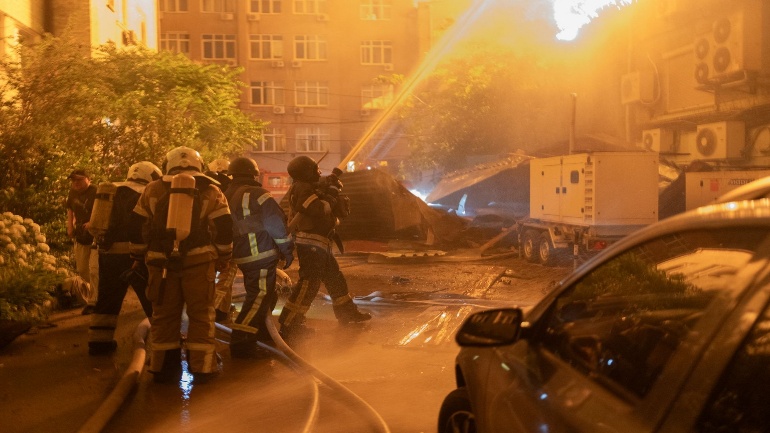
Ukrainian firefighters battle a fire in a building previously hit during a Russian air attack on Kyiv, Ukraine, early. (Roman Pilipey / AFP / Getty Images)
THE WORLD REACTS, AND KYIV ASKS FOR PATRIOTS
The diplomatic response arrived within hours. EU foreign policy chief Kaja Kallas said words alone would not stop the attacks and pledged new sanctions targeting Russia’s military-industrial complex; UN Secretary-General António Guterres condemned the barrage as a violation of international humanitarian law; Dutch Defense Minister Dilan Yeşilgöz-Zegerius said “Putin’s atrocities know no bounds”; Moldovan President Maia Sandu called for greater pressure on Moscow; and EU Ambassador to Ukraine Katarina Mathernova, who weathered the attack in Kyiv, described it simply as “hell on Kyiv.” British Prime Minister Keir Starmer called the strikes “barbaric,” while his predecessor as a vocal critic, Boris Johnson, went further, accusing Western governments of “doing nothing” and asking pointedly why the UK still imports Russian-derived aviation fuel through a loophole and why the West hasn’t seized the shadow fleet or released frozen Russian assets outright.
Zelensky used the moment to renew a longer-standing appeal: in his evening address, he said Ukraine needs to produce its own Patriot interceptors rather than rely solely on imports, noting Washington has been in talks with Kyiv over production licenses since before the G7 summit in France. “We have been discussing licenses for the production of Patriots with the U.S. administration for a long time already,” he said, estimating Ukraine would need at least 140 Patriot missiles to intercept a single attack involving 70 ballistic missiles. Defense Minister Mykhailo Fedorov separately appealed to nearly 40 partner countries to transfer Patriot missiles immediately from existing stockpiles, in exchange for future contracted deliveries, saying Ukraine has already signed contracts for hundreds of PAC-2 missiles with German backing and taken a first step toward buying 100 more through a €1 billion EU-backed loan. In a smaller but related development, aerospace giant Airbus signed a memorandum with Ukraine’s Brave1 defense-tech ecosystem on June 30, its first industrial partnership with a top-tier Western defense firm, to collaborate on frontline-tested military technology.
RUSSIA’S DRONES GET FASTER, AND SO DOES THE DAMAGE THEY DO
Ukrainian Air Force spokesperson Colonel Yuriy Ihnat said Russian forces used an unusually high number of jet-engine drones in the July 1–2 strike package, capable of speeds up to 500 kilometers per hour — fast enough that Ukrainian mobile fire groups and interceptor drones simply cannot catch them, leaving only scarce fighter jets and air defense missiles able to respond. Ukrainian drone and electronic-warfare advisor Serhiy “Flash” Beskrestnov reported that nearly all the Shahed-type drones launched at Kyiv this week operated on a new frequency band, 3,900 to 4,100 megahertz, that Russian forces began testing in late June specifically to outrun Ukrainian jamming systems. Both adaptations point the same direction: Russia continues refining its strike packages specifically to make them harder to intercept, a pattern ISW assesses will keep increasing civilian harm as it succeeds.
A SHADOW FLEET’S SECOND JOB: LAUNCHING DRONES INTO NATO SKIES
The International Institute for Strategic Studies published a report July 2 concluding that Russia has used shadow fleet tankers as floating launch and recovery platforms for drone incursions into NATO airspace since 2024, recording 144 such incursions over 13 NATO states and Ireland between August 2024 and February 2026, including flights over military and submarine bases in the UK and France. IISS identified one to five shadow fleet vessels near each incursion site, with the Russian GRU orchestrating a pattern of launching drones from ships running dark and recovering them via other vessels acting as relay stations. ISW independently confirmed 11 of 15 vessels IISS identified using ship-tracking data, and assesses the campaign is part of a broader Russian “Phase Zero” effort to destabilize NATO cohesion ahead of any future confrontation with the alliance.
DID UKRAINE JUST FIRE ITS FIRST BALLISTIC MISSILE?
Russia’s Ministry of Defense claimed in its July 2 briefing that Russian air defenses intercepted a “long-range operational-tactical missile” over the past 24 hours alongside seven guided bombs and 602 fixed-wing drones — a claim Bloomberg noted, if confirmed, would mark Ukraine’s first documented use of a ballistic missile in the war, beyond the cruise and drone systems it has relied on so far. Russian military bloggers separately claimed a Ukrainian ballistic missile was shot down over Moscow Oblast on June 30, describing an S-300/S-400 engagement at unusually high altitude and a large impact crater; some speculated the object was Fire Point’s domestically developed FP-9, still officially under development, with a claimed range of roughly 850 kilometers. Fire Point’s chief designer said in June the FP-9 could begin flight tests “toward Moscow” as soon as this summer. Ukraine has not confirmed using any ballistic missile, and Kyiv Post could not independently locate Russia’s original statement.
NO ADVANCES, FRONTLINES HOLD — AGAIN
Neither side made confirmed gains anywhere along the front on July 2, continuing a pattern now well into its second week. In northern Kharkiv Oblast, Ukrainian forces cleared Russian infiltrators — some of whom had disguised themselves as civilians, a war crime under the Geneva Convention — from Kozacha Lopan and Hraniv. Russian forces appear to be running short on certain drone types in the area, increasingly cutting anti-tank mine warheads in half to arm Molniya drones rather than using their preferred fiber-optic FPVs. Near Pokrovsk, a Ukrainian battalion commander reported that Russian forces have twice withdrawn elements of the 90th Tank Division for replenishment and are now infiltrating on foot rather than risking armored assaults, while Ukrainian forces extend fiber-optic drone range past 15 kilometers. Russian milbloggers continued posting likely AI-altered footage of flag-raising ceremonies — this time near Podoly and in Pyskunivka east of Slovyansk — as part of what ISW calls a systematic cognitive-warfare effort to manufacture the appearance of a collapsing Ukrainian front where none exists.
Ukraine’s intermediate-range strike campaign kept pace: a command post near occupied Vilshana, a railway bridge over the Siverskyi Donets near occupied Luhansk City, a gas distribution station near Aidar, an electrical substation near Tymonove, a drone depot near occupied Kamyanka, and a Russian Tornado-S rocket system worth roughly $15 million, destroyed near Hulyaipole. Southern Defense Forces spokesperson Vladyslav Voloshyn reported that Russian troops are increasingly refusing deployment to observation posts on the Dnipro River’s contested islands near Kherson, citing collapsed logistics that leave them without evacuation routes, water, or medical supplies — soldiers who refuse are reportedly being reassigned to assault units near Orikhiv instead. Separately, Ukrainian Commander-in-Chief Oleksandr Syrsky reported Russian military command is scaling back plans to build strategic reserves in favor of feeding troops directly to the front, a claim ISW says is at least consistent with Russia’s staggering June casualties. In Belarus, officials accused Ukraine of drone-striking a passenger bus traveling from Minsk to Krasnodar Krai, injuring two; Ukraine’s General Staff denied any such strike and called it a Russian information operation, and Belarusian Security Council Secretary Alexander Volfovich notably declined to blame Ukraine directly, continuing a pattern of Minsk resisting Kremlin framing that casts Ukraine as a threat to Belarus.
UKRAINE HITS RUSSIA’S FOURTH-LARGEST REFINERY, AND A WARNING SYSTEM GOES DARK
Ukrainian forces struck the AVT-6 primary processing unit of the Lukoil-Nizhegorodnefteorgsintez Oil Refinery and the Starolikeevo Linear Production and Dispatching Station in Kstovo, Nizhny Novgorod Oblast, roughly 780 kilometers from the border, overnight. The refinery is Russia’s fourth-largest and its second-largest gasoline producer, processing some 17 million metric tons of crude annually and supplying jet fuel, diesel, and lubricants to the Russian military; the strike caused a fire and damaged the AVT-6 unit, though the facility had already been offline following a June 25 Ukrainian strike, Reuters reported. Nizhny Novgorod’s governor said regional air defense destroyed 30 aerial targets and confirmed one death.
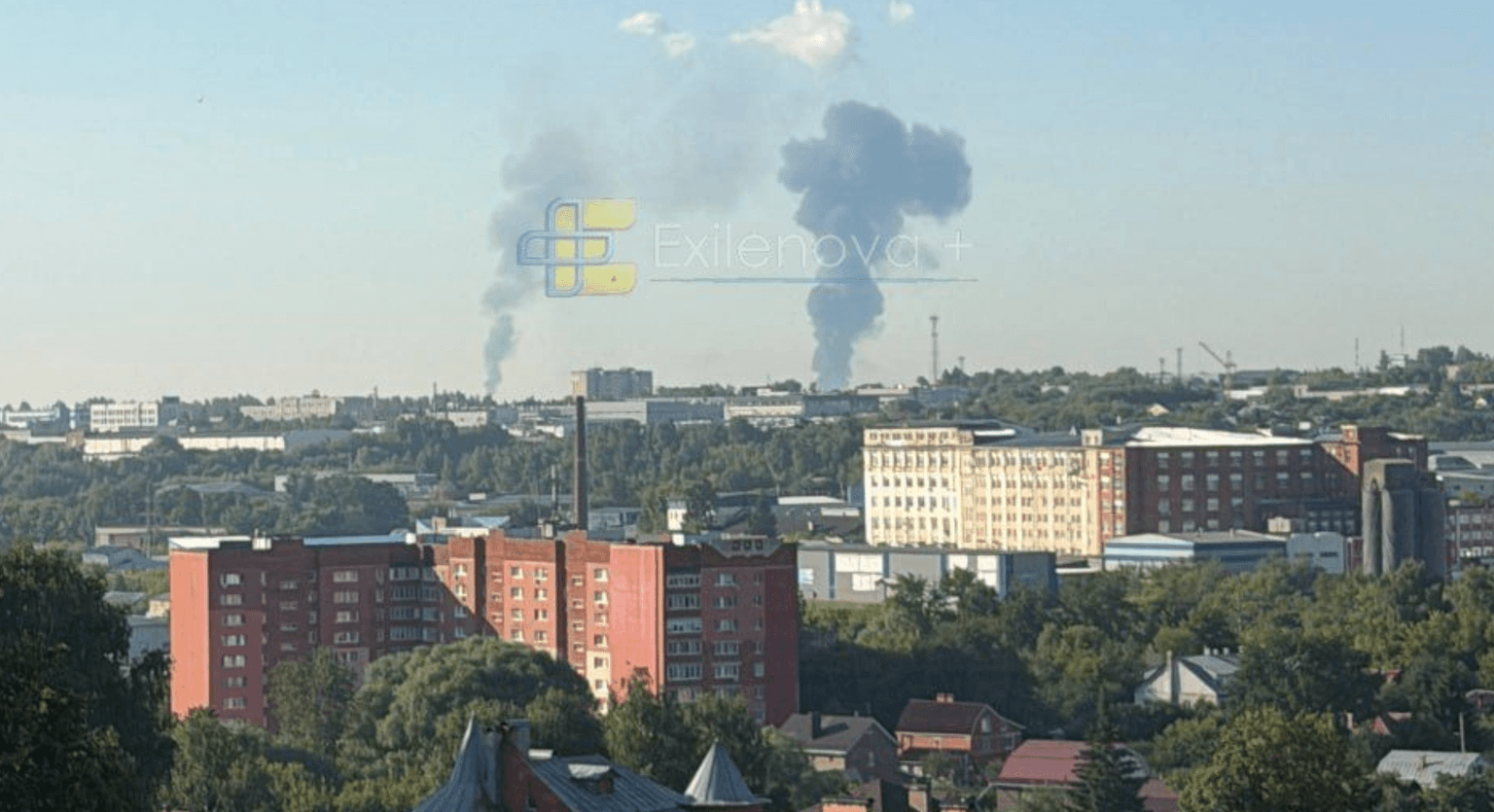
Smoke rose after a Ukrainian strike on the Lukoil-Nizhegorodnefteorgsintez oil refinery in Kstovo, Russia’s Nizhny Novgorod. (Exilenova Plus+/Telegram)
New battle damage assessments filled out the picture of Ukraine’s broader campaign against Russia’s early-warning infrastructure: the Ukrainian General Staff confirmed its June 26 strike on a space communications center near Beloomut, Moscow Oblast destroyed technical buildings and antennas, while a Russian insider source claimed combined strikes on communications centers in Beloomut, Dubna, and Gus-Khrustalny disrupted the Russian Missile Attack Warning System’s communications with the Voronezh and Daryal early-warning radars and cut the KROKUS channel that alerts Russian leadership to incoming strikes. Geolocated imagery also confirmed smoke still rising from the Penza missile-component plant Ukraine struck July 1.
A MOONLIT NIGHT FOR CRIMEA: TWELVE SUBSTATIONS GO DARK
Ukraine’s Unmanned Systems Forces conducted a 48-hour operation July 1–2 that knocked out twelve electrical substations and a gas distribution station across occupied Crimea, Donetsk, Luhansk, and Zaporizhzhia oblasts, commander Major Robert “Magyar” Brovdi reported, along with a fuel depot near occupied Melitopol. “What a moonlit, starry, clear night… Moscow will fall,” Brovdi wrote, releasing footage of the strikes. NASA satellite data confirmed heat anomalies at several of the targeted sites, and an anonymous source told RFE/RL’s Crimean Service that a large quarry near occupied Bilohirsk halted operations entirely for lack of fuel. The strikes deepen an energy and fuel crisis already severe enough that occupation authorities declared a state of emergency in Crimea in late June; before 2014, the peninsula relied on mainland Ukraine for over 80 percent of its electricity, and the Russian-built plants meant to replace that supply remain just as vulnerable to Ukrainian drones.
BEHIND THE LINES: DEPORTED CHILDREN, CRACKDOWNS, AND A WAR ON MINORS
Russian occupation authorities completed the evacuation of the Artek International Children’s Camp in occupied Crimea, sending some children home and transporting others to camps in Krasnodar Krai — a move ISW says may constitute deportation, not mere transfer, if any of the children were Ukrainian nationals. Separately, Ukrainian outlet RIA Melitopol reported Russia deported at least ten political prisoners, including retired journalist Iryna Levchenko, from a Simferopol detention center to Krasnodar Krai. Russia’s Ministry of Education confirmed it is raising the “basic military training” share of mandatory school curriculum from 20 to 50 percent starting September 1, including compulsory drone assembly and operation instruction, in occupied Ukraine as well as Russia itself. Occupation authorities in Luhansk and Kherson continue paying Russians tens of thousands of dollars to relocate to occupied territory, while Russia’s FSB continues prosecuting residents on fabricated treason charges — a Melitopol woman was sentenced to 11 years for transferring $26 to the Ukrainian military. An investigation by human rights group Parubets Analytics found Russia has added 465 minors to its “terrorist and extremist” registry since 2022, including at least 37 identified Ukrainians, the youngest just 14 years and three months old.
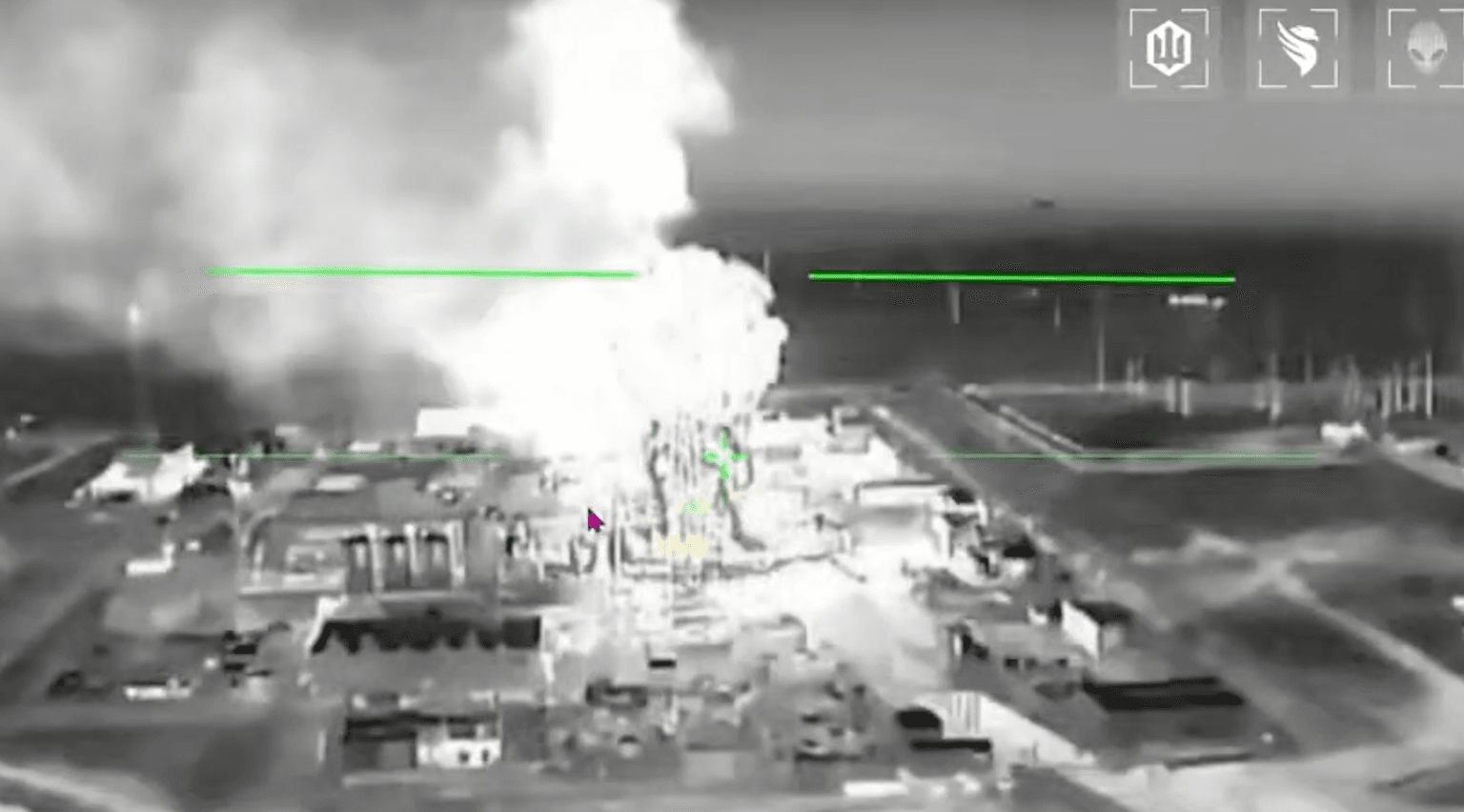
Screenshot from a video depicting Ukrainian drone strikes on power substations in Russian-occupied Crimea during an operation. (Robert “Madyar” Brovdi / Telegram)
THE REAL NUMBERS: TWO MILLION CASUALTIES AND A WAR MOVING AT WORLD WAR I SPEED
A new report from the Center for Strategic and International Studies, “Russian Blood and Treasure,” estimates combined Russian and Ukrainian casualties have surpassed two million. Russia has likely suffered 1.4 million total casualties, including 400,000 to 450,000 dead, since February 2022; Ukraine has suffered between 525,000 and 625,000 casualties, including 125,000 to 150,000 dead. Independent researchers with BBC Russian Service and Mediazona have confirmed 223,000 to 228,000 named Russian dead using obituaries and court records alone — researchers believe the true figure exceeds 352,000. CSIS found Russia’s 2026 monthly casualty rate, 30,000 to 34,000, now exceeds its monthly recruitment of roughly 27,000, and the casualty exchange ratio has worsened to nearly 8 to 1 in Ukraine’s favor this year, up from 2:1 or 3:1 for most of the war.
The human cost buys almost nothing on the map: CSIS found Russian ground gains toward Kostyantynivka averaged just 50 meters a day in the first half of 2026 — a pace comparable to the Battle of the Somme, and 30 to 100 times slower than Russia’s advances in the war’s first year. The report directly rebuts Putin’s June claim, made in a state TV interview, that Russian forces were advancing “in virtually all sectors,” noting ISW’s own analysis found Russian reports claiming 96 percent control of Kostyantynivka when the actual figure was 30 to 40 percent. CSIS credited Ukraine’s mass fielding of tactical drones, including the AI-enabled Hornet system, with fighting Russia to a standstill by the end of 2025, and confirmed the Ukrainian first half of 2026 saw the first net Russian territorial loss since 2024 — about 400 square kilometers retaken in April and May alone.
DAYLIGHT BROUGHT MORE: KHERSON, KHARKIV, DONETSK, AND A KINDERGARTEN IN SUMY
Beyond Kyiv, Russian attacks continued across the country through July 2. In Kherson Oblast, three people were killed and 45 injured, including three children, across multiple settlements. Kharkiv Oblast recorded two more killed and 48 injured over the same period. Donetsk Oblast lost one person with ten injured, including a strike using seven aerial bombs on Oleksandrivka. Sumy Oblast saw seven injured in general strikes, and separately, a Russian guided bomb struck a kindergarten directly in Sumy City, injuring two staff members and damaging three private homes during ongoing summer educational activities — the latest in a string of strikes on Ukrainian schools that have killed a security guard in an earlier Sumy kindergarten attack and destroyed a kindergarten building in Odesa Oblast in February. In Dnipropetrovsk Oblast, a seven-year-old girl was killed and two more children injured near Synelnykove, while a separate strike near Nikopol killed one person and injured three more. Zaporizhzhia Oblast reported three injured. Ukrainian authorities say Russia has now killed more than 707 Ukrainian children since the start of the full-scale invasion.
POLAND AND UKRAINE TRY AGAIN
Ukrainian Foreign Minister Andrii Sybiha is set to meet Polish counterpart Radosław Sikorski July 3 in Warsaw, as both governments attempt to contain fallout from Polish President Karol Nawrocki’s June 19 decision to strip Zelensky of Poland’s Order of the White Eagle — a response to Ukraine naming a special forces unit after the Ukrainian Insurgent Army. Sikorski has called Nawrocki’s move “inappropriate,” saying it deprived him of the ability to conduct dialogue with the president of “an important country that is waging a war,” while Polish Prime Minister Donald Tusk has warned that continued escalation only benefits Moscow. Several senior Ukrainian officials, including Sybiha himself, have returned Polish state honors in protest.
SMALLER FIRES: A STEPPE RESERVE BURNS, A TRAIN COLLIDES, TANKERS KEEP SAILING
Fires linked to Russian military activity have burned nearly 2,000 hectares of the Askania-Nova Biosphere Reserve in occupied Kherson Oblast, one of Europe’s oldest steppe reserves, destroying habitat for several endangered feather grass species; reserve officials rejected occupation media’s claim that a downed drone caused the blaze, saying it traces instead to Russian military equipment stationed inside the protected zone. In unrelated tragedy, a minibus collided with a train at a crossing in Rivne Oblast, killing four people and hospitalizing eleven more, including three children; the cause remains under investigation. Georgia’s only full-cycle oil refinery, Kulevi, announced it will stop processing Russian crude entirely by August or September, seeking access to higher-margin non-Russian markets. And Ukraine’s sanctions office accused Denmark’s Fayard shipyard of being the last EU facility still servicing Russia’s specialized Arc7 ice-class tankers, which carry Arctic LNG worth an estimated $4.6 billion in cargo since 2022; Fayard says it is complying with an EU exemption that runs until the bloc’s Russian LNG import ban takes full effect in January 2027.
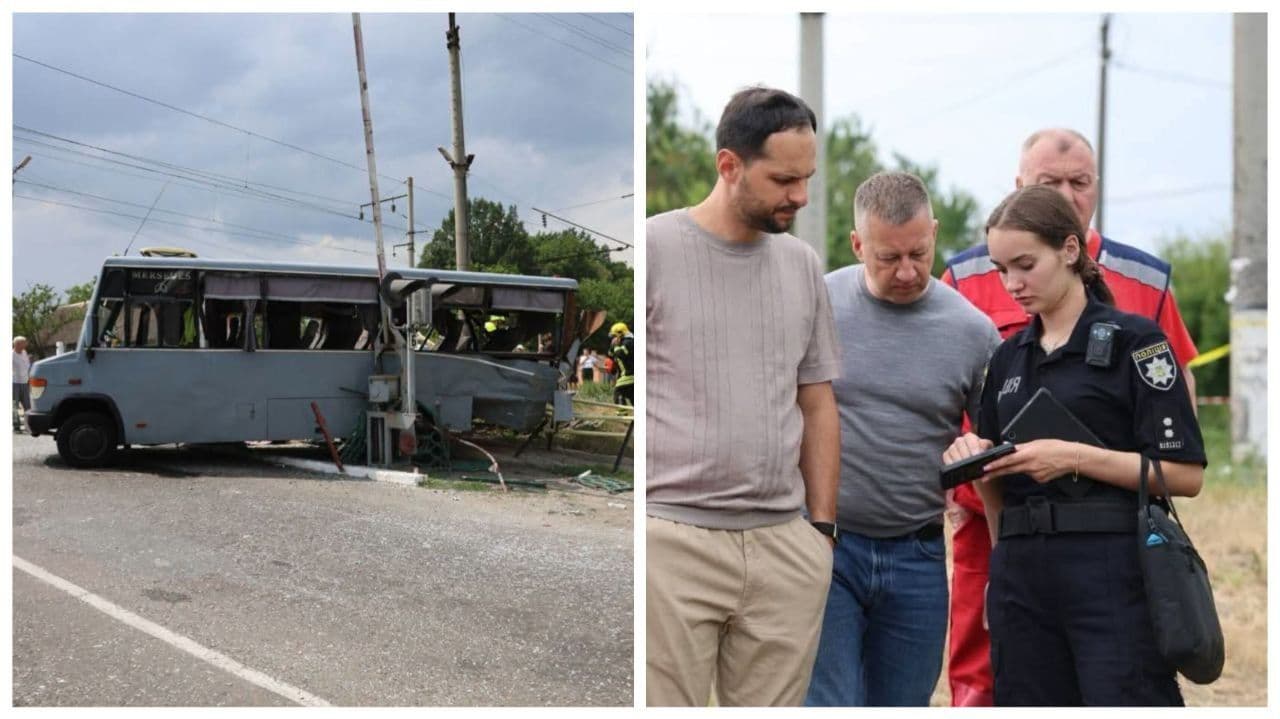
L: A minibus damaged by a collision with a train in Rivne Oblast. R: Law enforcement and other personnel at the scene of the accident. (Oleksandr Koval / Telegram)
PUTIN BUILDS A BIGGER WALL AROUND HIMSELF
A decree that took effect July 1 raised the maximum staff of the Federal Protective Service’s central apparatus to 812 people, from 785 — the fourth expansion of Putin’s protective service since the invasion began, and the first ever implemented mid-year rather than at a calendar boundary, independent outlet Verstka reported. The FSO now oversees a headcount 12 percent larger than before the war, part of a broader pattern Western intelligence assessments have linked to Putin’s deepening concern for his own security: aides near him reportedly now surrender phones and watches and wear masks before meetings, and his foreign travel — such as a May trip to Kazakhstan — increasingly includes electronic-warfare escort vehicles designed to jam potential threats.
By the end of July 2, Kyiv had buried its numbers for the day without finishing the count: 30 confirmed dead in the capital alone, a Day of Mourning declared before the sun had fully set on the wreckage, and a Kremlin spokesman insisting, over the ruins of a hospital and a warehouse full of donated medical equipment, that everything struck had been military. Somewhere in the same 24 hours, a research institute finished tallying a war that has now cost both sides more than two million casualties combined, for a front line that moved, on its best recent days, about fifty meters. Both numbers were true at once. Neither one stopped the missiles.
A PRAYER FOR UKRAINE
1. For the Dead of Darnytskyi
Lord, at least four people did not survive the direct hit that turned sixty-four apartments in one Kyiv building to rubble overnight. Seventeen came out alive, some pulled from beneath the debris by hand. We ask for rest for the ones who didn’t make it, and strength for the seventeen who did — for the specific, unbearable work of rebuilding a life that fit inside an apartment that no longer exists.
2. For the Seven-Year-Old Girl Near Synelnykove
God of the smallest among us, a seven-year-old girl was killed today near Synelnykove, and two more children were hurt beside her. We do not ask why. We ask only that her family be held by people who love them in the days ahead, and that no more small coffins get added to a count that is already far too long.
3. For Every City Struck Today Besides the One the World Was Watching
Father, while the world’s attention went to Kyiv, Kherson lost three people and counted forty-five wounded, Kharkiv lost two more, Donetsk one, and a guided bomb hit a kindergarten full of summer classes in Sumy. We pray for every one of these places, seen or unseen by anyone outside Ukraine tonight, and for the staff and children who walked away from that kindergarten still breathing.
4. For a President Asking, Again, for What Was Already Promised
Lord, Volodymyr Zelensky said today that Ukraine isn’t asking for anything new — only for what allies already agreed to deliver, on time. We pray for the speed of that promise-keeping, for the missiles still sitting in stockpiles somewhere, and for the patience of a country that has now waited 1,590 days to stop needing to ask.
5. For an End That Two Million Casualties Have Not Yet Bought
God of mercy, a report released today counted more than two million dead, wounded, and missing on both sides of this war, and a front line that has barely moved in the months it took to reach that number. We do not understand a mathematics like this. We ask only that You do — and that in Your time, the number stops climbing, and the war ends before it costs a single life more.