
Ukraine Daily Briefing | April 27, 2026 | Day 1,524 of the Full-Scale Invasion
Russian drones struck Odesa overnight, injuring 14 civilians including two children, while a strike on the Black Sea port of Chornomorsk destroyed a sunflower oil tank and spilled 6,000 tons of oil into the sea — and a separate strike near the Zaporizhzhia Nuclear Power Plant killed a driver in what the IAEA called an unacceptable threat to nuclear safety. In St. Petersburg, Vladimir Putin hosted Iran’s Foreign Minister and praised Iranian soldiers fighting in the Middle East as “courageous heroes,” deepening a strategic axis that has supplied Russia with the Shahed drones now falling on Ukrainian cities. And in a statement that tore away the diplomatic facade, a senior Kremlin official declared that Russia’s territorial goals extend far beyond Donetsk — into Dnipropetrovsk Oblast and all of unoccupied Zaporizhzhia — a direct contradiction of Moscow’s public negotiating posture.
The Day’s Reckoning
The drones came to Odesa at 1:30 in the morning. Residents heard the explosions first, then the fires. By dawn, 14 people had been taken to hospital, including two children. In the Prymorskyi district, a hotel burned. In Khadzhibeyskyi and Kyivskyi districts, residential buildings were struck. A few kilometers north along the Black Sea coast, Russian drones had found the port of Chornomorsk the night before — and one of them hit a storage tank containing 6,000 tons of sunflower oil. The oil poured into the harbor, forming a slick stretching 400 meters across the water’s surface.
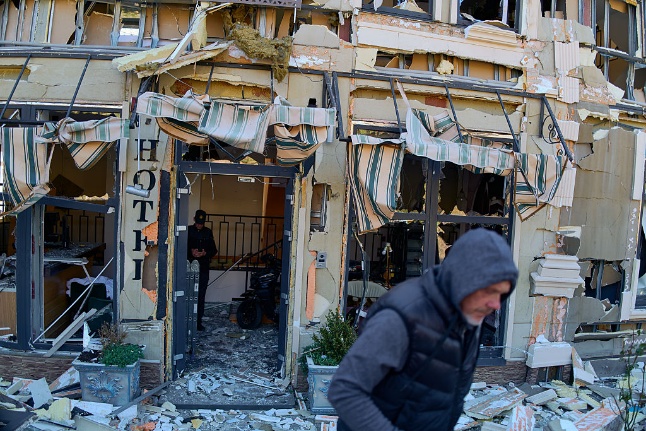
A security guard stands watch at the entrance of a hotel destroyed by a Russian Shahed drone strike in Odesa. (Pierre Crom/Getty Images)
Further east, a drone struck near Enerhodar — the city adjacent to the Zaporizhzhia Nuclear Power Plant, Europe’s largest. A driver died in a transport workshop near the site. The IAEA, which has a team permanently stationed at the plant, issued a warning: strikes near nuclear facilities must not take place. The plant’s reactors are shut down, but cooling systems that prevent nuclear catastrophe still depend on external power that Russian forces control.
In St. Petersburg, Vladimir Putin sat with Iran’s Foreign Minister Abbas Araghchi and praised Iranian soldiers in the Middle East as “courageous and heroic.” Iran supplies Russia the Shahed drones that struck Odesa. Russia supplies Iran satellite imagery to strike American and Israeli targets. The alliance was on display, officially and without apology.
And then a Kremlin official said what Russian diplomats have been carefully avoiding: Russia’s territorial demands do not end at Donetsk. They extend into Dnipropetrovsk Oblast. They include all of unoccupied Zaporizhzhia. The “buffer zone” language was used — the same language Moscow used before it seized Crimea, before it sent troops into Donbas, before February 24, 2022.
1:30 a.m. in Odesa: Drones Find a Hotel, Homes, and a Harbor
The overnight drone attack on Odesa on April 27 was not the first this week — Russian drones had struck residential buildings in the city on April 24, killing a married couple and injuring 15. It was not the largest strike of the month — on April 25, Russia launched what was described as one of its largest aerial attacks of the war, killing at least 10 people across the country. But it was April 27’s blow to a city that has been absorbing Russian strikes since the first week of the full-scale invasion.
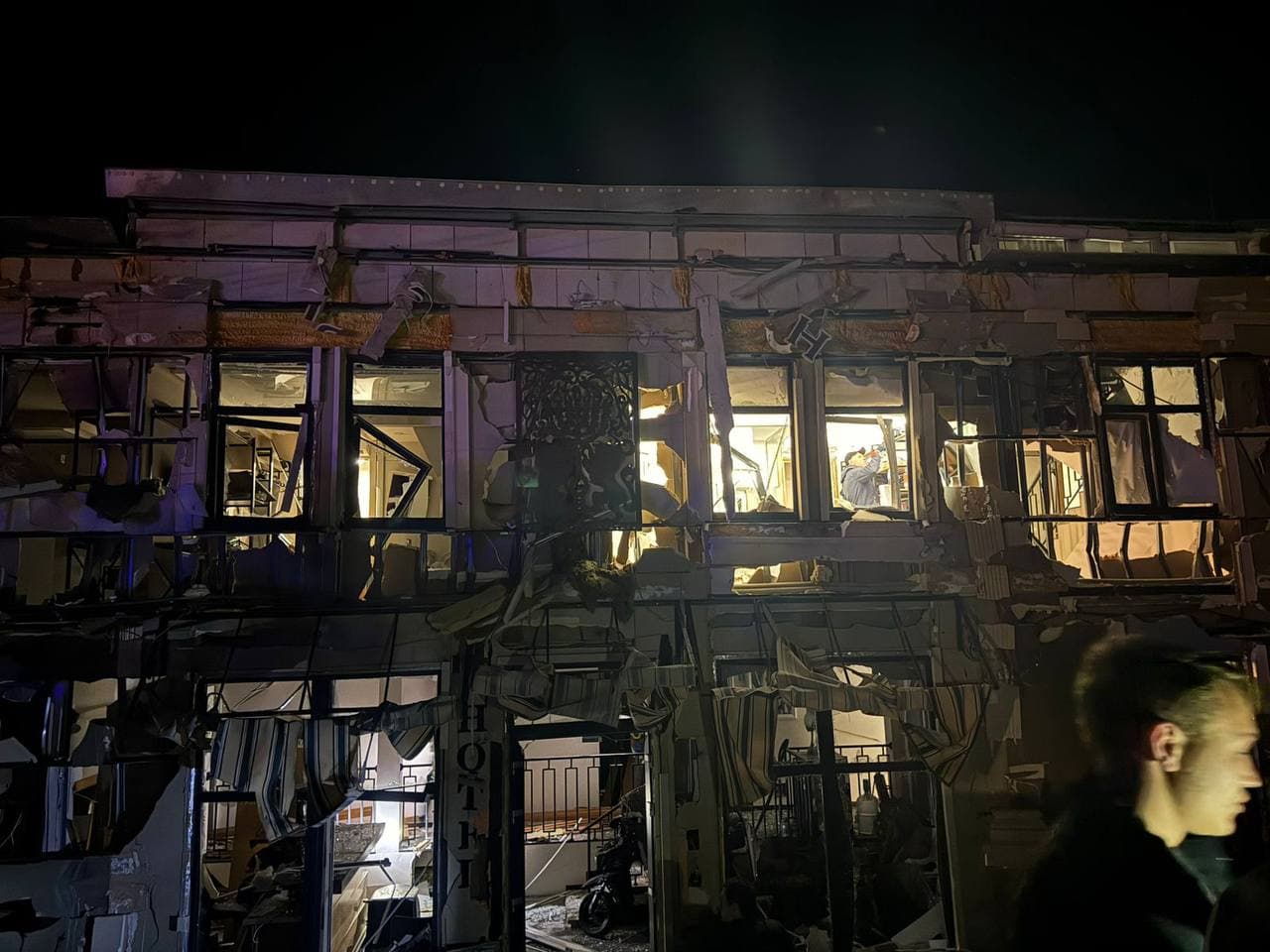
The aftermath of a Russian drone attack on a hotel in Odesa overnight. (Odesa City Military Administration head Syrhii Lysak/Telegram)
Ninety-four drones were launched toward Ukraine that night — Shahed, Gerbera, Italmas, and other variants — from Kursk, Oryol, Smolensk Oblast, Krasnodar Krai, and occupied Crimea. Ukrainian air defenses downed 74 of them. Twenty struck 15 locations; debris from downed drones fell on 11 more. Odesa was among the primary targets.
Governor Oleh Kiper reported 14 injured, including two children, in Odesa City alone. Strikes hit residential buildings in two districts, a hotel in Prymorskyi district, warehouse facilities, and port infrastructure. Russian forces also struck energy infrastructure in Zaporizhzhia Oblast, leaving 4,400 customers without power. In Chernihiv Oblast, 18 drones attacked the city of Koriukivka, injuring two men — a 42-year-old with burns, an 81-year-old hospitalized with shrapnel wounds.
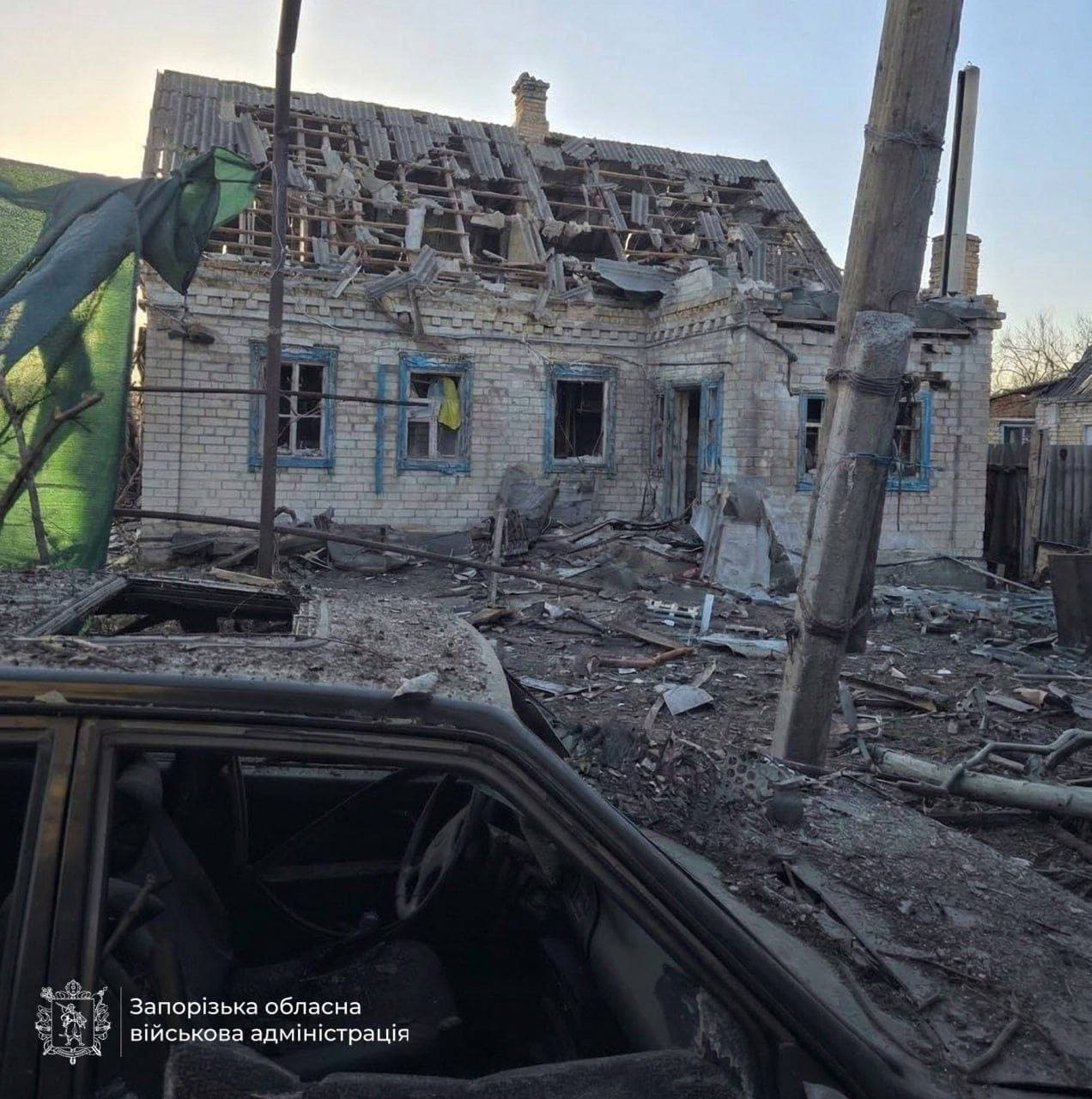
Aftermath of a Russian attack on Zaporizhzhia. (Zaporizhzhia Regional Military Administration.)
Zelensky reported on April 27 that Russian forces had launched roughly 1,900 strike drones against Ukraine in the preceding week, and that Ukrainian forces intercepted over 90 percent of them. Ukrainian drone manufacturer General Chereshnya reported that its drones were used in 11,473 interceptions in March 2026 alone — 5,800 more than in February — including three times as many interceptions of Russia’s Molniya drones.
Four Dead, Twenty-Three Wounded: The Day’s Human Toll
Russian attacks on April 27 killed at least four people and injured 23 others across Ukraine, according to consolidated regional reporting.
In Donetsk Oblast, two people were killed and one injured in Kramatorsk. Two more were injured in the villages of Kopani and Druzhkivka. Homes and infrastructure were damaged across several settlements in the oblast.
In Sumy Oblast, a woman was killed in the Shostkynska community and three others were injured. A separate Russian attack on April 25 killed two brothers — aged 48 and 53 — in the Bilopilska community; those deaths were recorded in the April 27 reporting period.
In Zaporizhzhia Oblast, a 59-year-old man was killed in a Russian attack on the Zaporizhzhia district. Governor Ivan Fedorov reported that over the past day, Russian forces launched 629 attacks on 45 settlements across Zaporizhzhia Oblast — a figure that captures the relentless, grinding scale of attacks on a region that contains Europe’s largest nuclear plant and a front line that runs through farmland and industrial towns alike.
In Kherson Oblast, three people were injured. Russian strikes damaged three apartment buildings, three houses, and a church. In Mykolaiv Oblast, a 70-year-old man was hospitalized in stable condition after a Russian attack on the village of Lupareve.
Sunflower Oil in the Black Sea: The Strike on Chornomorsk
The strike on the port of Chornomorsk, in Odesa Oblast, destroyed a storage tank containing approximately 6,000 tons of sunflower oil. The oil poured into the port’s water area and formed a slick measuring roughly 400 by 200 meters on the surface. Emergency crews deployed containment booms; port services blocked stormwater drainage to prevent the oil from spreading further into the sea. No soil contamination was recorded — the affected area is covered with concrete.
The State Environmental Inspectorate of the South-Western District reported the incident on April 27. Environmental specialists took seawater samples for laboratory analysis. The full assessment of ecological harm will be completed once all data is collected.
Sunflower oil is far less toxic than petroleum, but it poses real dangers. Greenpeace has noted that it can coat seabirds, destroying feather insulation and causing death by hypothermia. In the water, bacterial decomposition of the oil consumes oxygen, threatening marine life. The Black Sea has been absorbing the ecological costs of this war since 2022 — oil spills, shipwrecks, munitions on the seabed. Chornomorsk’s harbor now carries a 400-meter reminder of what port infrastructure attacks mean beyond the rubble count.
Ukraine is the world’s leading exporter of sunflower oil, supplying approximately 33 percent of global exports. The destroyed tank represents a fraction of national capacity — but the Chornomorsk port is a critical node in the supply chain that moves Ukrainian agricultural products to the world, including to countries in the Global South where cooking oil prices affect millions of people’s daily lives.
A Death Near the Nuclear Plant: The IAEA’s Warning
A drone strike near the Zaporizhzhia Nuclear Power Plant in Russian-occupied Enerhodar killed a driver on April 27. The strike hit a transport workshop near the site. The IAEA, which maintains a permanent monitoring team at the plant, confirmed the death and issued a formal warning: “Strikes on or near nuclear power plants can endanger nuclear safety and must not take place.”
The ZNPP is Europe’s largest nuclear plant, with a capacity that once generated roughly 20 percent of Ukraine’s electricity. Its six reactors have been shut down since Russian forces seized it in March 2022, but the plant still requires continuous external power to operate the cooling systems that prevent its spent fuel from overheating and triggering a nuclear accident. That external power is controlled by Russian forces.
Zelensky had reported on April 26 that Russian forces continue to store military equipment at the plant and have mined its perimeter — turning it, in his words, into “an object of war.” Russian forces have shut down the plant’s external power supply 14 times since the occupation began. The IAEA has repeatedly warned of the danger. The death of a driver in a workshop near the plant on April 27 is the latest reminder that the warnings are not theoretical.
The plant also sits at the center of a broader Russian ambition: Moscow is attempting to connect the ZNPP to its own power grid, a move that would permanently integrate Europe’s largest nuclear facility into Russian energy infrastructure. Ukraine and its partners reject the annexation of Zaporizhzhia Oblast and consider the plant Ukrainian territory under occupation.
Putin and Iran: The Alliance That Builds the Drones Hitting Odesa
Iranian Foreign Minister Abbas Araghchi arrived in St. Petersburg on April 27 and met Vladimir Putin. The visit was framed as a routine diplomatic consultation — Araghchi briefing Putin on ceasefire negotiations with the United States and the situation in the Middle East following the conflict that killed Iran’s Supreme Leader Ali Khamenei in February. The diplomatic language was careful. The substance was not.
Putin described Iranian forces fighting in the Middle East as acting “courageously and heroically” in defense of Iranian sovereignty. He said Russia was ready to help bring peace to the region. Araghchi thanked Putin and Russia for their “strategic partnership” and said Iranian-Russian ties would continue to develop “regardless of what is happening.”
What is happening is a war in Ukraine fought in part with Iranian weapons. Iran has supplied Russia with Shahed strike drones throughout the full-scale invasion and has assisted Moscow in developing and mass-producing its own variants — the drones that struck Odesa on the night of April 26 to 27, that have struck Ukrainian cities in near-daily waves for more than two years. Russia, in turn, has provided Iran with satellite imagery of American, Gulf, and Turkish military assets in the Middle East.
The Russia-Iran strategic partnership agreement was signed in January 2025. Both governments signed a cooperation plan covering 2027 to 2031 during recent talks between Russian Defense Minister Belousov and Kim Jong Un — reflecting a broader axis of autocracies coordinating military and diplomatic support. The April 27 meeting in St. Petersburg was not a diplomatic courtesy. It was a working session between two governments at war with the Western-led order, comparing notes.
“Buffer Zone” in Dnipropetrovsk: The Kremlin Unmasks Its True Map
The diplomatic fiction maintained by Moscow throughout the peace negotiations has been that Russia’s unresolved demand is limited: Ukraine must cede unoccupied Donetsk Oblast. If Kyiv accepts this, peace is possible. This framing has been the basis of multiple rounds of American-mediated talks.
On April 27, DNR Head Denis Pushilin gave an interview to Kremlin newswire TASS that shredded that framing. Russia, Pushilin said, must establish a “buffer zone” in Dnipropetrovsk Oblast — Ukrainian territory that Russia does not occupy — to ensure the security of Russian-held territory in Donetsk Oblast. Russia must also completely seize the remainder of unoccupied Zaporizhzhia Oblast. These are not Pushilin’s personal ambitions. He holds his position at Moscow’s pleasure.
ISW’s assessment is direct: Pushilin’s statement contradicts the Kremlin’s attempts to portray the only unresolved issue in peace negotiations as Ukraine’s refusal to cede unoccupied Donetsk Oblast. The real map of Russian territorial ambition, as stated by a senior Russian official to a Kremlin newswire, extends well beyond what Moscow acknowledges at the negotiating table.
Russia currently occupies roughly 20 percent of Ukrainian territory. Its stated appetite, as of April 27, includes Dnipropetrovsk Oblast — a region that contains Dnipro city, one of Ukraine’s largest cities and a major industrial center — and the remainder of Zaporizhzhia Oblast, which contains the nuclear plant. For anyone wondering why Ukraine has refused to withdraw from Donbas as a good-faith gesture toward peace, Pushilin’s interview is part of the answer.
On the Ground: Pipeline Infiltrations, 629 Attacks, and Logistics Cracking
Russian forces continued offensive operations across multiple axes on April 27 but made no confirmed advances. The day’s frontline picture was defined less by territorial shifts and more by the grinding methods Russia is using to try to create them.
In the Kupyansk direction, Russian forces continued attempting to infiltrate toward the city through a gas pipeline near Holubivka, despite reportedly sustaining up to 70 percent casualties in such assaults. Ukrainian Joint Forces Task Force Spokesperson Colonel Viktor Trehubov reported on April 27 that the infiltration attempts are part of broader efforts to degrade Ukrainian positions on the left bank of the Oskil River and push toward Kupyansk-Vuzlovyi. ISW had previously observed similar pipeline infiltration missions in the same area on April 25.
In Sumy Oblast, Russian forces continued offensive operations north, northeast, and southeast of Sumy City and conducted two KAB airstrikes. Russian sources claimed advances in Kindrativka and Andriivka, and claimed the seizure of Taratutyne by elements of the 34th Separate Motorized Rifle Brigade — though Ukrainian counterattacks were reported near the settlement. In northern Kharkiv Oblast, Russian forces attempted motorcycle infiltrations in the Budarky-Zemlyanky direction; Ukrainian forces repelled the attempt and captured one Russian servicemember.
In Donetsk Oblast, Russian forces raised a flag in northern Ozerne, northeast of Slovyansk, in what ISW assessed as an infiltration mission rather than a confirmed seizure. Russian milbloggers claimed advances in Illinivka, Dovha Balka, and several other settlements near Kostyantynivka — claims that other milbloggers contradicted. In the Pokrovsk direction, the Ukrainian 7th Rapid Reaction Corps reported Russian forces accumulating heavy equipment, artillery, and tanks in southeastern Pokrovsk — and also reported that Russian troops are experiencing logistics problems, lacking adequate food and medicine.
On the southern axis, Russian forces attempted to use spring foliage as cover for infiltration near the Velykomykhailivka forest, attempting to scout crossings of the Vovcha River for future assault operations toward Pokrovsk and Dnipropetrovsk Oblast. Ukrainian forces prevented them from establishing positions in the area. In Nikopol Raion, Ukrainian 30th Marine Corps Spokesperson Lieutenant Pavlo Drohal reported on April 27 that Russian forces have conducted roughly 2,000 drone strikes against the raion since March 2026 — double the monthly number from before March — and are intentionally targeting civilians.
Ukraine’s Strike Campaign: Tuapse BDA, Yaroslavl, and Air Defense Attrition
The Ukrainian General Staff provided battle damage assessments on April 27 for recent deep strikes. The April 20 strike on the Tuapse Oil Refinery in Krasnodar Krai — confirmed by geolocated footage at the time — destroyed 24 fuel tanks and damaged four more. The April 26 strike on the Yaroslavl Oil Refinery, one of Russia’s major fuel processing facilities with annual capacity of approximately 15 million tons, damaged a vacuum distillation unit — a key component in converting crude oil into usable fuel products.
ISW noted on April 27 that Russia’s air defenses are “overstretched,” creating vulnerabilities that Ukrainian forces are exploiting to expand both the range and intensity of strikes. Analysts pointed to attacks reaching Chelyabinsk — more than 1,800 kilometers from the Ukrainian border — as evidence of how far Ukraine’s long-range drone campaign has extended. As Ukraine expands domestic drone production, experts assess that more frequent and larger-scale strikes on Russian economic and military infrastructure are likely to follow.
Ukrainian forces also struck multiple targets in occupied territories on April 27: a drone control point near occupied Malynivka and an ammunition depot and command observation post near occupied Selydove in Donetsk Oblast; a Tornado-S multiple launch rocket system in occupied Melitopol and a drone control point near occupied Hulyaipole in Zaporizhzhia Oblast; and a Russian repair unit near occupied Mykolaivka. The Tornado-S is a heavy multiple rocket launcher capable of striking targets at ranges of up to 90 kilometers — its destruction in Melitopol removes a significant fire support asset from Russian forces operating in southern Ukraine.
A Ukrainian drone strike on the night of April 25 to 26 damaged two Russian Black Sea Fleet landing ships — the Yamal and the Filchenkov — which satellite imagery showed had been relocated to Korabelna Bay in Sevastopol, possibly due to damage sustained in the attack.
Russia’s Student Soldiers: The MoD Holds a Meeting, the Problem Remains
The Russian Ministry of Defense convened an emergency joint meeting on April 27 with the Ministries of Science and Higher Education and heads of Russian universities to address a crisis it cannot publicly name as such: its recruitment drive targeting university students has been met with fear, resistance, and — apparently — coercion that has become embarrassing enough to require official denial.
The MoD’s Unmanned Systems Forces recruitment campaign, launched in December 2025 to January 2026, was designed to attract students with the promise of drone warfare service rather than front-line infantry assaults. It has not worked as planned. Russian milbloggers criticized its ineffectiveness as early as March 2026. The reason is straightforward: students fear that once they sign a contract and enter a USF unit, military commanders will transfer them to high-casualty assault units — precisely the outcome the campaign’s marketing promises to prevent.
Deputy Defense Minister Viktor Goremykin claimed at the April 27 meeting that all student contracts are for one-year terms at the signer’s choice, that transfers between branches require the servicemember’s permission, and that Defense Minister Belousov will issue guidance by the end of April holding commanders “personally responsible” for unauthorized transfers. Deputy Science Minister Dmitry Afanasyev claimed only six complaints of coercion were received and all were found unfounded. Goremykin claimed 93 percent of surveyed students trust the MoD.
The numbers suggest a different reality. Russia’s Minister of Science reportedly directed large universities in early 2026 to ensure at least two percent of students sign military contracts — an institutional quota that implies pressure rather than voluntarism. The MoD does not hold emergency joint meetings with university heads to address problems that do not exist.
“Everything Beyond 40 Days Cannot Be Effective”: Ukraine’s Ombudsman on Troop Exhaustion
Ukraine’s Military Ombudsman Olha Reshetylova presented findings on April 27 from research conducted by her office: soldiers deployed for more than 40 days on front-line positions develop apathy and, in her words, “stop caring whether they survive or not.” The psychological deterioration is not a moral failure on the soldiers’ part — it is a measurable outcome of sustained combat exposure without rotation, and it reduces combat effectiveness.
Ukrainian regulations technically limit time on a front-line position to 15 days. Reshetylova stated plainly on April 27 that this rule is “a dead norm that no one follows,” leaving some troops deployed for months or longer without rotation due to a shortage of replacements. Her office is preparing proposals for Commander-in-Chief Syrskyi to revise the rules governing front-line deployment periods.
Reshetylova linked the psychological problem directly to Ukraine’s mobilization shortfall. She argued that clearer, defined service terms — two to three years — could help address staffing gaps by giving potential recruits the certainty they need to decide to serve. She noted that approximately 1.6 million people could potentially be mobilized, which would allow for regular troop rotations. “Certainty will help people decide to serve,” she said.
The remarks arrived alongside reports of dismissed commanders: on April 24, the General Staff announced the dismissal of the 14th Mechanized Brigade and 10th Army Corps commanders over allegations of losing positions, failing to support frontline troops, and concealing the real situation from higher command. Reports circulated of soldiers in the 14th Brigade’s sector in Kharkiv Oblast left without food or water — a failure that the Defense Ministry on April 27 said involved isolated supply cases under review, with inspections ordered and accountability promised.
50,000 Ground Robots: Zelensky Names the Next Weapon
President Zelensky announced on April 27, following a meeting of the Staff of the Supreme Commander-in-Chief, that he has ordered a major expansion in the production and deployment of unmanned ground systems — setting a target of at least 50,000 units for Ukraine’s military this year. “It is already impossible to imagine defense without drones,” he said, “and the same applies to ground robotic systems.”
Unmanned ground vehicles — UGVs — are robots that move on land rather than flying through the air. They can carry ammunition to front-line positions, evacuate wounded soldiers without exposing medics to fire, lay smoke screens, and conduct direct combat operations in terrain too dangerous for personnel. Ukraine has been testing and deploying early versions throughout the war; the April 27 order represents a decision to scale from experiment to mass deployment.
Zelensky noted that contracts for ground robotic systems in 2026 already exceed last year’s volume by more than twofold — but said production must continue to grow. He also used the April 27 announcement to address Ukraine’s air defense crisis: Kyiv is actively seeking anti-ballistic missile systems, he said, warning that the global situation — including the Iran conflict — is complicating the supply of interceptor missiles. Ukraine is working toward developing its own anti-ballistic capabilities in cooperation with partners.
Norway Builds Ukraine’s Drones, Poland Announces Its Own “Armada”
Ukraine and Norway signed an agreement on April 27 to launch joint production of Ukrainian-designed mid-strike drones, with several thousand units planned for the Armed Forces of Ukraine. The drones will be manufactured in Norway and transferred to Ukraine; the first systems are expected to be delivered by summer 2026. The project will be financed by Norway using funds additional to its previously pledged $7 billion in military support for Ukraine in 2026. Norway has committed roughly $28 billion in total support for Ukraine between 2023 and 2030.
Defense Minister Fedorov described the partnership’s logic clearly: “Norway gets to produce technologies already proven in combat; Ukraine receives critical equipment needed to regain the initiative on the front line.” Norwegian Defense Minister Sandvik called supporting Ukraine’s fight “the most important thing we do for Norway’s security.”
In Rzeszow, Polish Prime Minister Donald Tusk announced separately on April 27 that Poland is launching a project to build a modern drone fleet using Ukrainian technical expertise and European funding. “Poland must have its own modern drone armada, so that we can not only help Ukraine today, but also tell the Polish people with full confidence that we are safe,” Tusk said. Ukrainian Prime Minister Svyrydenko was present at the announcement. The project follows a pattern emerging across Europe: countries seeking Ukraine’s hard-won expertise in drone warfare as both a contribution to Kyiv’s defense and an investment in their own security.
Stolen Grain at Haifa: Ukraine Summons the Israeli Ambassador
Ukraine summoned Israeli Ambassador Michael Brodsky on April 27 and issued a formal warning: a Panama-flagged bulk carrier, the Panormitis, had entered Haifa Bay carrying what Kyiv says is grain stolen from Russian-occupied Ukrainian territories — over 6,200 tons of wheat and 19,000 tons of barley, loaded at the Port of Kavkaz in Russia’s Krasnodar Krai via transfers from other vessels.
Foreign Minister Andrii Sybiha said Ukraine “reserves the right to deploy a full suite of diplomatic and international legal responses” if Israel allows the vessel to dock and unload. “It is difficult to understand Israel’s lack of appropriate response to Ukraine’s legitimate request regarding the previous vessel,” Sybiha said — a reference to the Russian bulk carrier Abinsk, which docked in Haifa earlier in April with nearly 44,000 tons of stolen Ukrainian wheat and received no Israeli action.
An investigation published by the Israeli newspaper Haaretz found that at least four shipments of stolen Ukrainian grain have already been unloaded in Israel this year. Israeli Foreign Minister Gideon Sa’ar responded publicly on April 27, rejecting Kyiv’s characterization and saying diplomatic matters between “friendly nations” should not be conducted through social media — while adding that “allegations are not evidence” and that Israeli authorities would act “in accordance with the law.”
Ukraine plans to hand over a formal protest note and request action during its meeting with the Israeli ambassador on April 28. The incident reflects a broader pattern: Russia has seized millions of tons of Ukrainian grain from occupied territories and exports it via shadow fleet vessels to global markets. The diplomatic pressure is also complicated by the state of Ukraine-Israeli relations, which have been strained throughout the war by Israel’s refusal to provide direct military aid while maintaining ties with Moscow.
Merz Speaks the Unspeakable: Territory for EU Membership
German Chancellor Friedrich Merz said on April 27 that Ukraine might lose territory as part of a peace deal with Russia — and suggested that EU membership could be the political justification Zelensky offers Ukrainians for accepting that loss. The remarks were made during a discussion with students in Marsberg, Germany.
“Hopefully, there will eventually be a peace treaty with Russia. Then, possibly, part of Ukraine’s territory will no longer be Ukrainian,” Merz said. He added that Zelensky would need a referendum majority for territorial concessions — and that to secure it, Zelensky would tell the Ukrainian people: “But I have opened the way to Europe for you.”
Zelensky responded the same day, without naming Merz directly. “Russia wants our territory so that it can seize the territories of others as well,” he said in a video address. “If it succeeds with one state, with one neighbor, then it will do the same with others.” Zelensky cited Moldova, Georgia, Crimea, Donbas, and Belarus as part of a pattern of Russian expansion that can only be stopped through real strength from allies.
Merz also said on April 27 that Ukraine entering the EU by January 2027 or 2028 is “unrealistic” — while insisting that Ukraine must have a European perspective and that Europe “must not lose Ukraine to Russia.” Ukraine has rejected any form of partial membership and has maintained it will not accept territorial concessions without a referendum. On April 27, a senior Kremlin official stated that Russia’s territorial ambitions extend into Dnipropetrovsk Oblast. The gap between what Moscow demands and what Merz suggests Ukraine accept is not narrow.
$13 Million Stolen from Military Contracts: Seven Charged
Ukraine’s Prosecutor General’s Office announced on April 27 that seven people have been charged in a criminal scheme that laundered at least 576 million hryvnias — approximately $13.1 million — from defense contracts. A private company awarded a 2.5 billion hryvnia ($57 million) state contract to repair and maintain military equipment siphoned the funds through a network of more than 40 shell companies.
“On paper, the money was used to purchase spare parts and other materials; in reality, it went directly into the pockets of the scheme’s organizers,” police said. The state also lost approximately 100 million hryvnias ($2.3 million) in unpaid taxes. The shell companies were reportedly headed by individuals living in Russian-occupied areas of Donetsk Oblast since 2014 and described as supporters of Russia’s aggression against Ukraine — as well as by a teacher awarded the title “Teacher of Russia.”
Law enforcement carried out about 40 searches in Dnipropetrovsk Oblast, seizing evidence and 2 million hryvnias in cash. Five suspects are in custody and await trial. Three alleged ringleaders, including the head of the “conversion center” at the heart of the scheme, were charged in December 2025. Suspects attempted to pressure the investigating officer, including an offer of money to have the investigator’s car set on fire.
The case arrives amid broader accountability efforts in Ukraine’s defense sector: on April 24, the General Staff dismissed the commanders of the 14th Mechanized Brigade and 10th Army Corps. The military ombudsman’s findings on April 27 about troop supply failures connect to the same institutional failure that allows corruption to coexist with soldiers left without food.
Minsk and Beijing Meet in Shanghai: The Other Axis
Belarus’s Defense Minister Lieutenant General Viktor Khrenin met Chinese Defense Minister Admiral Dong Jun at the Shanghai Cooperation Organization defense ministerial summit on April 27. The meeting was brief in the day’s news — no significant announced outcomes — but its context matters.
Belarus hosts Russian military forces and has served as a launch platform for Russian strikes against northern Ukraine since February 2022. The Shanghai Cooperation Organization, which includes Russia, China, Belarus, and several Central Asian states, represents an institutional framework for the axis of powers aligned against the Western-led international order. A Belarusian-Chinese defense ministerial meeting in that context is not routine diplomacy — it is the maintenance of relationships within a bloc whose members share an interest in weakening Western influence.
China has publicly maintained a position of nominal neutrality in the Ukraine war while providing Russia with dual-use technology, economic support through trade, and diplomatic cover at the UN. Beijing’s simultaneous engagement with Minsk and its defense of Russian economic interests reflects the broader challenge facing the Western coalition: the adversaries of the liberal international order are meeting, coordinating, and signing cooperation plans stretching to 2031, while Ukraine’s Western partners debate the terms of support.
The Weight of the Day
Six thousand tons of sunflower oil floated in the harbor at Chornomorsk. In Odesa, 14 people were in hospital, two of them children. Near Enerhodar, a driver died in a workshop beside the plant that once lit a fifth of Ukraine’s homes. In St. Petersburg, Putin and Araghchi called each other partners and the drones that connect them kept flying.
A Kremlin official said the quiet part out loud: the map Russia wants is larger than the map it is showing. A German chancellor said the price of peace might be territory, and that EU membership might make the selling easier. A Ukrainian ombudsman said soldiers stop caring whether they live after 40 days on the line, and that the rule limiting deployment to 15 days is a dead letter.
The sunflower is Ukraine’s national flower. It turns toward the sun. What was in that tank was pressed from seeds grown in Ukrainian soil, in fields that someone worked, in a country that has been at war for longer than most wars last.
A Prayer for Ukraine
1. For the Two Children Injured in Odesa
Lord, two children were taken to hospital before sunrise on April 27. We do not know their names, how old they are, what they were dreaming when the explosions woke them. We know a drone found their city, their district, their street. Hold them in your care — their bodies in healing, their minds in something gentler than the memories this night will leave. And hold the adults who ran to them in the dark, who carried them through smoke and broken glass: give them the strength they did not know they had.
2. For the Driver Killed Near Enerhodar
Father, a man died on April 27 near a nuclear plant that should have been quiet. He was driving. It was a workday. The IAEA called his death a warning; to his family it was an ending. We do not ask why the warnings are not enough, though we want to. We ask instead that you receive him with the gentleness his death did not have, and that you be close to those who are now learning what it means to continue when someone does not come home.
3. For the Soldiers Beyond Their 40 Days
God of the exhausted, a military ombudsman said on April 27 that after 40 days on a front-line position, soldiers stop caring whether they survive. She said it as a finding, a data point, a policy problem. But behind the finding are individual people who have been in the dirt longer than the regulations allow, without rotation, without rest, without certainty that anyone is coming. See them where they are. Sustain what is left of their will. And move the people in offices and parliaments to solve what they have the power to solve.
4. For the People of Nikopol Raion
Lord, 2,000 drone strikes since March. That is what a Ukrainian commander reported for one raion on one day. Two thousand. Double what it was before. The people in Nikopol Raion are not soldiers. They live across the river from occupied territory, within sight of a nuclear plant, and they have been struck 2,000 times since March. We do not know how to pray for a number that large except to say: they are not a number. They are people. Hold each one.
5. For the Long Arc of Justice
God of justice, on April 27 a Kremlin official said Russia wants Dnipropetrovsk, wants all of Zaporizhzhia, wants land it does not hold and has not been offered. The map of Russian ambition is larger than the map Moscow shows at the table. Seven people were charged in Ukraine for stealing $13 million from the soldiers defending it. Grain stolen from occupied fields floated in a harbor in Haifa. The gap between what is and what should be is very wide. In Your mercy, in Your justice, in Your time — bring this war to its end, and let the ending be worthy of what Ukraine has endured.