
Ukraine Daily Briefing | May 6, 2026 | Day 1,533 of the Full-Scale Invasion
Ukraine’s self-declared ceasefire began at midnight on May 6. By 10 a.m., Russia had violated it 1,820 times — including 20 assault operations and over 70 guided aerial bombs — as part of an overnight strike package that killed 26 civilians and injured at least 118. Russian missiles struck Zaporizhzhia (12 killed), Kramatorsk (6 killed), and Dnipro (4 killed); on the morning of May 6 two drones hit a kindergarten building in central Sumy. Russia simultaneously canceled Victory Day parades in nine jurisdictions, relocated air defense systems from other regions to protect Moscow, and cut internet in its own cities. Also on May 6: Hungary returned $82 million in seized Oschadbank assets; EU ambassadors approved the International Claims Commission for war reparations; Zelensky announced legislation to legalize private military companies; and Sense Bank’s supervisory board chairman suspended himself as Ukraine’s National Bank opened a probe.
The Day’s Reckoning
The ceasefire was Ukraine’s proposal. It began at midnight. Russia’s answer came immediately: assault operations, guided aerial bombs, drone attacks. By 10 a.m. on May 6, President Zelensky had counted 1,820 violations. That number is the most precise record available of what Russia understands a ceasefire to mean.
The night before the count had already killed 26 people. Twelve in Zaporizhzhia, where Russian missiles struck civilian infrastructure. Six in Kramatorsk, hit by FAB-250 glide bombs in the city center. Four in Dnipro. One 69-year-old woman killed by a drone strike on a car in Sumy Oblast. And then, in the morning of May 6, two Russian drones struck a kindergarten building in central Sumy City.
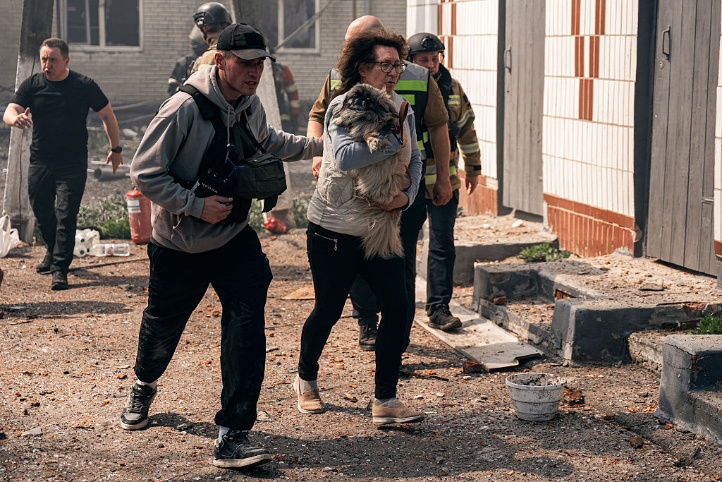
A man in a bulletproof vest helps evacuate a woman with a dog in Sumy. (Pavlo Zarva/Kordon Media/Global Images Ukraine via Getty Images)
Russia’s response to the ceasefire it had itself proposed was to cancel Victory Day military parades across nine jurisdictions — Oryol, Voronezh, Veliky Novgorod, Pskov, Nizhny Novgorod, Chuvashia, Kaluga, Saratov, and occupied Crimea — citing “security concerns” and “the difficult operational situation.” Russia also relocated air defense systems from other federal subjects to Moscow specifically, stripping regional defenses to protect the capital’s spectacle. The same country that threatened to destroy Kyiv’s center if its parade were disrupted could not safely hold its own parades in nine of its own regions.
The day also held its counter-movements. Hungary returned $82 million in seized Ukrainian bank assets. EU ambassadors approved the body that will handle war reparations. Ukraine announced legislation for private military companies. The legal and diplomatic architecture of the aftermath is being built while the strikes continue.
1,820 Violations: The Arithmetic of Russia’s Ceasefire
Ukraine’s ceasefire declaration, announced by Zelensky on May 4, took effect at midnight on May 5–6. The terms were identical to Russia’s own May 8–9 proposal: a unilateral silence, maintained if the other side reciprocated. The Kremlin never acknowledged the offer. By 10 a.m. on May 6, Zelensky reported 1,820 recorded violations, including 20 assault operations on key front sectors, over 70 guided aerial bombs, and continuous drone and missile strikes. “Russia’s choice is a clear refusal of silence and the preservation of lives,” he wrote.
Russia attempted to claim Ukraine had violated the ceasefire first, with Ambassador-at-Large Rodion Miroshnik citing Ukrainian strikes on occupied Crimea and Bryansk Oblast. The ISW assessment is direct: Ukrainian strikes on Crimea occurred shortly before midnight — before the ceasefire began. Crimean occupation head Aksyonov posted about incoming drones at 10:28 p.m. on May 5 and about Dzhankoy being struck at ten minutes past midnight on May 6. Two Russian State Duma deputies also acknowledged the Ukrainian strikes preceded the ceasefire start time. Strikes conducted before a ceasefire begins do not violate the ceasefire. Russian forces continued ground assaults and fired missiles after midnight. For context: Russia violated the Orthodox Easter ceasefire 10,721 times over 32 hours in April 2026; 7,696 times during the Easter ceasefire in April 2025.
A senior Ukrainian official told the Kyiv Independent on May 6 that Ukraine sees no reason to observe Russia’s May 8–9 Victory Day ceasefire: “We just don’t see the point for the parade.” Foreign Minister Sybiha stated: “Putin only cares about military parades, not human lives.” Estonia’s Foreign Minister Margus Tsakhna said EU allies support Ukraine’s ceasefire proposal and noted that Russia has “consistently acted in bad faith, not respecting even its own unilaterally declared ceasefires.”
The Strike Package: 26 Dead, 118 Injured, a Kindergarten Struck
The overnight package of May 5–6 comprised two Iskander-M ballistic missiles, one Kh-31 air-to-surface cruise missile, and 108 Shahed, Gerbera, Italmas, Parodiya, and other drones. Ukrainian air defenses downed 89 drones; all three missiles and nine drones struck eight locations; debris fell on one additional location. Strikes targeted energy infrastructure in Poltava, Kharkiv, Dnipropetrovsk, Zaporizhzhia, and Kyiv oblasts.
In Zaporizhzhia City, Russian missiles struck civilian infrastructure on May 5, killing 12 people and injuring 51 others. Ages of the wounded ranged from 20 to 66. Eighteen remain hospitalized, including four in serious condition. Over the full 24-hour period, 49 people were injured across Zaporizhzhia Oblast. In Kramatorsk, three FAB-250 glide bomb strikes hit the city center, killing six and injuring fourteen. In Dnipro, a ballistic missile struck on the night of May 5, killing four and injuring nineteen; thirteen remain hospitalized, four in serious condition. In Sumy City on the morning of May 6, two Russian drones struck a civilian building in the center of the city confirmed by authorities as a kindergarten. In Sumy Oblast: one 69-year-old woman killed by a drone, one man wounded in the same strike, six more injured across the region. In Kharkiv Oblast: 17 injured including two children. In Donetsk Oblast: six killed, fourteen injured over 24 hours. In Kherson Oblast: one killed, twelve injured.
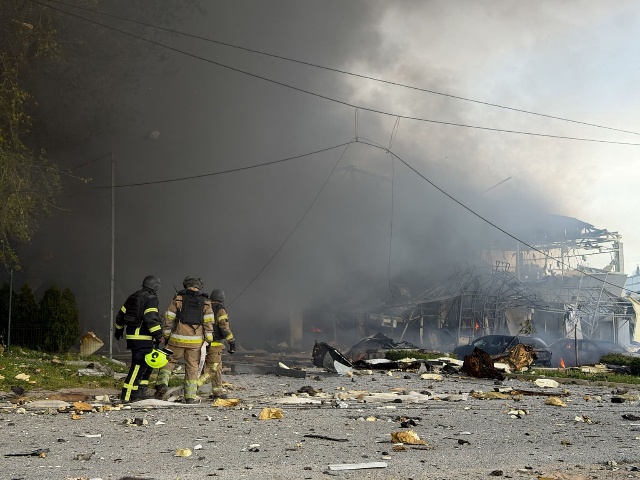
Ukrainian rescuers work at the site following a Russian air attack in Zaporizhzhia. (Darya Nazarova/ AFP via Getty Images)
ISW assessed that Russia deliberately uses a disproportionate number of ballistic missiles relative to the total strike package size, exploiting the fact that Ukraine can only intercept Iskanders with Patriot systems and that global Patriot interceptor shortages limit Ukrainian capacity. The pattern: large drone waves exhaust and disperse air defenses, then ballistic missiles follow in the same operational window. Ukraine downed 89 of 108 drones but only one of three missiles in the overnight package.
Victory Day Parades Canceled in Nine Jurisdictions: Russia Cannot Protect Its Own Spectacle
Regional officials in Oryol, Voronezh, Veliky Novgorod, Pskov, Nizhny Novgorod, Chuvashia, Kaluga, and Saratov announced cancellations or severe restrictions on Victory Day military parades, with Chuvashia also canceling the Immortal Regiment march. Occupied Crimea’s Aksyonov announced full cancellation of all major events on May 5. Kremlin spokesman Peskov confirmed the Moscow parade will proceed in “reduced format” — no columns of heavy military equipment, no tanks, armored vehicles, or missiles, the first such parade without hardware since 2007. Su-25 attack aircraft and infantry will march.
Zelensky reported on May 6 that Ukrainian intelligence observed Russian forces relocating air defense systems from other federal subjects specifically to defend Moscow City ahead of May 9. ISW first observed reports of such redeployments on May 3. The relocation strips regional defenses to protect the capital’s event. A Kremlin-affiliated milblogger complained on May 5 that Russian forces lack the magazine depth to counter Ukrainian drone strikes, that Russian interceptor drones are “comparatively undeveloped,” and that internet shutdowns are “ineffective at countering drone strikes and only cause popular discontent.” The same milblogger noted that the military hardware normally staged for the parade is stored in open-air lots now vulnerable to Ukrainian strikes.
FSB Building Struck in Crimea; Ghosts Unit Confirms April Railway Operations
Drones struck an FSB border guard service building in Russian-occupied Armiansk in northern Crimea in the late evening of May 5. The Crimean Wind monitoring channel reported that “half of the FSB building is completely gone.” Aksyonov confirmed incoming drone attacks. Separately, Ukrainian military intelligence agency HUR released video on May 5 confirming the April 2026 operations by its Prymary (“Ghosts”) special forces unit in Crimea: five precision strikes on moving locomotives transporting military equipment and fuel, setting fire to key railway assets and disrupting logistics on the peninsula. Geolocated footage confirmed destruction of a Be-12 Chaika anti-submarine aircraft at Kacha Airfield, three Project 05060 landing boats in Mizhvodne, a supply ship in Myrnyi, and a storage hangar in Chornomorske.
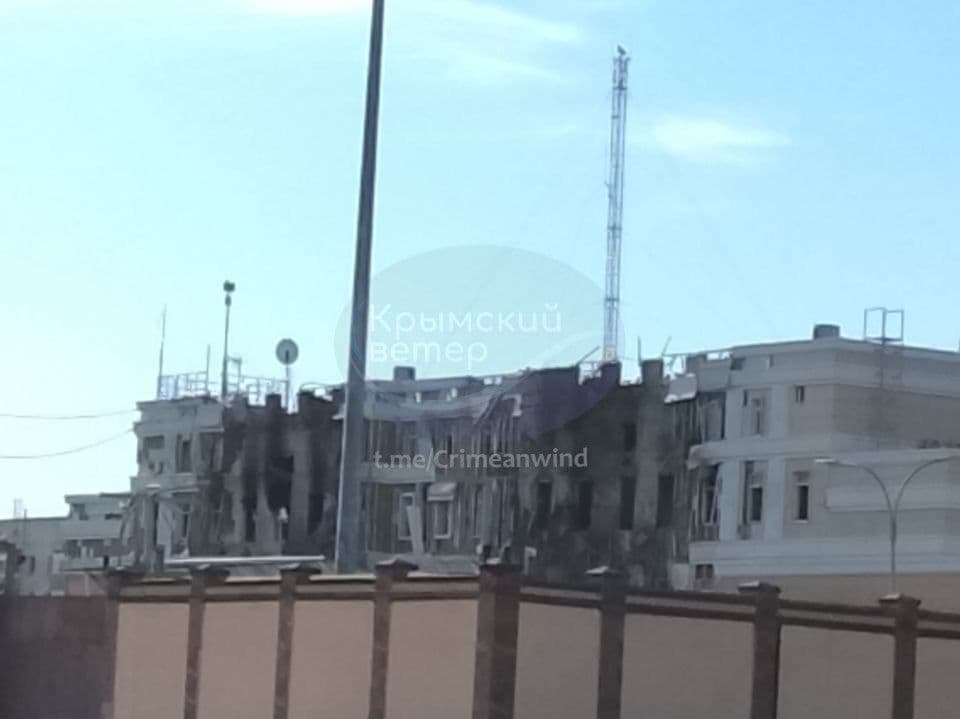
A photo showing the facility of the Russian Federal Security Service (FSB) in Russian-occupied Crimea reportedly struck by drones overnight. (The Crimean Wind / Telegram)
Frontline: Sopych Lost, Bilytske Held, Sleeper FPV Drones in Pokrovsk
Russian forces recently advanced in northern Sumy Oblast: geolocated footage published on May 6 shows Ukrainian forces striking a Russian servicemember west of Sopych, northwest of Sumy City, indicating Russian forces likely seized Sopych and infiltrated west of it on a prior date. A Kremlin-affiliated milblogger claimed northern Myropillya — where Ukraine had raised a flag on May 4 — had become a contested gray area after Ukrainian counterattacks. Russian forces continued intensifying infiltration attempts in Sumy Oblast.
North of Pokrovsk, a Kremlin-affiliated milblogger’s own map published on May 6 showed Ukrainian forces holding western Bilytske, contradicting Russian claims. Russian forces continued infiltrating west and northwest of Pokrovsk; milblogger claims of advances west of Hryshyne, north of Kotlyne, and east of Serhiivka were not confirmed by ISW. A Ukrainian brigade spokesperson reported that Russian unmanned systems Spetsnaz elements are deploying sleeper FPV drones in the Pokrovsk direction — pre-positioned drones that activate with a delay, resistant to detection, and forcing Ukrainian operators to commit significant effort to locate and neutralize them.
Ukrainian forces recently marginally advanced northeast of Kamyanske in western Zaporizhzhia Oblast, confirmed by geolocated footage. Russian forces advanced in the Hulyaipole direction: footage confirms Russian positions in southern Dobropillya and east of Vozdvyzhivka. In the Kostyantynivka-Druzhkivka area, a Ukrainian brigade officer reported Russian infiltrators typically operate alone or in pairs with constant pressure, but Russian forces have not yet been able to initiate full urban combat in Kostyantynivka. ISW assessed that the Russian military likely redeployed elements of the 1st Motorized Rifle Regiment (Strategic Missile Forces) from Sumy Oblast to the Velykyi Burluk direction in Kharkiv Oblast; drone operators of the regiment struck Ukrainian positions in the Velykyi Burluk area on May 6. The 106th Airborne Division may have been redeployed from Sumy Oblast to the Kherson direction, where its elements are reportedly operating near Karantynnyi Island on the Dnipro’s right bank.
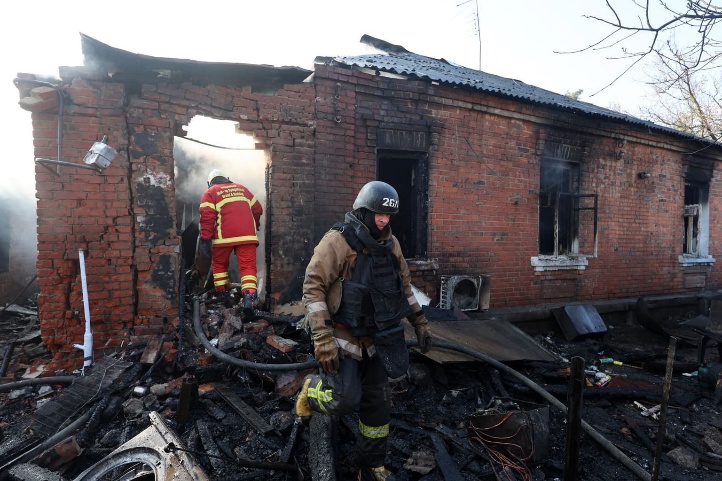
Firefighters extinguish a fire in a private house in Kharkiv, Ukraine. On Wednesday morning, Russian military operations involved Shahed-type drones targeting Kharkiv. (Viacheslav Madiievskyi/Ukrinform/NurPhoto via Getty Images)
Russian Oil Revenue: The Subsidy That Ate the Windfall
Russia’s Ministry of Finance released April data on May 6 showing oil and gas revenues nearly doubled compared to March — rising to 917 billion rubles ($12 billion) from 443 billion rubles ($6 billion), driven by higher global oil prices following the Iran conflict. But Russian opposition source Vlast/Faridaily reported the data simultaneously shows Russia increased subsidies to oil companies by nearly 350 billion rubles ($4.68 billion), to keep domestic gasoline prices low and to fund repair of refineries damaged by Ukrainian strikes.
Net of the subsidies, oil and gas revenues totaled approximately 856 billion rubles ($11.4 billion) in April, compared to a forecast of 835 billion rubles — essentially on target. The windfall was consumed by the subsidy. ISW assessed that Ukraine’s strike campaign continues to prevent the Kremlin from fully benefiting from higher oil prices, as key export ports including Ust-Luga and Primorsk operate below capacity.
Russia Plans to Extract Minerals from 18 Occupied Ukrainian Deposits
Zelensky stated on May 6, after receiving a report from HUR chief Oleh Ivashchenko, that Russia has documented plans to expand resource extraction from occupied Ukrainian territory. “In the southern Ukrainian lands currently under occupation, Russia plans to implement the same processes of looting and deindustrialization that it carried out in the captured Donbas,” he said. He cited specific plans for geological exploration and rapid export of minerals from at least 18 identified deposits, including titanium, lithium, tantalum, niobium, zircon, molybdenum, and graphite. Russia has also documented plans to seize and export the current year’s grain harvest from occupied territories.
Deputy Presidential Office Head Iryna Mudra stated in an interview published on May 6 that Ukraine’s total losses could exceed $1 trillion, with damage to citizens and businesses potentially reaching “trillions.” World Bank estimates put total losses above $650 billion as of 2024; the Kyiv School of Economics Institute assessed total economic losses at $1.7 trillion in lost revenue and $600 billion in lost value as of March 2026. Mudra said efforts are underway to confiscate approximately $300 billion in frozen Russian assets and called for an international compensation commission involving at least 35 countries.
EU Ambassadors Approve International Claims Commission; Hungary Returns Oschadbank Assets
EU ambassadors approved creating the International Claims Commission on May 6, two EU officials confirmed to the Kyiv Independent. The commission will award damages to victims of Russia’s war. Ukraine, Estonia, Iceland, and Latvia have ratified the founding convention; 25 ratifications are needed to begin operations. More are expected ahead of the May 15 Council of Europe meeting in Chisinau. The EU itself seeks to join as a signatory; national ministers could vote as soon as May 11. The central unresolved question: once damages are awarded, the money must come from somewhere — the approximately $300 billion in frozen Russian sovereign assets being the primary candidate, though transfer mechanisms remain under negotiation.
Separately, Zelensky announced on May 6 that Hungary returned the seized assets of Oschadbank: $40 million in cash, 35 million euros, and 9 kilograms of gold, with total value approximately $82 million. The assets had been seized from armored vehicles in transit from Austria to Ukraine on March 5; seven employees were detained and later expelled. Budapest initially cited money laundering suspicions and withheld the funds after returning the vehicles. Hungary’s political landscape shifted after Peter Magyar’s Tisza party won parliamentary elections on April 12, ending Viktor Orban’s 16-year rule. Polish Foreign Minister Sikorski said at the Defense24 Days conference in Warsaw that Poland is willing to reset ties with Slovak PM Fico if Bratislava does not block EU support for Ukraine, and confirmed that incoming Hungarian PM Magyar’s government is expected to approve EU aid for Ukraine.
Sense Bank Scandal: Chairman Suspends Himself, National Bank Opens Probe
Mykola Hladyshchenko, head of state-owned Sense Bank’s supervisory board, temporarily suspended himself from duties on May 6 following the publication of alleged NABU audio transcripts implicating the bank in a $100 million corruption scheme centered on state nuclear monopoly Energoatom. The National Bank simultaneously announced a review of Sense Bank executives’ business reputations and launched a probe into whether CEO Oleksiy Stupak meets qualification requirements. The National Bank identified signs of “a possible hidden parallel management structure” involving representatives of former sanctioned owners — a reference to ABH Holdings, controlled by Russian oligarch Mikhail Fridman, which owned the bank as Alfa Bank Ukraine until nationalization in 2023.
Nine suspects are charged in the Energoatom case: among them Timur Mindich (close Zelensky associate, fled to Israel in November 2025), ex-Deputy PM Oleksiy Chernyshov, and former Energy Minister Herman Halushchenko. Former Chief of Staff Andriy Yermak — referred to in NABU recordings as “Khirurg” (Surgeon) — and Rustem Umerov, Secretary of the National Security and Defense Council, are under investigation but not charged. Zelensky stated at a meeting with Prime Minister Yulia Svyrydenko on May 6 that Sense Bank must be privatized by year’s end with no delays.
Ukraine Prepares PMC Legislation; Ukrzaliznytsia Deploys 800 Shelters
Zelensky announced on May 6 that he instructed the Interior Ministry, intelligence agencies, and Presidential Office to develop legislation legalizing private military companies and to pass it this year. Interior Minister Klymenko described the initiative as a “transparent and controlled model” for specialized security services, aimed at creating postwar economic opportunities for Ukraine’s veteran population and allowing Ukraine to compete in the global security market. Klymenko also briefed Zelensky on separate legislation regulating civilian firearms ownership.
Ukrzaliznytsia announced on May 6 the deployment of over 800 modular shelters to protect railway workers from Russian strikes. The operator has recorded 983 attacks on railway infrastructure since the start of 2026. Shelters are being installed near critical facilities and at stations lacking permanent protection. “Yesterday, such a shelter in Kharkiv Oblast saved the life of a train conductor,” the operator stated. In parts of eastern and southern Ukraine, rail routes have been replaced by buses due to ongoing drone threats.
401 Attacks on Emergency Responders; FPV Drones Extend Range Against Gas Stations
Truth Hounds published a report on May 6 documenting 401 Russian attacks on Ukrainian emergency responders since the start of the full-scale invasion: 43 rescuers killed, 258 wounded. Drone incidents numbered 118 in 2025 alone — nearly three times the 2024 figure. Researchers identified and verified 92 double-tap strikes causing at least 20 deaths and 108 injuries among emergency personnel. Researchers also documented 138 strikes on fire stations, with no military facility identified within 300 meters in most cases. Among those killed in the May 5 Poltava double-tap: Viktor Kuzmenko, deputy head of the Poltava DSNS Operational Coordination Center and a Hero of Ukraine who led rescue operations saving 17 people after the 2024 Poltava strike; and Dmytro Skryl, a firefighter-rescuer with 20 years of service who specialized in oil and gas fire response. Three Naftogaz employees were also killed in that strike.
Defense Ministry advisor “Flash” (Serhii Beskrestnov) reported on May 6 that Russian forces are extending FPV drone range by reducing warhead payload, enabling strikes against gas stations 20–25 kilometers from the frontline. On May 6, Russian drones struck five gas stations in the Kharkiv region: fires broke out at two — in Slobidskyi district and Chuhuiv — injuring two men and hospitalizing one. Ten civilian vehicles, fueling equipment, and a car wash building were damaged.
Humanitarian Blockade in Occupied Kherson: Oleshky Falls from 24,000 to 2,000 Residents
Ukraine’s Foreign Ministry issued a warning on May 6 of a severe humanitarian crisis in occupied Kherson Oblast settlements including Oleshky, Hola Prystan, Stara Zburivka, and Nova Zburivka. The population of Oleshky has fallen from approximately 24,000 before the occupation to approximately 2,000. The broader area has dropped from 40,000 to 6,000 residents. Ukraine estimates over 6,000 people, including approximately 200 children, urgently require humanitarian assistance; most remaining residents are low-mobility individuals unable to self-evacuate. Five of 13 settlements in the Oleshky community have been completely destroyed. Authorities have received more than 220 direct evacuation requests. People attempting to obtain food or leave the area risk drone attacks. Ukraine has launched urgent consultations with the UN and ICRC.
Belarus Border Filtration Intensifies; Russian Air Defense Shortages Documented
Russian border guards have begun selective detentions of Russian citizens at all land checkpoints on the Russia-Belarus border, subjecting travelers to interviews of up to eight hours as part of enhanced filtration, Vazhnye Istorii reported on May 5. Belarus announced on April 29 it will bar Russian citizens with draft notices and exit bans from transiting to third countries through Belarus. The combined measure is designed to prevent conscription evaders from using the Belarus route. ISW also confirmed air defense shortages: a Kremlin-affiliated milblogger stated Russian forces lack magazine depth to counter Ukrainian drone strikes, that interceptor drones remain “underdeveloped,” and that internet shutdowns are “ineffective” against drones.
Venice Biennale: Pussy Riot and Femen Storm the Russian Pavilion
Pussy Riot and Femen conducted a joint protest at the Russian pavilion at the Venice Biennale on May 6 — their first combined action. Fifty Pussy Riot members in pink ski masks performed the song “Disobey” inside the pavilion; Femen members deployed blue and yellow smoke bombs and carried Ukrainian flags while police tackled protesters who entered the building. An earlier protest on May 2 outside the pavilion during press previews had featured a banner reading “the Russian pavilion stands on Ukrainian mass graves.”
Russia’s inclusion at the Biennale — its first since 2022 — prompted the jury’s resignation (members refused to award prizes to countries whose leaders face ICC arrest warrants), European Commission threats to suspend its 2 million euro grant, a letter from 22 European ministers calling Russia’s presence “unacceptable,” and an EU inquiry to Italy over potential sanctions breaches. The Russian pavilion will not be open to the public; performances will be recorded during press previews and projected on outdoor screens. The award ceremony was postponed from May 9 to November 22.
The Weight of May 6
The ceasefire was Ukraine’s proposal. It lasted zero seconds from Russia’s side. By 10 a.m., 1,820 violations. By evening, 26 people dead. A kindergarten in Sumy struck by two drones in the morning.
Russia canceled parades in nine jurisdictions, stripped air defense from other regions to protect Moscow, held its parade without military hardware for the first time since 2007. The country that threatened to destroy Kyiv if its parade were disrupted cannot safely display a tank on its own main avenue.
Viktor Kuzmenko was a Hero of Ukraine. He saved 17 people after the 2024 Poltava strike. On May 5 he ran toward a fire and Russia struck again. Dmytro Skryl had 20 years of service in exactly that kind of work. Russia has done this 401 times.
Hungary returned $82 million. EU ambassadors approved the claims commission. Russia plans to mine 18 mineral deposits in occupied Ukraine. The legal architecture of the aftermath and the catalogue of the looting are being built at the same time.
A Prayer for Ukraine
1. For the Twenty-Six Who Died on May 6
Lord, twelve in Zaporizhzhia. Six in Kramatorsk. Four in Dnipro. One woman, sixty-nine years old, killed by a drone strike on a car in Sumy Oblast. Others in Donetsk, Kherson, Kharkiv, and Sumy. Twenty-six on the first day of a ceasefire that Ukraine declared and Russia violated 1,820 times before breakfast. Receive them. Hold the 118 who are injured. Hold the four in serious condition in Zaporizhzhia hospitals and the four in Dnipro. Hold the families who are learning this morning what yesterday cost them.
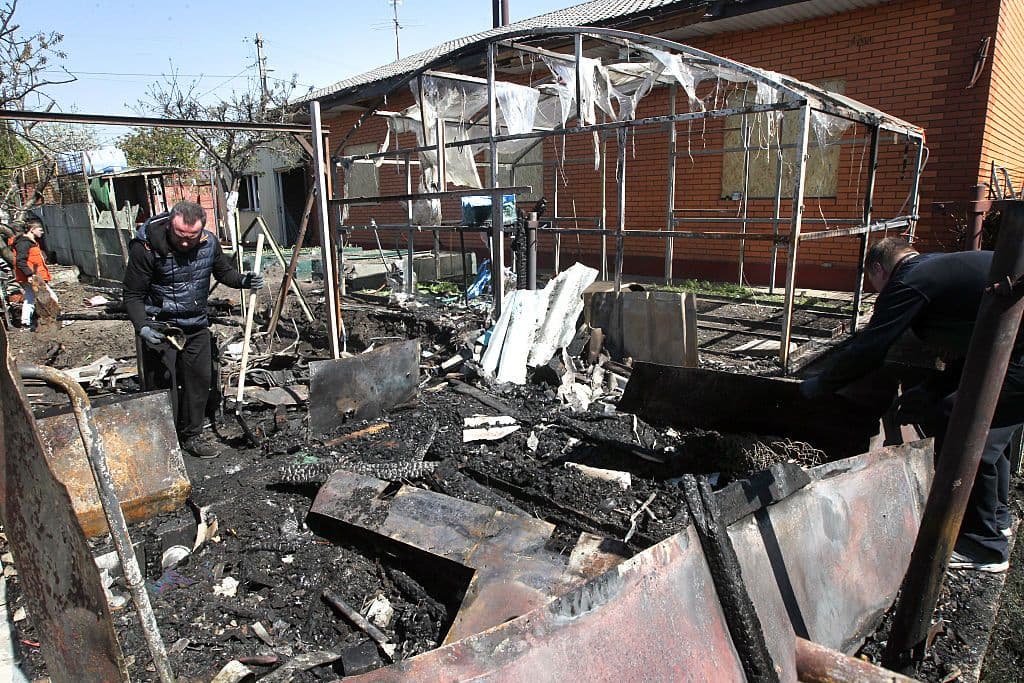
A man stands among debris in a yard affected by a Russian drone strike in Dnipro, Ukraine. (Mykola Miakshykov/Ukrinform/NurPhoto via Getty Images)
2. For the Kindergarten in Sumy
Father, two Russian drones struck a kindergarten building in central Sumy City on the morning of May 6. A kindergarten. We do not have the names of the children who were there or were on their way. We know only that Russia fired at a kindergarten on the morning after a ceasefire began. Protect the children of Sumy. Protect the children of every Ukrainian city that has been struck while children were in it. Let the world understand what it is looking at.
3. For Viktor Kuzmenko and Dmytro Skryl
God of the brave, Viktor Kuzmenko was a Hero of Ukraine who led the rescue operation after the 2024 Poltava strike and saved 17 people. On May 5 he ran toward a fire at a gas facility and Russia struck again while he was there. Dmytro Skryl was beside him — a firefighter with 20 years of service who specialized in oil and gas fire response. Three Naftogaz workers were also killed in that second strike. Russia has struck emergency responders 401 times. Be with the families of Viktor and Dmytro. And give the emergency services of Ukraine, who continue to run toward fires knowing Russia may strike again, the protection they cannot give themselves.
4. For the People of Oleshky
Lord, Oleshky had 24,000 people before the occupation. It has approximately 2,000 now. The remaining people cannot evacuate. They cannot receive food or medicine. Five of the thirteen surrounding settlements have been completely destroyed. More than 200 children remain in the area. Ukraine has filed requests with the UN and the ICRC. We pray those institutions move quickly. That the corridors open. That the 220 people who sent evacuation requests receive a response before another week passes in a place where the population has fallen by 92 percent.
5. For the Ceasefire That Was Not
God of justice, Ukraine declared a ceasefire and Russia violated it 1,820 times before 10 in the morning. The Easter ceasefire was violated 10,721 times. The pattern is fully established. And yet Ukraine proposed this silence because the alternative — not proposing it — would have surrendered the moral clarity of being the side that tried. We pray for the soldiers asked to be still while assault groups crossed into gray zones and missiles flew toward kindergartens. For the leaders who must now decide what to do when May 9 arrives and Russia asks the world to notice its parade. Let the world notice the kindergarten too. In Your mercy, in Your justice — bring this war to its end.