
Ukraine Daily Briefing | May 5, 2026 | Day 1,532 of the Full-Scale Invasion
Overnight into May 5, Ukraine struck the Kirishi oil refinery in Leningrad Oblast — one of Russia’s three largest, processing 20–21 million tons of crude annually — and the VNIIR-Progress military navigation plant in Cheboksary, 1,200 kilometers from the Ukrainian border, using Flamingo cruise missiles launched from over 1,500 kilometers away. Russia responded with 11 Iskander ballistic missiles and 164 drones, including a deliberate double-tap strike against first responders at a gas facility in Poltava Oblast. Then, as Ukraine’s self-declared ceasefire approached at midnight, Russian aircraft dropped guided bombs on the city centers of Zaporizhzhia and Kramatorsk and struck Dnipro in the evening: 22 civilians killed, 56 injured. Russia also cut mobile internet in Moscow and St. Petersburg for the first time ahead of the May 9 parade. The EU voted to formally join the Special Tribunal to prosecute Russian leaders for the crime of aggression.
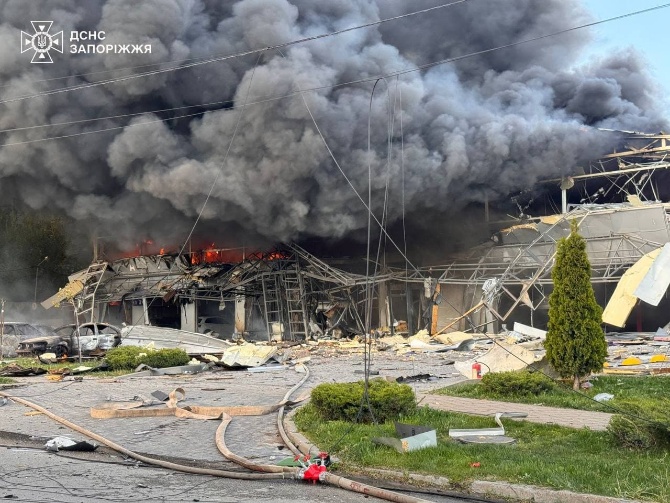
Aftermath of a Russian strike on Zaporizhzhia, southeastern Ukraine. (Ukraine’s Emergency Service)
The Day’s Reckoning
The day began with fire in Leningrad Oblast and smoke rising over Cheboksary. Ukraine had struck the Kirishi oil refinery — one of the three largest in Russia, processing over 20 million tons of crude per year and supplying more than 6 percent of Russia’s total refined oil, including fuel that sustains its armed forces — and had hit the VNIIR-Progress plant in Chuvashia, a facility that manufactures GLONASS, GPS, and Galileo navigation components for Russian drones and missiles. The VNIIR plant had reinforced its buildings with anti-drone protective structures. The structures did not stop the Flamingo cruise missiles. Six Flamingo missiles and an An-196 Lyutyi drone were confirmed striking the plant by geolocated footage. The Flamingo has a reported range of up to 3,000 kilometers and a warhead of approximately 1,100 kilograms. Zelensky confirmed the strikes publicly, calling the Cheboksary plant “a system Russia uses in its war against Ukraine.”
Russia’s response was calibrated to hurt. Eleven Iskander-M ballistic missiles and 164 drones launched overnight. Ukrainian air defenses downed 149 drones but only one of the eleven missiles. The ballistic missile campaign was deliberate — designed to exhaust Ukrainian Patriot interceptors by launching large drone waves first, then striking with weapons that only Western-provided systems can engage. One of those missiles hit a gas production facility in Poltava Oblast while emergency workers were already on site extinguishing the initial fire. Two rescuers were killed in the second strike. Three Naftogaz employees died. Thirty-seven more were injured. This is not a battlefield tactic. It is a tactic against people who run toward fires.
Then, in the afternoon and evening, as Ukraine’s self-declared midnight ceasefire approached, Russian aircraft dropped guided aerial bombs on Zaporizhzhia and Kramatorsk. In Zaporizhzhia, four guided bombs hit an automobile repair shop in the city center around 4 p.m. Twelve killed. Forty-three injured. Four critical. Eighteen hospitalized. The city declared a day of mourning. In Kramatorsk, aerial bombs hit the city center around 5 p.m. Six killed. Thirteen injured. Apartment buildings damaged. Parts of the city without electricity. In Dnipro, four more killed in evening strikes. Twenty-two dead in a single afternoon and evening, hours before a ceasefire was supposed to begin.
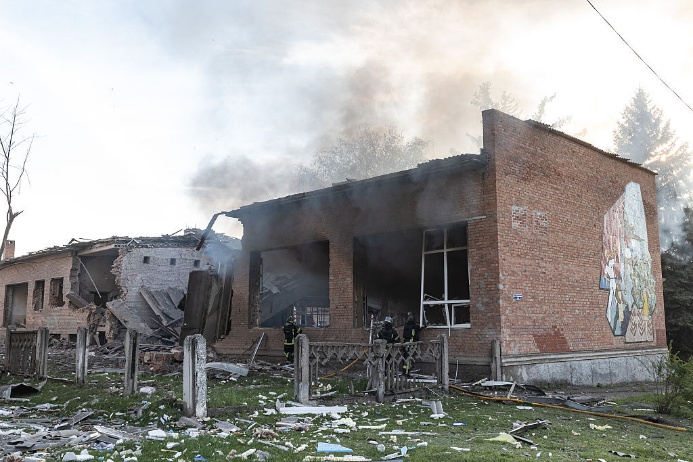
Firefighters try to extinguish a fire that broke out following a fatal Russian attack against Kramatorsk. (Diego Herrera Carcedo/Anadolu via Getty Images)
Russia also cut mobile internet in Moscow and St. Petersburg ahead of the May 9 parade — disrupting payments, navigation, and communication for millions of residents until the Ministry of Digital Development partially lifted the blackout later in the day, restoring access only to government-approved “whitelisted” sites. Eighteen Russian airports were placed on temporary ground stop during the overnight Ukrainian drone campaign. Air raid alerts reached Khanty-Mansi Autonomous Okrug, over 2,000 kilometers from the Ukrainian border — the first such alert in the okrug in nearly four years of war.
Kirishi and Cheboksary: Ukraine’s Deepest Industrial Strikes
The strike on the Kirishi oil refinery in Leningrad Oblast was confirmed by NASA FIRMS satellite fire data, Leningrad Oblast Governor Alexander Drozdenko, and Reuters, which reported that three of the four crude distillation units and several secondary units were damaged, halting refinery operations. The Kirishi refinery processes 20–21 million tons of crude oil annually, produces more than 6 percent of Russia’s total refined oil, and supplies fuel that sustains Russian military operations. Drozdenko reported 29 drones downed over Leningrad Oblast. The Ukrainian Unmanned Systems Forces confirmed the strike and identified Kirishi as one of Russia’s three largest refineries. NASA heat anomaly data confirmed fires near the facility on May 5.
The VNIIR-Progress plant in Cheboksary, capital of Russia’s Chuvash Republic, is approximately 1,200 kilometers from the Ukrainian border and roughly 300 kilometers from the Alabuga Special Economic Zone in Tatarstan — the major Russian production facility where many Shahed-type drones are manufactured. The VNIIR-Progress plant produces receivers and antennas for GLONASS, GPS, and Galileo satellite navigation systems, and Kometa electronic warfare-resistant navigation components used in Shahed drones, Iskander-K cruise missiles, and guided aerial bomb modules. The plant had installed metal protective structures on its buildings as anti-drone defenses. Ukrainian forces struck the facility with six confirmed Flamingo F-5 cruise missiles and an An-196 Lyutyi drone in the overnight strike, and Ukrainian drones struck the facility again around 7:30 a.m. local time. One person was reported injured by local Governor Oleg Nikolayev. The full extent of the damage has not been independently verified.
Zelensky confirmed the strikes in a Telegram post with video footage on May 5, describing the operation as part of Ukraine’s “Deep Strike” campaign. He stated that the missiles traveled over 1,500 kilometers to reach their targets. “These are the systems Russia uses in its war against Ukraine,” he said. Ukraine’s General Staff also confirmed the strikes and provided a detailed account of the Cheboksary plant’s role in Russian weapons production. Satellite imagery confirmed additional damage from the April 30 strike on the Sverdlov Plant explosives components manufacturer in Dzerzhinsk, Nizhny Novgorod Oblast, with two workshops destroyed. The Tuapse refinery damage total, confirmed on May 5 by the Ukrainian General Staff, now stands at over $300 million in direct damage to the refinery and port infrastructure combined.
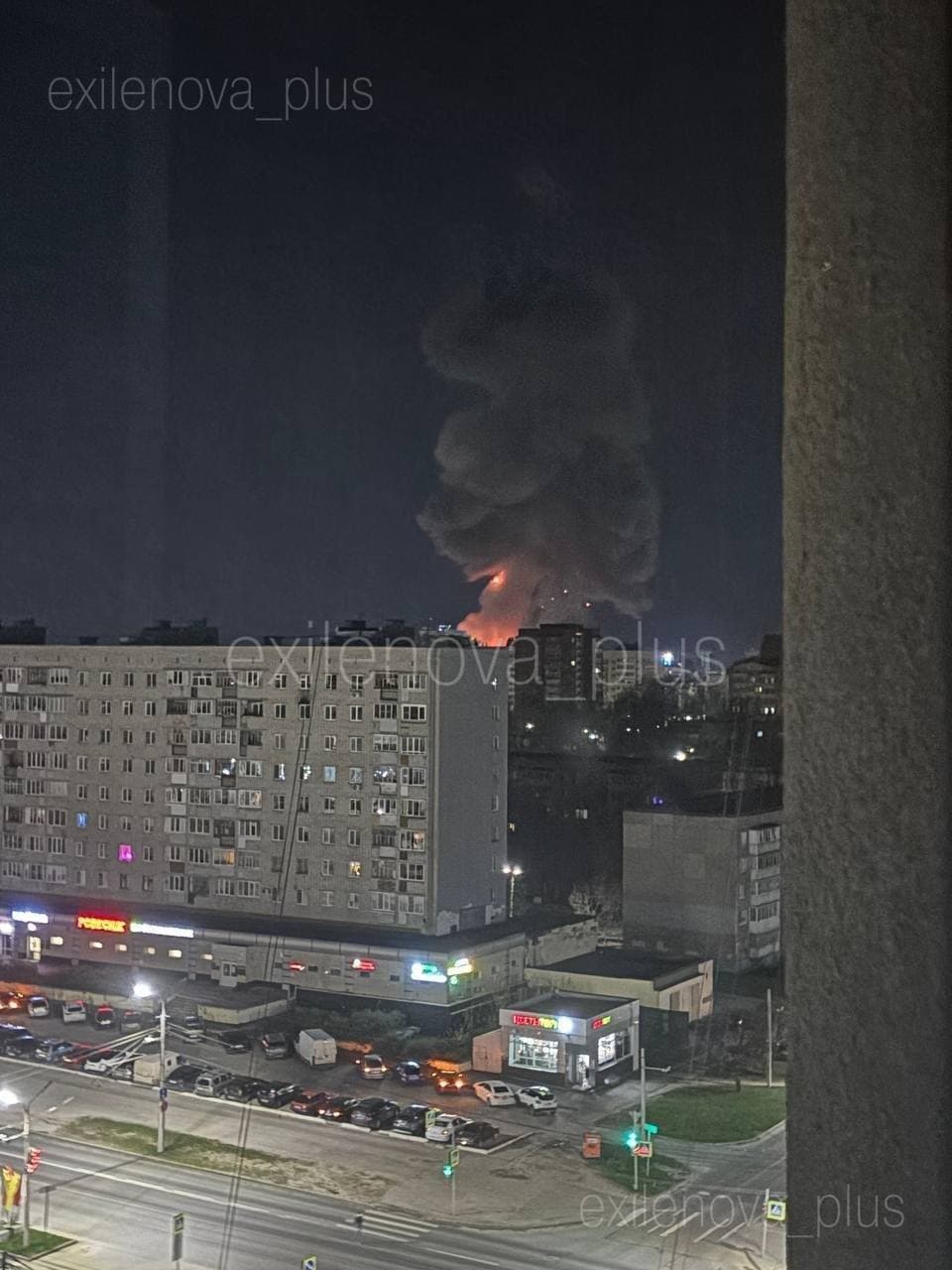
A large fire is purportedly seen emanating from the JSC VNIIR-Progress institute in the Russian city of Cheboksary overnight. (Exilenova_plus/Telegram)
The Double-Tap in Poltava: Russia Strikes First Responders
The Ukrainian State Emergency Services reported that Russian forces conducted a double-tap missile strike on a gas production facility in Poltava Oblast on May 5. Four missiles — assessed as likely Iskander-M ballistic missiles — were used. The first strike hit the facility. Emergency responders arrived and began fighting the fire. Then Russian forces struck again, targeting the responders at the scene. Two DSNS emergency workers were killed in the second strike. Three Naftogaz employees who had been at the facility were also killed. At least 37 people were injured. Kharkiv Oblast Governor Oleh Syniehubov confirmed the strike pattern on Telegram, writing: “They struck again very treacherously with a missile when emergency service workers were already on site, extinguishing the fire.” Zelensky stated that total casualties in Poltava Oblast from the overnight strikes reached at least four killed and “dozens” injured.
The double-tap strike tactic — a second strike specifically targeting emergency responders who arrive after the first — has been documented repeatedly across the war. ISW assessed on May 5 that Russia deliberately uses an unusually high proportion of ballistic missiles relative to the size of overall strike packages, knowing that Ukraine can only intercept ballistic missiles with Patriot systems and that global shortages of Patriot interceptors limit Ukrainian capacity. Russia launches large drone waves first to exhaust and stretch air defenses, then follows with ballistic missiles during the same operational window. Ukraine downed 219 drones during the May 4 day and May 4–5 overnight strike series, but only one of the eleven Iskander-Ms launched overnight. The remaining ten missiles reached their targets.
Zaporizhzhia, Kramatorsk, and Dnipro: 22 Dead Before the Ceasefire
At approximately 4 p.m. on May 5, Russian aircraft dropped four guided aerial bombs on Zaporizhzhia city, striking an automobile repair shop in the regional center. Twelve people were killed. Forty-three were injured, including four in critical condition and fourteen with moderate injuries. Eighteen people were hospitalized. Governor Ivan Fedorov confirmed that rescue crews were clearing rubble with people still believed to be trapped, and that Russian forces deployed strike drones to the area as police, emergency responders, and medical teams worked the scene. Zaporizhzhia City Council Secretary Regina Kharchenko declared a day of mourning. Zelensky described the strike as “absolutely cynical” with “no military justification whatsoever.”
At approximately 5 p.m., Russian aircraft struck Kramatorsk — the temporary capital of Ukrainian-controlled Donetsk Oblast — with aerial bombs targeting the city center. Five people were initially reported killed; the toll was updated to six. Thirteen people were injured. Apartment buildings and vehicles were damaged. Parts of the city lost electricity. Search and rescue operations continued into the evening with people believed still trapped beneath rubble. Governor Vadym Filashkin confirmed the casualty figures.
In Dnipro, four people were killed in Russian strikes in the evening, confirmed by Zelensky in a post on X. The same post confirmed the Zaporizhzhia casualty figures and stated: “It is essential that Russia is forced to end this war. We need silence from such strikes and all others like them every single day, not just for a few hours for ‘celebrations.’ Life must be protected.” The strikes on Zaporizhzhia, Kramatorsk, and Dnipro occurred on the same day that Ukraine’s self-declared ceasefire was set to begin at midnight. Russia had not acknowledged Zelensky’s ceasefire proposal.
The Full Strike Picture: 11 Iskanders, 164 Drones, and an Escalating Ballistic Campaign
Russian forces launched one Iskander-M ballistic missile and 88 Shahed, Gerbera, Italmas, and other drones against Ukraine from 0830 to 1830 local time on May 4, and then an additional eleven Iskander-Ms and 164 drones overnight into May 5. Ukrainian air defenses downed one missile and 219 drones across both periods; nine missiles and 28 drones struck at least 14 locations; debris from intercepted drones fell on ten more locations as of 0900 local time on May 5. Zelensky confirmed that Russian strikes in the overnight period primarily targeted energy infrastructure in Poltava, Kharkiv, Dnipropetrovsk, Zaporizhzhia, and Kyiv oblasts. Casualties in Kharkiv Oblast: one killed, four injured. Dnipropetrovsk Oblast: three injured. Poltava Oblast: at least four killed (see double-tap section), at least 37 injured. Sumy Oblast: one killed, five injured. Chernihiv Oblast: three injured. Kherson Oblast: two killed, seven injured.
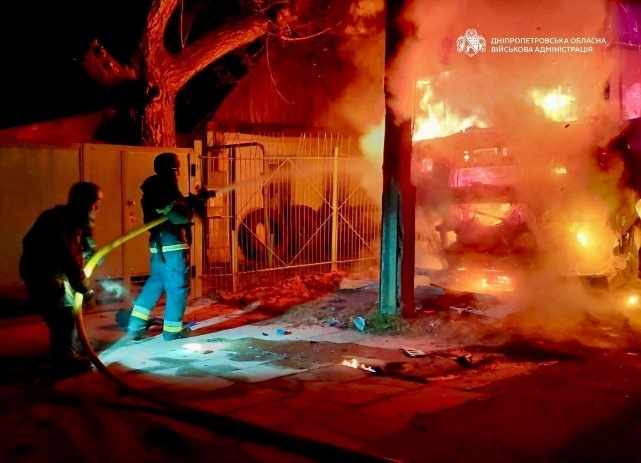
Firefighters respond to a blaze in Dnipropetrovsk Oblast. (Telegram / Governor Oleksandr Hanzha)
ISW assessed that Russia is deliberately increasing the frequency of combined missile and drone strikes as part of a strategy to destroy Ukrainian infrastructure and shape the battlefield for the Russian Spring-Summer 2026 offensive. The disproportionate use of ballistic missiles is calculated: Russia knows Ukrainian forces can only intercept Iskander-Ms with Patriot systems, of which global shortages exist. Russia also fired almost 8,000 KAB guided glide bombs in March 2026 and nearly 7,000 in April — the largest and second-largest monthly figures since the start of the full-scale invasion, respectively, according to Ukraine’s Ministry of Defense. A Russian milblogger affiliated with the Kremlin acknowledged on May 5 that Ukrainian interceptor drones are now effective enough that Russian forces are shifting Shahed drone usage toward frontline rather than rear-area targets. The same milblogger criticized the Russian long-range strike campaign for inconsistent targeting that shifts focus too frequently without completing any campaign objective.
Moscow and St. Petersburg Internet Blackout: The Parade President Cannot Defend His Capital
Russia cut mobile internet services in Moscow and St. Petersburg on May 5, the Kremlin confirmed, citing security concerns ahead of the May 9 Victory Day parade. The disruption affected payments, navigation, and communication for millions of residents. The Ministry of Digital Development announced a temporary lift of the blackout later in the day but restored access only to “whitelisted” government-approved sites. Internet disruptions were also reported in Perm and other regions. Moscow Mayor Sergei Sobyanin reported that five drones were downed while approaching the Russian capital overnight.
Air raid alerts were declared across at least 18 Russian regions during the overnight Ukrainian drone campaign, including Khanty-Mansi Autonomous Okrug — over 2,000 kilometers from the Ukrainian border — the first alert there in nearly four years of war. Russia’s Federal Air Transport Agency simultaneously closed airports in 15 Russian cities and introduced restrictions at all four Moscow airports. Russia’s Defense Ministry reported downing 289 drones over various regions overnight. Explosions were also reported in occupied Crimea and in Voronezh and Kazan.
ISW assessed that Putin’s insistence on staging the May 9 parade reflects a refusal to acknowledge the reality that Ukraine has brought the war back to Russia. Russia confirmed the parade will proceed but without military hardware on display — the first such parade without equipment since 2007. A Russian milblogger noted the equipment is usually stored in open-air lots that are now vulnerable to Ukrainian strikes. Another milblogger called for better allocation of air defense assets and the creation of regional air defense volunteer units. The ire in the Russian information space reflects a recognition that the Kremlin’s current mitigation efforts are insufficient to address Ukraine’s deepening strike campaign against European Russia.
Frontline: Ukrainian Advances at Myropillya and Bilytske, Russian Pressure in Sumy
Ukrainian forces advanced in northern Sumy Oblast, with geolocated footage published on May 4 confirming Ukrainian forces raising a flag in central Myropillya, northeast of Sumy City. Separately, geolocated footage published on May 3 confirmed Russian advances in Ryasne, southeast of Sumy City, where Ukrainian forces struck Russian vehicles in the settlement center and on a road to its west. Russian forces conducted a platoon-sized motorized assault in northern Sumy Oblast on May 3 involving at least 18 servicemembers, eight ATVs, and two motorcycles. A Ukrainian servicemember operating in the area reported on May 5 that Russian forces are increasing activity and replenishing losses, intensifying infiltration attempts to establish a defensible buffer zone along the international border.
In the Pokrovsk direction, Ukrainian forces advanced in southern Bilytske, north of Pokrovsk, confirmed by geolocated footage published on May 3. Russian forces continued infiltrating west and northwest of Pokrovsk, with milbloggers claiming advances west of Rodynske and south and southwest of Hryshyne, though these were not confirmed by ISW. The Russian military command is redeploying elements of the 90th Tank Division to the area; separately, detachments of the Rubikon Center for Advanced Unmanned Technologies are establishing drone control points at elevated positions in urban areas of northwestern Pokrovsk.
Elsewhere: Russian forces continued offensive operations in the Kharkiv direction without confirmed advances; Ukrainian forces counterattacked northeast of Kharkiv City. Russian forces continued limited offensive operations in the Kupyansk and Velykyi Burluk directions without advances. In the Slovyansk direction, Russian forces continued offensive operations without confirmed advances; milbloggers claimed advances north of Staryi Karavan and east of Rai-Oleksandrivka. In the Kostyantynivka direction, a Ukrainian battalion commander reported on May 5 that Russian forces adapt their tactics to weather conditions — using anti-thermal imaging ponchos for nighttime attacks and conducting larger group advances when poor weather grounds drones. An FPV drone strike struck emergency responders near Druzhkivka, injuring one. Russian forces continued operations in Dobropillya, Novopavlivka, Oleksandrivka, Hulyaipole, western Zaporizhzhia, and Kherson directions without confirmed advances.
Ukrainian Long-Range Strikes Against Russian Military Assets
Ukrainian forces struck a Pantsir-S1 air defense system near Skryabino, Bryansk Oblast, approximately 88 kilometers from the border, between May 1 and 5, the Unmanned Systems Forces Commander Major “Magyar” Brovdi confirmed. Between May 3 and 5, Ukrainian forces struck a fuel and lubricants depot and material warehouse near occupied Dovzhansk in Luhansk Oblast (roughly 150 km from the front), a field artillery depot near occupied Novoselivka (70 km), and a fuel depot near occupied Vedmezhe (140 km). Brovdi confirmed additional strikes during May 1–5: a temporary deployment point of the Russian 3rd Combined Arms Army near Kadiivka (55 km), an artillery depot of the 27th Motorized Rifle Division near Kypuche (69 km), warehouses of the 90th Tank Division near Dovzhansk, and a train near Raihorodka (84 km).
Ukrainian forces also struck a Russian logistics depot on the outskirts of occupied Donetsk City (41 km from the front) overnight May 4–5, and a drone depot in occupied Donetsk City on May 3. Ukrainian Unmanned Systems Forces struck a field ammunition depot near occupied Vilne (62 km) on May 3. A Pantsir-S1 air defense system near occupied Novyi Svit in Donetsk Oblast (44 km) was confirmed destroyed on May 3. In Zaporizhzhia Oblast, Ukrainian forces struck a drone depot in occupied Kamyanske (50 km) and an ammunition depot in occupied Sofiivka (78 km) on May 3, and a command and observation post in occupied Smile (34 km) and a Kasta-2E radar station in occupied Yelyseivka (64 km) overnight May 4–5. Ukraine’s GUR confirmed that an April 2026 strike against occupied Crimea destroyed a Russian Be-12 Chaika anti-submarine aircraft, three landing boats, a supply ship, and a storage hangar.
Russia’s Fiber-Optic FPV Drones Reach Kramatorsk
Photos published on May 5 by Iryna Rybakova, press officer for Ukraine’s 93rd Separate Mechanized Brigade, showed the aftermath of a drone strike on a car in a residential area of Kramatorsk — and she specifically identified the weapon as a Russian first-person view drone connected by fiber-optic cable. This is significant: fiber-optic FPV drones are resistant to jamming, spoofing, and loss of signal beyond the line of sight because they do not rely on radio frequency communication. They are normally limited in urban environments because buildings break up connectivity — but in a densely populated civilian area, they can operate with lethal precision.
Kramatorsk had previously faced regular missile and glide bomb attacks but had not been a major target for fiber-optic FPV drones. The city is the temporary capital of Ukrainian-controlled Donetsk Oblast, a staging area for Ukrainian units operating across the Donbas, and one of Ukraine’s most heavily fortified municipalities. Russia sources most of its fiber-optic spools directly from China; Ukrainian drone manufacturers rely on supply chains involving multiple intermediaries, resulting in less reliable and shorter-range optical fiber. The appearance of fiber-optic FPV drones in Kramatorsk marks an expansion of a weapon system that has already been used to systematically target civilians in Kherson.
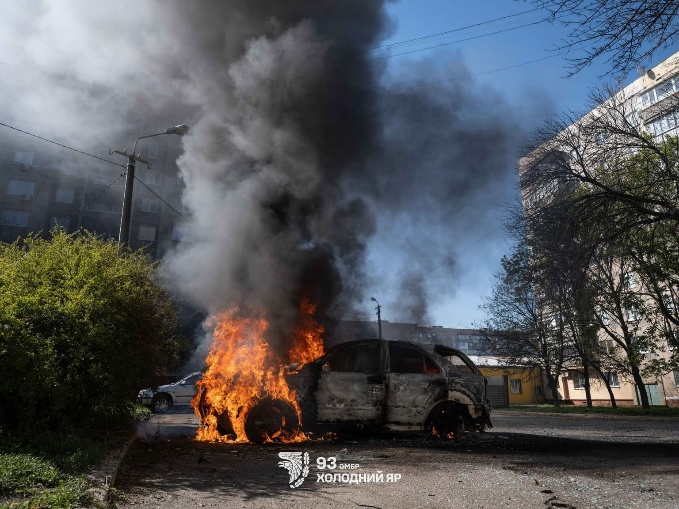
The aftermath of a drone strike on a car in Kramatorsk. (Iryna Rybakova / 93rd Separate Mechanized Brigade)
Russia’s Repopulation Campaign in Occupied Ukraine: Scale and Method
ISW published a detailed assessment on May 5 of Russia’s systematic campaign to repopulate occupied Ukrainian territories with Russian citizens — a campaign ISW assesses contravenes Russia’s obligations under the Fourth Geneva Convention and constitutes a war crime under the Rome Statute of the International Criminal Court. The report documents that 75 percent of apartments in occupied Mariupol have been purchased by Russian immigrants, according to data from Russia’s Unified Institute for Spatial Planning. Russian Deputy Prime Minister Marat Khusnullin confirmed that across all occupied Ukrainian territories, locals purchase only 30 percent of available housing while Russian workers, military personnel, and other immigrants purchase the remaining 70 percent.
The mechanisms are documented: properties declared “ownerless” under criteria as vague as the presence of overgrown weeds are transferred to municipal ownership after three months and redistributed to Russian military personnel, civil servants, and settlers. As of March 2026, 13,000 apartments in Mariupol were classified as ownerless, with 100–200 being added weekly. Putin signed a law in December 2025 federalizing the seizure and redistribution of “ownerless” property across all four occupied oblasts. Russian state institute EIPP and development corporation VEB.RF published joint plans in March 2026 to resettle 114,000 Russians in occupied Ukraine by 2045. The Kremlin’s Zemstvo programs pay 2 million rubles ($27,000) to Russian medical, educational, and cultural professionals who relocate to occupied settlements for at least five years. Six Russian banks offer a 2 percent preferential mortgage to any Russian citizen purchasing property in occupied Ukrainian territories. ISW notes that the occupation’s demographic engineering has already greatly complicated the prospects of Crimea’s reintegration after 12 years — and the same process is now operating across four additional oblasts.
EU Joins the Special Tribunal to Prosecute Russia for the Crime of Aggression
EU ministers voted on May 5 to formally join the Council of Europe’s Special Tribunal that will prosecute Russian leaders for the crime of aggression against Ukraine — the same crime for which Nazi German leaders were convicted at Nuremberg. Three EU officials confirmed the vote to the Kyiv Independent. Iryna Mudra, deputy head of Ukraine’s presidential office, described the decision as marking “the transition from conceptual design to the final phase of institutional establishment.” The Special Tribunal is necessary because no existing court has a legal mandate to prosecute the international crime of starting a war of aggression. The ICC can prosecute war crimes and crimes against humanity but not the crime of aggression when committed by nationals of states that have not ratified the Rome Statute.
The tribunal already has significantly more than the 16 backers required to proceed. The Council of Europe will announce concrete progress when its 46 foreign ministers meet in Chisinau, Moldova on May 15. The Netherlands has expressed interest in hosting the court; the EU has provided funding for evidence-gathering and preparatory work. Once operational, key Russian leadership figures including Putin will face charges. The tribunal’s remit could also extend to Belarus and North Korea for their roles in supporting Russia’s war. Ukraine expects the tribunal to be fully operational by 2027.
U.S. Approves $373.6 Million JDAM Sale and UK Targets Russian Drone Supply Chains
The U.S. State Department approved a potential $373.6 million sale of extended-range Joint Direct Attack Munition (JDAM) systems to Ukraine on May 5. The package includes 1,200 KMU-572 JDAM tail kits, 332 KMU-556 JDAM tail kits, fuze systems, support equipment, logistics, and technical services. The main contractor is Boeing. JDAM kits convert existing free-fall bombs into precision-guided weapons capable of operating in adverse weather, using inertial navigation combined with GPS guidance. The approval follows the Pentagon’s $400 million military aid package released last week.
The United Kingdom announced on May 5 sanctions against 35 individuals and entities for involvement in migrant exploitation and human trafficking to sustain Russia’s war effort. The sanctions target networks that recruit migrants from Egypt, Iraq, Ivory Coast, Morocco, Nigeria, Syria, and Yemen by promising legitimate work, then deploy them to frontline Russian military units or weapons production facilities including drone manufacturing sites. UK Sanctions Minister Stephen Doughty called the practices “barbaric.” Among those sanctioned is Pavel Nikitin, whose company develops the VT40 drone used extensively by Russian forces against Ukraine. Also sanctioned are companies and individuals in Thailand and China accused of supplying drone components and other military goods to Russia. The UK designated targets under both its Global Migration and Human Trafficking Regime and its Russia sanctions framework.
Ukraine Condemns Egypt, Sybiha Warns on Belarus, Zelensky Pitches Bahrain
Ukraine formally condemned Egypt on May 5 for allowing the vessel Asomatos to unload 26,900 tons of stolen Ukrainian grain at the port of Abu Qir — the fourth such case since April and the second involving Egypt specifically. The unloading occurred four days after Ukraine formally requested legal assistance from Egypt’s Justice Ministry and provided documentation for seizure. Foreign Minister Andrii Sybiha wrote: “Ukraine is a country that has played the role of a reliable food security guarantor for Egypt for many years — and we don’t understand why Egyptian partners pay us back by continuing to accept stolen Ukrainian grain. Looting is not trade, and complicity only fuels further aggression.” Sybiha invoked the Holodomor in his message to Egyptian officials, drawing a direct line between Soviet-era agricultural theft and the current systematic seizure of grain from occupied Ukrainian territory.
Foreign Minister Sybiha also held talks on May 5 with Belarusian opposition leader Sviatlana Tsikhanouskaya, warning that Russia is increasingly using Belarus as a platform for aggression not only against Ukraine but against Europe as a whole. “Moscow is increasingly dragging Belarus into its war against Ukraine, turning it into a platform for aggression,” Sybiha wrote on X. He pledged continued Ukrainian engagement with democratic Belarusian forces and expressed confidence that a future democratic Belarus would join the European community. The talks came amid Lukashenko’s recent signing of a decree allowing conscription of reserve officers, Belarus’s enforcement of Russian travel bans at its border crossings, and Ukraine’s own detection of “specific activity” along the Belarusian border.
Separately, Zelensky pitched Ukraine’s battlefield-tested drone expertise and security cooperation to Bahrain, following a pattern of outreach to Gulf states that has accelerated since Ukraine’s experience with Iranian-origin Shahed drones became recognized as a unique source of knowledge about that weapons system. Zelensky also condemned the recent Iranian strikes on the UAE as the outreach to Bahrain was announced. The European Commission formally launched the EU-Ukraine Drone Alliance on May 5, with applications for founding members open until May 25; the alliance aims to bring together participants from EU member states, the EEA, EFTA, and Ukraine to strengthen unmanned aerial and counter-drone capabilities using Ukraine’s frontline experience.
Russia’s Losses and the Estonian Assessment
Ukraine’s Defense Minister Mykhailo Fedorov stated on May 5 that Russia lost 35,203 troops killed or seriously wounded in April 2026, marking the fifth consecutive month its battlefield losses exceeded its ability to mobilize new forces. “For the fifth month in a row, Russia is losing more than it can mobilize and is gradually choking on its losses,” Fedorov said. He identified Ukraine’s strategic goal as reaching 50,000 confirmed Russian losses per month, a threshold at which he assessed further Russian offensive advances would become unsustainable. All casualties are verified through the Army of Drones bonus system and the ePoints mechanism. The Kyiv Independent noted these figures cannot be independently verified.
Estonia’s Defense Forces published their 2025 annual yearbook on May 5, warning that Russia could restore its military combat readiness as early as 2027. Estonian Chief of Defense Andrus Merilo stated that despite heavy losses, Russia continues implementing military reforms and that “the war in Ukraine will not end with Russia losing the ability to conduct hostilities against us.” Merilo assessed that after a reduction in active fighting, Russia will focus on restoring its armed forces while simultaneously seeking new targets through destabilization campaigns. “In my opinion, 2027 is the year when Russia’s combat readiness will be restored, and if it then sees a favorable opportunity to use its armed forces, it will do it,” he said. The EDF report concluded that traditional concepts of readiness are no longer sufficient and that Estonia must be capable of stopping an adversary at the very outset of a conflict.
Varyag Brigade, Trump on Zelensky, Romania, and Europe’s Political Fault Lines
A Russian milblogger reported on May 5 that drone operators of the Russian 50th Separate Varyag Unmanned Systems Brigade of the Supreme Command struck three Ukrainian radar stations in deep rear areas of Kharkiv and Mykolaiv oblasts. ISW noted in January that the Russian military command planned to form the brigade from the Grom-Kaskad drone brigade by December 2026; its participation in long-range strikes represents the activation of a new dedicated long-range unmanned systems unit at the highest command level.
U.S. President Donald Trump, in remarks reported on May 5, described Zelensky as a “tricky” guy but said he “likes him.” The United States also announced plans to withdraw troops from Germany, a decision described as connected to the fallout from U.S. involvement in the Iran situation. The simultaneous signals — a characterization of Ukraine’s president as “tricky” and a drawdown of the U.S. military presence in a key NATO state — add to the uncertainty over Washington’s long-term posture in European security as ceasefire negotiations proceed without Ukrainian participation.
Romania’s pro-EU prime minister faced a no-confidence motion on May 5 over austerity measures, raising concerns in Kyiv and Brussels that a key NATO eastern flank member could shift toward pro-Kremlin parties — following a similar pattern already observed in Bulgaria. Czech and Finnish leaders stated at the European Political Community summit in Yerevan that Europe must learn from Ukraine’s wartime experience and incorporate its battlefield knowledge into European defense doctrine. Also at the summit margins: Lukashenko was reported to have been invited to join U.S. President Trump’s “Board of Peace” following the release of political prisoners from Belarusian detention — a development described by analysts as a potentially controversial signal of warming ties between Washington and Minsk despite ongoing security concerns along Ukraine’s northern border.
Amsterdam: The “Mortal Regiment” Counter-Protest
On May 2, Ukrainian activists from the Free Defenders movement confronted a pro-Russian Immortal Regiment rally at Dam Square in Amsterdam. As Russian and Soviet flags moved through the city center with Soviet-era music, the activists pushed to the front of the column and unfurled a large banner reading “Mortal Regiment.” They held photos of Russian soldiers implicated in war crimes in Bucha and Mariupol alongside the Immortal Regiment participants. The footage was reported by the Kyiv Independent on May 5. Natalia Vorontsova — also known as Nata Heezen, a key figure in pro-Russian demonstrations in the Netherlands and previously documented by the Kyiv Independent as part of the “Vredesdemonstratie” network that poses as a peace movement while campaigning against aid to Ukraine — ran toward the Ukrainian activists and attempted to tear down the banner. The counterprotest concluded at Dam Square with Ukrainian activists calling for the return of Ukrainian prisoners of war.
The Weight of May 5
Ukraine struck one of Russia’s three largest oil refineries and a plant that makes navigation systems for Russian drones and missiles. Russia responded with eleven ballistic missiles, killing people who were trying to put out fires. Then, as a ceasefire approached at midnight, Russian aircraft dropped guided bombs on Zaporizhzhia and Kramatorsk and struck Dnipro. Twenty-two people died in an afternoon and an evening.
Russia cut the internet in Moscow and St. Petersburg. Eighteen airports closed. Air raid sirens reached 2,000 kilometers from the Ukrainian border for the first time in four years. The parade will go forward without military equipment because the open-air lots where the tanks are stored are now vulnerable to Ukrainian strikes.
The EU voted to join the tribunal that will prosecute Russia for starting the war. Estonia said Russia could restore its military readiness by 2027. Ukraine’s defense minister said Russia has been losing more men than it can replace for five consecutive months. The ceasefire began at midnight. Russia had not acknowledged it.
Twenty-two dead on the day of a ceasefire. The silence, if it came at all, arrived too late for them.
A Prayer for Ukraine
1. For the Twenty-Two Who Died on May 5
Lord, twelve people were killed in Zaporizhzhia when four guided bombs hit an automobile repair shop. Six were killed in Kramatorsk when the city center was struck. Four more in Dnipro in the evening. Names that regional governors have not yet released, or have released in the formal language of official statements that cannot carry the weight of a name. They were in their city on a Monday afternoon, a few hours before a ceasefire was supposed to begin. Receive them. Hold the dozens hospitalized in Zaporizhzhia, the thirteen injured in Kramatorsk, the four who arrived at hospital in critical condition. And hold the city of Zaporizhzhia, which declared a day of mourning for people killed by a country that simultaneously claimed it wanted a pause.
2. For the Rescuers Who Ran Toward the Fire
Father, two emergency workers were killed in Poltava Oblast because they ran toward a fire at a gas facility and Russia struck again while they were there. Three Naftogaz workers were also killed in that second strike. Thirty-seven more were injured. We pray for them by their roles because we do not yet have their names — the people whose job it is to arrive when others flee. Give peace to those who died doing that work. Give strength to those who survived it. And give the emergency services of Ukraine, who have responded to thousands of double-tap strikes in this war, the knowledge that the world sees what Russia does to people who put out fires.
3. For the People of Kramatorsk and the Fiber-Optic Threat
God of protection, Russian fiber-optic FPV drones have appeared in Kramatorsk for the first time. These drones cannot be jammed. They are guided by cable, not signal. They found a car in a residential area of a city that has already survived years of missiles and glide bombs. Kramatorsk is heavily fortified. It is also full of people living as close to ordinary life as they can manage inside a war. Protect them as this war continues to find new instruments against the places they refuse to leave. Give the engineers and soldiers working on countermeasures the speed they need.
4. For the Occupied and the Displaced
Lord, Russia is systematically populating occupied Ukrainian territories with Russian citizens, converting stolen apartments into homes for settlers, using 2 percent mortgages and signing bonuses to bring 75 percent of Mariupol’s housing stock into the hands of Russians from Moscow and Krasnodar and Nizhny Novgorod. This is a demographic fact now, not a plan. The Ukrainians who fled are being replaced. The buildings where they lived are being given to people from a country that bombed them. We pray for the millions displaced from these territories. For the 20 percent of Ukraine that has been occupied for four years and longer. For their right of return, which international law protects and which Russia is engineering out of existence one apartment at a time. Let the tribunal that the EU voted to join today be one instrument of a justice that does not forget them.
5. For the Midnight That Came
God of justice, the ceasefire began at midnight. Ukraine’s guns went quiet. Russia had not acknowledged the proposal. The day’s dead — twenty-two of them — were already being counted. We do not know yet what the night brought. We do not know if the silence held or if drones flew. But we pray for the people of Ukraine who went to sleep in the first minutes of May 6 not knowing whether the war would pause for even a single night, or whether the missiles would come again before morning. Give them rest. Give them the morning. And let the silence, if it came, be the first thread of something that eventually holds.