
The Ukraine Daily Briefing · Friday, October 30, 2026
Prepared by Diana Bozhyk
The first civilians left occupied Oleshky on buses, some bound for Ukraine and some for Russia, after aid reached the town under a ceasefire that held for 87 hours. The U.S. approved the sale of 500 Patriot interceptors to Ukraine, but Zelensky said deliveries may begin “only in a few years” and asked allies to send missiles from their own stocks now. Ukrainian drones set the Novokuybyshevsk refinery ablaze, the first refinery strike in two weeks, as Russian attacks killed a woman in Shostka and hit Dnipro’s railway station again.
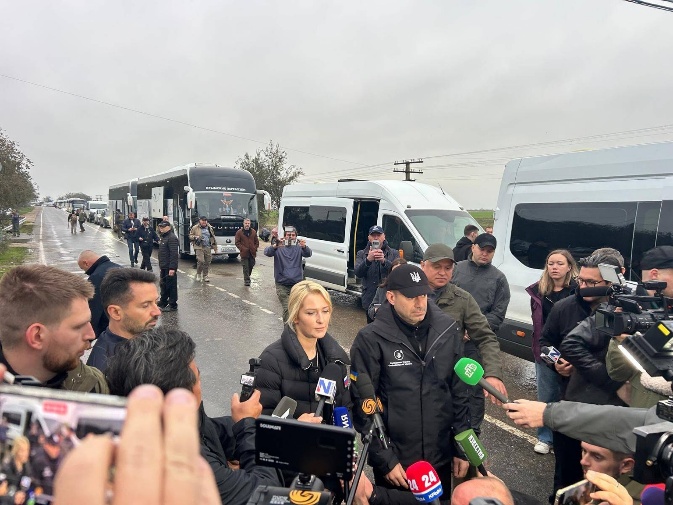
Ukraine’s Human Rights Ombudsman Dmytro Lubinets and Russia’s Commissioner for Human Rights Yana Lantratova attend a joint press briefing in Armiansk, Russian-occupied Crimea, ahead of the evacuation from Oleshky in Kherson Oblast. (Ukraine’s Ombudsman’s Office)
The Day’s Reckoning
At about 11:30 a.m., Ukraine’s human rights ombudsman walked into Oleshky, the town across the river from Kherson, and asked its people what they needed. It was the first humanitarian operation on this scale since Russian troops seized the town in 2022. By noon, the food had arrived. By evening, two columns of buses had left, one turning toward Ukraine and one toward Russia.
That is the plot of this Friday: a day of firsts that came with conditions. Washington approved 500 Patriot missiles, but the first may arrive in years, not weeks. Ukraine struck a Russian refinery again after a two-week pause. And the people of Oleshky got their way out, though not all on the terms Kyiv had hoped.
“The ceasefire has now lasted 87 hours,” Ombudsman Dmytro Lubinets said in the evening. “No violations have been recorded.”
The Road Out of Oleshky
You have lived in occupied Oleshky through four years of war. On Friday morning, Ukraine’s ombudsman arrives in your town and asks residents what they need.
Lubinets and his Russian counterpart, Yana Lantratova, met for a joint briefing in Armiansk, in occupied Crimea, before driving north. “Is everything all right?” Lantratova asked him in Russian in a clip aired by Russian state media. “Yes, we were warmly welcomed,” he answered in Ukrainian. Journalists from France, Italy, Russia, Ukraine and the United States traveled with the convoy, though photos from the ombudsman’s office showed mostly Russian media.
The Ukrainian delegation reached Oleshky at about 11:30 a.m. Kyiv time. Lubinets spoke with residents about what help they needed most, and around noon lawmaker Davyd Arakhamia said the aid had been delivered. Twenty-five buses with room for 750 people waited, along with ambulances for those who could not walk and a bus for people with pets. “Everyone who wishes to leave Oleshky will be given the opportunity to leave safely,” Lubinets said. “At the same time, those who have decided to stay can stay and will receive all the necessary humanitarian support.” People who had not registered in advance were also allowed to leave.
At Armiansk, the buses split into two convoys, Lantratova said, one toward Ukrainian-held territory and one toward Russia. Lubinets traveled with the one bound for Ukraine, which was to go through Anapa and then fly to Belarus before continuing home by bus. Neither side said how many people chose each direction. Prime Minister Serhii Koretskyi first said 527 residents were heading to Ukraine, then called that figure a mistake. Lantratova said two people had been killed during demining around the town; on Thursday, Kherson Governor Oleksandr Prokudin said a Russian mine had injured one person.
Not everyone trusted the process. Evacuation volunteer Kseniia Arkhipova said Russia broke the agreement by starting evacuations early; Russian state agency TASS aired footage of residents it said left on Thursday, with only Russian forces present. A source told the Kyiv Independent that patients at the town’s only working hospital were told they would face filtration if they left, and that people in outlying villages were warned they could be shot if they came to the assembly point. On Thursday, Putin accused Ukraine of “creating a humanitarian catastrophe” in a town his army has held since 2022.
As the convoys parted, Lubinets proposed that missions mediated by Melania Trump become a regular practice, saying the operation in Oleshky showed such agreements could help civilians. In Moscow, Kremlin aide Yuri Ushakov said Russia would watch whether Ukraine launches large strikes around its November 4 holiday, a sign, ISW said, that Moscow is setting conditions for any talks.
Five Hundred Patriots, Someday
The U.S. State Department approved a possible $2.1 billion sale of 500 PAC-3 MSE Patriot interceptors to Ukraine, paid for by Canada, Germany and Norway through the JUMPSTART fast-track program and by EU-backed Ukrainian funds, with no U.S. money. Congress has 30 days to review it. No delivery schedule was given.
Zelensky thanked Trump, Secretary of State Marco Rubio and the State Department, then pointed to the fine print. “It has been stipulated that deliveries may begin ONLY IN A FEW YEARS,” he wrote. Ukraine had asked for a winter package of 100 PAC-3s a month, he said, as Russia carried out more than 30 attacks on the power grid in the last two weeks of October alone. “We are asking our American partners to find a solution for the time when there is a real danger and a real need to use PAC-3 interceptors,” he said, proposing that the U.S. and European allies send missiles from their own stocks now and replace them later from the new order. Lockheed Martin plans to raise PAC-3 production from about 600 a year to 2,000 by 2030.
In Riga, NATO’s top commander, U.S. Gen. Alexus Grynkewich, said American deliveries had not stopped. “Everything has been delivered, in fact, we just had the delivery within the last week,” he said. “Every single third-party transfer that has been requested of the U.S. government has been approved.” His account contrasts with Zelensky’s repeated complaints about waiting a month for Defense Secretary Pete Hegseth’s approval. Ukraine’s own anti-ballistic project, Freyja, is finished on the Ukrainian side, but key European components are still in development, Defense News reported.
Shostka, Dnipro, Kharkiv, Kyiv
You work at a business in Shostka, in the Sumy region. On Friday morning, a Russian drone hits it while you are on shift. A 43-year-old woman was killed and eight people wounded, one critically, Governor Oleh Hryhorov said.
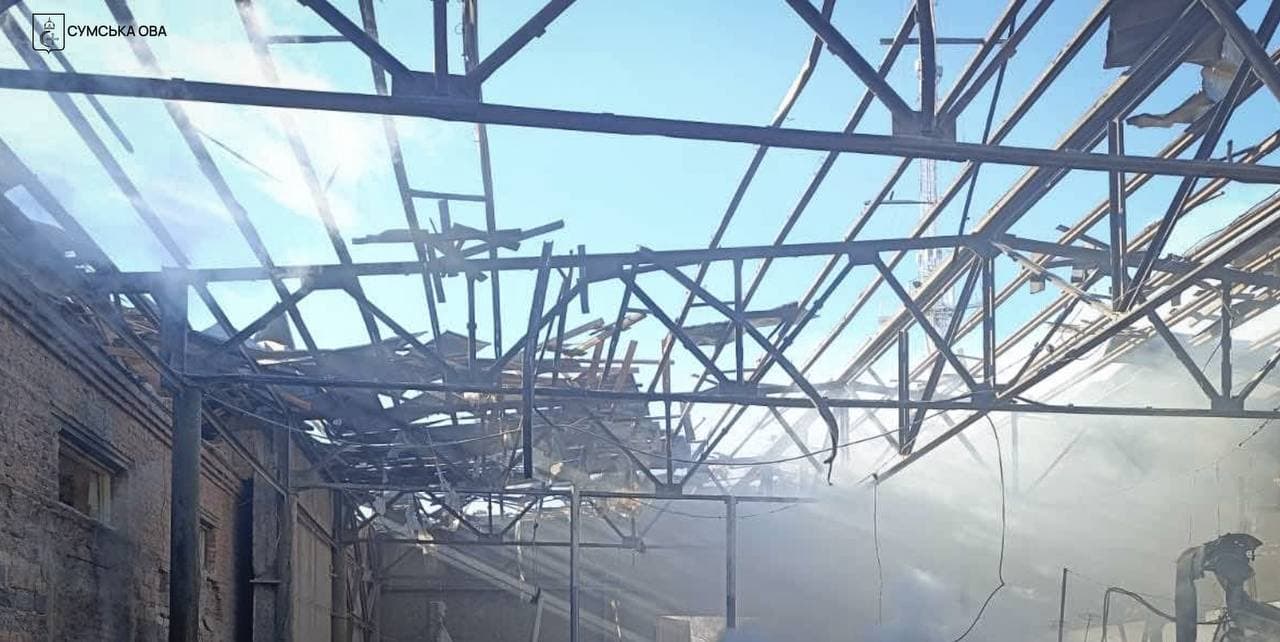
A cicilian enterpirse damaged in a drone strike on the Shostka community in Sumy Oblast, Ukraine. (Oleh Hryhorov/Telegram)
In Dnipro, the death toll from Thursday’s drone strike on the railway platform rose to 15 when another wounded man died. Five of the dead were railway workers, among them staff helping passengers to shelter and an engine driver going home on leave; Ukrainian Railways announced a review of its safety rules. On Friday evening, Russia struck the station again, several times, setting it on fire. Passengers and staff were already in shelters, and one woman was wounded. “The enemy has again struck the railway station in Dnipro,” Governor Oleksandr Hanzha said. The railway offered full refunds to anyone postponing a non-essential trip. On Friday morning, the Dnipro–Lviv train was running more than 16 hours late. Since January, Russian attacks have damaged 4,856 railway facilities, including 380 locomotives, and trains are now evacuated 100 to 200 times a day. “Everything tightens inside when you realise that the shelter is still far away and your child is beside you,” passenger Kateryna Kumratova, traveling with her four-year-old daughter, told AFP.
Earlier, a strike damaged five apartment buildings and a school in Dnipro. In Kharkiv, a jet-powered Geran-3 hit the roof of the Dafi shopping center, wounding four people, and late at night a drone in the Osnovianskyi district wounded three and damaged 10 homes. In Kyiv, a strike on an energy facility in the evening cut power to parts of the Obolonskyi, Darnytskyi, Desnianskyi and Podilskyi districts, DTEK said, and Mayor Vitali Klitschko said three drones hitting critical infrastructure left the entire left bank without water.
Overnight, Russia fired ballistic missiles, four guided missiles and 113 drones, 83 of them jet-powered, mainly at the Kyiv, Poltava and Dnipropetrovsk regions; 96 drones and three missiles were downed. The late-Thursday strike on Kyiv killed one person and injured another. Across the past day, Russian attacks killed at least 27 people and wounded 127. In Izium, the toll from Thursday’s guided bombs rose to four dead and 12 wounded; Kyiv Post reported that five employees of a local health care facility were killed. In the Zaporizhzhia region, two were killed and 23 wounded; in the Donetsk region, five were wounded. Chernihiv and the Poltava region observed a day of mourning.
Ukraine requested an emergency meeting of the UN Security Council. “Kick Russia out,” wrote Andrii Melnyk, its UN ambassador. “Russia must understand that its campaign of terror leads only to consequences, not concessions,” Foreign Minister Andrii Sybiha said.
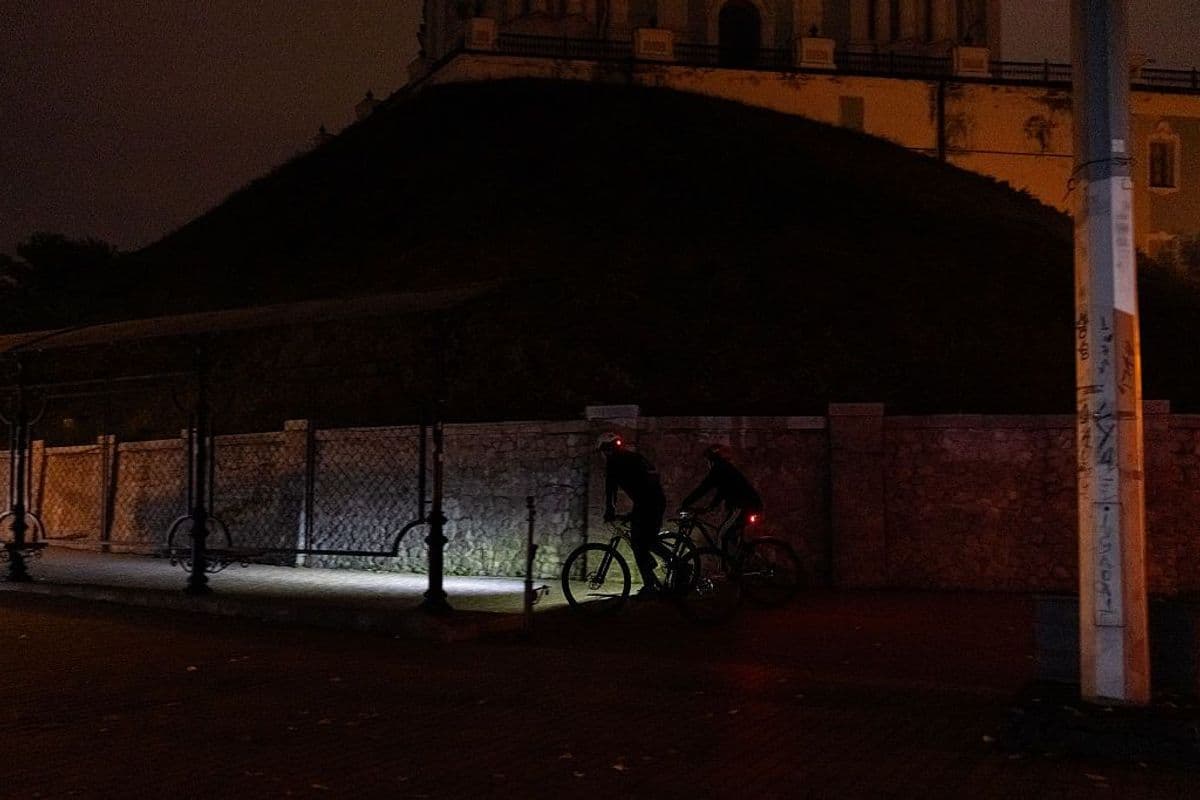
People ride bicycles near St. Andrew’s Church during a partial power outage following Russian attacks in Kyiv. (Tetiana Dzhafarova/AFP via Getty Images)
The Refineries Burn Again
Residents of Novokuybyshevsk, in Russia’s Samara region, woke before 6 a.m. to explosions. Ukrainian drone maker Fire Point said its FP-1s hit the Rosneft refinery there, which processes about 8.8 million tons of crude a year and makes jet fuel for Russia’s air force, scoring multiple hits including on its diesel hydrotreating unit. Satellite images showed a large fire and thick black smoke. Samara’s governor said two people died clearing up after the attack. It was the first reported Ukrainian strike on a Russian refinery since the attacks on Ryazan on October 15 and Surgut on October 16; in the meantime, Ukraine had turned its drones on Russian steelmakers. The Wall Street Journal had reported on Thursday that long-range units had informally paused refinery strikes under U.S. pressure until after the midterm elections. Deputy Prime Minister Alexander Novak said Ukraine attacked three refineries and a gas-chemical complex. “We had a brief pause, but today, attacks on refineries have resumed,” he said.
Drones also set fire to the Konservsushprod plant in Starodub, Bryansk region, which makes canned food and field rations for Russian forces under the “Russian Army” brand. Moscow’s mayor said 862 drones flew at the region overnight, and all four Moscow airports and Yaroslavl’s closed.
The Line
You hold a position in northeastern Fillya, southwest of Novopavlivka. A Russian drone hits it, and the video, geolocated by analysts, proves you got there.
The Institute for the Study of War reported that Ukrainian forces recently advanced south of Novopavlivka, while Russian troops advanced southeast of Dobropillia: a Ukrainian military source said Russian forces have reached the town’s southern edge, holding Svitle and Vodyanske. A Ukrainian soldier there said Russia keeps up intense drone strikes and infiltrations, and drops glide bombs on Dobropillia itself, which undercuts Moscow’s claims to control it. North of Kharkiv, Russians infiltrated Vysoka Yaruha but do not control it, ISW said, while footage showed Ukrainian troops still holding eastern Kozacha Lopan, which Putin claimed in September. A Russian surrendered to a Ukrainian drone north of Lyman. Russian troops slipped into Vilkhuvatka, northeast of Velykyi Burluk, where Ukrainian forces were counterattacking, and a Russian blogger claimed Russian forces had entered Tokarivka, north of Kharkiv, which ISW did not confirm. Military observer Kostyantyn Mashovets had reported on October 21 that Russian forward units reached a line between Svitle and Bilytske.
Ukrainian forces still hold the northern outskirts of Kostiantynivka, contrary to Russian claims. A Ukrainian brigade said a HIMARS strike destroyed the command post of Russia’s 26th Tank Regiment near Kupyansk after months of surveillance, and the General Staff reported hitting radar stations near Starodub and Medvedovo in the Bryansk region, about 33 and 27 kilometers from the border. In the Belgorod region, the governor has reportedly put a military unit under regional control to strike Ukrainian drone teams; a Russian blogger claimed it had hit six of them, which ISW could not confirm. A source close to Russia’s Western Group of Forces said Russian troops are striking Ukrainian supply lines along the Oskil River near Borova. In Sloviansk, a Russian FPV drone hit an evacuation vehicle of the Relief Coordination Centre on Thursday, wounding two.
At sea, Russian military bloggers confirmed that Russian naval drones struck and sank the Liberian-flagged Contship Jet off Bulgaria on Wednesday, boasting that the strike served Russian interests. A Ukrainian open-source channel claimed a Russian Su-57, Russia’s most advanced fighter, burned at Akhtubinsk airfield on Thursday during engine start; Russia did not confirm it, and the claim could not be verified. The Insider counted 11 Russian fighter jets and a helicopter lost in October. Russian attacks near Kupyansk, Lyman, Sloviansk, Hulyaipole, Orikhiv and in the Oleksandrivka direction made no gains. In northern Sumy, Russian assaults stalled as Ukrainian forces counterattacked, and the Kherson front was quiet under the truce.
Also Today
Shielding the grid. Energy Minister Denys Shmyhal said Russia has carried out more than 350 attacks on the grid since September, damaging over 800 pieces of equipment; 235 transformers now have a second layer of protection, and only one has been hit by a ballistic missile in six months. The government also approved a Finnish-backed loan of nearly 939 million hryvnias for Ukrnafta to build gas-engine power plants adding about 60 megawatts in western Ukraine.
New crossings for Kyiv. Infrastructure Minister Mykola Kalashnyk said backup crossings over the Dnipro are under construction, the first to open in early 2027, part of a program of 21 alternative crossings nationwide. One lane of the Southern Bridge reopened for vehicles up to 10 tons.
Shelters for newborns. The government is spending 354.6 million hryvnias to repair shelters at 84 maternity hospitals and protect intensive care and delivery rooms.
Money for 2027. The European Commission set out €45 billion for Ukraine next year, €31.7 billion of it for defense, and Canadian Prime Minister Mark Carney pledged an initial €500 million to the EU loan. Ukraine still faces a €70 billion gap. Euroclear, which holds €204 billion in frozen Russian assets, said Russian countermeasures cost it €233 million this year, while the assets have generated €8 billion in windfall profits for Ukraine since 2024. Deputy Prime Minister Vsevolod Chentsov has proposed moving them to a European custodian, but EU officials say using the assets is “at the bottom” of their options.
No photo with Lavrov. The U.S. canceled the G20 foreign ministers’ group photo in Atlanta after European diplomats refused to stand with Russia’s Sergey Lavrov; Ukraine was not invited, and U.S. lawmakers including Republican Don Bacon had urged that Lavrov be barred. “There will definitely not be a family photo in which our European partners are together with Mr. Lavrov,” German Foreign Minister Johann Wadephul said.
Zelensky to Istanbul. Zelensky will visit Turkey on Saturday to discuss Black Sea security with President Erdogan. “We expect that in November, we will be able to move forward with the formats that have been under discussion for so long,” he said.
Estonia won’t soften. After Reuters reported Pentagon officials asked the Baltic states to tone down their rhetoric on Russia, Estonian Prime Minister Kristen Michal said: “Putin is a dictator who kills women and children.”
Russia back on the ice. The Court of Arbitration for Sport ruled the ice hockey federation’s ban on Russia unlawful; Canadian Foreign Minister Anita Anand called it “very unwelcome,” and Serhii Mazur, head of Ukraine’s hockey association, said Russia “has destroyed many sports arenas in Ukraine, and must be held accountable.”
Novaya Gazeta closes. Russia’s leading independent newspaper shut down under state pressure. “Novaya Gazeta has been killed,” editor Sergei Sokolov said.
A case over MiGs. Slovakia’s prosecutor general reopened a criminal case against former Prime Minister Eduard Heger and Defense Minister Jaroslav Nad, who gave Ukraine 13 MiG-29s in 2023; a regional prosecutor had closed it in February.
Treason claims. Russia’s FSB accused Gennady Stepakhno, a 76-year-old Communist ex-legislator in Murmansk, of spying for Ukraine, which a party colleague called unbelievable, and Ukraine’s investigators said on Monday they detained a soldier suspected of passing troop positions to Russia.
A winter appeal. The UN refugee agency launched a $50 million winter appeal, warning that temperatures in Ukraine could fall to minus 20 Celsius.
Yandex cuts its forecast. Russia’s Yandex abandoned its 2026 revenue forecasts after Ukrainian strikes on its data centers.
Europe counts its drones. A European-Ukrainian alliance and a Kyiv think tank launched a Drone Security Index, counting 129 drone incidents in 18 EU countries since 2022, and the EU opened drone technology hubs in Latvia and the Netherlands.
Turmoil in Warsaw. Polish President Karol Nawrocki cut short a trip to Senegal amid a dispute over the Constitutional Tribunal, and Poland’s ambassador to China resigned.
The Closing
Tonight, two convoys from Oleshky are moving through the dark, one toward home and one away from it. In Dnipro, railway workers are mourning five colleagues. In Washington, 500 missiles exist on paper. Ukraine is grateful for every one, and it is asking, again, for the ones that can arrive before the snow.
A Prayer for Ukraine
1. For Those Who Defend
Lord of hosts, cover the soldiers near Novopavlivka, Dobropillia, Kostiantynivka and Kozacha Lopan who hold ground the enemy claims on paper. Guard the drone crews, the air defenders and the rocket teams who strike the commanders of the invaders. Give them courage through the cold nights, wisdom in every hard choice, and bring them home safely to those who love them.
2. For the Wounded and the Grieving
God of all comfort, receive the woman of Shostka, the fifteen of the Dnipro platform, among them five railway workers, the dead of Izium and Zaporizhzhia region, and all who died this week. Heal the wounded in Dnipro, Kharkiv and Kyiv. Comfort the families of Chernihiv and Kremenchuk on this day of mourning, and be near to every family that waits for news.
3. For Those Who Lead
King of kings, give President Zelensky wisdom in Istanbul and strength in every capital. Move the leaders of America and Europe to send help that arrives in time, not years too late. Let the voice of Ukraine be heard at the Security Council, and let those who wage war face consequences, not rewards. Grant every negotiator patience, courage and truth.
4. For Oleshky
Faithful God, go with the buses leaving Oleshky, the ones bound for home and the ones bound away. Let every person choose freely, without fear, and let none be held back by threats. Bless those who stayed, and keep the food and medicine flowing. Protect Ombudsman Lubinets and all who serve on this road, and reunite every scattered family in peace.
5. For a People Who Keep Standing
Father, Ukraine keeps its trains running, its hospitals open and its newborns sheltered while the bombs fall. Sustain the railway workers, the energy crews, the doctors and the mothers who give birth in shelters. In Your mercy, in Your justice, in Your time — bring this war to its end, and let the ending be worthy of what Ukraine has endured.