
The Ukraine Daily Briefing · Thursday, October 29, 2026
Prepared by Diana Bozhyk
A Russian jet-powered drone struck a crowded platform at Dnipro’s railway station, killing 14 people, and by evening Russian attacks across Ukraine had killed 20 and wounded at least 109, including two 15-year-old girls in Chernihiv. Ukraine answered with Neptune missiles that destroyed two Su-34 bombers in the Volgograd region. In Oleshky, the ceasefire held into its third day, the roads were cleared of mines, and delegations from Ukraine, Russia and the United States gathered to send in the first convoy.
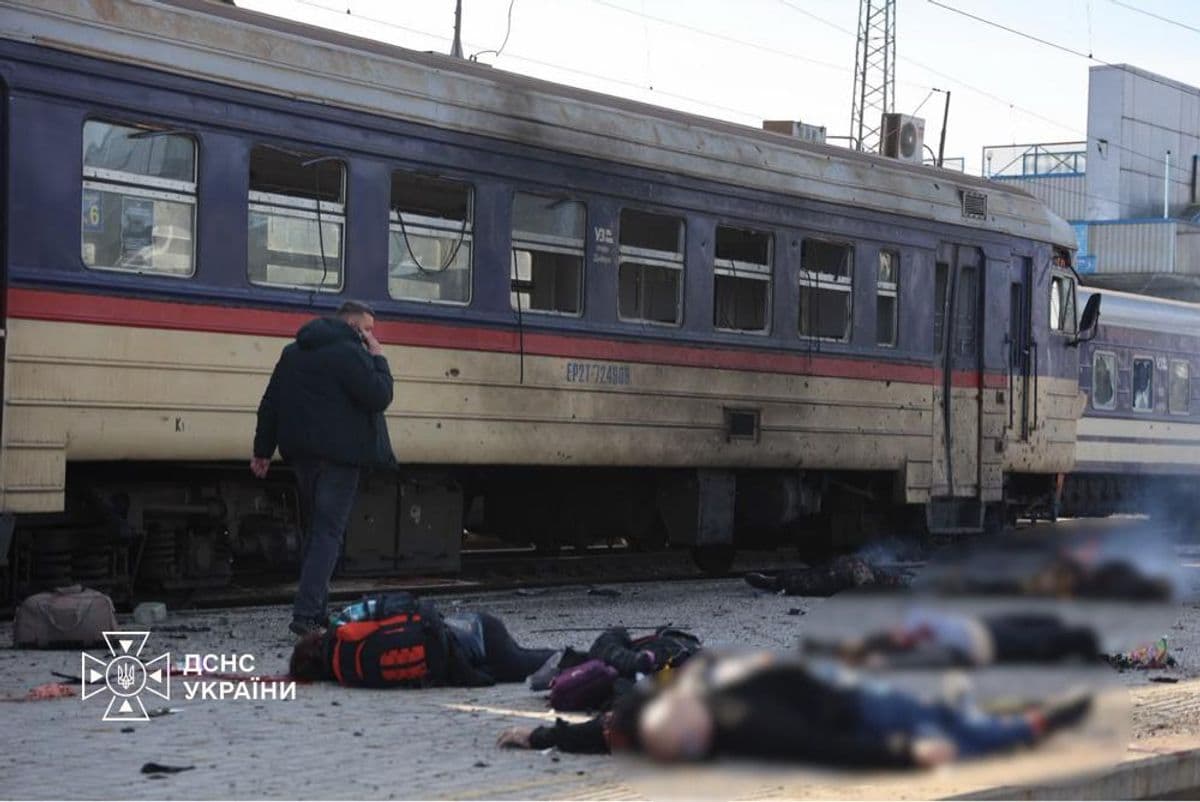
A photo showing the aftermath of a deadly Russian drone attack on the railway station of Dnipro, Ukraine. (State Emergency Service / Telegram)
The Day’s Reckoning
At about 11 a.m., four Russian jet-powered drones flew at Dnipro. Ukrainian air defenses shot down three. The fourth hit the railway station, where a commuter train and passenger train No. 866 to Zaporizhzhia stood at the platform. Fourteen people were killed. Among the wounded were an 11-year-old boy and a man who lost both legs.
That is the plot of this Thursday: the bloodiest day in weeks, in the middle of a ceasefire. Around Oleshky, nothing was falling, and in Kherson across the river people walked the streets as they had not in years. Everywhere else, Russia struck: a train platform in Dnipro, the center of Chernihiv at lunchtime, apartment blocks in Kremenchuk and Izium, buses in Zaporizhzhia. By nightfall, ballistic missiles were falling on Kyiv again.
“How many such terrorist attacks has Russia carried out on our people after lifting sanctions on some Russian oligarchs and energy companies instead of de-escalating,” Zelensky said.
Platform at Dnipro
You are waiting for the train to Zaporizhzhia. The air-raid alert has sounded, and station and train staff are walking through the cars, one by one, telling everyone to get off.
The jet-powered drone hit at about 11 a.m., Ukrainian Railways said, noting that passengers had been told to leave the train about ten minutes earlier but that people remained on the platform despite the warning. By 11:29, medics were treating the wounded, Dnipropetrovsk Governor Oleksandr Hanzha said. Fourteen people were killed and at least 14 wounded, six of them seriously, including an 11-year-old boy and a man who lost both legs.
“A horrific Russian attack on Dnipro train station,” Zelensky wrote. “The Russians used a drone to attack a platform where a regular commuter train and a regular passenger train were standing.” He said sanctions on Moscow “must not be eased for as long as this Russian war continues.”
French President Emmanuel Macron said Russia was choosing escalation. “We must aspire to far more than a localized ceasefire like the one that has just been negotiated locally in Oleshky,” he wrote. “It is intolerable that Russia continues to oppose all proposals to this end, continuing to bet on escalation and targeting civilians.” Latvian Foreign Minister Baiba Braze called it “mass murder.”
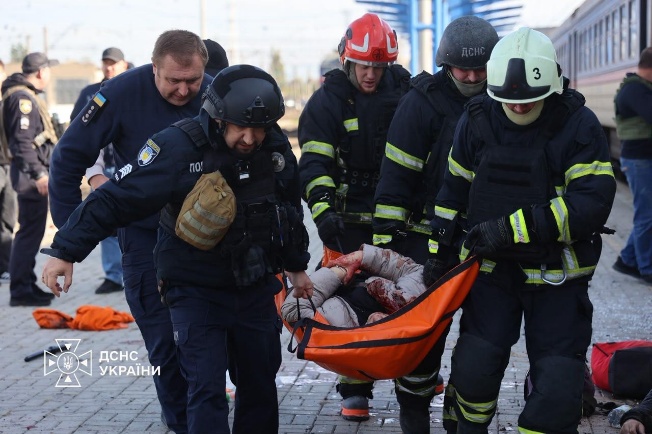
A photo showing the aftermath of a deadly Russian drone attack on the railway station of Dnipro, Ukraine. (State Emergency Service / Telegram)
Russia’s jet-powered drones have made railways a constant target, and Ukrainian Railways has adopted strict rules: during alerts, passengers are evacuated from trains, sometimes in open countryside for hours, and those waiting in stations are told to leave the platforms. Crowds and reluctance to go to shelters create new risks.
Dnipro kept being hit. That afternoon, a drone set the fifth floor of a vocational school dormitory on fire, Mayor Borys Filatov said; students had reached the shelter, and two girls aged 15 and 16 were treated for shock. About 25,000 people lost power after the morning attack. Late at night, Russian strikes on energy infrastructure left more than 350,000 customers in Dnipro and nearby communities in the dark, and water and sewage pumps switched to generators. “The enemy has attacked Dnipro again today,” Hanzha said. Across the region, Russian attacks wounded four more people during the day, including a 15-year-old girl.
Chernihiv, Kremenchuk, Izium, Zaporizhzhia
Around noon in Chernihiv, the streets were busy. Banderol missiles struck the city center, damaging shops, homes and cars. Two 15-year-old girls were killed. “They were only 15 years old. The enemy killed two children,” Governor Viacheslav Chaus said. By 4 p.m., 27 people were wounded, among them a 10-month-old girl, a 10-year-old girl and two boys aged 16 and 17; a brother and sister were in serious condition. The day before, a drone had wounded three women at the city’s municipal animal shelter, and more than 100 animals were placed in foster care.
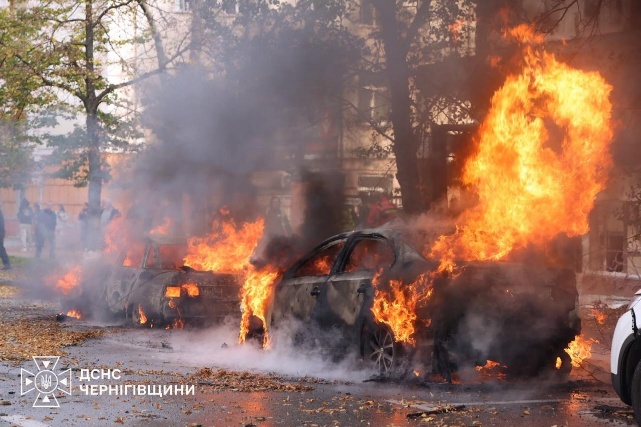
Cars burning in central Chernihiv, Ukraine, after a Russian missile strike. (State Emergency Service of Ukraine / Telegram)
In Kremenchuk, Russian missiles hit two places: the space between apartment buildings, where three people were killed and parked cars burned, and a street of private houses and a boarding school, whose children had reached the shelter in time. Thirty-two people were wounded, six of them children; a 16-year-old boy and a 72-year-old man were in serious condition. Prosecutors said Banderol cruise missiles were used, and together with the Security Service and police opened a war crimes investigation. The Chernihiv and Poltava regions declared Friday a day of mourning.
In Izium, in the Kharkiv region, three guided bombs hit a five-story building. Rescuers pulled two people from the rubble, the number of wounded rose to 13, and four people might still be trapped, Governor Oleh Syniehubov said. In Lozova, six men were hospitalized with shrapnel wounds.
In Zaporizhzhia, Russian FPV drones hunted public transport. One hit a city bus in the center, wounding four; another hit a minibus taxi; a third hit a trolleybus, wounding three women, one of them, 56, seriously. Two more men, aged 66 and 41, were hurt in separate strikes that also damaged 15 vehicles, a warehouse and a power line. “The enemy has changed its tactics and modified its drones,” said regional head Mykhailo Semikin, urging residents not to ignore alerts. In the village of Bilenke, a 49-year-old man was killed. At the Russian-occupied Zaporizhzhia Nuclear Power Plant, a drone attack killed a welder from the plant’s repair workshop, the International Atomic Energy Agency said, without saying who launched it. “Attacks on nuclear plant personnel are unacceptable,” Director General Rafael Grossi said.
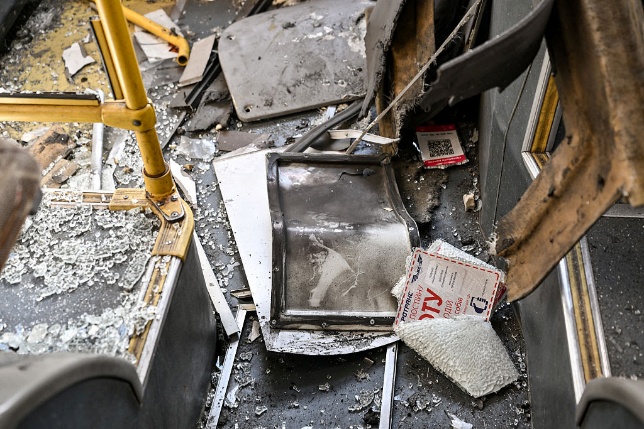
The floor is littered with shattered glass and structural debris inside a municipal bus damaged by a drone strike in Zaporizhzhia, Ukraine. (Dmytro Smolienko/Ukrinform/NurPhoto via Getty Images)
In Kyiv, at about 10:45 p.m., ballistic missiles flew in from the north, over the Chernihiv region. They set warehouses ablaze in the Darnytskyi district and killed one person; debris partially destroyed a store and burned in a courtyard in the Dniprovskyi district, and blast waves shattered windows and damaged cars. The Air Force lifted the alert at 11:23 p.m., as jet-powered drones kept flying over the region toward Brovary and Fastiv. Hours earlier, Zelensky had warned: “We now have intel about the Russians preparing new ballistic missile attacks.”
Overnight before all this, Russia sent 112 drones, 40 jet-powered; 97 were downed. In the Kharkiv region, one person was killed and eight wounded, including a 13-year-old girl; eight were hurt in the Sumy region and two in Kramatorsk. Across the day, Russian attacks killed 20 people and wounded at least 109.
The Convoy Waits at Oleshky
You are an elderly woman in Oleshky. No food delivery has reached your town since May 26. On Thursday evening, a convoy stands ready at the edge of town.
Ombudsman Dmytro Lubinets set out in the morning, traveling with the Ukrainian delegation through Belarus and Russia. By evening he announced that the roads into Oleshky had been cleared of mines and that the convoy was ready to drive to the town’s central hospital, where residents can get help. “Delegations from Ukraine, the Russian Federation and the United States of America have now gathered to coordinate further steps,” he said. Journalists from all three countries were present. Residents who want to leave may do so until 2 p.m. on Friday, and aid distribution begins at 2:30 p.m. “Our shared goal is to deliver humanitarian aid to civilians and facilitate the safe departure of everyone who wishes to leave the city,” he said. By then, the truce had held for more than 64 hours without a reported incident.
Documents published by Fox News and cited by RBC-Ukraine describe the route out for those heading to Ukraine: first to Anapa in Russia’s Krasnodar region, then a Russian military transport flight to Gomel in Belarus on October 31, with Lubinets and his team aboard. The pages do not explain how evacuees would then reach Ukrainian-held territory. Fox News also reported that both sides agreed to repeat such humanitarian operations in Kherson region communities at least once a month.
On Wednesday, Melania Trump announced that four journalists from the U.S. broadcaster Newsmax would accompany the officials as “neutral observers,” after sharing a welcome from Kremlin envoy Kirill Dmitriev. Zelensky said bringing American journalists had been Ukraine’s idea, because Kyiv does not trust Moscow. “I know how technically the evacuation to Ukraine can take place, but I don’t know what will really happen,” he said. Oleksandr Pavlichenko of the Ukrainian Helsinki Human Rights Union warned that Russia sees Oleshky’s civilians as a human shield and that evacuees could face filtration. Estimates of who remains differ: Foreign Minister Andrii Sybiha has put the number at about 1,700, including 47 children, while Lubinets has spoken of about 6,000 people, including some 200 children, across Oleshky and nearby villages.
Across the river, Kherson came back to life. “Essentially, the city has returned to pre-war times,” a resident told Kyiv Post. “Many people are walking in the streets, and cars and public transport have reappeared.” Businessman Oleksandr Vlasov said enemy drones, “even reconnaissance drones, are indeed no longer crossing the Dnipro River.” Municipal workers used the quiet to board up windows and fix roofs near the river, still carrying drone detectors.
Neptunes Over Marinovka
You are a crewman on a Ukrainian Navy Neptune launcher. On Thursday, your missiles fly about 400 kilometers into Russia.
The Navy said its Neptunes destroyed two Su-34 fighter-bombers at the Marinovka airfield near Oktyabrsky in the Volgograd region, home to the 11th Mixed Aviation Regiment. Zelensky confirmed the strike and said a second missile attack that day hit an Iskander launcher. The Navy released no images, and the claim could not be independently verified. The Su-34 is Russia’s main jet for dropping guided bombs on Ukrainian cities, the weapon that wounded 13 in Izium the same day. Ukraine’s military intelligence said Russia had about 140 Su-34s as of October 22, has lost 43 destroyed and seven damaged since 2022, and can build only 14 to 18 a year. “Such losses are quite significant for the aggressor’s aircraft fleet,” the agency said. It was Ukraine’s second Neptune strike on Su-34s in two weeks, after four were destroyed at Borisoglebsk on October 15. The Neptune, best known for sinking the Russian flagship Moskva in 2022, now has a land-attack version that can reach targets up to 1,000 kilometers away.
Ukraine also hit a Russian drone base near Navlya in the Bryansk region, about 70 kilometers from the border, damaging a Geran storage site, fuel depots and the launch area itself, the General Staff said. It was the second strike on the site, after an attack on August 3. Ukrainian media and open-source analysts have tracked Russia building several large “drone ports” along its western border, a sign of Moscow’s long-term bet on long-range attack drones against Ukraine and, potentially, NATO’s eastern flank. Overnight, Moscow’s mayor said 613 drones flew toward the capital as Putin hosted the Russia-Africa summit; Russian authorities reported no casualties or damage. “This shows once again that the situation continues, and the (war) must continue so that we are protected from threats,” Kremlin spokesman Dmitry Peskov said.
Russia, meanwhile, may be using the quiet in the south. The Institute for the Study of War warned that “Russian forces may use the limited ceasefire to reconstitute their forces in Kherson Oblast,” and Petro Andriushchenko of the Center for the Study of Occupation said both sides would almost certainly use it to rotate units. Russia’s Defense Minister Andrei Belousov inspected the Dnepr grouping of forces, which faces Kherson, on Tuesday, meeting its commander, Col. Gen. Mikhail Teplinsky, and hearing briefings on the battlefield, drone operations and equipment deliveries.
Talks, Tankers and Money
Kremlin aide Yuri Ushakov said talks in Abu Dhabi could come “after Nov. 4,” but that timing “will depend on the situation on the battlefield and the overall situation,” and that “no one is planning to invite” Europeans. Ushakov also accused Kyiv of derailing the previous round. Zelensky told The Sun he hoped for November 10, and that he had proposed meeting on Sunday but chose to wait for the U.S. vote. Turkish President Recep Tayyip Erdogan told Trump on Wednesday that Turkey “stands ready to contribute” to reviving diplomacy; they also discussed the Strait of Hormuz and Yemen.
At the end of the Russia-Africa summit, Putin defended Finland’s and Norway’s leaders for calling him. “I know that criticism was later directed at them, but it is not for us to judge,” he said, while warning that a war between Russia and Europe would have “no winners” and claiming the West could not inflict a strategic defeat on Russia by 2030. Swedish Prime Minister Ulf Kristersson said she had “pretty low expectations for this kind of [direct] talk.” Norway’s Prime Minister Jonas Gahr Støre asked the Financial Times to correct its report of a history lecture. “That he gave a lecture on Slavic history is simply not correct,” he said, explaining that Putin reviewed events from 2014 onward and that speaking time was split roughly evenly; the paper declined.
Greenpeace Ukraine identified seven tankers carrying 288,000 tons of Russian diesel toward the United States: the Taurus, Pvt Azura, Agioi Fanendes, Talisman, Leruo, Iblea and Primorye. Three are sanctioned shadow-fleet ships, and the Talisman has been under U.S. sanctions since January 2025. New Jersey Governor Mikie Sherrill said she was weighing whether to block them from the state’s ports. “Trump’s diesel deal with Putin is corrupt and illegal,” she said. Inside Russia, 15 regions, including occupied Crimea, lifted fuel-sale limits as Ukraine’s refinery strikes slowed, though the Tambov region still caps purchases and parts of the Leningrad region still face shortages.
Help kept coming from Europe. Poland will send two MiG-29 fighters, one still airworthy, in a package worth about €50 million, with artillery shells, cannon rounds for F-16s and Piorun missiles. The EU invited countries to apply for €21.3 billion more in SAFE defense loans, urging them to prioritize joint projects with Ukraine, after 19 countries took part in the first round and Italy and Hungary scaled back their borrowing, and Finland’s Patria announced a joint venture with Ukrainian drone maker General Cherry. “Press your national governments to support Ukraine and to provide more,” former Prime Minister Arseniy Yatsenyuk told European arms makers in Brussels. Ukraine needs it: the National Bank said the economy will shrink 0.4 percent this year, the first contraction since 2022, raised its key rate to 16.5 percent, and forecast inflation of 12.5 percent by year’s end. It blamed Russia’s blockade of the ports and attacks on logistics and factories, and expects partners to provide $52 billion in budget support and $37 billion for defense next year. Businesses are expected to lose about $10 billion this year, and the Agriculture Ministry said farmers will see no profit from crops. The bank expects a slow recovery in 2027 and 2028, and the Economy Ministry plans a war-risk insurance fund for businesses from January.
Also Today
A Russian in charge of mines. The UN appointed Russian diplomat Gleb Desyatnikov to oversee mine action. “Moscow has mined the United Nations,” Foreign Ministry spokesperson Heorhii Tykhyi said. Deminers on the Ukrainian-held right bank of the Kherson region have now neutralized more than 300,000 explosive devices and cleared nearly three-quarters of the area marked for clearance.
Skovoroda’s museum. Prosecutors charged a Russian lieutenant general in absentia with ordering the May 2022 missile strike on the museum of philosopher Hryhorii Skovoroda, in the estate where he spent his final years. Russia has damaged or destroyed more than 2,100 Ukrainian cultural heritage sites.
Russia looks to Africa. Putin said Russian companies want to move some production to Africa to escape sanctions, and Rusal signed a bauxite deal in Ghana, while Rosatom offered floating nuclear power plants and Novatek its LNG technology. State arms exporter Rosoboronexport used the summit to pitch an “Anti-Drone Dome” system.
Germany’s commandos. Germany’s KSK special forces have begun training for conventional war with Russia, their commander told BILD.
The Closing
Tonight, families in Dnipro, Chernihiv and Kremenchuk are mourning, and two regions will lower their flags on Friday. In Oleshky, a convoy is parked at the edge of a town that has waited since May for food. Mediators call the quiet there a sign of good faith. The platform in Dnipro tells the rest of the story.
A Prayer for Ukraine
1. For Those Who Defend
Lord of hosts, bless the Navy crews whose Neptunes struck the bombers that drop death on our cities, and the soldiers who hold the line while Russia uses the quiet to regroup. Guard the air defenders who shot down three drones over Dnipro and grieve the one they could not stop. Give them strength for the nights ahead, and bring them home whole to the families who wait for them.
2. For the Wounded and the Grieving
God of all comfort, receive the fourteen who died on the platform in Dnipro, the two fifteen-year-old girls of Chernihiv, the three of Kremenchuk, the man of Bilenke, the welder at the nuclear plant, and the one lost in Kyiv tonight. Heal the eleven-year-old boy, the man who lost his legs, the baby girl of Chernihiv, and all who suffer.
3. For Those Who Lead
King of kings, give President Zelensky courage to keep calling evil by its name and wisdom to keep seeking peace. Move the leaders of the world to see that a truce in one town does not excuse terror in others. Bless the nations that send help, and let no deal reward the one who strikes the innocent. Let the coming talks bring a peace that lasts.
4. For Oleshky
Faithful God, as the convoy enters Oleshky, guide it safely to the hospital and to every hungry home. Let those who wish to leave be free to choose their way, and let no one be held as a shield. Protect Ombudsman Lubinets and all who walk into danger to bring mercy, and let the quiet in Kherson last long enough to heal.
5. For a People Who Keep Standing
Father, Ukraine buries its children and still goes to work, still boards trains, still sends help to its neighbors across the river. Sustain the rail workers, the rescuers and the families who will wake tomorrow to a day of mourning. In Your mercy, in Your justice, in Your time — bring this war to its end, and let the ending be worthy of what Ukraine has endured.