
Ukraine Daily Briefing | May 4, 2026 | Day 1,531 of the Full-Scale Invasion
A leaked European intelligence report reveals that Vladimir Putin now spends most of his time in underground bunkers in Krasnodar Krai — on the same day a Ukrainian drone struck the Mosfilm Tower in Moscow, seven kilometers from the Kremlin. Russia declared a “Victory Day ceasefire” for May 8–9 while simultaneously threatening a massive missile strike on central Kyiv if Ukraine disrupted its parade; Zelensky called the bluff by declaring Ukraine’s own ceasefire starting midnight May 5–6 and daring Russia to follow. Ten Ukrainians were killed — seven of them in a single morning missile strike on Merefa in Kharkiv Oblast — as Russian forces launched 132 combat engagements across the front, fired 234 drones and two ballistic missiles during the day on May 3, and sent 155 drones overnight.
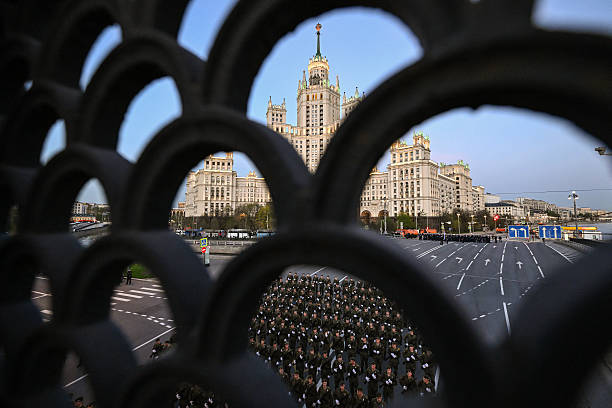
Russian servicemen attend the rehearsal of the Victory Day military parade, to be held at Red Square, in central Moscow. Russia declared a unilateral ceasefire with Ukraine between May 8-9, when Moscow marks its annual World War II Victory Day commemorations, and threatened a “massive missile strike” on Kyiv if Ukraine violated it. (Igor Ivanko / AFP via Getty Images)
The Day’s Reckoning
Imagine a man who launched a war to expand his empire, now spending his days beneath Russian soil in an underground bunker in Krasnodar Krai — too afraid to sleep in his own residences, surrounded by generals who also now require security details because one of their colleagues was assassinated on a Moscow street in December. This is the portrait of Vladimir Putin that a leaked European intelligence report presented on May 4.
On the same day the report surfaced, a Ukrainian drone struck the Mosfilm Tower, a luxury high-rise seven kilometers west of the Kremlin and three kilometers from the Russian Defense Ministry. Debris scattered in the street. Moscow Mayor Sobyanin confirmed the hit and claimed no casualties. Whether Putin was in Moscow or in his Krasnodar bunker 1,200 kilometers south made no difference. The drone found the city either way.
Across Ukraine, ten people died. Seven of them in a single missile strike on the town of Merefa on a Sunday morning — two men, two women, three others still being counted. Gas stations in Kharkiv were struck fifteen times in seven days. Russian forces conducted 132 combat engagements across the front. Drones hit Dnipro, Brovary, Vyshhorod, Zaporizhzhia, Kharkiv. The night brought sirens across Kyiv and ballistic missile warnings.
And through all of it ran the day’s central question: what does Russia’s Victory Day ceasefire actually mean when the offer arrives in the same statement as a threat to destroy the center of Kyiv? Zelensky answered by moving first. Ukraine’s guns will go quiet at midnight May 5–6. Russia can follow, or the answer it gives will be visible to everyone.
The Bunker President: Putin’s Fear and the Drone That Proved It
The European intelligence report, obtained by CNN, draws on Western and Russian opposition sources and details a president in a state of acute personal anxiety. Putin has stopped visiting his Moscow Oblast and Valdai residences entirely. He passes most of his time in underground bunkers in Krasnodar Krai. The internet disruptions Muscovites have noticed in recent months are at least partially related to anti-drone protection systems deployed around his usual routes.
After a December 2025 meeting where senior officials shifted blame onto each other for the assassination of Lieutenant General Fanil Sarvarov — chief of the Russian General Staff’s Operational Training Department, killed in Moscow City on December 22 — Putin amended Federal Protective Service regulations to extend full security details to ten high-ranking generals. ISW has documented the movement of Pantsir-S1 and S-400 systems near Putin’s Valdai and Moscow residences since at least 2023. The European report also portrays former Defense Minister Sergei Shoigu as “associated with the risk of a coup,” though ISW assessed it has not observed independent evidence to support that specific claim, and CNN noted the report provides no substantiation for it.

Damage is purportedly seen at a high-rise residential building in Moscow following a reported Ukrainian drone attack. (Supernova_plus/Telegram)
Then, in the early hours of May 4, a Ukrainian drone struck the Mosfilm Tower in Moscow’s elite western district. Moscow Mayor Sobyanin confirmed the attack, claimed no casualties, and reported two more incoming drones were downed by air defense. Ukraine’s military did not immediately comment. The strike marks one of the deepest penetrations into Moscow’s residential core of the war. For the man in the Krasnodar bunker, the coordinates of the Mosfilm Tower are not an abstraction.
The Bucha Commander Takes the Air Force: Chayko’s Appointment
General Viktor Afzalov, who had commanded the Russian Aerospace Forces since 2023, has been replaced by Colonel General Alexander Chayko. The appointment was reported by Russian outlet RBC citing a source close to the Ministry of Defense, and first surfaced in the pro-war Telegram channel Fighterbomber. The change comes amid sustained milblogger criticism of VKS failures: poor targeting decisions, aircraft and maintenance crew shortages, and the fundamental inability to stop Ukrainian drones from reaching deep into Russian territory.
Chayko’s record across two wars is specific. He served as commander of the Russian Force Grouping in Syria during periods between 2015 and 2022, where Human Rights Watch documented his direct involvement in strikes on civilian infrastructure around Idlib in 2019. He then commanded the Eastern Military District from February 24 to May 26, 2022, overseeing the Russian attempt to encircle Kyiv from Belarus. His forces occupied Bucha. An October 2022 Associated Press investigation found the “clearing” missions during the massacre’s final days were personally ordered and signed by Chayko. In March 2026, the European Union sanctioned him specifically for that role. Putin promoted him in May.
After the Syria appointment ended, Kommersant reported Chayko became deputy chief of the General Staff. This is now his fifth posting since the invasion began. Putin does not dismiss failed commanders — he rotates them. Chayko was the first military district commander removed at the start of the full-scale invasion. He inherits an aerospace force that is losing the battle over Russian skies to the country it invaded.
Victory Day Theater: The Ceasefire That Came With a Threat
Russia’s ceasefire announcement for May 8–9 came in the same statement as a threat. The Russian Defense Ministry declared it would respond to any Ukrainian attempt to disrupt Victory Day celebrations with a “massive missile strike on the center of Kyiv,” and warned the civilian population of the capital — and foreign diplomats — to leave before that date. The Ministry also falsely accused Zelensky of threatening to strike Moscow during his Yerevan speech. What Zelensky had actually said was that Russia removed military hardware from its parade because it “fears drones may buzz over Red Square.” That is a description of Russia’s situation, not a threat.
Putin had first proposed a one-day ceasefire for May 9 during his April 29 call with U.S. President Trump — negotiations that took place without Ukrainian participation. “If the U.S. and Russia are negotiating, it is important that our side knows what they are talking about,” Zelensky said. Ukraine recorded over 400 violations during the Easter ceasefire that preceded this proposal. The pattern was documented before the proposal was made.
Zelensky’s counter-move was deliberate. Ukraine would declare its own ceasefire beginning midnight May 5–6 — four days before Russia’s proposed pause, not limited to a 48-hour holiday window. “We believe that human life is far more valuable than any anniversary ‘celebration.’” If Russia was serious about halting hostilities, Ukraine’s longer ceasefire was available to join. If Russia rejected Ukraine’s offer but demanded compliance with its own shorter one, that asymmetry would speak for itself. Meanwhile, Russia confirmed it would proceed with the May 9 parade — but without military hardware, citing drone concerns. The country that invaded its neighbor to project strength cannot safely display a tank in its own capital.
Merefa, Gas Stations, and the Daily Arithmetic of Civilian Death
At midmorning on May 4, a Russian missile — assessed as likely an Iskander-M ballistic missile — struck the town of Merefa in Kharkiv Oblast. Seven people were killed: two men aged 50 and 63, two women aged 41 and 52, and three others. Thirty-five people were injured; fourteen were being treated at Kharkiv hospitals by evening. Fires broke out across private homes and vehicles. Four shops and a service station were destroyed.
The full May 4 casualty picture across Ukraine: one killed and twelve injured in Kherson Oblast — Russian forces continue to strike civilians along the Dnipro riverbank with drones, artillery, and glide bombs daily. One killed and twenty-seven injured in Dnipropetrovsk Oblast. One killed in Donetsk Oblast, in Oleksiievo-Druzhkivka north of Kostyantynivka. Eleven injured including two children in Zaporizhzhia Oblast. Seven injured in Sumy Oblast. One man injured by a drone near his home in Chernihiv Oblast, ten kilometers from the Russian border.
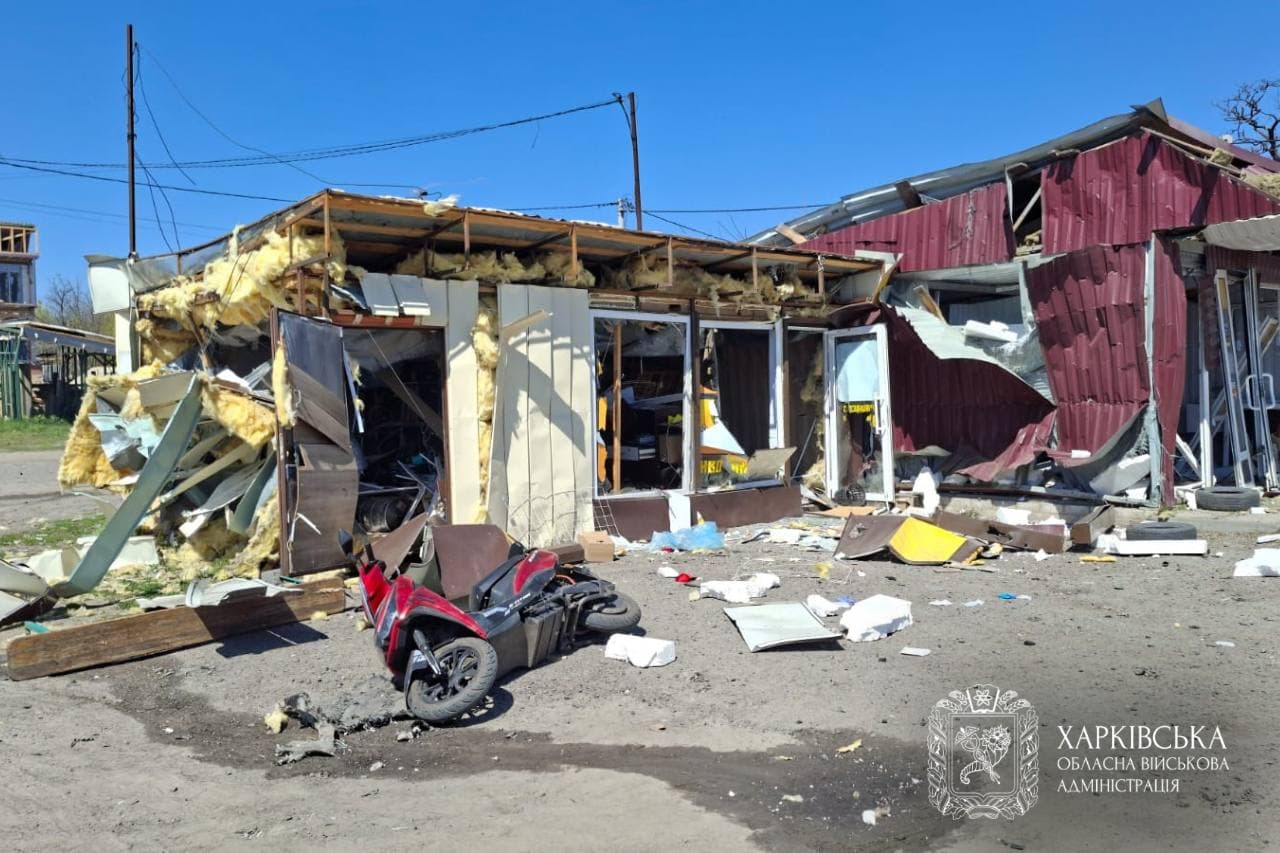
Damaged suffered by the town of Merefa after a Russian missile attack on the morning. (Kharkiv Oblast Military Administration / Telegram)
Kharkiv City Mayor Ihor Terekhov reported that Russian forces struck gas stations in the city fifteen times between April 27 and May 3 — a single week. Not military targets. Not fuel depots. Gas stations, specifically. Ukrainian petroleum expert Leonid Kosyanchuk explained the operational logic: gas stations cannot defend themselves against flammable ammunition fragments. They generate visible fire, audible explosions, and communal fear with no fuel shortage as a side effect. The psychological damage is the point. Residents filling their tanks before work are supposed to feel the war as a personal, physical presence. Russia has been methodical about this in Kharkiv.
The Night of May 3–4: Drones Across Ten Regions, Missiles Over Kyiv
Russia’s aerial campaign on the night of May 3 to 4 covered at least ten regions. The Ukrainian Air Force reported 155 Shahed, Gerbera, Italmas, Parodiya, and other drones launched from six directions: Kursk and Oryol cities; Shatalovo, Smolensk Oblast; Primorsko-Akhtarsk, Krasnodar Krai; Millerovo, Rostov Oblast; occupied Donetsk City; and occupied Hvardiiske in Crimea. Ukrainian forces downed 135; 14 struck 10 locations; debris fell on four more. Damage to civilian and non-residential infrastructure was reported in Sumy and Zaporizhzhia oblasts.
At approximately 3:12 a.m., nationwide air raid alerts were issued over the threat of ballistic missiles. Ukrainian military monitoring tracked high-speed targets toward Kharkiv and Cherkasy. Additional guided aerial bombs (KABs) were launched toward Zaporizhzhia. Authorities reported that missiles targeting Cherkasy failed to reach their objectives. In Zaporizhzhia around 3:50 a.m., a guided aerial bomb struck a non-residential building in the regional center, injuring one woman. Explosions were reported in Kharkiv; overnight strikes in the Kholodnohirskyi and Osnovianskyi districts at 7:25 and 7:35 a.m. injured at least one person.
In the Kyiv region, air raid sirens sounded at 4:33 a.m. with explosions and air defense activity reported in the capital; no immediate damage was confirmed inside the city. In Brovary, northeast of Kyiv, a drone attack injured two people — a 34-year-old woman with a hand injury from glass fragments and a 37-year-old man with a cut to his heel. In Vyshhorod district, a strike triggered a fire at an industrial facility and wounded one person. In Dnipro, three private homes were heavily damaged overnight, a critical infrastructure facility was struck, and a 62-year-old man was injured.
132 Combat Engagements: The Frontline on May 4
Russian forces attacked Ukrainian positions 132 times across the front on May 4, according to the General Staff of the Armed Forces of Ukraine. The heaviest fighting was concentrated near Kostyantynivka and Pokrovsk. Russian forces carried out 54 airstrikes, dropped 175 guided aerial bombs, deployed more than 5,700 kamikaze drones, and conducted over 2,500 shelling attacks on populated areas and military positions during the day.
In the Kharkiv direction, Russian forces continued offensive operations north and northeast of the city while Ukrainian forces counterattacked. A Ukrainian brigade spokesperson reported that Russian assault groups continue to use motorcycles, electric scooters, and buggy-type vehicles for small-unit attacks — an adaptation to the drone-surveilled battlefield. In the Kupyansk direction, limited ground assaults continued southeast of Kupyansk and in the Borova direction without confirmed advances. Geolocated footage confirmed Ukrainian mid-to-long-range strikes against Russian assets in occupied Luhansk Oblast: a Tor air defense system northwest of Kreydyane (111 km from the front), a P-18 radar southwest of Herasivka (120 km), and a Russian repair base in Kadiivka (55 km).
In Sumy Oblast, Russian forces continued offensive operations in the north as Ukrainian forces reportedly counterattacked northeast of Sumy City. In the Slovyansk direction, Russian forces conducted an infiltration mission but did not advance; geolocated footage showed Ukrainian forces striking a Russian position along the Donetska Railway southeast of Lyman. Ukrainian forces maintained positions east of Rai-Oleksandrivka contrary to Russian claims, confirmed by footage of Russian shelling in that area. In the Dobropillya direction, limited attacks continued without advances. In the Novopavlivka, Oleksandrivka, Hulyaipole, western Zaporizhzhia, and Kherson directions, Russian forces continued offensive operations and airstrikes but did not advance.
Pokrovsk Buildup: 90th Tank Division Redeployment and Drone Control Points
The Russian military command is actively preparing to intensify operations in the Pokrovsk direction. A deputy commander of a Ukrainian brigade operating there reported on May 4 that elements of the 90th Tank Division — 41st Combined Arms Army, Central Military District — are being redeployed to Pokrovsk, including the 6th and 239th tank regiments, the 228th and 429th motorized rifle regiments, and the 30th Separate Reconnaissance Battalion. The planned deployment also includes the 80th Tank Regiment and an unspecified motorized rifle brigade, with estimated total strength of up to 3,000 servicemembers.
Simultaneously, Ukrainian military observer Kostyantyn Mashovets reported that the Russian Rubikon Center for Advanced Unmanned Technologies has deployed several detachments to the Pokrovsk direction. These units are installing drone control equipment and establishing drone control points at elevated positions in urban areas of northwestern Pokrovsk — a systematic effort to dominate the low-altitude tactical airspace over the area, strike Ukrainian logistics routes, and provide aerial cover for Russian infantry during assaults. ISW assesses that the Russian military command previously redeployed the 68th Army Corps from the Pokrovsk and Dobropillya area to the Hulyaipole direction in early March 2026; the 90th Tank Division redeployment may represent a reorientation of Central Military District forces into the Central Grouping of Forces’ area of responsibility.
Six Months, Ten Percent: The Stall at Kostyantynivka and Russia’s Net Territorial Loss
Western media reported in early May that fighting had reached the outskirts of Kostyantynivka — a framing that understates how long this has been true and how little Russia has achieved since. Russian forces first infiltrated the city’s eastern edge on October 24, 2025. Six months later, ISW assesses they have infiltrated 10.14 percent of the city and advanced in only 0.7 percent of its eastern outskirts. Senior Russian officials have made numerous exaggerated claims about alleged successes there; Russian milbloggers, more candid than official sources, have criticized those claims and documented the slow tempo themselves.
The broader April picture confirms structural decline. According to ISW, Russian forces suffered a net territorial loss in April 2026 — the first since Ukraine’s 2024 Kursk incursion — losing control of 116 square kilometers. Between November 2025 and April 2026, Russian forces captured 1,443 square kilometers; the same period a year earlier produced 2,368. Daily gains have fallen to approximately 2.9 square kilometers, down from nearly ten in early 2025. Russia has shifted toward small-unit infiltration of “gray zones,” generating the appearance of progress while firmly controlling significantly less territory than claimed. ISW estimates up to 1,716 square kilometers were claimed over six months but much less was secured. Russia’s air campaign faces parallel constraints: milbloggers report that Su-34 jets are being equipped to carry more glide bombs, but aircraft shortages, maintenance deficits, and poor targeting prioritization are limiting effectiveness.
Ukraine’s Deep Strike Campaign: Tuapse Gets Bomb Shelters, Gorky BDA Confirmed
The municipal government of Tuapse posted an official bomb shelter list on May 4 for the first time — 186 shelters for a city of 61,000, mostly in apartment basements, with a combined capacity of 38,600 and only one accessible to people with disabilities. The list appeared without announcement, more than two weeks after Ukrainian drones began systematically targeting the Tuapse oil refinery. Four strikes since April 16: the 16th, 20th, 28th, and May 1st. After the third, a state of emergency was declared. After the fourth, fires declared extinguished reignited. Dozens of storage tanks have been destroyed or damaged. Petroleum byproducts are in the air above a resort town where the tourist season has been effectively canceled.
Separately, satellite imagery analyzed on May 4 provided a confirmed battle damage assessment of the April 23 Ukrainian strike against the Gorky oil pumping station in Neshikha, Nizhny Novgorod Oblast: two fuel tanks with a combined capacity of 50,000 cubic meters destroyed, filtration equipment damaged, storage facilities likely damaged. According to Bloomberg data, Ukraine’s strikes on Russian oil infrastructure reached a four-month high in April — at least 21 attacks on refineries, pipelines, and oil assets. Russia’s average refinery capacity has fallen to 4.69 million barrels per day, the lowest since December 2009. The bomb shelter list in Tuapse is the administrative acknowledgment that this is no longer a distant war for Russian civilians hundreds of kilometers from the front.
The Shadow Fleet Captain Arrested: Sweden’s Baltic Enforcement Continues
Sweden arrested the captain of the tanker Jin Hui on May 4 — a Chinese national, name undisclosed — on suspicion of operating an unseaworthy vessel and using forged documents. The Jin Hui was seized by the Swedish Coast Guard and Police on May 3 southwest of Trelleborg. AIS tracking data showed the vessel sailing under a Syrian flag, having departed from the Turkish port of Limas on April 16 before heading toward the Baltic. The ship is on the sanctions lists of the European Union, United Kingdom, and Ukraine. Senior prosecutor Adrien Combier-Hogg confirmed the captain was scheduled for questioning. A Swedish Coast Guard spokesperson stated that a criminal investigation into the vessel’s seaworthiness had been initiated.
The Jin Hui is part of Russia’s shadow fleet — the network of vessels assembled after 2022 to transport Russian oil in defiance of Western sanctions. Analysts estimate shadow fleet vessels now account for roughly 20 percent of the world’s tanker fleet. ISW has assessed that Russia’s ability to sell oil is a function of its ability to transport it; each vessel detained reduces that capacity. The seizure follows Sweden’s earlier detention of the Caffa, suspected of carrying Ukrainian grain illegally exported from Russian-occupied Crimea. European states have been accelerating enforcement actions in Baltic waters. Russia has not commented on the Jin Hui but has previously described such seizures as “hostile.”
Yerevan Diplomacy: The €90 Billion Loan, UK Accession, Fico, Armenia, and Georgia
British Prime Minister Keir Starmer announced at the European Political Community summit in Yerevan on May 4 that the UK is entering talks to join the EU’s €90 billion Ukraine support loan. The loan was approved in April after outgoing Hungarian Prime Minister Viktor Orbán dropped his veto; the first disbursement is expected in late May. Of the total, €45 billion is allocated to 2026, with €28 billion designated for defense. Starmer and European Commission President Ursula von der Leyen agreed that UK participation “would be a major step forward in the EU-UK defense industrial relationship.” Previous UK negotiations over the €150 billion SAFE defense loan collapsed in November 2025 over contribution disagreements. The EU Economy Commissioner signaled that using frozen Russian assets to repay the loan will need to be revisited; the UK holds approximately £25 billion in immobilized Russian assets.
Zelensky met Slovak Prime Minister Robert Fico on the sidelines of the summit — days before Fico’s planned trip to Moscow for Victory Day. The two agreed to hold intergovernmental talks by end of June, either in Bratislava or Kyiv. Fico affirmed Slovakia’s support for Ukraine’s EU accession and stated that no peace agreement is possible “without the consent of the Ukrainian side.” Relations between Kyiv and Bratislava have been tense since Fico took office in 2023; in recent weeks, Slovakia lifted its veto on the 20th Russia sanctions package following resumption of Druzhba pipeline oil transit. Fico was the only EU leader to attend Moscow’s Victory Day in 2025.
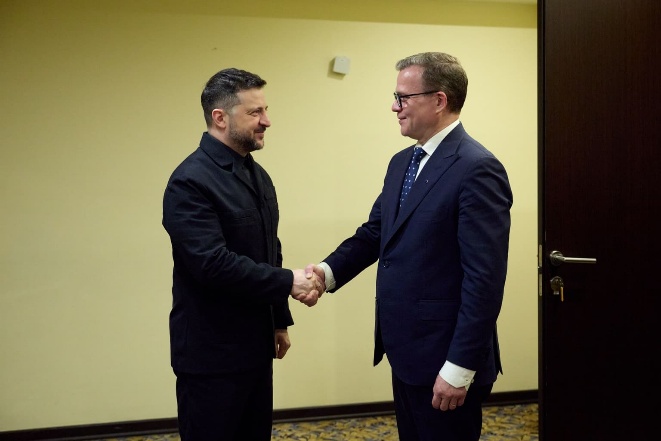
President Volodymyr Zelensky (left) meets Finnish Prime Minister Petteri Orpo in Yerevan, Armenia. (President Volodymyr Zelensky/X)
Zelensky also met Armenian Prime Minister Nikol Pashinyan — his first visit to Armenia in 24 years since a Ukrainian president was last there — discussing regional security, economic cooperation, and the resumption of bilateral intergovernmental commission work. And he met Georgian Prime Minister Irakli Kobakhidze, though in a more cautious register, with no deliverables announced. Relations between Kyiv and Tbilisi have deteriorated under Georgian Dream’s perceived alignment with Moscow. Finland’s Prime Minister Orpo raised the matter of two Ukrainian drones that briefly entered Finnish airspace near the Russian border on May 3 during a Ukrainian strike on Leningrad Oblast, calling the violations “not acceptable.” Zelensky indicated greater caution would be exercised and thanked Orpo for a $300 million defense package.
Europe’s Drone Industry and Ukraine’s Battlefield Technology
Polish Prime Minister Donald Tusk announced this week that Warsaw will cooperate with Kyiv to build Poland’s new drone fleet. The announcement is the latest in a series of joint production agreements that European defense industries are signing with Ukrainian manufacturers: German company Quantum Systems established two joint ventures with Ukrainian firms WIY Drones and Tencore in April; Ukrainian company Ukrspecsystems opened a drone factory in Suffolk, England in early 2025, creating approximately 500 jobs; Fire Point, maker of the Flamingo missile, began constructing a rocket fuel production facility in Denmark in December 2025. Gulf countries have also begun seeking Ukrainian wartime know-how.
What European companies are buying is battlefield-tested knowledge that no NATO testing range can replicate: real-time data from operators in active combat, specific expertise in the rapid production and deployment of low-cost systems at scale, and software integration techniques for pairing cheap sensors with cheap effectors. Ukraine operates the Unmanned Systems Force, a separate branch of its military dedicated solely to drone warfare — no European country has an equivalent. The industrial partnerships also serve Ukrainian strategic interests: a Polish drone fleet built with Ukrainian technology creates economic interdependence and a domestic constituency for continued Polish commitment to Ukraine’s defense.
Belarus Expansion, Austrian Expulsions, and the UAE Escalation
Ukraine’s State Border Guard Service issued a calibrated warning on May 4: Belarus is developing military logistics routes, training grounds, and other infrastructure in coordination with Russia, but the current Russian troop presence does not constitute an immediate direct threat. “Not yet” is the operative phrase; the infrastructure could be activated at any time. The warning followed Zelensky’s May 2 statement about “specific activity” on the Belarusian border and reports of a balloon carrying a signal repeater for Russian strike drones entering Ukrainian airspace from Belarus. Belarus has also confirmed it is enforcing Russian conscription travel bans at its border crossings.
In Vienna, Austria expelled three Russian embassy staff members on May 3 over suspected signals intelligence operations — satellite dishes on Russian diplomatic buildings assessed by Austrian intelligence as being used to intercept data from international organizations including the OSCE and UN institutions. Austrian Foreign Minister Beate Meinl-Reisinger: “It is unacceptable that diplomatic immunity be used to commit espionage.” The Russian Embassy called the move “outrageous” and “purely politically motivated.” Austria has now expelled 14 Russian diplomats since the start of the full-scale invasion.
On May 4, the United Arab Emirates reported that its air defenses engaged missiles and drones launched from Iran — the first such incident since the U.S.-brokered ceasefire of April 8. Four cruise missiles were launched from Iran toward various UAE areas; three were intercepted over territorial waters, one fell in the sea. A fire broke out at an oil facility in the Fujairah emirate after a drone strike. The attack marks a significant escalation in a regional conflict that has driven global energy prices sharply higher since late February, indirectly elevating Russia’s oil revenues and complicating Ukraine’s economic pressure campaign.
Draft Office Corruption Raids and Polish Capital Enters Ukraine
Ukraine’s National Police conducted 44 searches across 16 regions on May 4, targeting current and former draft office employees suspected of illegal enrichment totaling approximately Hr 92 million — roughly $2 million. Seized assets included Tesla vehicles, motorcycles, and cash in multiple currencies. The head of a district draft office in Odesa allegedly acquired assets worth over $1 million. Two other suspects allegedly enriched themselves by Hr 10 million and Hr 6.6 million respectively while working at draft offices during martial law. Over 150 administrative citations related to corruption were issued in the same period. Ukraine’s Human Rights Ombudsman received over 6,000 complaints against enlistment officers in 2025.
In a separate economic development, Poland’s largest insurer, PZU, acquired a 100% stake in MetLife Ukraine on May 4 — Ukraine’s largest life insurer, holding 50% of the domestic market with 900,000 clients and nearly Hr 1 billion in annual profit. The acquisition was insured by Poland’s export credit agency KUKE. “The acquisition of MetLife Ukraine is an important step in our long-term strategy for the development of a strong, international insurance and financial group in Central and Eastern Europe,” said PZU President Bogdan Benczak. The deal follows Polish fintech Zen.com’s purchase of a nationalized Ukrainian bank last month and comes ahead of the Ukraine Recovery Conference in Gdansk this summer.
Fourteen Days Underground: Corporal Vadym Lietunov’s Survival
The Guardian published on May 3 the account of Corporal Vadym Lietunov, 34, from Odesa, who spent nearly two weeks trapped in a Russian dugout after his own shelter was destroyed by a drone strike in late February. After the strike killed his fellow soldier, Lietunov fled toward Ukrainian lines and ran directly into a Russian position. He entered the bunker unarmed and found a man named Nikita pointing an automatic rifle at him.
Nikita — a former prisoner and drug user sent to the front — kept Lietunov captive for fourteen days. The two shared approximately 250 grams of rations dropped daily by drone and small amounts of water. Nikita believed Kremlin propaganda that Ukrainian soldiers carried GPS trackers and drugs, and searched Lietunov’s belongings for both. His behavior was unpredictable: “He would put a gun to my forehead and say he would kill me, then suddenly calm down.” Lietunov’s brigade informed his family he was likely dead. His wife did not stop believing otherwise.
Survival came through the same technology that defines this war. Spotting a Ukrainian drone in fog, Lietunov placed a sign with his call sign and brigade number in the open — hoping to be recognized before being struck. Ukrainian forces initially sent a strike drone for both men; the attack was called off only after commanders verified his identity through social media. Food, water, and a radio arrived by drone. When a Ukrainian armored vehicle reached the position, Nikita surrendered without resistance. Lietunov lost a toe. He called the outcome “a one-in-a-million chance.”
The Weight of May 4
Vladimir Putin is in a bunker in Krasnodar Krai. A Ukrainian drone struck a luxury high-rise seven kilometers from the Kremlin. The general who commanded Russian forces during the massacre at Bucha now leads Russia’s air force. Russia declared a ceasefire and threatened to destroy Kyiv in the same breath.
Seven people were killed in Merefa on a Sunday morning. Gas stations in Kharkiv burned fifteen times in seven days. 132 combat engagements were recorded across the front. Drones hit Dnipro, Brovary, Vyshhorod, Zaporizhzhia, and Kharkiv through the night. A soldier named Vadym spent fourteen days in a hole in the ground with a man who held a gun to his forehead. Ten people died. Over a hundred were wounded.
Zelensky stood in Yerevan and said: Ukraine will stop at midnight. You follow us, or you don’t. The answer will come in the hours after midnight on May 5–6. Every hour of silence from the Russian side will mean something. Every drone that launches will mean something else entirely.
The war does not pause for anniversaries. It continues at 2.9 square kilometers a day, one missile at a time, in the direction of a conclusion that neither side can yet force.
A Prayer for Ukraine
1. For the Seven Who Died in Merefa
Lord, a missile came down on Merefa on a Sunday morning. Two men — fifty years old and sixty-three. Two women — forty-one and fifty-two. Three more still being counted. They were in their town, on a morning that had not yet required any heroism of them. We do not need to dramatize it. The facts are sufficient. Receive them. Hold the thirty-five who are now in hospitals in Kharkiv. And hold the families who learned this news on a day that began as an ordinary Sunday.
2. For the Cities That Were Struck Through the Night
Father, Dnipro was hit first. Then Brovary, Vyshhorod, Zaporizhzhia, Kharkiv. A 62-year-old man in Dnipro. A young woman with glass in her hand in Brovary. A man with a cut to his heel. A woman injured in Zaporizhzhia as bombs struck in the early morning. Eleven people injured including two children in Zaporizhzhia Oblast. Seven in Sumy. One man near his home in Chernihiv Oblast, ten kilometers from the Russian border. They are not a list. They are people who were in their homes when the night came for them. Be near to each of them in their pain and their fear.
3. For Vadym Lietunov, Who Placed a Sign in the Fog
God of the improbable, a soldier spent fourteen days underground with a man who held a gun to his forehead. He survived not by force but by patience and by writing his call sign on a sign and holding it toward a drone in fog, hoping to be recognized by his own people before being struck. He came home. He lost a toe. His wife never stopped believing he was alive. Be with him in the recovery that follows — the physical, and all the rest of it.
4. For the Decision-Makers at Midnight
God of justice, Ukraine will go quiet at midnight. Somewhere in Moscow, men will decide whether to honor that or violate it. They will decide knowing the history — 400 violations during the Easter truce. Knowing the threat they attached to their own ceasefire proposal. Give the men with authority over Ukrainian lives the full weight of that history as they make this choice. And give Ukraine’s defenders, standing down after midnight, the knowledge that restraint is not weakness. That the world is watching. That it matters who fires first.
5. For the Long Arc of Accountability
Lord, the man who commanded Russian forces during the massacre at Bucha has been promoted to lead Russia’s air force. The EU sanctioned him in March. Putin promoted him in May. The files exist. The testimonies exist. The satellite imagery exists. The Associated Press found his signature on the orders. We pray for the arc of justice — not the arc that bends on its own, but the one that requires human choice and institutional courage to make it bend. Let the evidence outlast the impunity. In Your mercy, in Your justice, in Your time — bring this war to its end, and let the ending be worthy of what Ukraine has endured.